Best Hashtag Strategy for Instagram Reels in 2026
|
8
min read
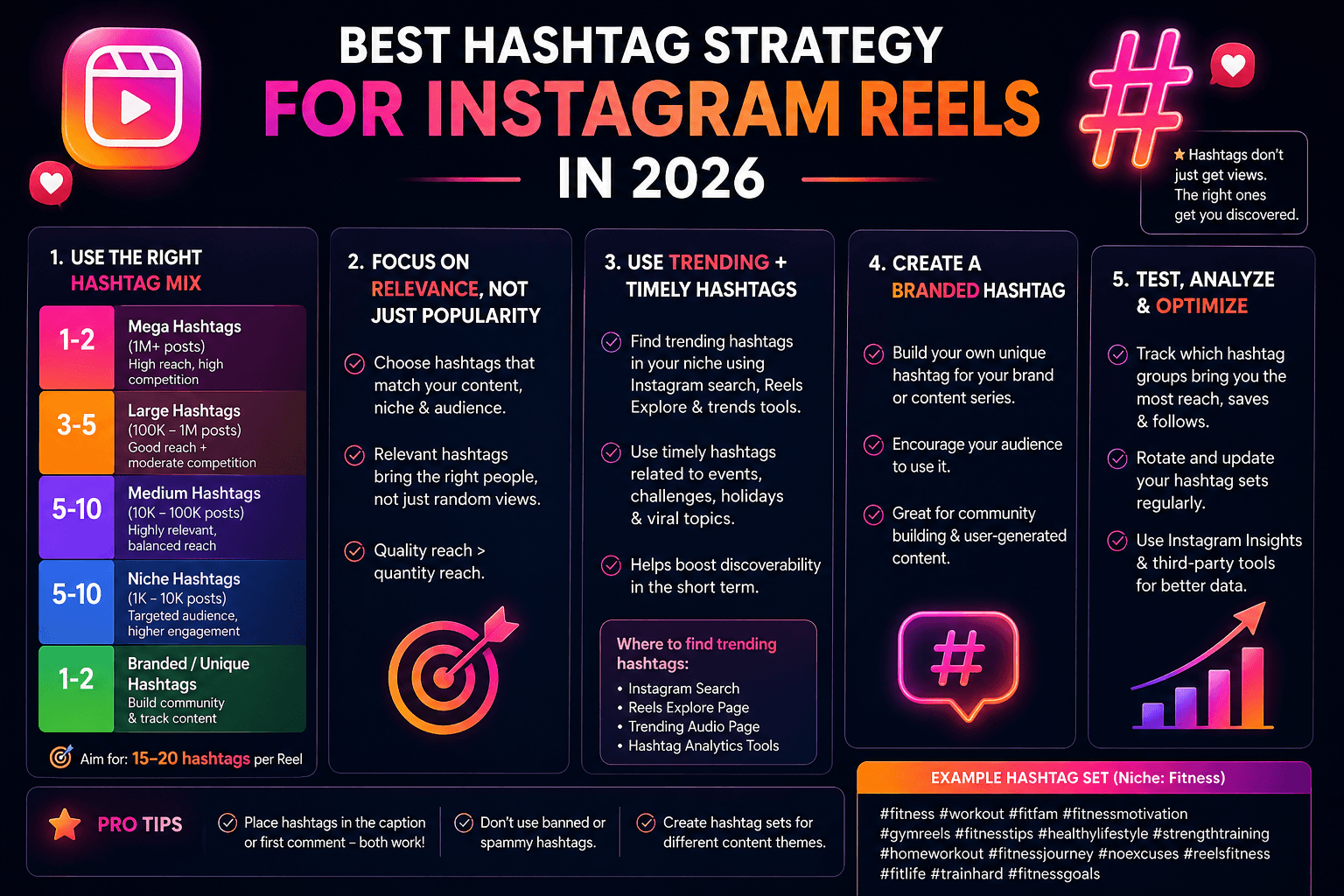
Best Hashtag Strategy for Instagram Reels in 2026
The Truth About Hashtags No One Wants to Admit
Let’s be honest…
Most marketers aren’t struggling with creating Reels anymore. The content is there. The effort is there. The consistency is somewhat there.
But the reach?
That’s where things quietly fall apart.
You post a Reel you genuinely believe in, add 20–25 hashtags like you’ve always done, and then… nothing. A few hundred views. Maybe a couple of likes. No real traction.
Here’s the reality: hashtags didn’t stop working. But the way you’re using them probably did.
And in 2026, that gap between effort and performance is only getting wider.
Why Hashtag Strategy Matters More in 2026
Instagram’s algorithm has evolved far beyond keyword matching. Reels are now evaluated through behavioral signals, contextual understanding, and audience intent.
That means hashtags are no longer discovery shortcuts—they’re context signals.
When used correctly, they help Instagram understand:
What your content is about
Who it should be shown to
Where it fits in the content ecosystem
But when used poorly—which is still the norm—they confuse the algorithm more than they help it.
The shift is subtle, but critical.
In 2022, hashtags were about reach.
In 2024, they became about relevance.
In 2026, they’re about alignment.
And most brands are still playing by outdated rules.
The Real Problem: Why Most Hashtag Strategies Fail
Here’s what’s actually happening behind the scenes.
Most marketers treat hashtags as an afterthought. Something you “add at the end” once the content is ready. And that mindset alone is enough to break performance.
You see the same patterns everywhere:
Copy-pasting hashtag sets across posts
Using only high-volume hashtags
Following generic “30 hashtag formulas”
Ignoring content context entirely
Sounds simple—but it rarely works like that.
Because hashtags don’t operate in isolation anymore. They interact with:
Your caption
Your hook
Your video content
Your audience behavior
If those elements aren’t aligned, hashtags won’t save your Reel. They’ll just amplify the confusion.
And that’s why even good content often underperforms.
What Actually Works: The 2026 Hashtag Strategy Shift
The biggest mindset shift you need to make is this:
Hashtags are not a growth hack. They are a content positioning tool.
And once you start treating them that way, everything changes.
Context Over Volume
Using 30 hashtags doesn’t guarantee reach anymore. In fact, it often dilutes your signal.
What matters is how tightly your hashtags align with your content’s intent.
If your Reel is about “Instagram growth for coaches,” then mixing in broad tags like #marketing or #business doesn’t help. It weakens your targeting.
In 2026, fewer but more precise hashtags outperform larger, generic sets almost every time.Layered Hashtag Targeting
High-performing Reels now rely on layered discovery.
This means combining:
Broad discovery hashtags (for reach)
Niche-specific hashtags (for relevance)
Intent-based hashtags (for audience matching)
But here’s the catch…
These layers only work if they’re built intentionally. Not randomly.
Most people mix hashtags without a clear structure. The result? Inconsistent reach and unpredictable performance.Content-First Hashtag Mapping
This is where things get interesting.
Instead of asking, “What hashtags should I use?” the better question is:
“What category does this content belong to?”
Because Instagram is now categorizing content at a deeper level.
If your Reel falls into:
Educational content
Entertaining content
Trend-driven content
Authority-building content
Your hashtag strategy should reflect that category—not just the topic.
That’s how you align with how the algorithm actually thinks.Consistency Over Experimentation Chaos
Let’s address something most people won’t say.
Constantly changing hashtag strategies doesn’t help.
It creates noise.
What works now is structured consistency. Testing frameworks—not random guesses.
When your hashtags follow a consistent pattern tied to your content themes, Instagram learns faster. Your reach stabilizes. Your performance becomes predictable.
And predictability is what scaling depends on.
Turning Strategy Into a System
This is where most marketers get stuck.
Understanding the strategy is one thing. Applying it consistently across dozens of Reels, multiple clients, or different brands?
That’s a completely different challenge.
Because now you’re dealing with:
Content pipelines
Posting schedules
Multiple content categories
Different audience segments
And suddenly, hashtag strategy becomes a workflow problem.
This is exactly where a strong content calendar strategy starts making a difference. When your content themes, posting schedule, and hashtag clusters are aligned in one system, execution becomes easier—and results become more consistent.
Without that structure, even the best strategy falls apart in execution.
From Chaos to Structure: The Shift Most Teams Need
Here’s the reality inside most teams and agencies.
Hashtag planning is scattered.
Some ideas live in spreadsheets. Some in notes. Some are reused blindly. There’s no real connection between content planning and hashtag execution.
And that disconnect creates performance gaps.
When you’re managing multiple accounts or dealing with multi-brand content management, the complexity multiplies. Different audiences, different niches, different positioning—yet often the same lazy hashtag habits.
This is where relying purely on manual processes starts to break.
Modern teams are moving toward integrated social media automation tools that connect planning, creation, and optimization in one place.
Because hashtag strategy isn’t a one-time task anymore. It’s part of a repeatable system.
How Sociali.ai Changes the Way You Execute Hashtags
This is where the shift becomes practical.
Instead of treating hashtags as an isolated step, Sociali.ai integrates them into your entire content workflow.
Before:
You create content → write captions → scramble for hashtags → copy-paste from old posts → hope it works.
After:
You plan content categories → align messaging → generate context-aware hashtags → maintain consistency across campaigns.
That shift removes guesswork.
It connects hashtags directly to:
Content intent
Audience targeting
Posting consistency
And more importantly, it scales.
Because when you’re managing multiple brands or running high-volume content pipelines, manual hashtag thinking simply doesn’t keep up.
How to Actually Implement This (Without Overcomplicating It)
Let’s break this down into how it works in the real world.
Start by defining your core content categories. Not loosely—but clearly. What are the 3–5 types of Reels you consistently create?
Once that’s done, build hashtag clusters for each category. Not random lists, but intentional groupings that reflect:
Topic relevance
Audience intent
Discovery potential
Then, map those clusters into your posting workflow.
This is where most people fail—because they don’t connect planning with execution.
If you already have a system for how to plan social media content, this becomes easier. Hashtags become an extension of your planning—not an afterthought.
And once that system is in place, you stop guessing.
You start optimizing.
The Bottom Line
Hashtags didn’t stop working.
But lazy hashtag strategies did.
In 2026, success on Instagram Reels isn’t about adding more tags. It’s about building a system where hashtags, content, and audience intent are aligned.
That’s what creates consistency.
That’s what drives reach.
And that’s what turns content into actual results.
Because at the end of the day, it’s not about visibility.
It’s about relevant visibility.
FAQs
Are hashtags still important for Instagram Reels in 2026?
Yes—but not in the old way. They now act as contextual signals rather than simple discovery tools. Their effectiveness depends on how well they align with your content and audience intent.
How many hashtags should I use on Reels?
There’s no fixed number anymore. What matters is relevance and structure. A smaller, well-targeted set often performs better than a large, generic one.
Should I reuse the same hashtags for every post?
Not blindly. You should reuse structured hashtag clusters tied to content categories, but adapt them based on the specific Reel’s intent.
Do trending hashtags still work?
Only if they genuinely match your content. Using trending hashtags without relevance can actually hurt performance by confusing the algorithm.
How do I scale hashtag strategy across multiple accounts?
You need a system. Manual tracking doesn’t scale. Using structured workflows and tools designed for content planning and optimization makes this manageable and consistent.
Because once you connect hashtags to your content system, everything changes. Your reach stabilizes. Your content performs more predictably. And scaling stops feeling chaotic.
That’s exactly what Sociali.ai is built for.
From planning to execution, it helps you turn scattered efforts into a structured content engine—where hashtags aren’t random add-ons, but part of a strategy that actually drives results.
If you’re serious about improving your Reels performance in 2026, it’s time to stop experimenting blindly and start building a system that works.
Free resource
Get the checklist


