Best Healthcare Social Media Management Tools for 2026
|
9
min read

Best Healthcare Social Media Management Tools for 2026
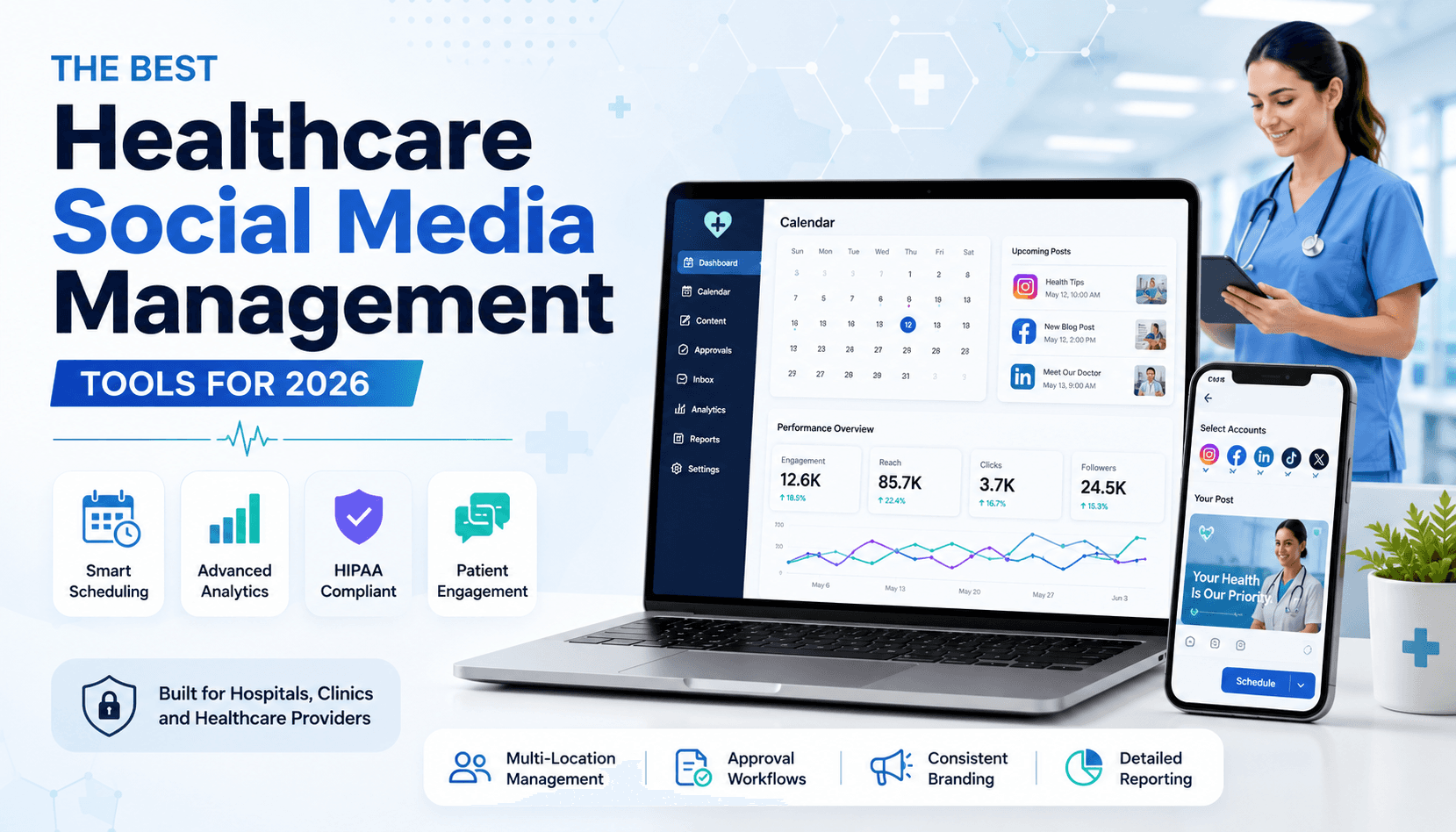
Healthcare marketing teams carry a heavier load than most. You are not only building a brand. You are earning trust from patients while staying inside strict privacy rules, all while competitors post daily and leadership keeps asking why engagement has gone flat. If you have ever tried to handle healthcare social media management with a shared calendar, three logins, and a lot of copy pasting, you already know the real problem is not effort. It is the tools.
This guide looks at the best healthcare social media management tools for 2026, what actually separates a general purpose platform from one built for healthcare, and how to choose software that fits the way hospitals, clinics, and medical practices really operate. Along the way we will cover analytics, HIPAA compliant workflows, scheduling, and the review steps that keep marketing, legal, and compliance teams from working against each other. If you want a broader view of the full marketing picture first, this complete guide to healthcare social media marketing is a good companion to this one.
What Is Healthcare Social Media Management?
Healthcare social media management is the ongoing work of planning, publishing, monitoring, and reporting on social content for hospitals, clinics, physician groups, dental practices, and behavioral health organizations across channels like Facebook, Instagram, LinkedIn, and TikTok. It covers content calendars, scheduling, compliance review, patient engagement, reputation management, and the reporting that goes back to leadership every month.
The difference between this and general social media management comes down to one thing: review. A retail brand can snap a product photo and post it in seconds. A hospital marketing team usually needs a compliance reviewer to check that same post before it goes live, especially if it references a procedure, a provider, or anything that touches patient privacy. That single extra step reshapes the entire workflow, and it is exactly why tools built for ecommerce or influencer marketing tend to fall short once a healthcare organization tries to scale.
Why Healthcare Organizations Need Specialized Social Media Software
General purpose social media management software was built to solve a simple problem: post content, schedule it in advance, and check basic engagement numbers. Healthcare organizations need all of that, plus a layer of accountability that most platforms never had to consider.
A hospital system might have a marketing coordinator drafting posts, a physician reviewing clinical accuracy, a compliance officer checking for privacy issues, and a director approving the final version before anything goes live. Multiply that by ten locations and you can see why a plain scheduling tool creates more friction than it removes. Healthcare specific software builds that chain of review directly into the platform instead of forcing teams to manage it over email and screenshots.
Patient engagement is another factor. People often turn to a hospital or clinic’s social pages when they are anxious, searching for reassurance, or trying to reach someone quickly. That means response time, tone, and accuracy carry more weight in healthcare than in almost any other industry, and the software supporting that work needs to reflect it.
Key Challenges Hospitals and Clinics Face
Before comparing tools, it helps to name the problems healthcare marketers run into most often. These challenges show up again and again in conversations with hospital marketing directors and clinic owners alike.
Compliance review that slows everything down, especially when approvals happen over email threads
Multiple locations posting inconsistent messaging or off brand visuals
Small teams expected to manage dozens of social profiles across departments
Limited visibility into which posts actually drive patient engagement or appointment inquiries
Difficulty proving social media return on investment to hospital leadership
Providers and staff who want to contribute content but lack an easy, compliant way to submit it
Every one of these challenges points back to the same root cause. Generic tools were not designed with healthcare workflows in mind, so teams end up bolting together spreadsheets, email chains, and shared drives to compensate.
Best Healthcare Social Media Management Tools for 2026
There is no shortage of social media management software on the market. Hootsuite, Buffer, Sprout Social, Metricool, SocialPilot, Agorapulse, Later, HubSpot, and Zoho Social all have loyal users, and each one does a solid job for the audience it was built for. The question for a hospital, clinic, or physician group is not which tool is popular. It is which tool understands healthcare social media management well enough to support compliance, multi location publishing, and patient trust without adding extra manual work.
The comparison below focuses on how each platform handles the parts of the job that matter most to healthcare teams: approval workflows, reporting depth, and how much healthcare specific thinking is actually built in.
Platform | Best For | Strengths | Limitations | Pricing Style | Healthcare Friendly |
|---|---|---|---|---|---|
Sociali.ai | Hospitals, clinics, and multi location healthcare groups | Built around healthcare workflows, approval steps, AI assisted content, and multi location publishing | Newer to the market than legacy platforms, so brand recognition is still growing | Tiered subscription based on locations and users | Yes, built specifically for healthcare |
Hootsuite | Large marketing teams needing broad platform coverage | Wide integration list, established reporting suite, large app marketplace | Approval workflows are generic and not designed around clinical compliance review | Tiered subscription by seats and features | Partial, healthcare use needs manual workarounds |
Buffer | Small teams that want simple scheduling | Clean interface, easy to learn, affordable entry point | Limited compliance controls and thin reporting for larger organizations | Tiered subscription by channels | Limited |
Sprout Social | Mid size to enterprise brands wanting deep analytics | Strong listening and reporting tools, solid customer support | Cost rises quickly for multi location healthcare groups, no healthcare specific review flow | Tiered subscription, higher price point | Partial |
Metricool | Small businesses and solo marketers | Affordable, decent scheduling and basic analytics | Not built for multi department approval chains common in healthcare | Tiered subscription, budget friendly | Limited |
SocialPilot | Agencies managing many client accounts | Good bulk scheduling and client management features | Compliance and clinical review workflows are not a core focus | Tiered subscription by client accounts | Limited |
How the leading platforms compare in practice
Hootsuite and Sprout Social are strong choices for large marketing departments that need broad integrations and mature reporting. Both work well for general brand marketing, but neither was built around the layered approval process that clinical content usually requires, so healthcare teams often end up recreating that process manually.
Buffer and Metricool are approachable and budget friendly, which makes them appealing for a single clinic or a small practice. The tradeoff is depth. Once an organization grows past one or two locations, the lack of healthcare specific workflow support becomes obvious quickly.
SocialPilot is a solid option for agencies juggling many client accounts, with useful bulk scheduling features. It is not built with clinical review chains or HIPAA conscious publishing steps in mind, so healthcare clients typically need to supplement it with their own internal process.
Sociali.ai was built with a different starting point: healthcare organizations first. That shows up in the approval workflows, the multi location dashboard, and the AI assistance built around healthcare content specifically, rather than general marketing use cases. We will go deeper into that later in this article.
Healthcare Social Media Analytics
Healthcare social media analytics means more than counting likes. Marketing directors need to understand which content drives patient engagement, which posts lead to appointment inquiries, and how each location or department is performing compared to the others. Good analytics also help justify budget, since hospital leadership rarely approves spending based on vanity metrics alone.
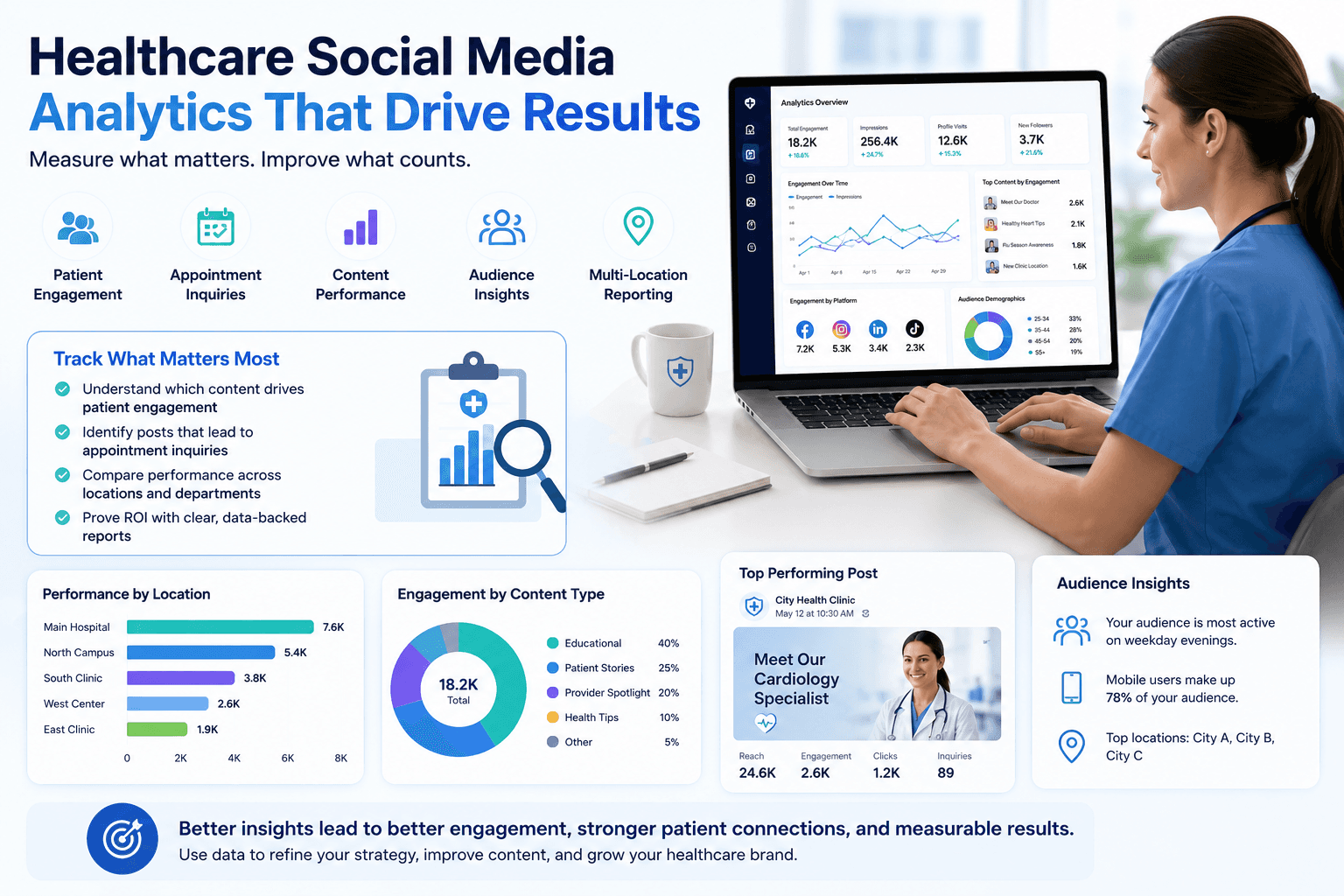
The most useful healthcare social media reporting tools break performance down by location, by department, and by content type, so a marketing team can see whether a physician spotlight post outperforms a general awareness campaign, or whether one hospital campus is consistently underperforming the rest of the network.
Audience insights matter just as much as engagement tracking. Understanding who is actually seeing and responding to content helps healthcare marketers refine messaging over time, which ties closely into the broader work of patient engagement on social media, a topic worth exploring in more depth if reporting is a priority for your team.
HIPAA Compliant Healthcare Social Media Tools
One of the most common questions healthcare marketers ask is whether social media tools are HIPAA compliant. The honest answer is nuanced. HIPAA governs protected health information, not marketing software in general, so a scheduling tool itself is not automatically HIPAA compliant or non compliant. What matters is how the organization uses the tool and whether the platform supports the safeguards a covered entity needs.
A genuinely HIPAA conscious social media workflow includes a few practical elements: a required approval step before anything publishes, clear record keeping of who approved what and when, restricted access based on role, and content review that specifically checks for accidental patient identifiers before a post goes live. Software that supports these steps natively makes compliance part of the daily workflow instead of a separate manual task that is easy to skip when a team is busy.
This is one of the clearest ways healthcare specific social media management software earns its keep. General tools can technically be used carefully, but the responsibility falls entirely on the team to build and enforce that process by hand.
AI Healthcare Social Media Management
AI has moved from a novelty to a genuine time saver in healthcare marketing, particularly for teams that are stretched thin across many responsibilities. An AI social media assistant built for healthcare can help draft first versions of patient education posts, suggest captions that match a hospital’s tone, and repurpose long form content like blog posts into shorter social updates.
The key distinction is context. A general AI writing tool has no idea that a healthcare organization cannot make certain claims, needs to avoid implying guaranteed outcomes, or must be careful with language around sensitive topics like behavioral health or oncology. AI tools trained with healthcare marketing in mind are far more useful here, since they reduce the editing burden instead of creating more of it.
Healthcare Social Media Scheduling
Consistency is one of the simplest ways to build trust on social media, and scheduling tools are what make consistency realistic for a busy healthcare team.plan around awareness months and observances relevant to healthcare, and queue content for multiple platforms without logging into each one separately.
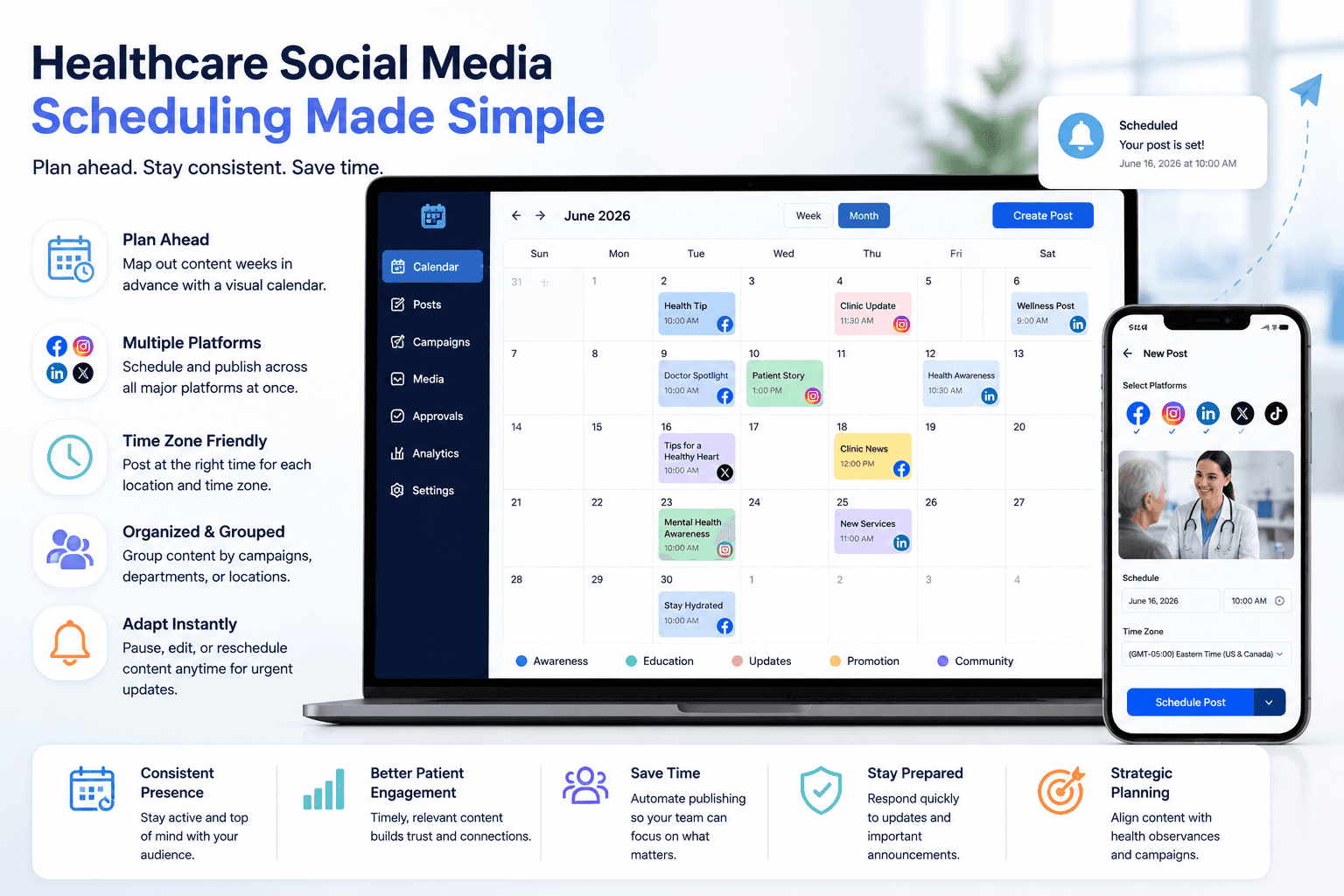
The best healthcare social media scheduling tools also account for time zones across multiple facilities, allow content to be grouped by campaign or department, and make it easy to pause or adjust a schedule quickly if something urgent comes up, such as a weather closure or a public health notice.
Healthcare Content Approval Workflow
Nothing separates healthcare social media management from general marketing quite like the approval process. In most industries, a marketing manager can write a post and publish it within minutes. In healthcare, that same post might need a sign off from a compliance officer, a physician, or a department head before it is safe to publish.
A strong content approval workflow lets teams assign reviewers, track where a post sits in the approval chain, and keep a clear record of who signed off and when. Without this built into the software itself, teams typically rely on email threads or shared documents, which slows everything down and makes it easy for a post to go live without proper review.
Multi Location Healthcare Marketing
Hospital systems, dental groups, and multi-site physician practices face a specific version of this challenge: keeping dozens of local profiles on brand while still giving each location room to post about its own community, staff, and events.
A multi location healthcare marketing setup needs a central dashboard where corporate marketing can see everything happening across the network, set brand guidelines, and step in when needed, while local teams still have enough flexibility to post relevant, timely content for their own community. Software that forces every location into a rigid, identical template tends to produce content that feels generic and disconnected from the community it is meant to serve.
Features Every Healthcare Team Should Look For
When evaluating social media management software for healthcare, a few features consistently separate the platforms that work well from the ones that create extra work down the line.
A built in content approval workflow with clear reviewer assignments
Multi location dashboard with both centralized and local level control
Healthcare social media analytics broken down by location and content type
AI assistance trained with healthcare context, not generic marketing copy
Reporting that can be shared easily with leadership and board members
Support for social listening so teams can respond quickly to patient questions or concerns
How to Choose Healthcare Social Media Management Software
Start by mapping your actual workflow before looking at any platform. How many people need to review a post before it goes live? How many locations or departments need their own login? What does your leadership team actually want to see in a monthly report?
From there, weigh each platform against those specific needs rather than a generic feature checklist. A tool with impressive integrations but no real approval workflow will still leave your team managing compliance manually. A tool with a beautiful calendar but weak reporting will make it harder to prove the value of your work when budget season comes around.
It also helps to ask vendors directly how healthcare organizations use their platform day to day, rather than relying only on the marketing page. A vendor that understands healthcare social media management will have specific, concrete answers about approval chains, multi location setups, and reporting, not vague reassurances.
Common Mistakes to Avoid
A handful of mistakes show up repeatedly when healthcare organizations choose or implement social media software, and most of them are avoidable with a bit of planning.
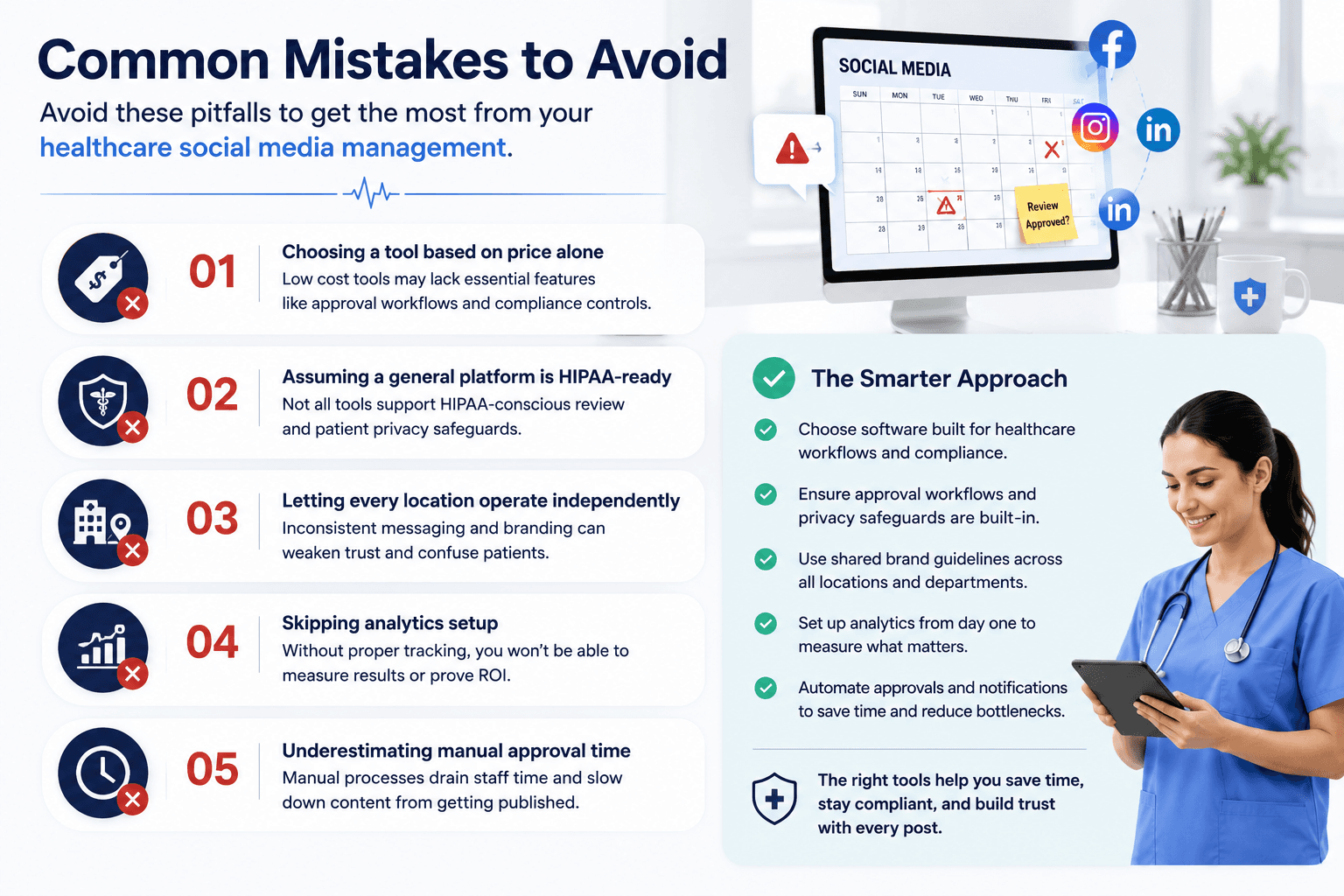
Choosing a tool based on price alone without checking whether it supports an approval workflow
Assuming a general purpose platform will handle HIPAA conscious review without any extra setup
Letting every location operate independently with no shared brand guidelines
Skipping analytics setup, then struggling to prove results months later
Underestimating how much staff time manual approval processes actually consume
Avoiding these mistakes usually comes down to the same idea: choose software built around how healthcare marketing actually works, rather than trying to force a generic tool to behave like one.
Why Sociali.ai Is Built for Healthcare Teams
Sociali.ai was designed around the realities described throughout this article, rather than adapted after the fact for healthcare use. You can see the full breakdown of how it supports healthcare organizations on the healthcare solution page, but a few things are worth highlighting here.
The AI assistance inside Sociali.ai is built around healthcare content specifically, which means it helps draft patient education posts and repurpose content without needing constant correction for tone or claims that would not hold up under compliance review. Multi location management gives corporate teams a central view of the entire network while still letting individual locations post community relevant content.
Analytics and reporting are built to answer the questions healthcare leadership actually asks: which content is working, which locations need support, and how social media is contributing to broader goals like patient engagement and reputation management. None of this replaces a healthcare organization’s own compliance policies, but it does make following those policies part of the daily workflow instead of an extra burden layered on top of it.
For teams that want to go further into how content strategy ties into all of this, this guide on healthcare content marketing is worth reading alongside this one.
Frequently Asked Questions
What is healthcare social media management?
It is the process of planning, publishing, reviewing, and reporting on social content for hospitals, clinics, and medical practices, with extra attention to compliance, patient trust, and multi location consistency.
Which social media tools are best for healthcare?
Platforms that build in a compliance friendly approval workflow, multi location management, and healthcare specific reporting tend to serve hospitals and clinics better than general purpose tools.
How do hospitals manage social media across multiple locations?
Most use a central dashboard that lets corporate marketing set brand guidelines and oversee performance, while individual locations retain some control over local, community focused content.
Are healthcare social media tools HIPAA compliant?
HIPAA compliance depends on how a tool is used, not the software alone. The most helpful platforms support approval steps, access controls, and record keeping that make compliant use easier to maintain.
What is healthcare social media analytics?
It refers to tracking and reporting on how social content performs, broken down by location, department, and content type, so teams can connect activity to patient engagement and organizational goals.
What features should healthcare social media software have?
Look for a built in approval workflow, multi location dashboards, healthcare focused analytics, scheduling tools, and AI assistance designed with healthcare content in mind.
See How Sociali.ai Fits Your Team
Choosing the right healthcare social media management software is not about finding the flashiest platform. It is about finding one that fits how your team actually works, respects the compliance requirements you cannot ignore, and gives leadership the reporting they need to keep supporting your work.
If your team is ready to move past spreadsheets and scattered approval emails, take a look at Sociali.ai’s healthcare solution and see whether it fits the way your organization manages social media today.
Free resource
Get the checklist


