Content Repurposing Strategy: Turn 1 Post into 10 (2026 System)
|
9
min read

Content Repurposing Strategy: Turn 1 Post into 10 (2026 System)
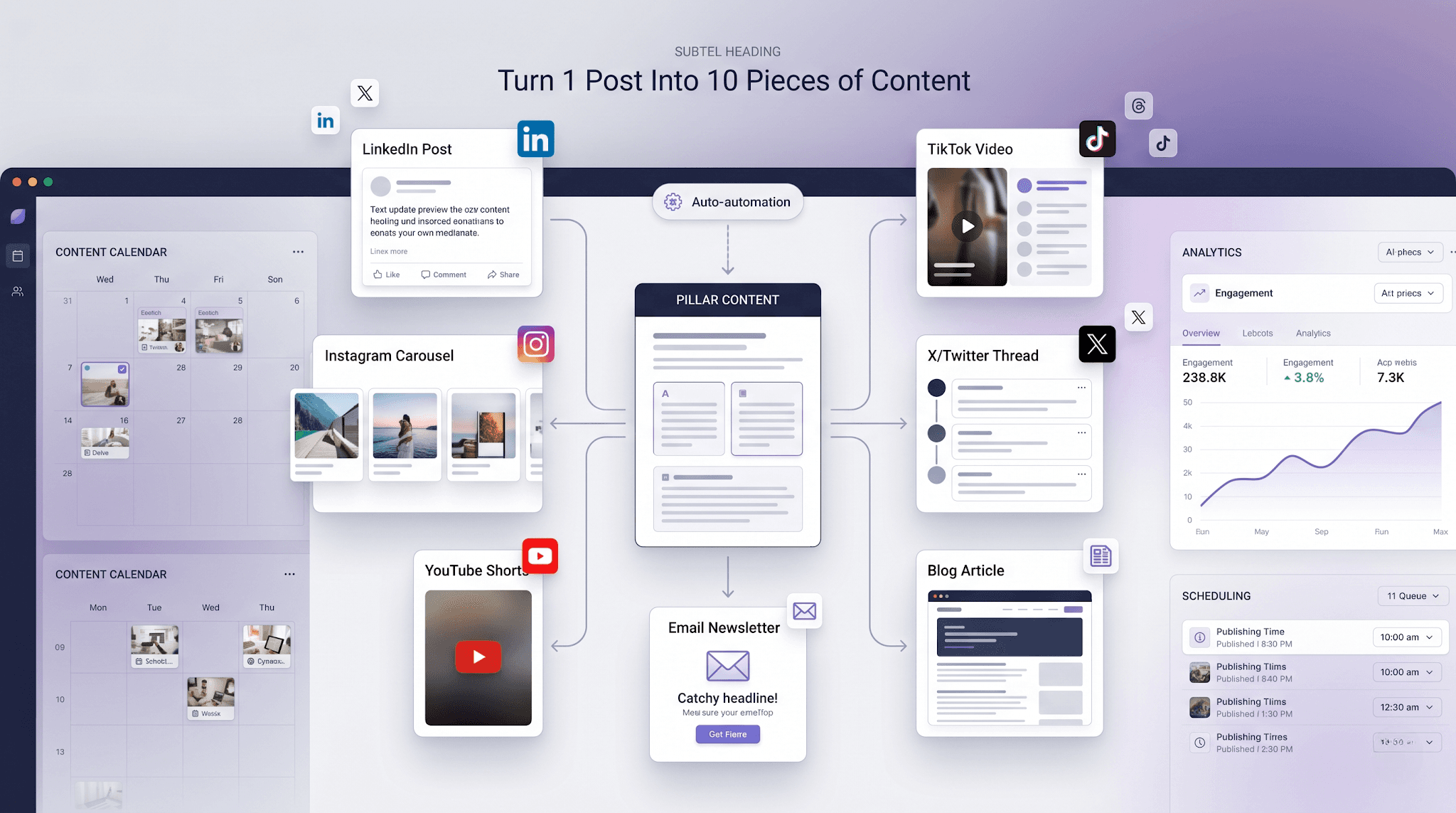
You’ve got a content calendar to fill, five platforms demanding fresh posts, and a team that’s already running on fumes.
So what happens? Someone spends three hours on a LinkedIn post. It goes live. Gets decent engagement. And then… it disappears into the void. Next week, you’re back at square one, staring at a blank doc, trying to squeeze out another “original” idea.
Sound familiar?
Here’s the thing most content teams don’t realize until they’re completely burned out: the problem isn’t that you don’t have enough ideas. It’s that you’re treating every piece of content like a one-time event instead of a launchpad.
The teams consistently showing up across Instagram, LinkedIn, X, TikTok, and YouTube posting three, four, five times a week without melting down aren’t generating more ideas than you. They’ve just built a smarter system around the ideas they already have.
Most brands don’t need more content ideas, they need better systems for extracting more value from the ideas they already have.
Why Most Content Teams Struggle With Consistency
Let’s be honest about what’s actually happening.
You create a post. It performs. You move on. You create another post. You run out of ideas. You force something mediocre. You post it anyway. Engagement tanks. You feel stuck. Repeat.
That’s not a creativity problem. That’s a workflow problem.
Content burnout is real, and it almost always comes from the same place: teams are expected to produce platform-native, original content for five different channels, week after week, with no system behind it. Every piece starts from scratch. Every caption, every hook, every format invented on the spot.
It’s exhausting. And it’s completely unnecessary.
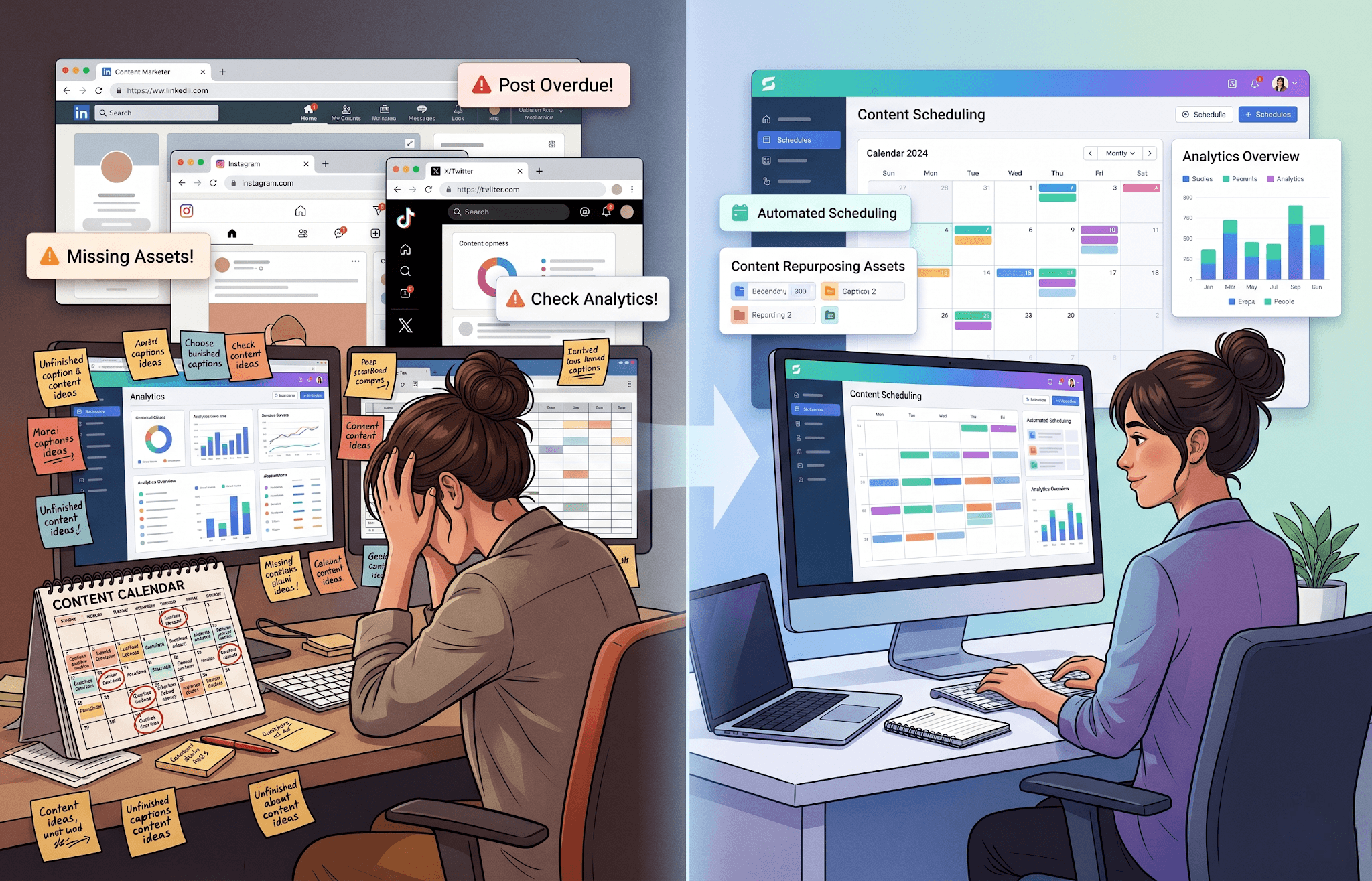
There’s also the platform pressure side of this. Instagram wants Reels. LinkedIn wants carousels. X wants threads. TikTok wants talking-head videos. Each platform has its own rhythm, its own format preferences, its own audience behavior. Creating fully original content for each one is not a scalable strategy for any team that isn’t a full-scale media company.
Here’s the distinction that changes everything: repurposing is not reposting.
Reposting is copying your LinkedIn caption and pasting it into Instagram. Repurposing is taking the core idea from that LinkedIn post and completely rebuilding it in a format, tone, and structure that actually works on Instagram.
One of those trains your audience to stop paying attention. The other builds an audience.
The 2026 Content Repurposing Strategy: Turn 1 Post into 10
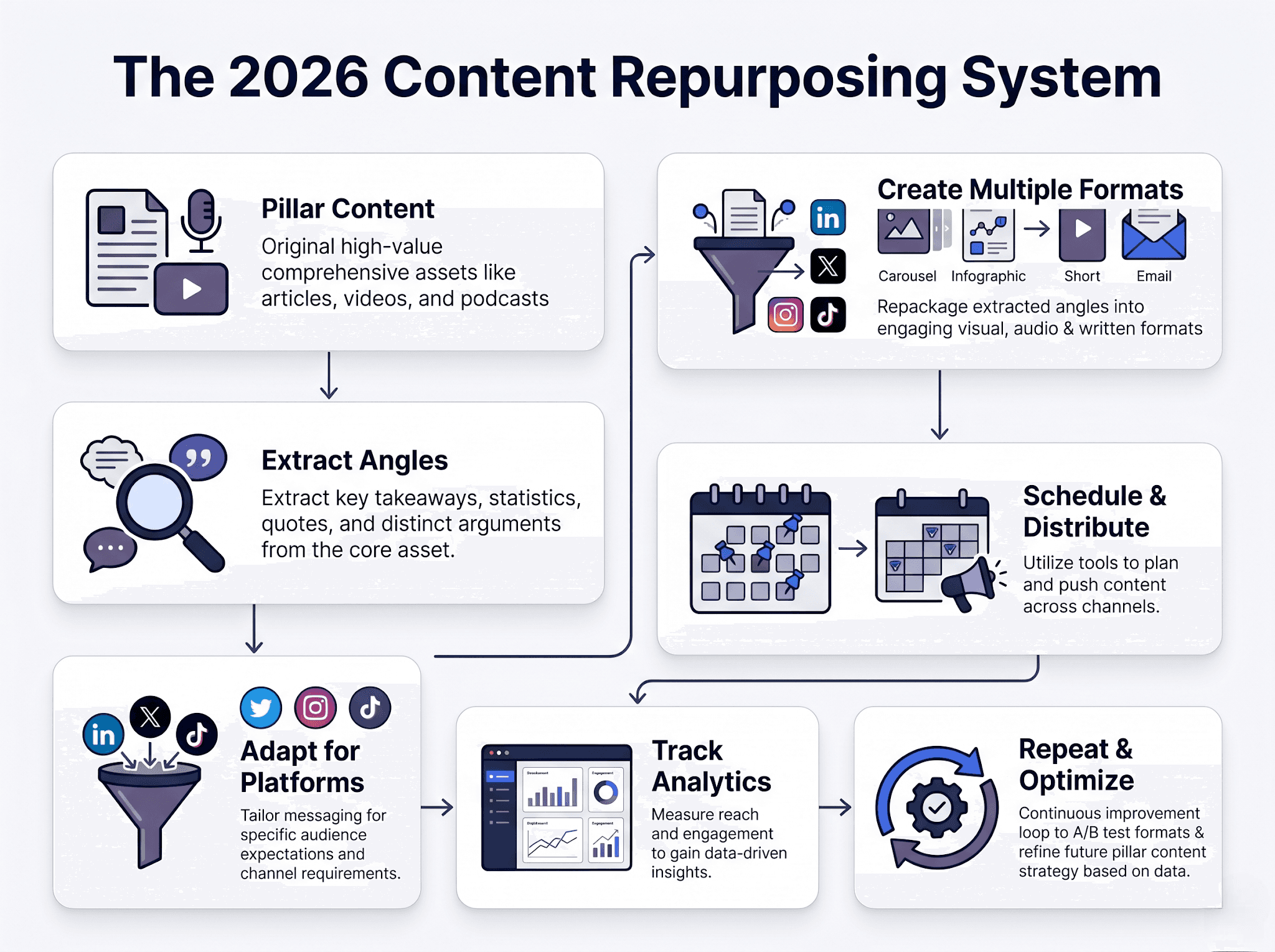
This is the actual framework. Not theory a repeatable system you can implement with your next piece of content.
Step 1: Start With a Core Content Asset
Everything flows from one strong piece. This is your “pillar content” , something meaty enough to extract multiple angles from.
This could be:
A long-form LinkedIn post with a strong opinion or framework
A 10-minute YouTube video or podcast episode
A webinar or live Q&A
A detailed carousel post
A thought leadership article or case study
The key is substance. A quick caption or a surface-level take won’t have enough inside it to generate ten variations. You need a piece with a clear point of view, real data, a framework, or a compelling story.
When you’re choosing your pillar, ask: If I had to teach this concept for 20 minutes, could I? If yes, it’s rich enough to repurpose.
Step 2: Extract Multiple Angles Before You Create Anything
Before you touch a single piece of content, pull everything useful out of your pillar.
Go through it and extract:
The hook — what’s the provocative opening line or counterintuitive idea?
The key stats or data points — anything that stops someone mid-scroll
The opinions — strong takes that are defensible but not obvious
The lessons — what would someone walk away knowing?
The questions — what objections or curiosities does this raise?
The story — is there a before/after, a mistake, a win?
One well-written LinkedIn article might give you six or seven of these. That’s six or seven completely different pieces of content waiting to be written each with a different angle, different hook, different emotional pull.
Don’t start creating until you’ve mapped these out. This planning step is what separates a content machine from content chaos.
Step 3: Adapt Content for Each Platform Don’t Just Translate It
This is where most repurposing falls apart. People take their LinkedIn post, change a few words, and paste it into Instagram. Then they wonder why it underperforms.
Platform-native formatting isn’t optional. It’s the whole point.
Here’s how the same core idea should shift across platforms:
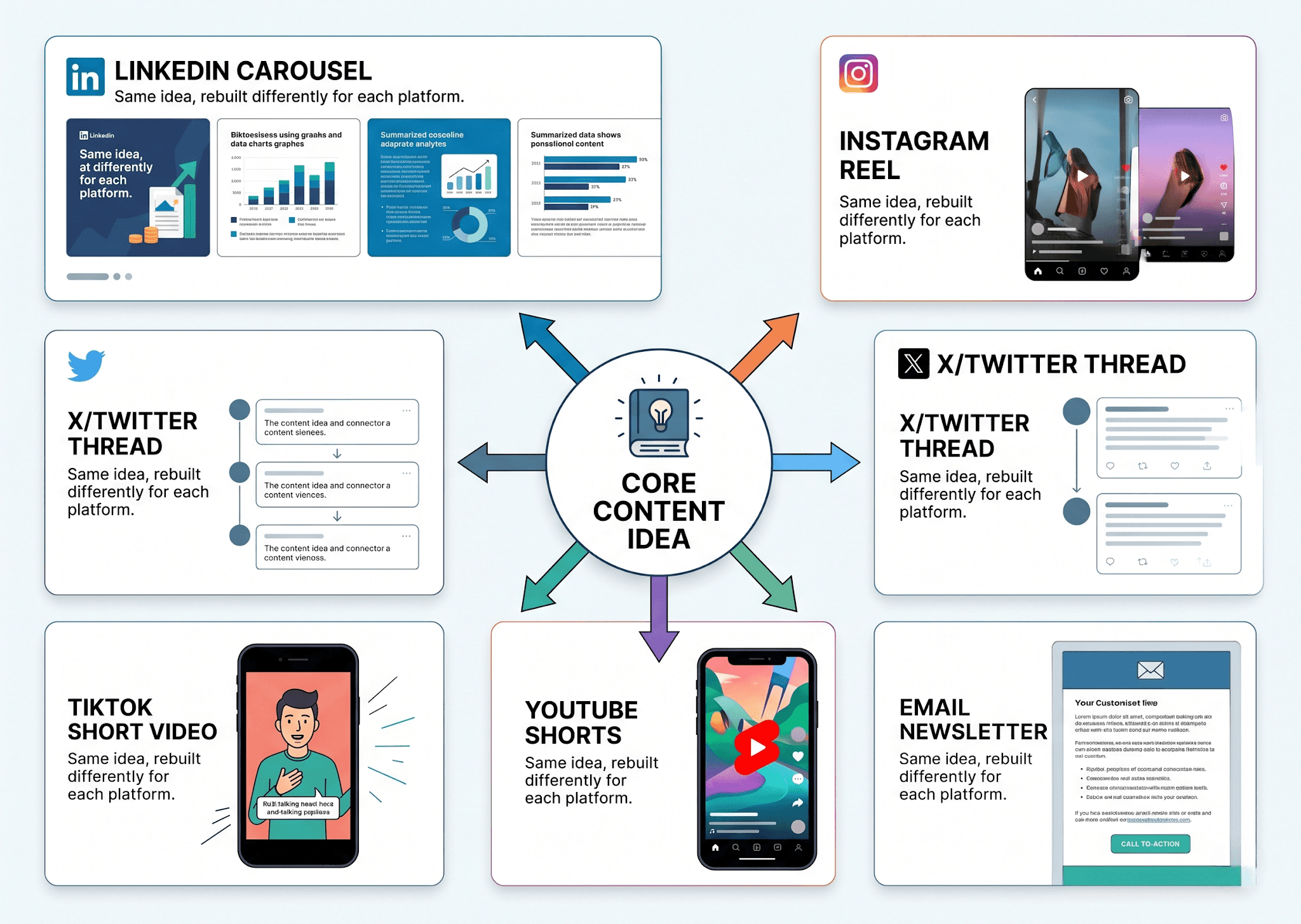
LinkedIn: Long-form opinion posts, carousels with tactical frameworks, first-person stories. Professional but human. Paragraphs are fine. Lists work well.
Instagram: Visual-first. Carousels for education, Reels for reach, quote graphics for shareability. Captions are secondary to the visual hook.
X/Twitter: Sharp, punchy, opinionated. Threads for depth, standalone tweets for hooks. One idea per tweet. Fast.
TikTok: Hook in the first two seconds. Talking head works if you’re confident on camera. Trending sounds help. Raw and real outperforms polished.
YouTube Shorts / Instagram Reels: Vertical, fast-paced, clear value in under 60 seconds. Think “one tip, one minute.”
The same insight can live on all five platforms — but the packaging has to be rebuilt for each one, not just reformatted.
Step 4: Turn One Idea Into Multiple Formats
Once you know your angles and your platforms, start mapping formats to each.
From a single pillar piece, you should be able to produce:
A carousel (3–10 slides breaking down a framework or step-by-step process)
A short-form video (one tip, one take, one compelling hook)
A Twitter/X thread (sequential breakdown of the core argument)
A quote graphic (one powerful line pulled from the original)
An email newsletter section (deeper explanation with a personal angle)
A blog intro or supporting section (SEO-driven, longer form)
A LinkedIn caption (first-person story version of the idea)
A poll or question post (engagement-driven, uses the idea as the premise)
A “hot take” standalone post (the most provocative version of your opinion)
A save-worthy checklist (distills the framework into a visual list)
That’s ten pieces of content from one idea. And this isn’t padding. Eachpadding each one serves a different format, different audience behavior, different momentsmoment in the scroll.
Step 5: Schedule and Distribute Systematically
This is where the system actually lives or dies.
Creating the content is only half the job. Getting it consistently out the door on the right platforms, at the right cadence, without dropping the ball requires a workflow.
A few things that separate teams who do this well:
Batch by asset, not by day. When you sit down to repurpose, do all ten variations in one session. Don’t try to repurpose on the fly every morning.
Use a content calendar that maps platform and format. Know in advance where each variation is going. Not just “post this week” Tuesday, LinkedIn, carousel, framework post.
Schedule everything ahead. Teams that post consistently aren’t posting in real time every day. They’re scheduled two to three weeks out. This is where platforms with integrated scheduling and automation become genuinely useful tools that support an end-to-end social media automation workflow to takeworkflow take the cognitive load off execution so you can stay focused on creation.
Build in a repeating cycle. Repurposing shouldn’t be a one-time event. Build it into your weekly or biweekly workflow: pick a pillar, extract angles, create variations, schedule, move on.
Step 6: Track Performance and Double Down
Repurposing isn’t just about volume. It’s about learning.
When you distribute ten variations of one idea, you’re running ten small experiments. Different hooks on different platforms, different formats, different angles — and you’re watching what lands.
Pay attention to:
Which angle drove the most saves, shares, or comments
Which format outperformed on each platform
Which hook generated the most profile visits or link clicks
Which topic generated the most DMs or replies
Then feed that back into your next pillar. If your “mistake I made” angle on a topic destroyed everything else, leadelse lead with that energy on your next piece. If carousels are outperforming Reels for your audience, weighweight your repurposing toward carousels.
Good repurposing is iterative. The system gets smarter every cycle.
Here’s Where Most Teams Get Repurposing Wrong
Let’s talk about the failure modes, because they’re common and avoidable.
Reposting identical content. Same caption, same visual, same hook just on a different platform. This doesn’t just underperform. It trains your cross-platform audience to tune you out. If someone follows you on both LinkedIn and Instagram and sees the same post twice, you’ve wasted a touchpoint.
Copy-pasting captions without reformatting. LinkedIn captions don’t work on Instagram. Instagram captions don’t work on X. The structure, the length, the tone all of it needs to be rebuilt. Skipping this step is one of the most common automation mistakes teams make when they first start repurposing at scale.
Ignoring platform behavior. What performs on one platform often fails on another not because the idea is bad, but because the format doesn’t fit how users behave there. A 500-word caption might kill it on LinkedIn and die completely on Instagram.
Prioritizing quantity over adaptation. Repurposing ten pieces of lazy content isn’t a content strategy. It’s noise. The goal is ten well-adapted pieces, each built for where it’s going.
What High-Performing Content Teams Do Differently
They don’t work harder. They work with better systems.
A few patterns you’ll consistently see in teams that maintain strong social presence without burning out:
Systems over spontaneity. They don’t rely on inspiration. They have a documented workflow that tells them exactly what to do with every piece of content the moment it’s created.
Workflows over hustle. Posting every day by grinding every day isn’t sustainable. Posting every day by building a scheduled, batched, systematized workflow is. These teams plan in sprints, batch in sessions, and schedule in advance.
Adaptation over duplication. They treat each platform as its own audience with its own preferences. Content gets rebuilt for each destination, not just resized.
Analytics-driven iteration. They don’t guess what’s working. They track, review, and adjust their repurposing strategy based on real performance data. Over time, their content gets tighter and more effective because they’re learning with every cycle.
Platforms like Sociali.ai make this kind of workflow much more manageable by bringing planning, scheduling, repurposing, and analytics into one place so teams can run a proper content system without juggling five different tools or living in spreadsheets.
Frequently Asked Questions
What is content repurposing?
Content repurposing is the process of taking one piece of content a video, article, post, or webinar and adapting it into multiple formats or variations for different platforms. Unlike reposting, repurposing involves rebuilding the content to fit each platform’s native format and audience behavior.
Is repurposing content good for SEO?
Yes. When repurposing leads to long-form blog content, it can directly support search rankings. More broadly, repurposing helps build topical authority across channels, drives traffic back to core assets, and increases the surface area of your content without requiring entirely new ideas.
How do you repurpose one post into multiple formats?
Start with a pillar piece of content. Extract key angles, hooksangles hooks, stats, opinions, lessons. Then rebuild each angle in a format suited to each platform: carousel for Instagram, thread for X, short-form video for TikTok, email snippet for your newsletter. Each variation should feel native to its platform, not like a copy-paste.
What platforms should content be adapted for?
It depends on your audience, but most B2B and B2C brands should cover LinkedIn, Instagram, X/Twitter, and either TikTok or YouTube Shorts. The platforms you choose should align with where your audience actually spends time, nottime not just where you think you should be.
What is the difference between reposting and repurposing?
Reposting is sharing the same content again, often unchanged. Repurposing is extracting the core idea and rebuilding it in a new format, tone, or structure suited to a different context or platform. Repurposing adds value; reposting usually just adds noise.
How often should brands repurpose content?
There’s no universal answer, but a solid baseline is to repurpose every significant piece of pillar content immediately after publishing. If you’re publishing one strong pillar piece per week, you should be generating enough variations from it to sustain a consistent multi-platform posting schedule without needing entirely new ideas every day.
Stop Starting From Scratch
The teams winning on social media in 2026 aren’t out-creating anyone. They’re out-systematizing everyone.
One strong idea, properly extracted and adapted, can sustain your content calendar across five platforms for a week or more. That’s not a hack, it’shack it’s just a smarter way to work.
Build the pillar. Extract the angles. Adapt for each platform. Schedule consistently. Track what lands. Repeat.
If that workflow sounds like something you want to run without duct-taping five tools together, platforms like Sociali.ai are built exactly for this, bringingthis bringing your content planning, scheduling, distribution, and analytics into a single system so the repurposing machine actually runs.
The content is already there. You just need to stop leaving so much of it on the table.
Free resource
Get the checklist


