End-to-End Social Media Automation Workflow (From Idea to Analytics) in 2026
|
9
min read
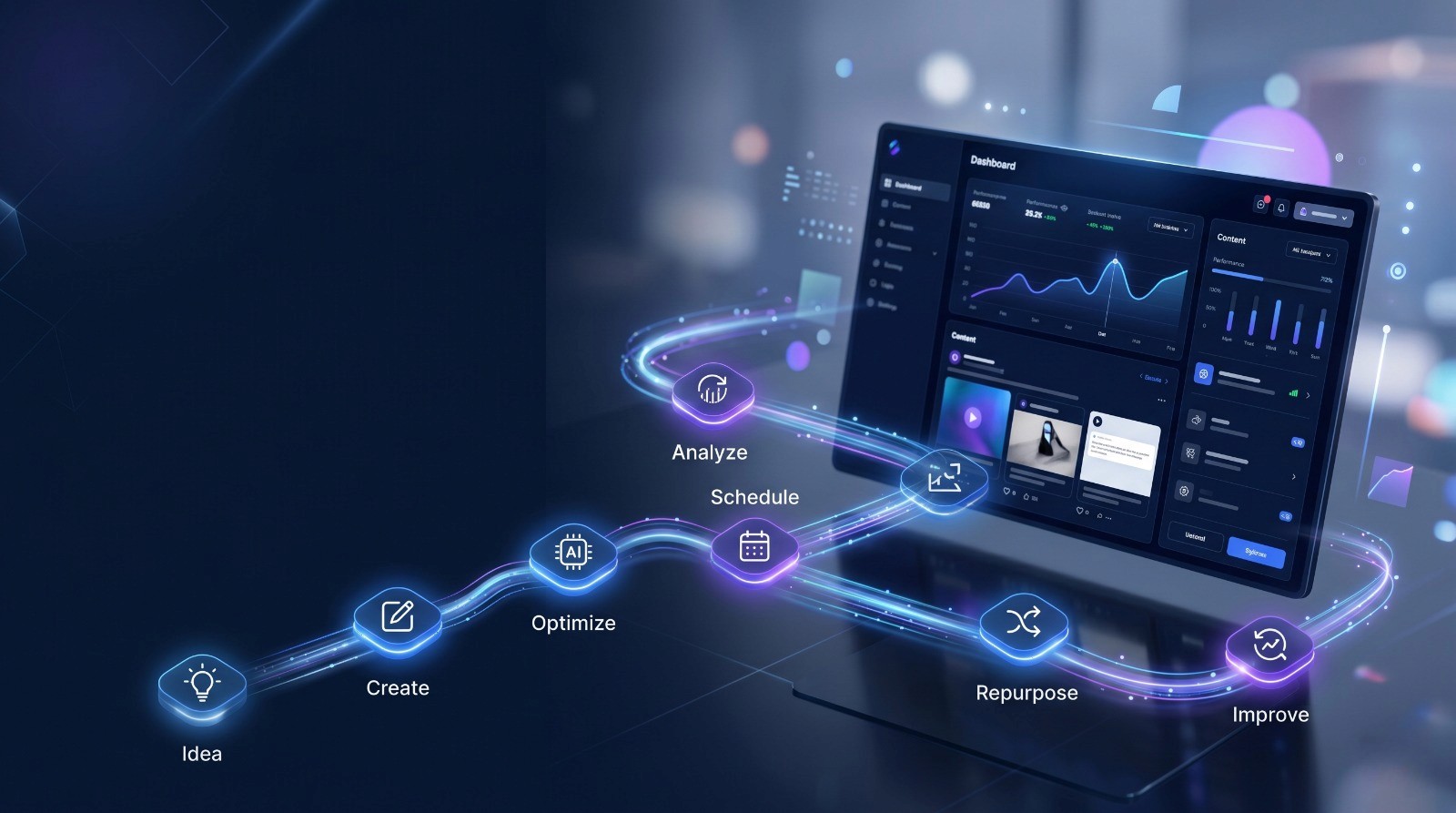
The End-to-End Social Media Automation Workflow That Actually Works in 2026
For marketers, agencies, and creators who are done wasting hours on tasks a system should handle.
You open your laptop on Monday morning with a clear head and a content plan. By Wednesday, you’ve answered 40 Slack messages, missed a posting window, and your analytics tab has been open untouched since last Thursday.
Sound familiar?
Manual social media management doesn’t just eat time it creates chaos. You’re making creative decisions under deadline pressure, posting inconsistently, and then wondering why the results aren’t compounding. The problem isn’t effort. The problem is that you’re running a production operation like it’s a side project.
In 2026, the brands, agencies, and creators winning on social all have one thing in common: a real workflow. Not a content calendar in Notion. Not a half-finished spreadsheet. A repeatable, automated system that takes content from idea to publish and then turns performance data back into better content.
This is exactly what that system looks like step by step.
Most brands don’t fail because of bad content, they fail because they don’t have a system.
What Is a Social Media Automation Workflow in 2026?
A social media automation workflow is a structured, repeatable system that moves content from initial idea through creation, scheduling, publishing, repurposing, and analysis with as little manual intervention as possible at each stage.
In 2026, this goes well beyond scheduling posts in advance. A real automation workflow connects every part of your content operation: idea capture, AI-assisted creation, platform-specific formatting, automated scheduling, systematic repurposing, and unified analytics all feeding into each other continuously.
The difference between a content calendar and an automation workflow is what happens between the steps. A calendar tells you when to post. A workflow handles how it gets there and takes most of the execution off your plate.
Before building a system like this, it’s worth understanding where most teams go wrong, especially the common automation mistakes that break consistency and results.
The Social Media Automation Workflow at a Glance
What High-Performing Social Media Teams Do Differently in 2026
There’s a visible gap between the teams that are growing consistently and the ones that are grinding without traction. It’s not a budget. It’s not team size. It’s how they operate.
Here’s what separates them:
They plan in systems, not sprints. High-performing teams don’t scramble at the start of each week. They have an always-running content pipeline ideas flowing in continuously, content batched and queued ahead of time.
They treat repurposing as a first-class workflow step. Not an afterthought. Every piece of content is planned with distribution in mind from the start. One shoot. Ten formats. Multiple platforms.
They automate the operational layer completely. Scheduling, formatting, approval routing, performance reporting none of this involves manual effort. Human time is reserved for creative decisions and strategic judgment.
They review performance on a fixed cadence. Not whenever someone remembers. A weekly analytics review is a standing meeting. Insights go directly back into content planning not into a folder that never gets opened.
They consolidate their tools aggressively. Fewer tools mean fewer handoffs, less context-switching, and cleaner data. The best teams are running on one or two core platforms, not eight.
They build for consistency, not virality. One viral post doesn’t build an audience. Showing up reliably, week after week, with content that serves a specific audience that’s what compounds.
The Real Cost of Running Social Media Manually
Most teams underestimate what manual social media management actually costs them and it’s not just time.
The obvious drain is operational: logging into platforms, reformatting content per channel, chasing approvals, pulling analytics reports. A mid-size marketing team doing this manually can burn 10–15 hours per week on pure coordination that adds zero creative value.
The less obvious cost is momentum. Social media growth rewards consistency and speed of iteration. Every week spent in reactive mode putting out fires instead of executing a system is a week you’re falling behind teams that have already automated that layer.
Tool-switching overhead: Jumping between Canva, Google Docs, five platform dashboards, and a scheduling tool adds friction to every task. Small delays compound into real delays.
Inconsistency under pressure: Manual workflows break when someone is sick, overwhelmed, or just off their game. Automated workflows don’t take sick days.
Slow iteration: When analytics aren’t reviewed on a schedule, you keep making content that doesn’t work and miss angles that do.
The math isn’t complicated: less time on operational work means more capacity for the decisions that actually drive growth.
Here’s Where Most Teams Get It Wrong
Most social media teams don’t fail because they lack talent. They fail because they’re solving an operations problem with a creativity solution.
They hire another content creator when what they actually need is a better workflow. They experiment with new formats when the real issue is inconsistent publishing. They add more tools when the problem is that the existing tools aren’t connected.
The pattern looks like this: strong content week → inconsistent follow-up → algorithm penalizes the drop → team works harder to recover → burnout → inconsistency → repeat.
Breaking that cycle isn’t about effort. It’s about removing the dependency on effort for the parts of the workflow that a system should handle.
Why Most Social Media Strategies Stall Out
It’s rarely a creativity problem. Most teams have plenty of ideas. The breakdown is almost always in execution specifically, the absence of a content workflow system that keeps things moving without requiring heroic manual effort every single week.
Four things break down most often:
No ideation system: Content gets created when someone remembers to create it. Ideas aren’t being captured continuously, so the pipeline runs dry at the worst possible times.
Posting inconsistency: Algorithms reward accounts that show up reliably. Missing three days after a strong week doesn’t just feel bad — it actively resets momentum.
Content used once and abandoned: A blog post becomes one LinkedIn post and nothing else. That’s leaving the majority of its value on the table.
No feedback loop: Analytics get checked occasionally, not systematically. Decisions stay intuition-based long after real data is available.
The fix isn’t grinding harder. It’s building a workflow that handles the operational layer automatically and gets smarter with every iteration.
The Complete Social Media Automation Workflow (2026 Edition)
Step 1: Idea Generation Build a System, Not a Brainstorm Session
Most content planning starts with a blank page and a group chat. That’s the problem.
Great content systems treat ideation as an ongoing input process, not a one-time event. Build an always-on content feed: monitor your industry’s comment sections, trending audio on Reels and TikTok, competitor posts that are outperforming, and search queries your audience is actually typing. Customer questions in DMs or support tickets are some of the most underrated content goldmines available.
Common mistake: Waiting for inspiration to strike. By the time you’re stuck on Tuesday afternoon with nothing to post, the window has already closed. Capture ideas continuously: a shared doc, a Notion board, a voice note, whatever actually gets used.
AI-powered automation tools can now surface trending topics by niche and audience type, which means your ideation system has a head start before anyone’s written a single word.
Step 2: Content Creation Stop Conflating Strategy with Execution
This is where most content workflows quietly become bottlenecks. Creation gets treated as one big stage, when it’s actually two distinct modes: strategic thinking (what to say and why) and execution (writing, designing, editing).
Batch these separately. Block time for strategic content direction, what message serves your audience this week, which angles are underexplored, what’s happening in your industry that’s worth responding to. Then switch into execution mode. Don’t try to do both at once; the quality suffers in both directions.
For agencies managing multiple clients, this separation matters even more. Client-specific voice and direction lives in the strategic layer. AI-assisted drafting handles the volume.
Common mistake: Creating content in real-time, right before posting. This kills quality and consistency simultaneously and it’s the fastest path to burnout.
Step 3: Optimization Hooks, Formats, and Platform-Specific Fit
A great idea with a weak hook is an invisible post. Platform algorithms reward content that earns attention in the first two seconds. Your optimization step should cover:
Hook testing: Write three different opening lines before choosing one. The difference between 2% and 12% engagement often lives in that first sentence.
Format matching: Carousel vs. single image vs. Reel vs. text post each format has its moment. Match format to message, not just habit or convenience.
Platform-specific adaptation: A caption that works on LinkedIn reads awkwardly on Instagram. Platform voice is a craft, not an afterthought.
This is where platforms like Sociali.ai add genuine value. AI-assisted caption generation and platform-specific formatting means your team isn’t rebuilding the wheel every time a piece of content crosses from one channel to another.
Step 4: Scheduling and Publishing This Is Your Automation Foundation
If you’re still manually logging into platforms to hit publish, you’re running a 2019 operation in 2026. Social media scheduling isn’t just a convenience it’s the core of what makes consistency possible at scale.
A proper scheduling setup gives you:
A visual content calendar so you can spot gaps before they become missed posting days
Optimal timing per platform matters. Posting at 3 PM because you happened to be free is not a distribution strategy.
Cross-platform publishing without the tab-switching overhead
Approval workflows for team and client accounts ensure that nothing goes live before the right eyes have seen it especially when managing multiple brands from a single workspace through Sociali.ai’s multi-brand management system.
Instead of juggling multiple tools and browser tabs, platforms like Sociali.ai consolidate scheduling, approval, and multi-platform publishing into a single workflow. Less friction between content creation and content live.
Step 5: Content Repurposing One Idea Shouldn’t Die After One Post
Here’s an uncomfortable truth: if you’re publishing something once and moving on, you’re creating at maximum effort and minimum output. The top creators and brands are not producing more content, they’re extracting more value from the same ideas.
One video interview becomes a short-form clip, a LinkedIn post, a tweet thread, a quote graphic, a newsletter section, and a blog intro. That’s not lazy content strategy, that’s smart leverage.
Common mistake: Treating repurposing as copy-paste. Each platform deserves a native-feeling adaptation. A resized version of the original is not repurposing its leftovers.
A systematic repurposing pipeline where one piece of content is automatically transformed into optimized, platform-specific versions for different channels and brands is one of the highest-leverage systems in any modern content workflow.
Step 6: Analytics and Performance Tracking Stop Treating This as Optional
Most teams check analytics the way people check their weight occasionally, guiltily, and without doing much about it afterward. That’s not performance tracking. That’s performance theater.
Effective analytics means tracking metrics that actually connect to business outcomes. Reach and impressions tell you who saw something. Saves, link clicks, DMs, and conversion events tell you what mattered.
Build a weekly review into your workflow. Not a two-hour deep-dive, a 20-minute structured check. Which posts drove real engagement? Which formats underperformed? What does your audience respond to in the morning versus the evening?
Automated reporting removes the manual data-pulling entirely and gives your team a clean performance view across all platforms. What used to be a spreadsheet exercise becomes a real-time dashboard.
Step 7: Iteration The Step That Makes the Whole System Compound
Most workflows stop at analytics. The best ones use that data to feed back into ideation — closing the loop so the system improves itself over time.
In practice: your weekly review surfaces your top-performing post. You ask why it worked. Was it the topic? The hook? The format? The timing? That answer becomes a hypothesis that shapes the following week’s content batch.
Teams that do this consistently don’t just get incrementally better content they build a compounding advantage. Month six looks radically different from month one because the system has been learning.
Where Automation Tools Fit In (And Where They Don’t)
Automation isn’t a replacement for strategy. It’s a multiplier for it. When the workflow has clear direction, automation handles the repetitive execution so your team can focus on the parts that actually require judgment.
Where automation genuinely moves the needle:
Scheduling and publishing: No human needs to press publish. Set it, approve it, done.
Content format adaptation: Automatically resizing, reformatting, and rewriting captions per platform.
Performance reporting: Pulling data across platforms into a single view without manual exports.
Repurposing pipelines: Auto-generating short-form clips from long-form video, spinning posts from long-form blog content.
Where it doesn’t replace humans:
Strategic creative direction
Community engagement and genuine conversation
Brand voice calibration especially early on
Most teams don’t struggle with automation itself, they struggle with how they implement it, often making avoidable mistakes that quietly hurt performance while surface metrics look fine. Before you build your full stack, it’s worth reading up on the most common social media automation mistakes brands make in 2026 and specifically how to avoid them.
What This Actually Looks Like: Three Real-World Scenarios
Scenario 1: The Agency Managing 12 Client Accounts
Without a system, this is 12 content calendars, 12 sets of logins, 12 weekly review calls, and a team stretched thin by Thursday.
With the right workflow: content is created in client batches, approved through a streamlined portal, scheduled across platforms automatically, and performance is reported in a unified dashboard. Account managers spend time on strategy and relationships not copy-pasting captions across five different scheduling tools. Sociali.ai multi-account structure is built specifically for this scenario.
Scenario 2: The Solo Creator Posting Across Platforms Daily
Posting daily across Instagram, LinkedIn, TikTok, and X manually isn’t a strategy, it’s a second job. The creators doing this sustainably aren’t working harder. They have a production system.
The workflow: one long-form weekly video becomes a short clip, a carousel, a LinkedIn reflection, and three posts all formatted natively, scheduled in advance. The creator records twice a week. Everything else runs on the repurposing and scheduling system. Output increases. Creative energy stops getting consumed by logistics.
Scenario 3: The Brand Scaling Content Across Multiple Markets
Multi-market brands need consistency without rigidity. The core brand message holds; local teams adapt tone, examples, and timing.
An automated workflow with approval layers lets regional teams customize content within guidelines before anything goes live. Analytics consolidate centrally so leadership sees performance across all markets not a stack of manually assembled spreadsheets.
Actionable Takeaways: Where to Start This Week
Audit your current workflow: Map how content actually moves from idea to published right now. Identify every manual step that doesn’t require a human decision; those are your first automation candidates.
Set up your ideation capture system: Pick one tool and make it the single place every content idea lands, regardless of where it came from.
Batch your content creation: Block two focused sessions per week for creation. Stop building content in real-time it’s the single most damaging habit in social media operations.
Build a repurposing checklist: For every piece of content, define upfront which platforms get an adapted version. Make it a workflow step, not an afterthought.
Automate scheduling immediately: If you’re still manually posting, fix this first. It’s the easiest win with the most direct impact on consistency.
Schedule a standing weekly analytics review: 20 minutes. Fixed day. Review top performers, note patterns, feed insights back into the following week’s content plan.
Consolidate your tools: Running five tools to manage one social strategy adds coordination overhead and breaks data continuity. A single platform that handles the full workflow pays dividends in time and strategic clarity.
Final Word: The Teams Winning on Social Aren’t Working Harder
They’re working inside better systems.
Random posting, sporadic analytics reviews, content that gets published once and forgotten that approach has a ceiling. And most teams hit it within a few months, usually right around the point where it stops being exciting and starts feeling like a grind.
A real social media automation workflow changes the equation entirely. It turns social from a constant energy drain into a compounding asset. The system gets more efficient over time. The content gets sharper because the feedback loop actually closes. And your team gets to spend their time on the work that actually requires them, not on the operational layer that a platform should be handling.
You don’t need more hustle. You need a system that runs when you’re not watching it.
If you’re serious about scaling social media without burning out your team and without throwing more budget at a problem that’s fundamentally operational, Sociali.ai is built to bring this entire workflow into one place. Ideation, creation, scheduling, repurposing, analytics. One platform, one workflow, compounding results.
The best time to build the system was six months ago. The second best time is right now.
Frequently Asked Questions
What is social media automation?
Social media automation is the use of tools and systems to handle repetitive tasks scheduling posts, reformatting content per platform, routing approvals, pulling analytics without manual effort at each step. It handles the operational layer so your team can focus on strategy and creative work.
How does a social media automation workflow actually work?
A workflow connects each stage of your content operation into a continuous system. Ideas flow into creation, creation flows into optimization and scheduling, published content flows into repurposing, performance data flows into analytics, and analytics feed back into better ideation. Each stage triggers the next with minimal manual handoff between them.
What tools are used for social media automation?
Most teams use a combination of scheduling platforms, AI writing tools, analytics dashboards, and project management tools. The problem is that fragmented stacks add friction at every handoff. Platforms like Sociali.ai consolidate these functions into a single workflow so content moves faster and data stays connected across every stage.
Is social media automation bad for engagement?
Automation itself doesn’t hurt engagement but poor implementation does. Scheduling posts in advance, auto-adapting captions per platform, and automating analytics reporting have no negative effect on performance. What hurts engagement is generic messaging, ignoring platform culture, and over-automating community responses. The automation handles operations. Strategy and voice still need to be human.
How often should you analyze social media performance?
Weekly, at minimum and it doesn’t have to take long. A 20-minute structured review each week is more valuable than a quarterly deep-dive. Track which posts drove real engagement, which formats underperformed, and whether your reach is trending in the right direction. Monthly, look for broader patterns. Quarterly, reassess your strategy against business goals.
How long does it take to set up a social media automation workflow?
The setup is front-loaded but pays back quickly. Most teams can have a working automation workflow ideation capture, content batching, automated scheduling, weekly analytics review running within two to three weeks. More complex elements like multi-platform repurposing pipelines and client approval flows take longer to build, but they dramatically reduce ongoing operational effort once they’re in place.
Free resource
Get the checklist


