How AI Can Create Captions
|
9
min read
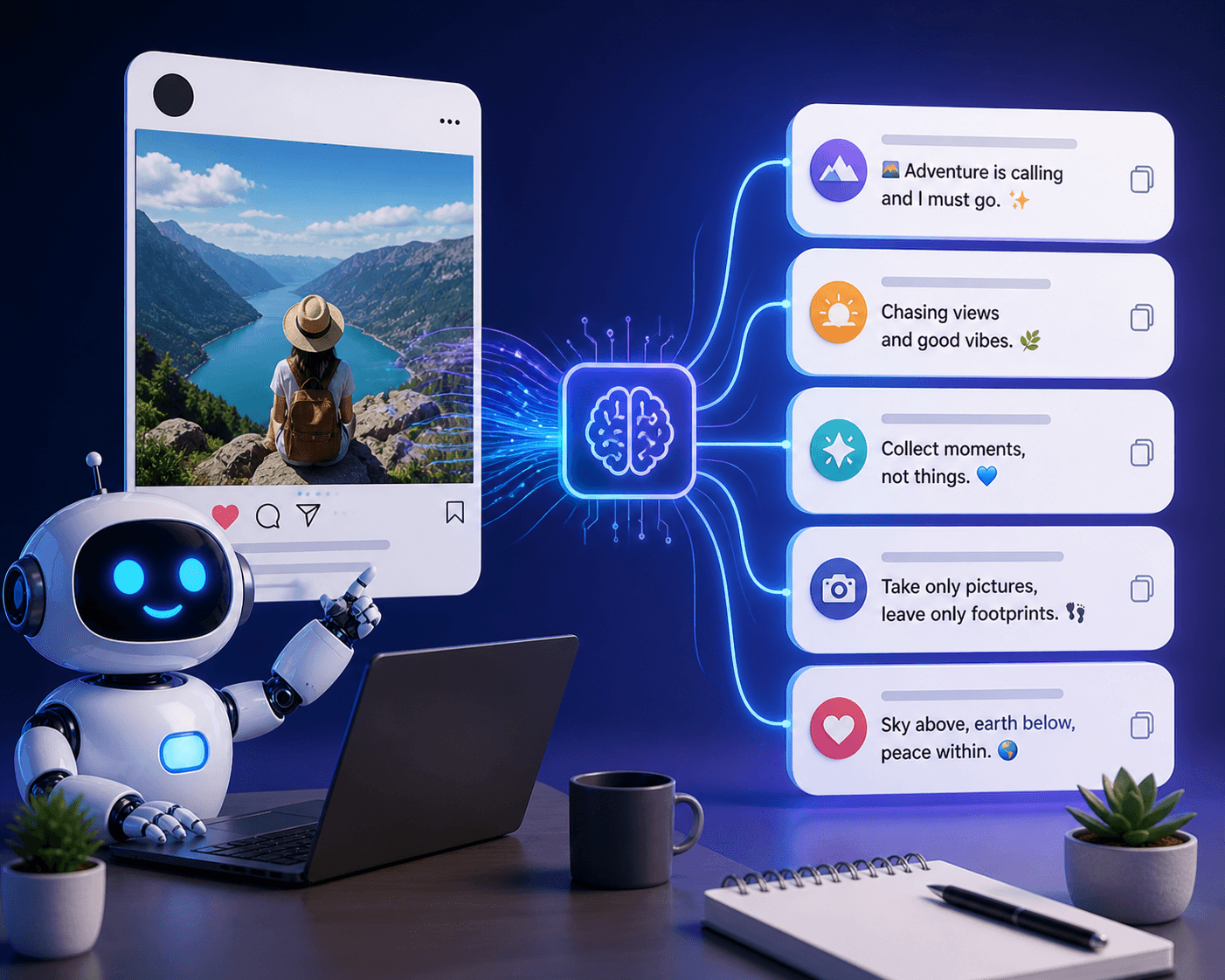
How AI Can Create Captions, Hashtags & Images in One Click
The real reason your content process feels broken
Most teams aren’t struggling with ideas anymore. They’re struggling with execution.
You know what to post. You know your audience. You even have a rough plan sitting somewhere in a Notion doc or spreadsheet. But when it comes to actually turning that into a caption, pairing it with the right hashtags, designing a visual, and getting it ready to publish it becomes a slow, fragmented process.
And that’s where things start falling apart.
Because content doesn’t fail at the strategy level. It fails in the gap between planning and publishing.
Why this matters more in 2026 than ever
The rules of social media have changed quietly but significantly.
In 2026, consistency is no longer a competitive advantage. It’s the baseline. Every serious brand is posting regularly. Every creator is experimenting with formats. Every agency is managing multiple clients at once.
What actually separates high-performing brands now is speed and cohesion.
Not just how often you post but how quickly you can go from idea to execution without losing quality. Not just what you say but how well your captions, hashtags, and visuals align as a single piece of communication.
This is exactly why more teams are rethinking their entire content calendar strategy. Because planning alone isn’t enough anymore. Execution needs to be just as structured.
The real problem: it’s not creativity, it’s fragmentation
Here’s the reality most teams don’t talk about.
Creating a single social media post often involves jumping between 4–6 different tools. You brainstorm in one place, write captions in another, generate hashtags using a separate tool, and design visuals somewhere else.
Sounds manageable but it rarely works like that.
Context gets lost. The tone of the caption doesn’t match the visual. Hashtags feel generic. And by the time everything is ready, you’ve spent more time coordinating than actually creating.
For agencies handling multi-brand content management, this gets even worse. Switching between brand voices, content styles, and campaign goals turns a simple workflow into operational chaos.
The issue isn’t lack of effort. It’s the lack of a unified system.
What “one-click content creation” actually means (and what it doesn’t)
There’s a misconception that AI-generated content is about replacing creativity with automation.
That’s not what high-performing teams are doing.
The real shift is this: AI is being used to compress the execution layer without compromising the thinking behind it.
When we talk about AI generating captions, hashtags, and images in one click, we’re not talking about random outputs. We’re talking about context-aware generation—where everything is built around a single idea, audience, and intent.
The caption isn’t just written. It’s aligned with your brand voice.
The hashtags aren’t just suggested. They’re relevant to the content’s reach potential.
The visual isn’t just designed. It complements the message, not distracts from it.
This is where most social media automation tools still fall short. They automate pieces of the workflow—but not the connection between them.
From scattered tasks to a connected system
To understand the real value of AI in content creation, you need to look at it as a system, not a feature.
Imagine starting with a single content idea let’s say a post about a product launch or a trending insight in your industry.
Instead of manually expanding that idea into multiple elements, AI can now interpret that context and generate:
A caption that fits the platform and audience
Hashtags that improve discoverability
A visual concept or design that reinforces the message
But more importantly, it does this in a connected way.
The tone of the caption influences the visual style. The hashtags reflect the positioning of the content. Everything works together.
This is the difference between creating content and producing content at scale.
How this changes your actual workflow
Here’s where things get practical.
Most teams currently approach content creation in stages: plan first, then create, then optimize. Each step feels separate, and delays in one stage affect the entire pipeline.
With AI-driven workflows, those boundaries start to collapse.
You begin with a structured input your idea, your audience, your objective. From there, AI generates a complete first draft of your content package.
Now instead of building from scratch, your team shifts into refinement mode.
You tweak the caption to better match your voice. You adjust the visual if needed. You fine-tune the hashtags based on campaign goals.
This small shift from creation to refinement has a massive impact on speed and consistency.
It also changes how you approach how to plan social media content. Planning becomes more about direction and intent, less about micromanaging every piece of output.
The shift from manual chaos to structured execution
This is exactly where platforms like Sociali.ai come into the picture not as another tool, but as a workflow layer.
Before, your process probably looked like this:
Ideas scattered across documents. Content creation split across tools. Endless back-and-forth to finalize a single post. And constant pressure to keep up with posting schedules.
After introducing a unified system, the experience changes entirely.
You input your idea once. The platform generates captions, hashtags, and visuals in a cohesive format. You review, refine, and schedule all within the same environment.
The biggest difference isn’t just speed. It’s clarity.
Your team knows what’s going out, when it’s going out, and why it matters.
What implementation actually looks like in real teams
Let’s ground this in reality.
A marketing team managing multiple campaigns doesn’t suddenly become fully automated overnight. What changes first is how they handle volume.
Instead of spending hours on each post, they start batching content creation. They feed multiple ideas into the system, generate drafts, and review them in one focused session.
Agencies handling multiple clients use AI to maintain consistency across brands without losing individuality. Each brand’s tone, audience, and goals are defined upfront, so outputs remain aligned.
Creators, on the other hand, benefit from removing decision fatigue. Instead of staring at a blank screen, they start with something tangible and that momentum keeps them consistent.
This is how AI moves from being a “nice-to-have” to an operational advantage.
The bigger takeaway most people miss
AI isn’t replacing content teams.
It’s removing the friction that slows them down.
The teams that win in 2026 aren’t the ones with the most ideas. They’re the ones who can execute those ideas quickly, consistently, and cohesively.
And that’s exactly what one-click content generation enables when it’s done right.
Not shortcuts. Not shortcuts disguised as strategy.
But a faster path from intent to execution.
FAQs
Is AI-generated content good enough for professional brands?
Yes but only when it’s used as a starting point, not a final output. The best teams use AI to generate drafts and then refine them based on brand voice and campaign goals. It’s about acceleration, not replacement.
Will AI make all content look the same?
It can, if used poorly. The key is providing clear inputs your audience, tone, and objectives. When those are defined, AI outputs become far more differentiated and brand-specific.
How does AI handle different platforms like Instagram, LinkedIn, and X?
Modern systems adapt content based on platform context. Caption length, tone, and structure can shift automatically, ensuring the content feels native rather than repurposed.
Can AI really generate effective hashtags?
Yes, especially when hashtags are generated based on content context rather than generic keyword lists. This improves discoverability while keeping relevance intact.
Is this suitable for agencies managing multiple clients?
It’s particularly useful for agencies. AI reduces the time spent on repetitive tasks while maintaining consistency across different brand accounts something that’s difficult to scale manually.
Final thought and what to do next
If your content process still feels slow, inconsistent, or overly manual, the problem isn’t your team.
It’s your workflow.
Because in today’s landscape, execution speed matters just as much as strategy. And trying to manage captions, hashtags, and visuals separately is only going to hold you back.
If you want to move faster without sacrificing quality, it’s worth experiencing what a unified system actually feels like.
That’s exactly what Sociali.ai is built for.
Not to replace your creativity but to help you execute it at the speed modern social media demands.
Free resource
Get the checklist


