How to Grow Instagram Engagement Organically in 2026
|
8
min read
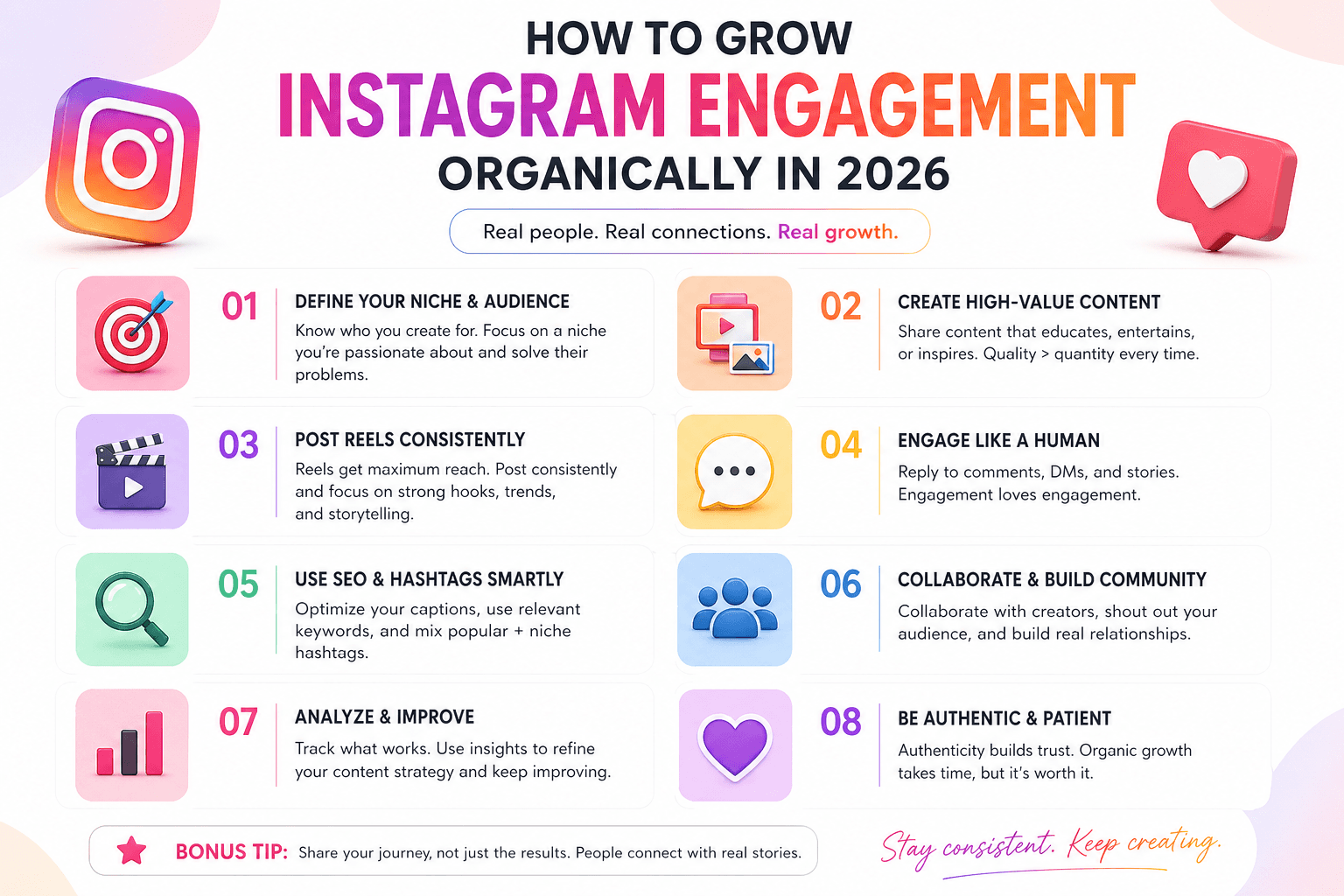
How to Grow Instagram Engagement Organically in 2026
The game hasn’t changed. The rules have.
Let’s be honest most brands aren’t struggling because they don’t post enough. They’re struggling because nothing they post moves the needle anymore.
You’re publishing consistently. You’re following trends. You’re even getting decent reach.
And yet… engagement feels unpredictable, shallow, and honestly, a bit disappointing.
Here’s the uncomfortable truth: organic growth on Instagram in 2026 isn’t about doing more it’s about doing the right things in a system that actually compounds.
And most teams don’t have that system.
Why This Matters More Than Ever in 2026
The Instagram algorithm didn’t suddenly become harder it became smarter. It no longer rewards isolated posts. It rewards behavior patterns.
That means your engagement isn’t judged post-by-post anymore. It’s judged across consistency, audience interaction loops, content depth, and timing patterns. In other words, your entire content ecosystem matters more than any single piece of content.
This shift has created a gap.
On one side, you have creators and brands who treat Instagram like a publishing platform. On the other, those who treat it like a feedback-driven system. The second group is winning not because they’re more creative, but because they’re more structured.
And if you're managing multiple clients, brands, or campaigns, this gap becomes even more painful. Because inconsistency at scale doesn’t just slow growth it kills it.
The Real Problem: It’s Not Engagement It’s Fragmentation
Most marketers think they have an engagement problem. They don’t. They have a workflow problem disguised as an engagement problem.
Content ideas live in one place. Captions are written last-minute. Posting times are guessed. Performance insights are barely used. And by the time something works, the team has already moved on to the next post.
Sounds familiar? That’s because this is how most social media teams operate reactively.
Here’s the reality: engagement is a by product of continuity. And continuity only happens when your content, timing, messaging, and feedback are all connected.
Without that, you’re just throwing content into the algorithm and hoping something sticks.
What Actually Drives Organic Engagement Now
In 2026, engagement doesn’t come from “good content.” It comes from aligned content systems.
The first shift is understanding that not all engagement is equal. Saves, shares, replies, and profile actions carry significantly more weight than likes. Which means your content must be designed for interaction depth, not surface-level appeal.
This is where most brands get it wrong.
They optimize for visibility instead of retention. They chase trends instead of building familiarity. And they post content that gets seen but not remembered.
What works now is layered content.
Content that starts conversations, continues narratives, and builds micro-context over time. A single post won’t do that. But a sequence will.
This is why your content calendar strategy matters more than ever. Not as a planning tool but as a behavior design system.
Because when your content builds on itself, engagement stops being random. It becomes predictable.
The Missing Piece: A Repeatable Engagement System
Let’s talk execution because this is where things usually fall apart.
You can understand everything about engagement and still fail if your workflow isn’t built to support consistency.
A working system in 2026 looks less like a calendar and more like a loop.
You start with audience signals what people are saving, replying to, or ignoring. That informs your next batch of content. That content is then structured across formats Reels, carousels, stories each playing a different role in the engagement journey.
Then comes distribution timing not just when your audience is active, but when they’re most likely to engage meaningfully. And finally, performance isn’t just tracked it’s fed back into the system.
This is where most teams hit a wall.
Because doing this manually especially across multiple brands isn’t just inefficient. It’s unsustainable.
That’s why modern teams rely on social media automation tools. Not to automate creativity, but to automate structure.
Where Most Teams Break (And How to Fix It)
Here’s the pattern: teams start strong with planning, lose momentum in execution, and completely drop the ball on optimization.
The issue isn’t effort. It’s fragmentation.
When your planning tool, publishing tool, and analytics tool don’t talk to each other, your workflow breaks. And when your workflow breaks, your engagement becomes inconsistent.
This is exactly where platforms like Sociali.ai change the equation.
Instead of managing content in pieces, you manage it as a system.
Before, your process looked like this: scattered ideas, rushed captions, inconsistent posting, and vague performance insights.
After, it becomes structured: planned content sequences, AI-assisted captions aligned with intent, optimized scheduling, and clear feedback loops that actually inform your next move.
It’s not about doing more. It’s about removing friction from doing the right things consistently.
Turning Strategy Into Daily Execution
Let’s make this practical.
Start by rethinking how you approach content planning. Instead of asking “What should we post today?”, shift to “What narrative are we building this week?”
This is where understanding how to plan social media content properly becomes critical. You’re not planning posts you’re planning progressions.
Each piece of content should have a role. Some posts attract attention. Others deepen interest. Some drive action. When these roles are defined, your engagement stops being accidental.
Next comes execution rhythm.
Batch your content, but don’t detach from performance. Review engagement signals every few days—not to react impulsively, but to adjust direction slightly. This keeps your content aligned without breaking consistency.
And if you’re managing multiple clients or brands, this becomes even more important. Because multi-brand content management isn’t just about organization it’s about maintaining quality at scale.
Without a system, scaling kills engagement. With the right workflow, scaling amplifies it.
The Shift That Changes Everything
At some point, every growing brand hits the same realization:
You can’t scale engagement with effort alone.
You need structure.
And more importantly, you need a system that doesn’t just help you post but helps you improve every time you post.
That’s the real difference between stagnant accounts and growing ones in 2026.
It’s not creativity. It’s continuity.
Conclusion
Organic Instagram growth isn’t dead. It’s just no longer forgiving.
You can’t rely on isolated wins or occasional viral posts. You need a system that compounds where every piece of content informs the next, and every insight is actually used.
The brands that win in 2026 aren’t posting more. They’re operating better.
And once you see that, you stop chasing engagement and start building it.
FAQs
Why is my Instagram engagement dropping even though I’m posting consistently?
Consistency alone isn’t enough anymore. If your content isn’t connected through a clear strategy or narrative, the algorithm sees it as isolated activity. Engagement drops when there’s no continuity or audience feedback loop.What type of content drives the most engagement in 2026?
Content that creates interaction depth like saves, shares, and replies performs best. Educational carousels, story-driven Reels, and opinion-based posts tend to generate stronger engagement signals than generic content.How often should I analyze performance?
You don’t need daily deep dives, but you should review engagement patterns every few days. The goal isn’t to react instantly, but to adjust direction without breaking consistency.Can small teams realistically build an engagement system?
Yes—but only if they simplify their workflow. Without structured tools, it becomes overwhelming quickly. That’s why systems and platforms matter more than team size.Is automation hurting organic reach?
Bad automation does. Smart automation doesn’t. Tools that help with planning, scheduling, and insights without compromising content quality actually improve consistency and engagement.
Ready to Turn Engagement Into a System?
If your current workflow feels scattered, you’re not alone. Most teams don’t fail because they lack ideas—they fail because they lack structure.
That’s exactly what Sociali.ai is built to solve.
From planning content sequences to optimizing publishing and learning from performance, it helps you move from reactive posting to structured growth.
Because in 2026, engagement isn’t something you chase.
It’s something you build systematically.
Free resource
Get the checklist


