How to Schedule Instagram
|
8
min read
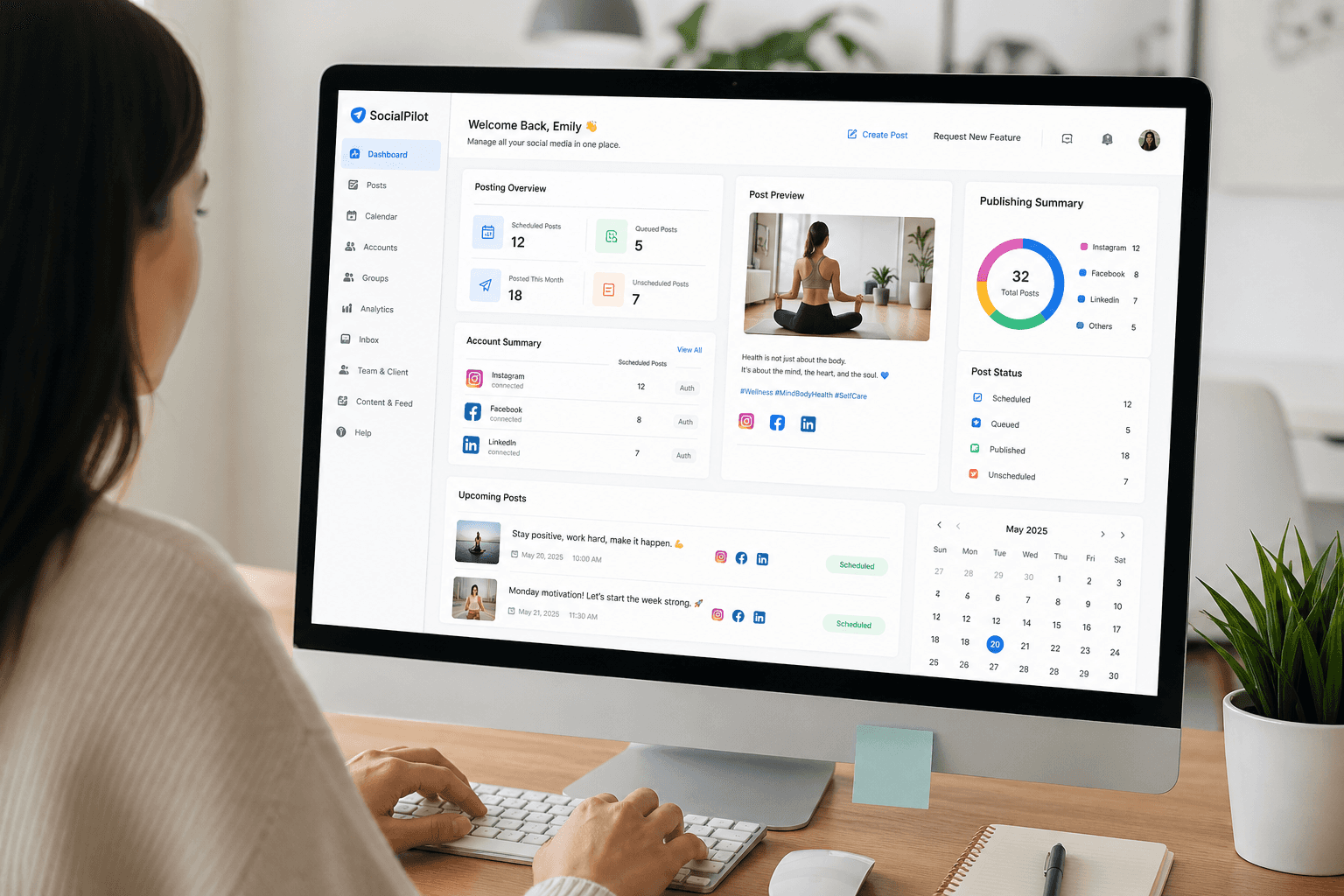
How to Schedule Instagram, Facebook & LinkedIn Posts from One Dashboard
Introduction
Let’s be honest—managing social media across platforms sounds simple on paper.
Post on Instagram. Share on Facebook. Repurpose for LinkedIn. Done.
But that’s not how it plays out in reality.
What actually happens is a messy loop of switching tabs, rewriting captions, resizing creatives, missing posting times, and constantly asking yourself: “Did we already publish this?” Somewhere between intent and execution, consistency breaks—and that’s where most brands lose momentum.
The problem isn’t effort. It’s the lack of a system.
Why This Matters in 2026
The way social media works in 2026 is fundamentally different from even a couple of years ago. Platforms are more algorithm-driven, audiences are more selective, and consistency isn’t optional anymore—it’s the baseline.
You’re not just competing with brands anymore. You’re competing with creators, niche experts, and AI-assisted content engines that publish daily without friction.
This shift has made one thing very clear:
If your posting process isn’t streamlined, you’re already behind.
Marketers today aren’t asking, “What should we post?”
They’re asking, “How do we execute at scale without burning out?”
That’s where having a unified system—and more importantly, a single dashboard—becomes critical.
The Real Problem
Most teams don’t struggle because they lack ideas. They struggle because execution is fragmented.
You might plan content in one place, design in another, write captions somewhere else, and then manually publish across three different platforms. Each step introduces friction. Each platform adds complexity. And every small delay compounds over time.
Here’s the reality:
Manual posting doesn’t fail because it’s hard. It fails because it’s inconsistent.
One missed day turns into a missed week. One delayed campaign disrupts your entire calendar. And suddenly, your “strategy” becomes reactive instead of intentional.
Even worse, when you’re managing multiple brands or clients, this chaos multiplies. You’re not just scheduling posts—you’re juggling timelines, approvals, and platform-specific nuances without a central system holding it together.
That’s the real bottleneck.
What It Actually Means to Schedule from One Dashboard
Scheduling posts from one dashboard isn’t just about convenience. It’s about control.
When done right, it changes how you think about content entirely.
Instead of treating Instagram, Facebook, and LinkedIn as separate tasks, you start treating them as part of a unified content flow. The idea isn’t to copy-paste the same post everywhere—it’s to adapt a core idea across platforms while managing everything from one place.
For example, a single campaign can be structured with platform-specific variations—short-form visual for Instagram, community-focused copy for Facebook, and insight-driven messaging for LinkedIn. The execution differs, but the planning stays centralized.
This is where a strong content calendar strategy becomes the backbone of your workflow. You’re no longer posting randomly—you’re orchestrating content across platforms with intent.
And when that orchestration happens inside one dashboard, something important happens:
You stop thinking in terms of posts, and start thinking in terms of systems.
Building a Real Workflow (Not Just Scheduling Posts)
Most scheduling advice stops at “use a tool and plan ahead.” That’s surface-level.
A real workflow goes deeper.
It starts with how you plan your content. Instead of deciding what to post daily, you define themes, campaigns, and content buckets in advance. This aligns your messaging across platforms without forcing duplication.
From there, creation becomes structured. Designers and copywriters aren’t working in isolation—they’re contributing to a shared pipeline. Everyone knows what’s coming next, what’s pending, and what’s already scheduled.
Scheduling then becomes the final layer—not the main task. You’re not scrambling to fill gaps; you’re executing a plan.
This is also where how to plan social media content becomes a strategic advantage rather than a recurring headache. When planning and scheduling live in the same ecosystem, execution becomes faster and far more predictable.
And for agencies or growing teams, this structure is non-negotiable. Without it, scaling content simply means scaling chaos.
The Shift: From Manual Chaos to Structured Systems
This is exactly where most teams hit a wall—and where the right system changes everything.
Before adopting a centralized approach, the workflow usually looks like this:
Multiple tools, scattered approvals, manual posting, and constant back-and-forth. Every platform feels like a separate job.
After the shift, everything starts to align.
With a platform like Sociali.ai, the focus moves from managing posts to managing workflows. Content is planned, created, scheduled, and tracked from a single dashboard—without switching contexts.
The difference isn’t just efficiency. It’s clarity.
You can see what’s going live, where it’s going live, and how it fits into your broader strategy. You’re not reacting anymore—you’re executing with intent.
And when you’re handling multi-brand content management, this kind of visibility isn’t just helpful—it’s essential.
How to Actually Implement This (Without Overcomplicating It)
Implementation is where most good ideas fall apart. Not because they’re wrong—but because they’re overcomplicated.
The key is to simplify.
Start by consolidating your planning and scheduling into one system. Don’t try to fix everything at once. Focus on visibility first—knowing what’s going out, when, and where.
Next, align your content around campaigns instead of individual posts. This makes cross-platform scheduling more natural because everything ties back to a central idea.
Then, build a repeatable structure. Weekly planning, batch creation, scheduled publishing. The goal isn’t perfection—it’s consistency.
Finally, use tools that reduce friction instead of adding to it. The best social media automation tools aren’t the ones with the most features—they’re the ones that fit seamlessly into your workflow.
That’s what allows you to scale without constantly rethinking your process.
Conclusion
Scheduling posts across Instagram, Facebook, and LinkedIn isn’t the real challenge.
Doing it consistently, strategically, and at scale—that’s where things break.
The difference comes down to systems.
If your workflow is fragmented, no amount of effort will fix it. But if your workflow is structured—even a small team can execute like a large one.
Here’s the reality most people don’t talk about:
Growth on social media isn’t just about better content. It’s about better execution.
And execution starts with how you manage your process.
FAQs
How is scheduling from one dashboard different from using multiple tools?
Using multiple tools creates fragmentation. A single dashboard centralizes planning, creation, and publishing, reducing errors and improving consistency across platforms.
Can I post the same content on Instagram, Facebook, and LinkedIn?
You can, but you shouldn’t do it blindly. Each platform requires slight adaptation in tone, format, and messaging to perform effectively.
Is scheduling enough to grow on social media?
No. Scheduling is just execution. Growth comes from combining consistent posting with a clear strategy and audience understanding.
How far in advance should I schedule posts?
Most effective teams work 1–2 weeks ahead. This gives enough flexibility while maintaining consistency.
What’s the biggest mistake teams make with scheduling?
Treating scheduling as a task instead of a system. Without a structured workflow, scheduling becomes reactive and inconsistent.
CTA
Instead of managing posts across multiple platforms manually, start thinking in terms of unified execution. That’s where real consistency—and real growth—comes from.
If you’re ready to move from chaos to clarity, it might be time to see how a single dashboard can transform the way you plan, create, and schedule content with Sociali.ai.
Free resource
Get the checklist


