Social Media for Medical Practices: 2026 Guide
|
8
min read

social media for medical practices
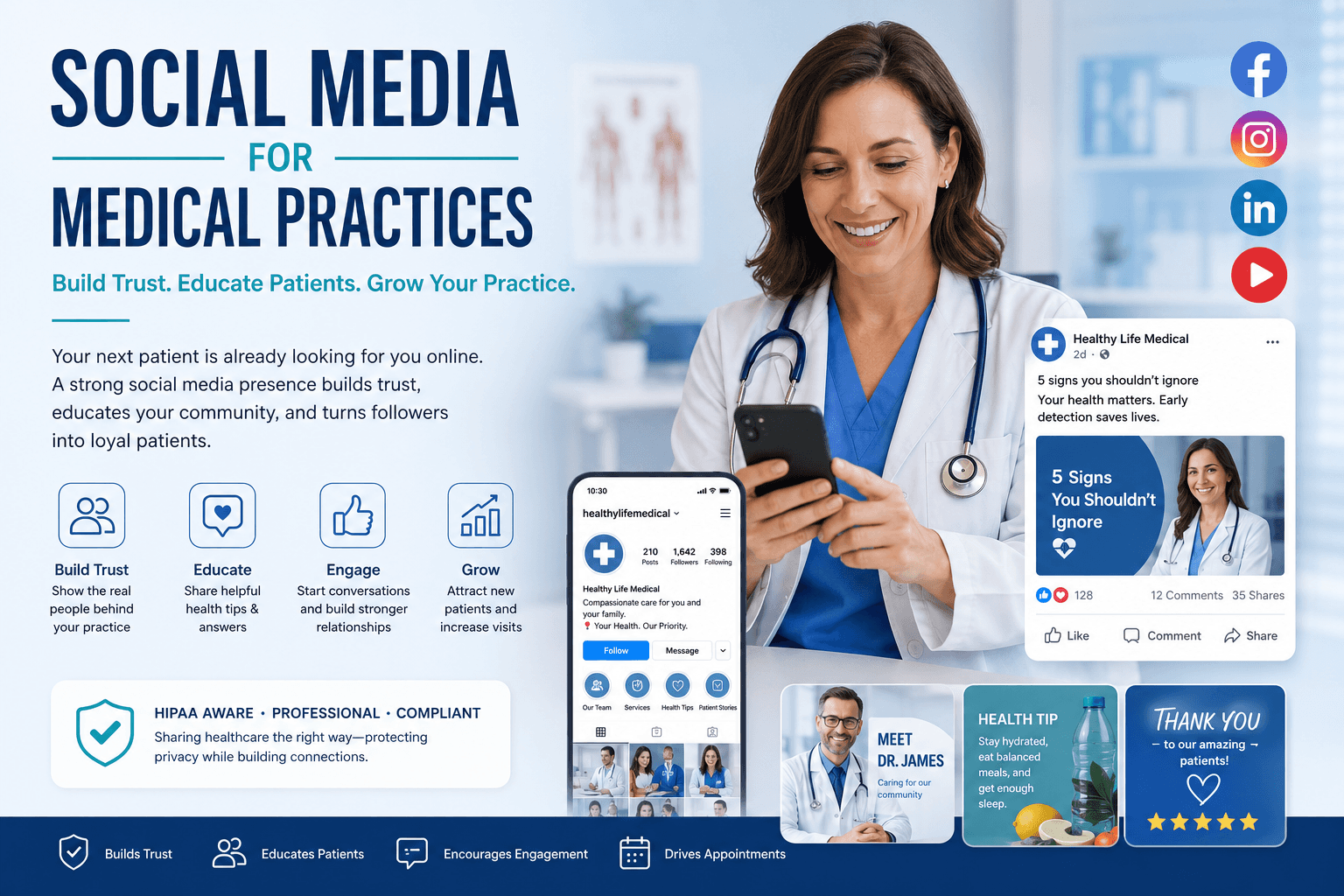
A patient searches your clinic on Google. They find your website, a few directory listings, and maybe a stale Facebook page from 2022. Then they check a competitor. That competitor has recent posts explaining common symptoms, a short video introducing the provider, and real patient reviews with thoughtful responses. Who do you think gets the call?
Social media is no longer optional for medical practices. It is one of the first places prospective patients look to decide if they can trust you. But it has to be done right. You cannot post the same way a coffee shop does. The stakes are higher. The regulations are real. And the payoff, when done well, is a steady stream of patients who already feel connected to your practice before they ever book an appointment.
This guide walks you through exactly how to build a social media presence that works for a medical practice in 2026. No fluff. No outdated tactics. Just the real steps that bring in patients and build lasting trust.
Key Takeaways
Social media for medical practices works best when it educates, not just entertains.
A clear strategy prevents wasted time and compliance risks.
Short educational video and patient-focused content perform better than stock imagery and canned health tips.
HIPAA considerations shape every decision, but they do not have to stop you from posting.
Consistent, platform-specific content builds local visibility faster than sporadic, generic posting.
You can manage social media without a full marketing team by using tools designed for healthcare.
Physicians and practice managers who actively respond to reviews and comments see higher patient retention.
What Social Media for Medical Practices Actually Means
Social media for medical practices is the strategic use of platforms like Instagram, Facebook, TikTok, LinkedIn, and YouTube to connect with current and potential patients. It goes beyond just having a page. It involves sharing health information that is accurate, useful, and specific to the people you treat. For a primary care clinic, that might mean explaining when to come in for a physical. For a dermatology practice, it might mean showing how to perform a skin self-check.
The goal is not to go viral. The goal is to become the practice people think of first when they need care. This happens through repeated, helpful interactions that build recognition and trust over time.
Why Social Media Matters More Than Ever for Modern Medical Practices
Patients today behave differently than they did ten years ago. They research symptoms online. They read reviews. They scroll through a doctor's Instagram before calling to schedule. Social media marketing for medical practices fills the gap between your website and that moment of decision.
A solid presence does a few things at once. It shows that your practice is active and engaged. It educates patients so they arrive better prepared. It humanizes your providers, which reduces anxiety. And it gives you a place to manage your reputation publicly.
When a practice ignores social media, it leaves that entire conversation to competitors or to third-party rating sites. When you participate, you get to shape the narrative.
Benefits of Medical Practice Social Media Marketing
The benefits are practical, not theoretical. New patient acquisition is the most obvious one. People searching for a local provider often click on social profiles before websites. If your last post is from nine months ago, they may assume you are not taking new patients or that the practice is not thriving.
Retention is another big one. Existing patients who follow you stay more loyal. They see your face, your advice, your reminders. They feel like they know you. That connection reduces no-shows and keeps your practice top-of-mind when a family member needs care.
There is also the recruitment angle. When you post about your team culture, you attract better job candidates. Clinicians want to work at places that feel current and professional.
Finally, social media gives you a chance to correct misinformation. If a wellness influencer spreads bad advice, your post offering evidence-based clarity becomes a public service and a trust builder.
Choosing the Right Platforms for Your Practice
Not every platform fits every practice. The right ones depend on your specialty, your audience, and how much time you can realistically commit.
Facebook remains strong for reaching adults 40 and older. It works well for primary care, family medicine, cardiology, and orthopedics. Local community groups make Facebook especially valuable for neighborhood clinics.
Instagram is ideal for visual specialties. Dermatology, plastic surgery, dentistry, and aesthetics thrive here. The platform favors short reels, before-and-after photos (within ethical guidelines), and provider spotlights.
TikTok reaches a younger, broader audience. Pediatric practices, behavioral health, and sports medicine clinics can use it to share quick tips that parents and younger adults actually watch. The tone is more casual, but the information still has to be precise.
LinkedIn is for professional networking and recruitment. Multi-location groups, hospital systems, and specialty practices can use it to share clinical expertise, hire staff, and build referral relationships.
YouTube is a search engine on its own. Long-form educational content like procedure explainers, provider interviews, and condition overviews can bring in traffic for years. It is underused by private practices but worth the effort if you can produce consistent video.
How to Build a Realistic Medical Practice Social Media Strategy
A strategy stops you from posting randomly and hoping for the best. Start by defining what you want. New patient bookings? Better reputation? More flu shot appointments? Goals shape everything else.
Pick your primary platforms. It is better to dominate two than to be mediocre on five. For most private practices, Facebook and Instagram are the practical starting points.
Decide who will do the work. A busy office manager cannot also be a full-time content creator. The most sustainable setups include a designated internal owner who works with a scheduling tool or a healthcare focused social media management platform. The key is making content creation easy enough to happen every week.
Create a content calendar that maps out themes. Mondays might be provider introductions. Wednesdays a quick health tip. Fridays a patient FAQ. This removes the daily question of what to post. If you need a deeper framework, a healthcare social media strategy guide can walk you through every layer of planning for patient engagement in 2026.
Choosing the Right Content Mix for a Medical Practice
Think of your content in three buckets: educational, humanizing, and action-oriented.
Educational content answers real patient questions. A pediatrician might post, "What does an RSV cough sound like?" A dental practice might explain "Why you still need cleanings even if you brush perfectly." This type of content performs well because it matches what people search for.
Humanizing content introduces your team. A 20-second video of a nurse practitioner explaining why she loves family medicine can calm new patient anxiety more than any credentials list. Practices with strong patient engagement on social media often lead with people first.
Action-oriented content drives behavior. Flu shot reminders, sports physical deadlines, or "schedule your annual skin check before summer" posts all fit here. These work best when they include a simple next step like a link to online booking.
Healthcare social media management at scale requires this mix to stay balanced. Too much education feels cold. Too much culture feels off-brand for a clinic. The blend builds trust.
HIPAA and Compliance Without Paralysis
Compliance is the number one fear that keeps practices from posting. It does not have to. The basic rule: never share identifiable patient information without written authorization. That includes photos, names, detailed case descriptions, or even metadata that can identify someone.
A dermatology practice can post a close-up of a mole removal site with the patient's permission, documented properly. They cannot screenshot a patient review that mentions a specific condition and repost it.
Simple safeguards work. Store signed consent forms in a central place. Train staff to never reply to a patient comment with clinical advice. Use a tool that allows approval workflows before anything goes live. The compliance burden shrinks when you have the right process. For practices managing multiple locations, a purpose-built platform for healthcare organizations can enforce these rules at scale without slowing down posting.
Building Trust Through Educational Content
Trust is the currency of healthcare marketing. A practice that consistently posts clear, helpful information earns a reputation as a reliable source. This matters when someone is anxious and searching for answers.
Educational posts should be specific. Instead of "Tips for managing diabetes," try "Three breakfast swaps that help keep blood sugar steady, explained by our dietitian." Specificity signals expertise. It also matches how people search by voice and in AI-powered search results.
Short-form video is especially effective. A 60-second reel showing an orthopedic surgeon explaining when knee pain actually needs imaging can outperform a 1,500-word blog post in terms of reach. When you pair that video with a longer article on your site, you capture both the scrollers and the deep researchers. This dual approach is exactly what advanced healthcare content marketing strategies cover in detail.
Managing Online Reviews and Patient Communication
Your social media pages are review platforms, not just content feeds. A 2026 patient is highly likely to leave a Facebook recommendation or comment on your Instagram before going to Google. Ignoring those is like ignoring a phone call from a patient.
Respond to every review, positive or negative, in a way that respects privacy. For a positive review: "Thank you for trusting us with your care. Our team appreciates the kind words." For a negative one: "We take your experience seriously. Please contact our office directly so we can learn more and address your concerns."
Never discuss details publicly. The goal is to show you listen, not to defend yourself in a comment thread. Future patients read these responses. They want to see a practice that handles feedback with grace.
Comments with health questions also need careful handling. A safe reply: "Thank you for asking. For specific medical questions, please call our office or book a visit so we can give you the best guidance." This protects the patient, the practice, and the integrity of the platform.
Content Planning, Scheduling, and Automation
Consistency matters more than perfection. A practice that posts twice a week every week wins over one that posts ten times in January and then disappears until April.
Batch creation is the most practical method for busy clinics. Set aside two hours once a month to record several videos, write captions, and gather photos. Then schedule everything through a social media management tool. The right platform will let you tailor posts for each network, add first comments, and preview the grid, all while keeping your content library organized.
For larger groups, automation becomes essential. Multi-location medical groups, behavioral health centers, and dental support organizations often struggle to maintain unique local pages while keeping brand consistency. A solution built for healthcare allows you to manage 10 or more locations without needing an agency. The technology handles localization, compliance checks, and even smart scheduling so each clinic sounds local without duplicating work. Dental DSOs and clinics, for example, benefit from a dedicated playbook that addresses their unique volume and compliance needs.
Performance Tracking That Actually Matters
Forget chasing likes. Track metrics tied to patient decisions. The most important ones are:
Profile visits to your website link
Appointment form submissions from social traffic
Messages received and response time
Comments that ask scheduling questions
Reach within a 10-mile radius of your clinic
Saves and shares of educational content
These signal real intent. If a post about seasonal allergies gets 5,000 views but zero website clicks, it entertained. If a post about sports physicals gets 1,000 views and 30 appointment requests, it succeeded. Adjust your content mix accordingly.
Check platform analytics monthly, not daily. Social media for medical practices is a long game. Trends emerge over weeks, not hours.
Common Mistakes Medical Practices Should Avoid
Posting without a content calendar is the most frequent error. It leads to bursts of activity followed by silence, which confuses the algorithm and erodes trust.
Another mistake is trying to be on every platform. A solo family medicine doctor does not need TikTok, LinkedIn, YouTube, and Instagram. Pick two, do them well, and expand only when the process is smooth.
Many practices treat social media like a billboard. They post only when there is something to promote: an event, a new service, a hiring push. Patients tune that out. Give value 80% of the time, ask for action 20%.
Compliance paralysis is a quiet killer. Practices that post nothing because they are afraid of HIPAA miss the opportunity entirely. The risks are manageable with education and the right guardrails.
Ignoring the local angle also hurts. A physical therapy clinic in Austin competes against other Austin PT clinics, not national chains. Use local landmarks, local events, and local language. That is what makes you discoverable in "near me" searches.
Future Trends in Healthcare Social Media
Search is changing. More patients ask ChatGPT or Perplexity, "What is the best pediatrician near me that takes my insurance?" Your social content is fuel for those answers. Practices that regularly post accurate, detailed information get surfaced more often in AI-generated responses. Voice search pulls from the same sources. A clear, conversational post answering "When does my child need stitches?" can become the snippet a smart speaker reads aloud.
Short-form video will continue dominating, but the bar is rising. Patients expect content that looks native to the platform, not a repurposed TV commercial. Authentic, unscripted explanations from a real provider in scrubs will outperform polished corporate videos.
Private communities are growing too. Some practices now run condition-specific Facebook groups or membership-based Instagram broadcast channels. These allow deeper patient education and create a sense of belonging without violating privacy.
Social media platforms are also becoming healthcare destinations in themselves. Appointment booking integrations, click-to-call buttons, and direct messaging for scheduling are getting smoother. In 2026, a patient might find you on Instagram and book a visit without ever leaving the app. Practices that set up those pathways now will win more of those conversions.
Frequently Asked Questions
How can medical practices use social media without violating HIPAA?
Never post patient photos or identifiable details without signed consent. Avoid discussing specific cases publicly. Use secure messaging for any private communication. Train all staff on clear social media policies and ensure an approval process exists before any post goes live.
Which social media platform works best for medical practices?
Facebook and Instagram are the most effective for most private practices. Facebook reaches older adults and supports local recommendations. Instagram suits visual specialties and younger demographics. Choose based on where your actual patients spend time, not trends.
How often should a medical practice post on social media?
Two to three times per week is a sustainable target. Consistency beats volume. A regular Wednesday and Friday post schedule builds audience expectation and keeps your practice visible without overwhelming your team.
What type of content gets the most engagement for healthcare providers?
Short educational videos, provider introductions, and patient FAQs typically perform best. Content that answers a specific question or solves a common worry gets more saves and shares than generic health advice or stock photos.
Can social media really bring in new patients?
Yes. Many patients research providers on social media before booking. An active, informative presence builds familiarity and trust. Including clear calls to action like "Book online" or "Call today" turns that trust into appointments.
How do I respond to negative reviews on social media?
Acknowledge the feedback, apologize for their experience, and invite them to contact your office privately. Never discuss medical details or become defensive. A compassionate, professional reply shows other readers that you take concerns seriously.
Do I need a professional to manage our social media?
Not necessarily. A trained staff member with a good scheduling tool can manage it effectively. As your practice grows, a healthcare-specific social media management platform saves time and ensures compliance, especially for multi-location groups.
What is the biggest mistake medical practices make on social media?
Posting inconsistently and treating social media like a promotional megaphone rather than an educational resource. Practices that focus on helping patients rather than selling services build stronger, longer-lasting relationships.
Every week your practice waits is a week your competitors are building familiarity with your community. You do not need a giant budget or a dedicated marketing hire. You need a clear plan and a tool that makes consistent, compliant posting practical.
If you are ready to turn social media into a reliable patient growth channel without sacrificing your team's time, see how Sociali.ai helps healthcare practices streamline everything from content scheduling to compliance. Visit the healthcare solution to get started.
Free resource
Get the checklist


