Sociali.ai vs Hootsuite vs Buffer: Best Healthcare Tool 2026
|
8
min read

Sociali.ai vs Hootsuite vs Buffer: Best Social Media Tool for Multi Location Healthcare Organizations in 2026

Managing social media for a single clinic is already a full-time job. Now multiply that by ten locations, add a compliance team that needs to approve every post, layer in Google Business Profile updates for each site, and throw in a constant stream of patient reviews that need timely responses. That is the reality for most healthcare marketing directors today.
The platform you choose to manage all of that matters more than most people realize. Pick the wrong one and you spend half your week doing manual workarounds. Pick the right one and your team actually has time to think strategically instead of just keeping the lights on.
This comparison looks at three platforms that frequently come up for healthcare organizations: Sociali.ai, Hootsuite, and Buffer. All three have their strengths, but they were not all built with the same use case in mind.
What Multi Location Healthcare Organizations Actually Need From a Social Media Platform
Before getting into the platforms themselves, it helps to define what working well actually looks like for a healthcare organization with multiple locations.
Multi location account management is the starting point. You need to be able to manage every location from a single dashboard without logging in and out of separate accounts. For a DSO with forty dental offices or a behavioral health network with clinics across three states, this is non-negotiable.
Role-based permissions matter enormously in healthcare settings. Your location-level marketing coordinator should be able to draft content and submit it for review. They should not be able to publish directly to the main hospital account without approval. The platform needs to enforce those boundaries cleanly.
Approval workflows go hand in hand with permissions. Regulated industries like healthcare cannot afford a situation where a well-meaning staff member publishes something that violates HIPAA guidelines or makes an unapproved clinical claim. Workflow tools that route content to the right reviewer before anything goes live are essential.
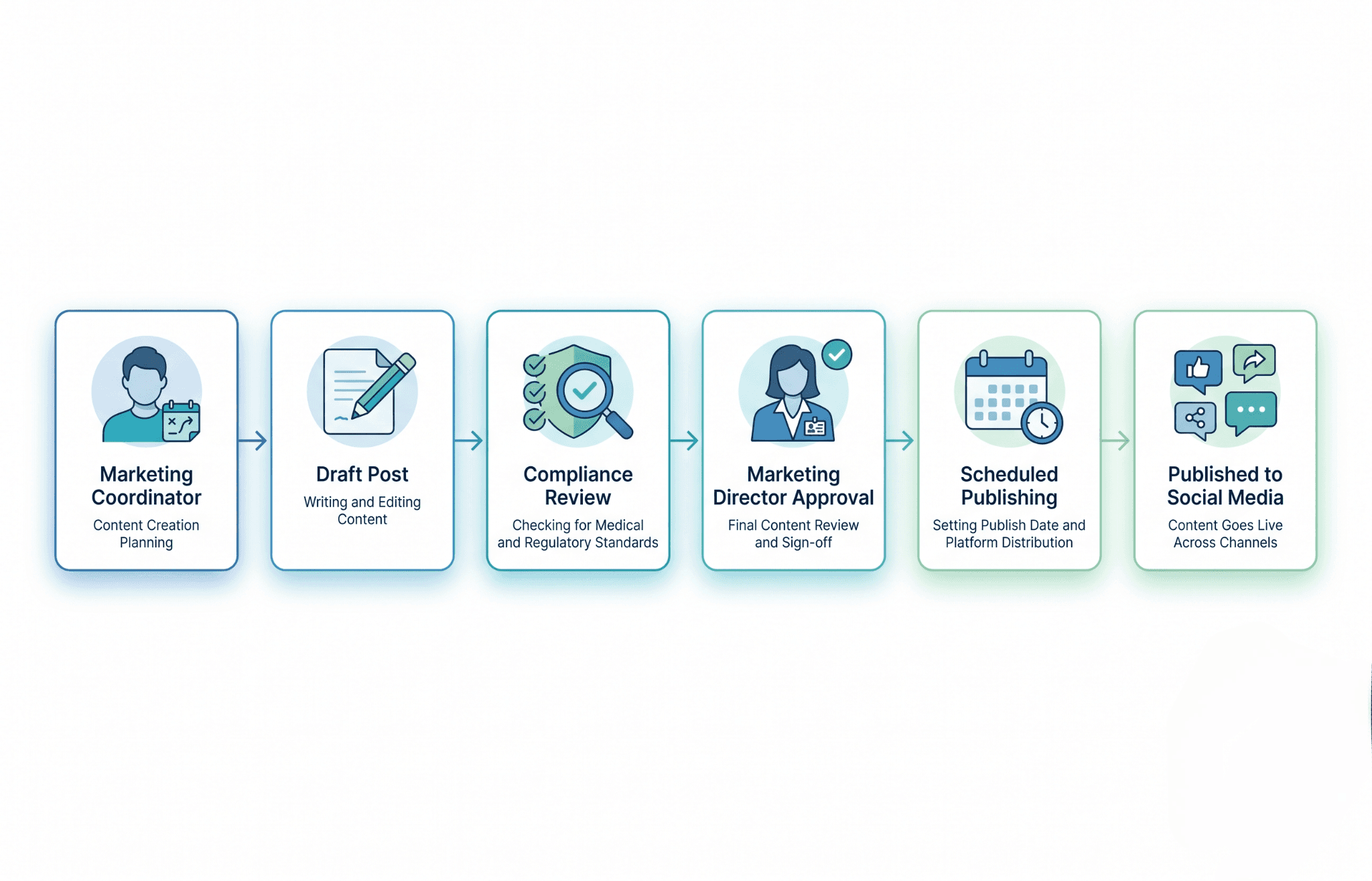
Content standardization with location-specific customization is the balancing act every multi-location organization struggles with. Brand voice, visual standards, and messaging pillars need to stay consistent. But the post from your Scottsdale location should feel relevant to that community, not like a copy-paste from your Phoenix flagship.
Review management is one of the most underrated features healthcare organizations look for. Patient reviews on Google, Healthgrades, and Facebook directly affect new patient acquisition. Being able to monitor and respond to reviews across every location from one place saves hours every week.
Google Business Profile management deserves its own mention. For most healthcare providers, GBP is the first thing a prospective patient sees. Updating hours, posting health tips, responding to Q&A, and keeping photos current across dozens of profiles is a massive operational burden without the right tools.
Analytics that actually reflect multi-location performance rounds out the core list. Aggregate numbers are useful for executive reporting. Location-specific breakdowns are useful for figuring out which clinics need more attention.
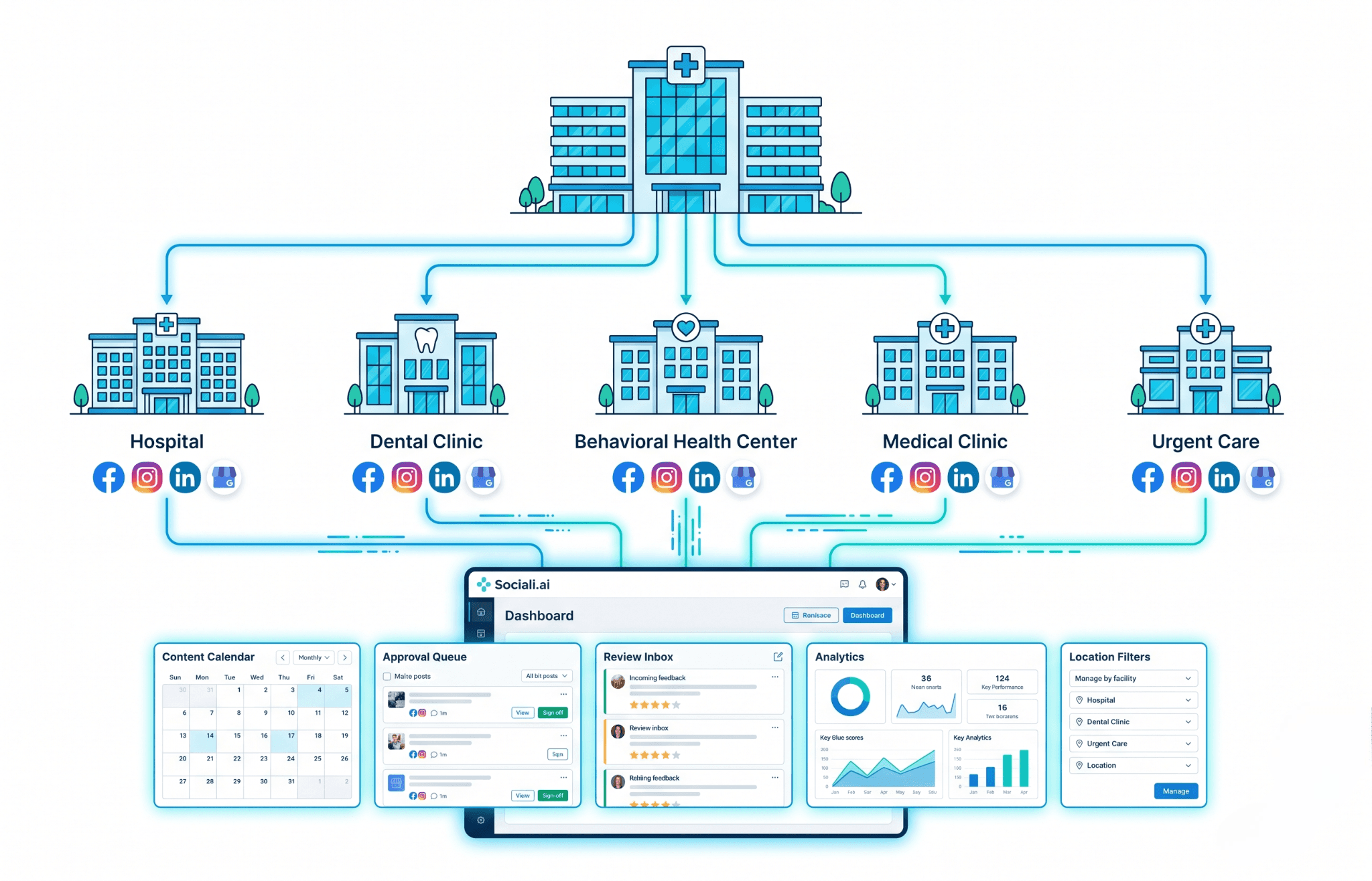
Sociali.ai: Built Specifically for Healthcare Marketing Teams
Sociali.ai is a healthcare focused social media management platform designed specifically for hospitals, healthcare clinics, behavioral health organizations, and dental DSOs, which changes the entire product experience compared to general purpose tools.
The multi-location infrastructure is built into the core of the platform, not bolted on. You can manage dozens of clinic profiles, hospital departments, or branded service lines from a single dashboard. Permissions and approval workflows are configurable at the location level, so a regional marketing manager can oversee five markets without having full access to everything.
AI-assisted content creation within Sociali.ai is calibrated for healthcare tone. Generating compliant, on-brand social posts for a behavioral health organization requires a different approach than writing captions for a retail brand. The content tools reflect that.
Google Business Profile management is integrated directly. You can schedule GBP posts, update location hours, manage photos, and monitor profile performance for each location without leaving the platform. For a healthcare organization managing GBP profiles at scale, this alone can be a strong advantage over a general social media management tool.
Hootsuite: Powerful, But Designed for a Different Audience
Hootsuite is one of the most established social media management platforms on the market. It has a large feature set, solid integrations, and a well-developed partner ecosystem. For enterprise brands with large social media teams, it works well.
The challenge for healthcare organizations is that Hootsuite was designed for a broad commercial audience, and that shows up in how it handles healthcare-specific workflows. Approval chains exist, but they require significant configuration to map to the way healthcare marketing teams actually operate. Getting the permissions structure right for a hospital system with multiple departments, regional teams, and a central compliance reviewer takes real setup time.
Review management across platforms like Healthgrades or Zocdoc is not native to Hootsuite. You would need third-party integrations to fill those gaps, which adds cost and complexity.
Google Business Profile integration exists but is limited compared to platforms that treat GBP as a first-class feature.
Buffer: Great for Small Teams, Limited for Large Healthcare Organizations
Buffer built its reputation on simplicity. The clean interface and straightforward scheduling workflow made it a favorite for small businesses and individual content creators. That simplicity is genuinely valuable.
For a single-location medical practice or a small group practice with two or three providers, Buffer handles the basics well. Scheduling posts across Facebook, Instagram, and LinkedIn is easy, and the analytics give a clear picture of what content is resonating.
The scalability gap becomes obvious quickly, though. Buffer was not built to manage thirty clinic profiles with separate branding guidelines, regional approval chains, and integrated review management. The platform’s architecture reflects its original audience.
Review management is not part of Buffer’s core offering. Google Business Profile integration exists in some plans but is not as deep as healthcare organizations need for true multi-location GBP management.
Buffer is a reasonable starting point for healthcare organizations that are just building a social media presence at one or two locations. It becomes a bottleneck the moment the organization tries to grow.
Feature Comparison
Feature | Sociali.ai | Hootsuite | Buffer |
|---|---|---|---|
Multi-location management | Built-in, purpose-built | Available, requires setup | Limited |
Healthcare-focused features | Yes | No | No |
Review management | Native, multi-platform | Third-party integrations | Not included |
Google Business Profile support | Deep integration | Limited | Basic |
Approval workflows | Configurable per location | Available, complex setup | Basic |
AI content creation | Healthcare-calibrated | General purpose | Basic |
Analytics | Multi-location reporting | Strong but general | Basic to mid-tier |
Team collaboration | Role-based, per location | Available | Limited |
Agency / multi-brand support | Built-in | Available | Limited |
Ease of use for healthcare teams | High | Moderate | High (limited scope) |
Pricing flexibility | Healthcare-focused tiers | High cost at scale | Affordable for small teams |
Which Platform Is Right for Different Healthcare Organizations?
Hospitals
Hospital marketing teams deal with complexity at every level. Multiple departments, multiple brands, compliance requirements, and a mix of corporate social content alongside location-specific posts. Sociali.ai’s approval workflows and multi-brand management make it the strongest fit. Hootsuite can work for large hospitals that have dedicated marketing technology staff to manage the setup and administration, but the ongoing operational overhead is higher. Buffer is not suited for hospital-scale operations.
Healthcare Clinics
For a group practice or multi-site clinic chain, Sociali.ai delivers the most value per marketing hour spent. Location managers can draft content that goes through a central approval process before publishing, and review management means no patient feedback goes unaddressed. Buffer is workable for a single clinic with minimal team structure. Hootsuite sits in the middle but often brings more complexity than small clinic teams can manage effectively.
Behavioral Health Organizations
Behavioral health marketing requires careful messaging. Content about mental health, substance use treatment, and crisis services carries real clinical and reputational weight. Sociali.ai’s healthcare-specific content tools and approval workflows fit that environment well. The ability to ensure no post goes live without the right reviewer seeing it first is not just a nice-to-have for behavioral health, it is a practical necessity.
Dental DSOs
A dental DSO managing fifty to several hundred locations needs a platform that was built for that kind of scale from day one. Sociali.ai’s infrastructure handles large location counts without the workarounds that Hootsuite requires. GBP management is particularly valuable for DSOs because dental practices rely heavily on local search visibility. Buffer does not serve DSOs at scale.
Healthcare Agencies
Agencies that manage social media for multiple healthcare clients need clean account separation, easy handoff between team members, and reporting that can be packaged per client. Sociali.ai’s multi-brand management and agency-oriented features address that directly. Hootsuite has agency functionality but the cost structure can make it difficult to price competitively. Buffer’s limitations become apparent quickly in an agency setting that handles healthcare clients with compliance needs.
Why Healthcare Organizations Are Moving Away From Generic Social Media Platforms
The shift is not about features on a spec sheet. It is about operational reality.
A healthcare marketing director managing twelve clinic locations does not have time to export data from one platform, import it into another for review monitoring, manually update twelve Google Business Profiles, and chase down approvals over email. Generic platforms were built for a different workflow.
Healthcare-specific platforms understand that patient reviews are not the same as consumer product reviews. They understand that a post about a new service line at a children’s hospital needs a different approval path than a general wellness tip. They understand that brand consistency across a network of locations is not just aesthetic, it reflects the credibility of the entire organization.
The organizations that have moved to healthcare-focused tools consistently report the same outcomes: less time spent on administrative coordination, faster content publishing cycles, and better visibility into what is actually happening across the full location network.
Patient engagement also improves when review response times drop and GBP profiles stay current. Those outcomes trace directly back to having a platform that makes those tasks manageable at scale.
Final Verdict
Hootsuite is a capable platform for large commercial brands with dedicated social media teams and the technical resources to configure and maintain complex workflows. It is not built for healthcare, and that gap shows up in day-to-day operations for hospital systems, DSOs, and multi-location clinics.
Buffer is a strong choice for very small healthcare organizations or individual practices that are just getting started with social media. It does not scale into the complexity that multi-location healthcare organizations face.
Sociali.ai is the right choice for healthcare organizations that are managing multiple locations and need a platform that understands how healthcare marketing actually works. The approval workflows, review management, GBP integration, and multi-location infrastructure were built for this specific use case, not adapted from a general-purpose product.
For healthcare marketing directors who have outgrown generic tools or are tired of stitching together multiple platforms to cover basic needs, Sociali.ai is worth a close look.
Ready to Simplify Healthcare Social Media Management?
If your team is spending more time on platform logistics than on actual marketing strategy, that is a problem worth fixing.
Sociali.ai gives healthcare organizations a single platform to manage all locations, create on-brand content faster, keep Google Business Profiles current, respond to patient reviews, and run every post through the right approval process before it goes live.
No more spreadsheet tracking. No more manual GBP updates. No more reviews slipping through the cracks.
Request a demo and see how Sociali.ai works for your specific organization structure.
Book your 25-minute demo here: https://tidycal.com/team/sociali.ai/demo-25-min
Frequently Asked Questions
Q1: What is the best social media management tool for healthcare organizations?
Sociali.ai is the strongest option for healthcare organizations, particularly those managing multiple locations. It was built specifically for healthcare marketing workflows, including approval processes, review management, Google Business Profile integration, and multi-location account management. General-purpose platforms like Hootsuite and Buffer require significant workarounds to meet the compliance and operational needs that healthcare teams deal with daily.
Q2: Is Hootsuite good for hospitals?
Hootsuite can work for hospitals that have large dedicated marketing teams and the technical resources to configure and maintain complex workflows. However, it was not built for healthcare, and critical features like native review management across healthcare-specific platforms and Google Business Profile management capabilities require third-party integrations. The cost and administrative overhead at scale makes it less efficient than purpose-built healthcare platforms.
Q3: Can Buffer manage multiple healthcare locations?
Buffer handles basic social media scheduling well for small teams, but it was not designed for multi-location healthcare operations. The permission structures, approval workflows, and review management capabilities are limited for organizations managing multiple clinic profiles with compliance requirements. It is a reasonable starting point for a single-location practice but becomes a bottleneck for growing healthcare organizations.
Q4: How can healthcare organizations manage social media across multiple locations?
The most efficient approach is a purpose-built platform that centralizes all location management in one dashboard. This means the ability to set location-level permissions, run content through approval workflows before publishing, manage Google Business Profiles for each location, and monitor patient reviews across platforms from a single interface. Sociali.ai was built specifically to handle this workflow for hospitals, clinic networks, DSOs, and behavioral health organizations.
Q5: Why is Sociali.ai built for healthcare marketing teams?
Sociali.ai was designed around the specific needs of healthcare organizations rather than adapted from a general-purpose social media tool. That means healthcare-calibrated AI content creation, approval workflows that map to how clinical compliance and marketing teams actually interact, native Google Business Profile management at scale, integrated review monitoring across the platforms patients actually use, and multi-brand support for organizations operating multiple distinct healthcare brands under one parent company.
Free resource
Get the checklist


