Best AI Tools for Healthcare Social Media Marketing in 2026
|
10
min read
Best AI Tools for Healthcare Social Media Marketing in 2026
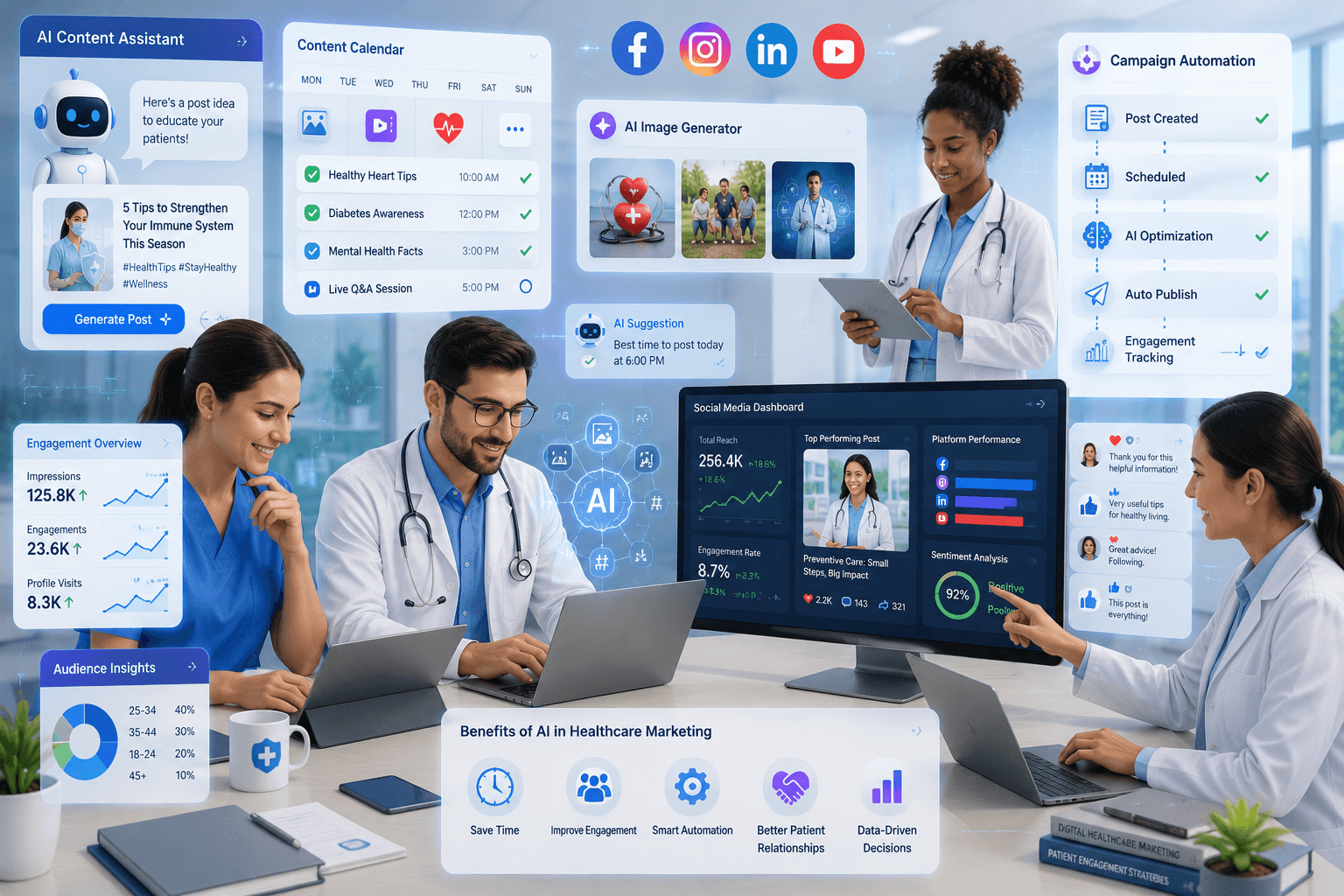
If you run marketing for a hospital, clinic, or healthcare group, you already know the pressure. Patients expect fast answers. Referring physicians expect a strong online presence. Leadership expects growth, and they expect it on a tight budget. This is exactly why AI healthcare marketing has moved from a nice idea to a daily necessity for teams that want to keep up.
Healthcare marketers are stretched thin. Most teams are small, content demands are large, and compliance adds another layer that general marketers never have to think about. That combination is why so many hospital and clinic marketing teams have started leaning on AI tools to create content faster, post more consistently, and understand what is actually working.
In this guide, we will walk through the AI tools healthcare marketers are using in 2026, what each one does well, where each one falls short for healthcare specifically, and how to think about choosing a platform that fits the way medical organizations actually operate. If you want a deeper look at building a full strategy around this, our healthcare social media marketing guide covers that in detail.
Let’s get into it.
What Is AI Healthcare Marketing?
AI healthcare marketing is the use of artificial intelligence, including generative AI, automation, and predictive analytics, to plan, create, distribute, and measure marketing for healthcare organizations. This includes hospitals, clinics, private practices, dental groups, and behavioral health providers.
In practice, this looks like using AI to draft social captions, generate blog outlines, schedule posts across locations, analyze which content drives appointment requests, and personalize messaging for different patient groups. It is not one tool. It is a set of capabilities that support the entire marketing workflow, from the first idea to the final report.
The important distinction is that healthcare marketing carries responsibilities that other industries do not. Every piece of content touches real patients, real conditions, and real trust. That is why the tools built specifically with healthcare in mind tend to perform differently than general marketing software, even when the underlying AI technology is similar.
Why AI Is Changing Healthcare Marketing
A few years ago, most hospital marketing teams were doing everything manually. Writing captions one at a time. Scheduling posts location by location. Pulling analytics into spreadsheets by hand. That approach does not scale, especially for multi-location health systems.
Generative AI changed the math. A marketing coordinator who used to spend an entire afternoon writing a week of social captions can now draft that same content in twenty minutes, then spend the rest of the time reviewing it for accuracy and tone. AI automation handles the repetitive parts of the job so people can focus on strategy, relationships, and judgment calls that still need a human.
This shift matters even more in healthcare because of how often content needs to go out. Health systems are expected to post regularly across multiple platforms, respond to trends, celebrate provider milestones, share health education, and promote services, all while staying compliant. AI powered healthcare marketing gives teams a realistic way to keep pace without burning out their staff.
Benefits of AI for Hospitals and Clinics
Hospitals and clinics that adopt AI thoughtfully tend to see a few consistent wins.
Faster content production. Teams can generate first drafts of captions, blog posts, and email copy in minutes instead of hours.
More consistent posting. AI social media automation makes it realistic to maintain a steady content calendar across every department and location.
Better use of data. Marketing analytics powered by AI can highlight which topics, formats, and posting times actually drive engagement and appointment requests.
Reduced staff burnout. Smaller marketing teams can do the work of a much larger department without constant overtime.
Stronger patient engagement. AI patient engagement tools help organizations respond to common questions and personalize outreach at a scale that was not possible before.
None of this replaces human oversight. It simply gives healthcare marketers more time to focus on the parts of the job that require clinical accuracy, brand judgment, and genuine care for the patient experience.
Best AI Tools for Healthcare Social Media Marketing in 2026
There is no shortage of AI tools competing for a healthcare marketer’s attention. Below is an honest look at where each one shines, and where healthcare teams tend to run into limits.
Tool | Best For | AI Features | Healthcare Friendly | Strengths | Limitations | Pricing Style |
|---|---|---|---|---|---|---|
Sociali.ai | Healthcare-focused content and social automation | AI content generation, caption writing, scheduling, approval workflows, analytics | Built specifically for healthcare | Healthcare context built into every suggestion, multi-location publishing, approval workflows | Newer platform compared to legacy general tools | Subscription, healthcare-focused plans |
ChatGPT | General writing and brainstorming | Generative text, conversational AI | Requires manual healthcare guardrails | Extremely flexible, strong at brainstorming and drafting | No built-in healthcare compliance awareness, no native scheduling | Subscription tiers |
Claude | Long-form writing and careful reasoning | Generative text, nuanced reasoning | Requires manual healthcare guardrails | Strong at longer, thoughtful content and accuracy-focused writing | No native social scheduling or healthcare workflows | Subscription tiers |
Gemini | Research-assisted content and Google ecosystem tasks | Generative text, search integration | Requires manual healthcare guardrails | Useful for research-backed drafts, integrates with Google tools | Not built for healthcare compliance or clinical tone | Subscription tiers |
Jasper | Marketing copy at scale | Templates, brand voice tools | Partial, with manual setup | Good for structured marketing copy and brand consistency | General marketing focus, not healthcare specific | Subscription tiers |
Copy.ai | Quick copywriting tasks | Templates, short-form generation | Partial, with manual setup | Fast for short copy like ads and captions | Limited depth for clinical or educational content | Subscription tiers |
Canva AI | Visual design | AI image generation, design templates | Partial, with manual setup | Easy to use, strong design templates | Not built for healthcare content strategy or compliance | Freemium and subscription tiers |
HubSpot AI | Marketing automation within CRM | AI content assistance, workflow automation | Partial, with manual setup | Strong CRM integration and lead tracking | Healthcare context and clinical nuance not built in | Subscription tiers |
Hootsuite AI | Social scheduling for general brands | AI caption suggestions, scheduling | Partial, with manual setup | Solid scheduling and multi-platform publishing | Generic content suggestions not tailored to healthcare | Subscription tiers |
Buffer AI | Simple social scheduling | AI caption assistance, scheduling | Partial, with manual setup | Easy to use, good for small teams | Limited healthcare specific features | Subscription tiers |
Sprout Social AI | Social analytics and scheduling | AI insights, scheduling, listening tools | Partial, with manual setup | Strong analytics and reporting | Higher learning curve, general marketing focus | Subscription tiers |
SocialPilot AI | Budget friendly scheduling | AI caption help, scheduling | Partial, with manual setup | Affordable, straightforward interface | Fewer advanced healthcare workflow features | Subscription tiers |
Semrush AI | SEO and content research | AI content ideas, keyword research | Partial, with manual setup | Strong SEO research capabilities | Not built for social publishing or healthcare workflows | Subscription tiers |
Surfer SEO | On-page SEO optimization | AI content scoring, SEO guidance | Partial, with manual setup | Helpful for optimizing blog content for search | Narrow focus on SEO, not full marketing workflow | Subscription tiers |
ChatGPT
ChatGPT is one of the most widely used generative AI tools for marketing teams of all kinds, and healthcare marketers use it often for brainstorming captions, drafting blog outlines, and rewording clinical language into something more patient friendly. It is flexible and fast. The tradeoff is that it has no built-in awareness of healthcare compliance, so every output still needs a careful human review before it goes anywhere near a patient audience.
Claude
Claude tends to be a favorite among marketers who want longer, more thoughtful writing with careful reasoning behind it. It handles nuanced topics well and tends to avoid overpromising, which matters in healthcare content. Like ChatGPT, it is a general purpose assistant, so scheduling, workflow, and compliance review still have to happen outside the tool.
Gemini
Gemini’s strength is its connection to Google’s ecosystem and its ability to pull in research-backed context for content. Healthcare teams sometimes use it for drafting patient education content that references current health guidance. It shares the same limitation as other general AI assistants: no healthcare specific guardrails and no native publishing workflow.
Copy.ai
Copy.ai is useful when a team just needs quick short-form copy, like ad variations or simple captions. It moves fast, but it does not offer the depth needed for clinical education content or longer form healthcare storytelling.
Canva AI
Canva AI has become a go-to for quick visual design, and its AI image generation features help marketing teams put together graphics without a dedicated designer. Healthcare teams like it for its simplicity, though it was not built with healthcare content strategy or compliance considerations in mind.
HubSpot AI
HubSpot AI works well for organizations that already run their marketing and CRM through HubSpot. Its automation and lead tracking features are strong. For healthcare organizations, the CRM integration is a real advantage, but the AI content suggestions still need healthcare specific review.
Hootsuite AI
Hootsuite has long been a name in social media scheduling, and its AI features help suggest captions and manage multiple platforms from one place. It is solid for general publishing, though the AI suggestions are not tailored to the tone or regulatory awareness healthcare content usually needs.
Buffer AI
Buffer is known for being simple and approachable, which makes it appealing for smaller clinics or single-location practices. Its AI caption assistance is helpful for basic scheduling needs, though it does not offer the deeper healthcare workflow features larger organizations often need.
Sprout Social AI
Sprout Social is strong on the analytics side, giving marketing teams a clear picture of engagement and audience behavior. Larger health systems sometimes use it for reporting. The learning curve is steeper, and like most general tools, it is not healthcare specific out of the box.
SocialPilot AI
SocialPilot is a budget friendly option for teams that need straightforward scheduling and basic AI caption support. It is a reasonable starting point for smaller practices, though it lacks the more advanced workflow and approval features larger healthcare marketing teams tend to need.
Semrush AI
Semrush is widely used for SEO and content research, and its AI features help generate content ideas based on real search data. Healthcare content teams often use it to identify what patients are actually searching for. It is not built for social publishing or day to day marketing automation.
Surfer SEO
Surfer SEO focuses specifically on optimizing written content for search performance. It is a helpful companion tool for healthcare blog content, scoring drafts against what is currently ranking. Its focus is narrow by design, so it works best alongside other tools rather than as a full marketing platform.
Why Healthcare Organizations Need More Than Generic AI Tools
General AI tools are genuinely useful, and most healthcare marketing teams will use at least one of them somewhere in their workflow. The challenge is that none of them were built with the specific realities of healthcare marketing in mind.
A hospital marketing manager is not just writing captions. They are writing about sensitive conditions, protecting patient privacy, following brand guidelines set by clinical leadership, coordinating across multiple locations, and routing everything through an approval process before it goes live. Generic tools can help with the writing itself, but they were not designed around that workflow.
This is the gap that healthcare focused platforms exist to close. Instead of stitching together five different tools and manually checking every output for healthcare appropriateness, a healthcare specific AI healthcare marketing platform builds that awareness directly into the content suggestions and the publishing workflow.
AI Healthcare Content Creation
The goal is not to replace the marketing team’s voice, but to give them a strong starting point that already reflects healthcare tone, avoids overpromising clinical outcomes, and speaks to patients with empathy rather than jargon.
A useful AI content generator for healthcare should understand the difference between writing about a routine service line and writing about a sensitive topic like oncology or behavioral health. That distinction matters, and it is one of the clearest signs of whether a tool was actually built for this industry.
AI Social Media Automation
AI social media automation helps healthcare marketing teams stay consistent without living inside their scheduling tool all day. This includes drafting posts, suggesting optimal posting times, and managing content across multiple platforms and, for health systems, multiple locations at once.
For a multi-location health system, this becomes a real time saver.
Healthcare Marketing Automation
Healthcare marketing automation extends beyond social media into the broader workflow, including content planning, approval routing and reporting. The idea is to reduce the number of manual steps between an idea and a published, on-brand, compliant piece of content.
For more detail on building this kind of workflow from the ground up, our guide on healthcare content marketing walks through the full strategy.
AI Image Generation for Healthcare Marketing
AI image generation has become a practical way to produce visuals quickly, especially for smaller teams without a dedicated design resource. The caution here is the same as with written content: healthcare visuals need to be accurate, respectful, and never misleading about clinical outcomes or treatments.
AI Patient Engagement
AI patient engagement tools help healthcare organizations respond to common questions, personalize outreach, and keep communication timely. This might look like AI assisted responses to frequently asked patient questions on social media, or personalized content recommendations based on what a patient has previously engaged with.
Patient engagement is one of the more sensitive areas of healthcare marketing, since every interaction touches real people making real health decisions. Our guide on patient engagement on social media goes deeper into how to approach this responsibly.
How AI Supports Healthcare Content Strategy
A strong healthcare content strategy is not just about producing more content. It is about producing the right content, consistently, in a way that builds trust over time. AI supports this by helping teams identify content gaps, repurpose existing content into new formats, and maintain a steady publishing rhythm without sacrificing quality.
Content personalization also plays a growing role here. AI can help tailor messaging for different patient populations, whether that means adjusting tone for a pediatric audience or simplifying language for general health education content.
HIPAA Considerations When Using AI
HIPAA compliance is one of the first questions any healthcare marketing team should ask before adopting a new AI tool. General AI assistants are not automatically HIPAA compliant, and healthcare organizations should never input protected health information into a tool that has not been properly reviewed and configured for that purpose.
The safest approach is to keep AI focused on general marketing content, such as service line promotion, health education, and brand storytelling, rather than anything involving specific patient information. Any organization considering a healthcare specific AI healthcare marketing software should ask directly how the platform handles data privacy and compliance before signing on.
Common Mistakes Healthcare Teams Make With AI
A few patterns show up again and again when healthcare organizations start using AI tools.
Publishing without review. AI drafts should always go through human review before publishing, especially for anything touching clinical topics.
Using one tool for everything. Relying only on a general writing assistant often means missing scheduling, workflow, and analytics needs entirely.
Ignoring brand voice. Without clear guidance, AI generated content can sound generic and disconnected from the organization’s actual tone.
Skipping compliance review. Assuming a general AI tool understands healthcare regulations is a common and risky mistake.
Underusing analytics. Many teams generate content with AI but never use AI powered analytics to learn what is actually working.
Avoiding these mistakes usually comes down to treating AI as a capable assistant rather than an autopilot.
How to Choose the Right AI Healthcare Marketing Platform
When evaluating AI healthcare marketing software, a few questions are worth asking directly.
Does the platform understand healthcare tone and sensitivity, or does it require heavy manual correction every time?
Does it support multi-location publishing if your organization has more than one facility?
Does it include an approval workflow so content can be reviewed before it goes live?
Does it offer real analytics tied to marketing goals, not just vanity metrics?
Does the vendor clearly explain how they handle data privacy?
Answering these questions honestly will usually point a healthcare marketing team toward the right fit, whether that is a general tool, a combination of tools, or a dedicated healthcare focused healthcare AI software platform.
Why Sociali.ai Is Built for AI Healthcare Marketing
Sociali.ai was built around the specific needs of healthcare organizations rather than adapted from a general marketing tool. The platform combines AI healthcare content generation with healthcare specific content suggestions, so captions and posts already reflect the tone and sensitivity healthcare content requires.
For teams managing content across multiple locations, Sociali.ai supports multi-location publishing alongside an approval workflow, so content can move from draft to review to published without getting lost in email threads. Content scheduling and a shared content calendar keep planning organized, while built-in analytics and performance reporting give teams a clear view of what is actually resonating with patients.
If you want to see how this fits your organization specifically, our healthcare solutions page walks through the details, and our comparison of healthcare social media management tools breaks down more platform options side by side.
AI is not going to replace the judgment, empathy, or clinical accuracy that healthcare marketing requires. What it can do is give your team back the time they need to focus on those things, instead of losing hours to repetitive content tasks every week.
If your team is ready to see what a healthcare focused AI healthcare marketing platform actually looks like in practice, explore Sociali.ai and see how content creation, scheduling, analytics, and workflow can work together in one place, built specifically for the way healthcare organizations market themselves.
Free resource
Get the checklist


