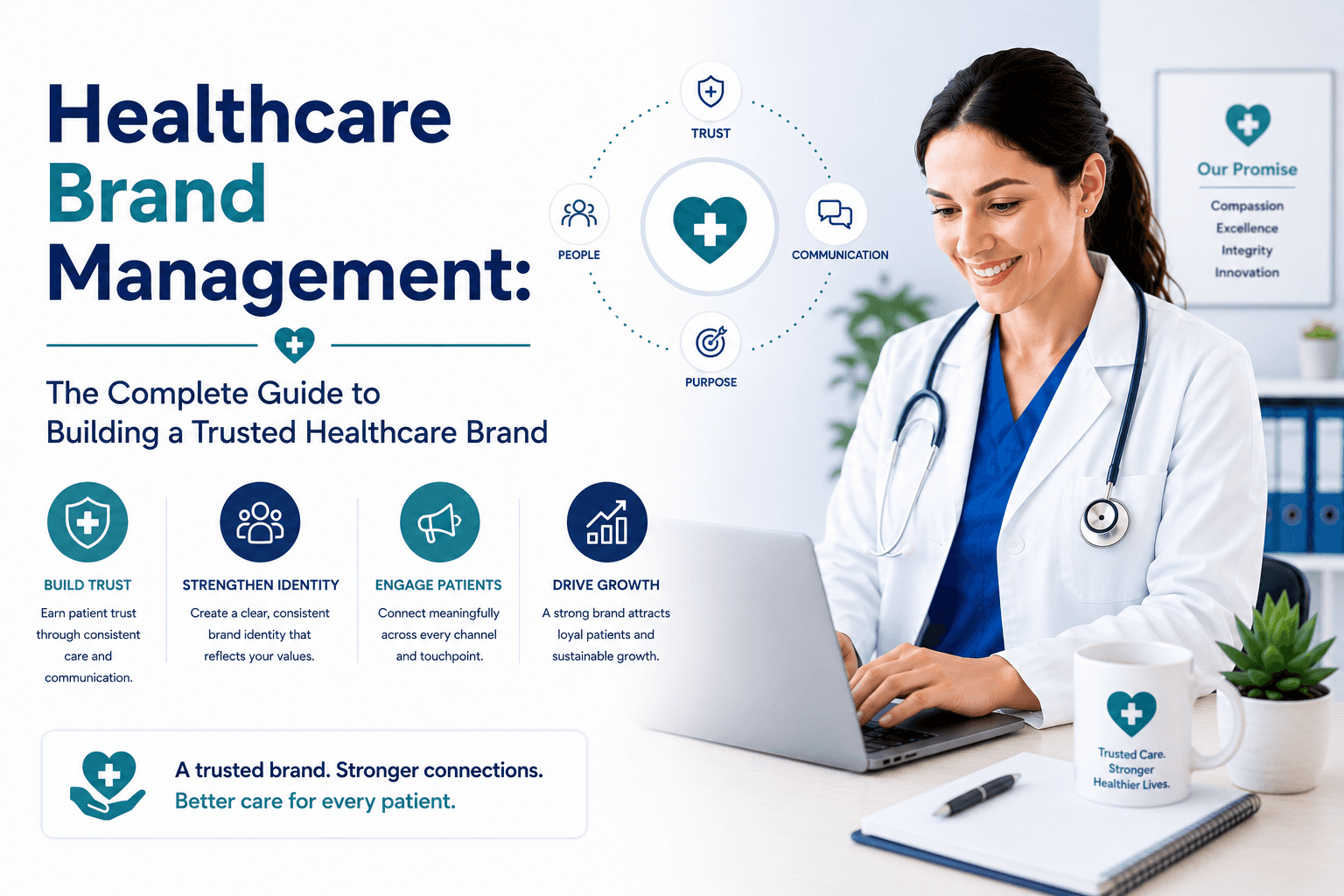
Healthcare Brand Management: The Complete Guide to Building a Trusted Healthcare Brand
|
9
min read

Healthcare Brand Management: The Complete Guide to Building a Trusted Healthcare Brand
Two hospitals sit three miles apart. Both have similar facilities. Both employ board-certified physicians. Both report comparable clinical outcomes on standard quality measures. Yet one operates at near capacity while the other struggles to fill beds. One commands premium rates from payers while the other accepts whatever reimbursement is offered. One attracts top clinical talent while the other cycles through recruitment firms constantly.
The difference is brand. Not logo design or tagline cleverness. Brand as the complete set of perceptions, associations, and expectations that patients and communities hold about each organization. One hospital has built a brand that signals trust, competence, and compassion. The other has not.
Healthcare brand management is the strategic discipline of defining, building, and protecting that perception. It determines whether patients choose you, trust you, and recommend you. This guide covers how to build a healthcare brand that attracts patients, inspires loyalty, and supports long-term organizational success.
Key Takeaways
Healthcare brand management is the ongoing work of shaping how patients and communities perceive your organization across every interaction, communication, and experience.
Brand is not a visual identity. Logos and color palettes matter, but brand is fundamentally the set of perceptions and expectations patients hold about your organization.
Healthcare brand marketing communicates organizational identity consistently across channels. It expresses who you genuinely are rather than creating an image unsupported by reality.
The most powerful brand-building force is patient experience. Marketing communicates promises. Only actual care delivery fulfills them. Gaps between promise and experience destroy brand credibility.
Brand consistency across multiple locations requires centralized standards with localized implementation flexibility. Patients expect consistent experience regardless of which facility they visit.
Employee engagement directly affects brand strength. Staff who believe in organizational purpose express that belief in every patient interaction and community conversation.
Brand measurement should assess awareness, perception, preference, and loyalty. These metrics connect brand investment to patient choice and organizational performance.
What Healthcare Brand Management Actually Means
Healthcare brand management is the strategic discipline of defining, expressing, delivering, and protecting the identity and reputation of a healthcare organization. It encompasses everything from organizational purpose and values to visual identity, communication voice, patient experience, and community perception.
This definition establishes that brand management extends far beyond marketing. Marketing communicates brand identity and value. Brand management ensures that what marketing communicates aligns with what operations deliver and what patients experience. When these elements align, brand strengthens. When they diverge, brand weakens.
The definition also clarifies the relationship between brand and reputation. Brand is what you intend patients to perceive about your organization. Reputation is what patients actually perceive. Brand management works to align intention with perception. Reputation management monitors and responds to gaps between the two.
Understanding this scope explains why brand management requires cross-functional commitment. Clinical operations, patient experience, human resources, community relations, and marketing all contribute to brand delivery. Organizations where brand is treated as a marketing function alone consistently underperform organizations where brand is treated as an organizational responsibility.
Why Healthcare Brand Management Matters
Healthcare decisions involve trust, vulnerability, and significant personal stakes. Patients choosing a provider are not comparison shopping for a commodity. They are deciding who they trust with their health during moments that matter deeply.
Strong brands simplify these decisions. When a patient needs a cardiologist, a strong brand makes the choice feel obvious rather than anxiety-provoking. The patient already knows the organization. They already trust the brand. They book with confidence rather than researching anxiously among unfamiliar options.
Strong brands also create measurable organizational advantages. Patient acquisition cost decreases because brand awareness reduces the marketing investment required to generate appointments. Patient retention improves because brand loyalty influences decisions when new health needs arise. Talent acquisition strengthens because clinicians prefer organizations with strong reputations. Payer negotiations improve because market preference supports value-based arguments. Crisis resilience increases because community trust provides a buffer against inevitable problems.
There is also a defensive dimension. Healthcare markets grow increasingly competitive with retail clinics, telehealth platforms, specialty chains, and private equity-backed practices competing for patients. Organizations with weak brands lose patients to these alternatives. Organizations with strong brands retain loyalty even as options multiply.
Building a Healthcare Brand Foundation
Strong brands rest on clear strategic foundations. Here is how to build yours.
Define Organizational Purpose and Values
Brand purpose is why your organization exists beyond generating revenue. It is the contribution you make to patient health and community wellbeing. Purpose provides meaning that engages both patients and staff.
Effective purpose statements are specific enough to guide decisions. "Improving community health" is too broad to be useful. "Ensuring every family in our region has access to exceptional pediatric care regardless of ability to pay" is specific enough to guide resource allocation, partnership decisions, and communication priorities.
Brand values are the principles that guide organizational behavior. Compassion. Innovation. Excellence. Integrity. Community commitment. The specific values matter less than genuine organizational commitment to living them. Values displayed on lobby walls but absent from daily operations damage brand credibility more than having no stated values at all.
Define purpose and values through inclusive processes that involve clinical staff, administrative leadership, and patient perspectives. The output should reflect genuine organizational identity, not aspirational wishes. Patients and staff both detect the difference between authentic identity and marketing language.
Establish Clear Brand Positioning
Brand positioning defines how you want patients to perceive your organization relative to alternatives. It answers the fundamental question: why should someone choose you?
Effective positioning identifies a meaningful difference that matters to patients and that your organization can credibly deliver. Clinical excellence in specific specialties. Exceptional patient experience and communication. Unmatched convenience and access. Deep community roots and commitment. Innovative treatment approaches unavailable elsewhere.
Positioning must be specific enough to differentiate and guide decisions. "Quality care" is not positioning. Every organization claims quality care. "The region's only comprehensive stroke center with outcomes exceeding national benchmarks for twelve consecutive years" is positioning. It is specific. It is provable. It is meaningful to patients making neurology decisions.
Develop Consistent Brand Voice
Brand voice is the consistent personality expressed through organizational communication. It shapes how patients perceive your character based on how you write, speak, and present information.
Healthcare brand voices typically range from warm and compassionate to professional and authoritative. A children's hospital naturally uses warmer, more playful language than an academic medical center. A community clinic may use more accessible, conversational language than a specialty surgical practice.
Document voice characteristics with clear examples. Train everyone who creates patient-facing content on voice standards. Audit communications periodically to ensure consistency. Voice consistency builds the familiarity that supports trust.
For organizations building brand presence through content, the healthcare content marketing guide covers content strategies that express brand values consistently.
Expressing Brand Across Every Touchpoint
Brand expression must be consistent across every point where patients encounter your organization.
Visual Brand Identity
Visual brand elements should be documented in comprehensive guidelines and applied consistently. Logo usage rules. Color specifications. Typography standards. Photography style. Iconography and graphic elements. Video and motion guidelines.
Consistent visual presentation builds recognition. Patients should recognize your social media posts before seeing your logo. Your website, facility signage, printed materials, and digital communications should feel like the same organization.
Visual identity guidelines should be accessible to everyone creating branded materials. Centralized asset libraries make approved brand elements easy to find and use. Regular auditing identifies inconsistencies before they fragment brand perception.
Digital Brand Presence
Your website is typically the first substantive brand encounter for prospective patients. It must express brand identity through design, content, and functionality.
Website design should reflect brand personality. Content should demonstrate brand voice and expertise. User experience should deliver on brand promises about patient-centeredness and accessibility. A brand that promises innovation delivered through a dated, difficult-to-use website creates immediate credibility gaps.
Social media provides daily brand expression opportunities. Every post either reinforces or undermines brand identity. Educational content demonstrates expertise. Provider features humanize the organization. Community engagement shows values in action. Response to comments and messages demonstrates brand character.
For organizations building social media brand presence, the healthcare social media marketing guide covers brand expression strategies across platforms.
Patient Experience as Brand Delivery
Patient experience is where brand promises meet reality. Marketing can communicate commitment to compassionate care. Only actual care experience can deliver that compassion.
Every patient interaction expresses brand identity. Phone calls with scheduling staff. Check-in experience at the front desk. Time spent in waiting areas. Clinical encounters with providers. Billing and financial communication. Follow-up contact after visits.
This means brand management must extend into operations. Marketing and patient experience teams need shared understanding of brand promises. Both need accountability for delivering them. The strongest healthcare brands are built by organizations where brand responsibility extends across every department.
Employee Brand Ambassadorship
Staff members represent your brand in every patient interaction and community conversation. How employees talk about your organization shapes community perception. How they interact with patients defines patient experience.
Engaged employees who believe in organizational purpose express that belief naturally. They communicate warmth and competence. They speak positively about their workplace. They deliver the patient experience your brand promises.
Invest in internal brand engagement. Help staff understand organizational purpose and how their work contributes to it. Connect daily responsibilities to brand promises. Recognize brand-aligned behavior. Address experiences that contradict brand values. The return on this investment appears in patient satisfaction, community reputation, and recruitment effectiveness.
Brand Management Across Multiple Locations
Health systems with multiple hospitals, clinics, and care sites face brand consistency challenges that single-location organizations do not.
Centralized Standards With Local Flexibility
The most effective approach combines centralized brand standards with localized implementation flexibility. Central marketing establishes brand guidelines covering visual identity, voice, messaging, and content standards. Local teams implement these standards appropriately for their specific communities.
This balance prevents the two common multi-location failures. Overly rigid centralization produces generic content disconnected from local communities. Complete decentralization produces brand fragmentation as each location develops its own identity and standards.
Technology-Enabled Consistency
Brand management technology helps maintain consistency across locations. Shared brand asset libraries. Pre-approved content templates. Centralized approval workflows. Consistent analytics and reporting.
These tools make brand standards accessible and adherence manageable. Local teams find approved brand elements quickly. Central teams monitor consistency without becoming bottlenecks that delay local content publication.
For organizations managing brand across multiple locations, the multi-location social media management guide covers governance models and operational frameworks.
Measuring Brand Performance
Brand measurement connects brand investment to organizational outcomes.
Brand Awareness
Track unaided and aided brand awareness in your service area. Unaided awareness measures whether people name your organization when asked about healthcare providers. Aided awareness measures whether people recognize your organization when named.
Awareness is the foundation of brand strength. Patients cannot choose organizations they do not know exist. Track awareness over time and against competitors.
Brand Perception
Measure what people associate with your brand. Clinical quality. Compassionate care. Innovation. Community commitment. Accessibility and convenience.
Perception research reveals whether brand positioning is landing as intended. If you position around clinical excellence but patients associate you primarily with convenience, the positioning strategy needs adjustment.
Brand Preference and Loyalty
Track whether patients who know your organization prefer it over alternatives. Measure patient retention and repeat visit patterns. Monitor referral likelihood.
These metrics connect brand strength to revenue impact. They demonstrate whether brand investment produces patient choice behavior that justifies continued investment.
Common Healthcare Brand Management Mistakes
Confusing visual identity with brand. Organizations that invest primarily in logos and colors while neglecting patient experience create attractive brands that patients do not trust.
Promising more than operations delivers. Marketing claims unsupported by patient experience create brand damage worse than making no claims at all.
Neglecting internal brand engagement. Staff who do not understand or believe in organizational brand deliver inconsistent experiences that undermine external brand investment.
Allowing brand inconsistency across touchpoints. Different visual presentation, voice, or experience quality across channels and locations fragments perception and reduces trust.
Chasing competitor positioning. Brands defined by competitor comparison rather than authentic identity struggle to differentiate meaningfully.
Abandoning brand during organizational challenges. Organizations that depart from brand values and voice during difficult periods damage trust when it matters most.
Frequently Asked Questions
What is healthcare brand management?
Healthcare brand management is the strategic discipline of defining, expressing, delivering, and protecting organizational identity and reputation. It encompasses purpose, values, positioning, visual identity, communication voice, patient experience, and community perception. Effective brand management aligns what organizations promise with what patients experience.
Why is brand management important for healthcare organizations?
Healthcare decisions involve trust and vulnerability. Strong brands simplify patient decisions by making organizations feel familiar and credible. Brands also attract clinical talent, strengthen payer relationships, improve crisis resilience, and create competitive advantage. Weak brands lose patients to competitors before organizations ever demonstrate care quality.
How do you build a strong healthcare brand?
Start with authentic organizational purpose and values. Establish clear positioning based on genuine strengths. Develop consistent visual identity and brand voice. Express brand consistently across every patient touchpoint. Invest in patient experience that delivers on brand promises. Engage staff as brand ambassadors. Measure brand perception and adjust based on what you learn.
What is the difference between branding and marketing in healthcare?
Branding defines organizational identity and shapes long-term patient perception. Marketing promotes specific services and drives immediate patient actions. Branding builds the trust foundation. Marketing activates that trust for specific purposes. Strong brands make marketing more effective. Marketing cannot compensate for weak brands.
How do you maintain brand consistency across multiple healthcare locations?
Establish centralized brand standards covering visual identity, voice, and content policies. Provide pre-approved templates and asset libraries. Enable local customization within brand guidelines. Use technology platforms that support consistent brand management. Audit periodically to identify and address inconsistencies.
What role does social media play in healthcare branding?
Social media provides daily brand expression opportunities. Educational content demonstrates expertise. Provider features humanize organizations. Community engagement shows values in action. Consistent, valuable social media presence builds brand familiarity and trust. Inconsistent or absent presence signals disorganization.
How do you measure healthcare brand strength?
Track brand awareness through aided and unaided recall. Measure brand perception and association strength. Monitor patient preference and loyalty. Assess patient retention and referral likelihood. Compare metrics against competitors. Track trends over time to understand whether brand investment produces improving perception.
What are the biggest healthcare branding mistakes?
Confusing visual identity with full brand experience. Promising through marketing what operations cannot consistently deliver. Neglecting internal brand engagement with staff. Allowing inconsistency across locations and touchpoints. Chasing competitor positioning rather than building authentic identity. Abandoning brand values during organizational challenges.
Building a Brand That Earns Lasting Patient Trust
Healthcare brand management succeeds when organizations align what they promise, what they deliver, and what patients perceive. The logo matters. The voice matters. The marketing matters. But what matters most is the cumulative impression created by every patient interaction, every staff communication, and every moment of organizational behavior.
Start with authentic identity. Define purpose and values that reflect genuine organizational character. Establish positioning based on real strengths. Express brand consistently across every touchpoint. Deliver patient experience that fulfills brand promises. Engage staff in brand ambassadorship. Measure what patients actually perceive and adjust accordingly.
The strongest healthcare brands share a common characteristic. They are built from the inside out, with organizational identity driving external expression rather than marketing creating identity that operations cannot sustain. Patients trust these brands because the brands are true.
For healthcare teams building brand presence through consistent social media and content, Sociali.ai provides a purpose-built healthcare solution for planning, scheduling, collaborating on, publishing, and analyzing branded content across every channel and location. From voice consistency to multi-location coordination, the platform supports the brand expression that builds lasting patient trust.
Free resource
Get the checklist


