How Hospitals, Healthcare Clinics & Behavioral Health Centers Can Manage 10+ Locations on Social Media Without an Agency
|
7
min read

How Hospitals, Healthcare Clinics & Behavioral Health Centers Can Manage 10+ Locations on Social Media Without an Agency
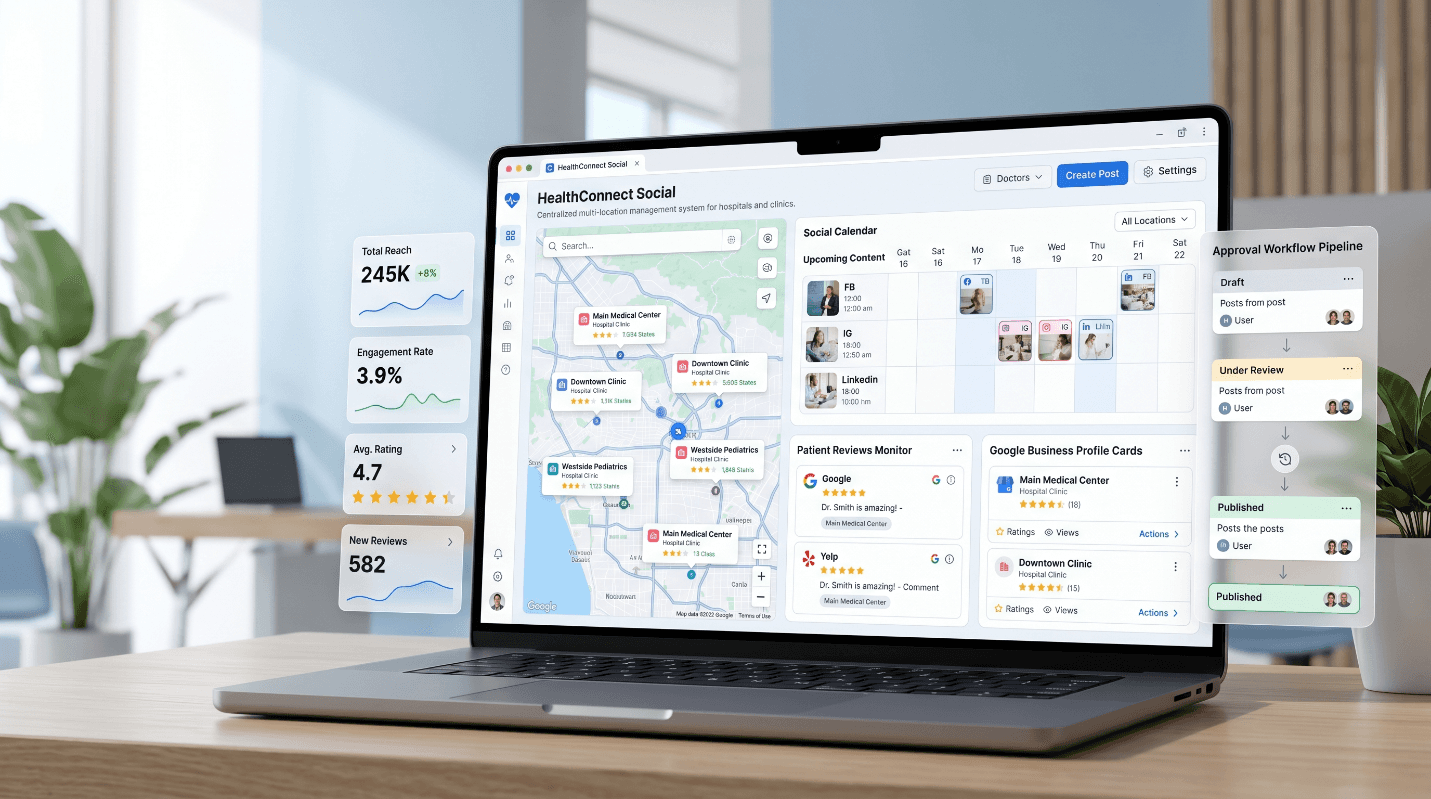
Running social media for a single medical practice is already a full-time job. Running it for ten, twenty, or fifty locations, each with its own providers, patient demographics, local community voice, and compliance requirements, is an entirely different problem. Yet that’s exactly what healthcare marketing teams are asked to do, often with limited staff and budgets that don’t scale with the complexity.
The default answer for most growing healthcare organizations has been to hire an agency. But agencies come with their own friction: slow turnaround times, limited clinical context, high monthly retainers, and a fundamental mismatch between what generalist marketers understand about healthcare and what healthcare operations actually require. The other default has been to hand off each location’s social accounts to someone on-site, a front desk coordinator, an office manager, a well-meaning physician, and hope for the best.
Neither approach holds up at scale. Healthcare social media management at the multi-location level requires something different: a purpose-built system that gives marketing teams centralized control without stripping local teams of autonomy.
Why Multi-Location Healthcare Social Media Gets Difficult Fast
It starts simply enough. A regional health system opens its third urgent care clinic and someone decides to create a Facebook page for the new location. A dental group acquires two practices and the new owners want to maintain their existing social presence. A behavioral health network expands into a new county and needs local visibility on Google.
Before long, there are dozens of social accounts across Facebook, Instagram, and Google Business Profile, each updated inconsistently, branded differently, and managed by whoever has time that week.
The deeper problem isn’t just inconsistency. It’s risk. A staff member at one location posts something well-intentioned but includes enough patient context to raise HIPAA concerns. A negative review on Google goes unanswered for three weeks because no one knew it was there. A competitor runs a local promotion and your clinic’s profile is so outdated it doesn’t even show current hours.
Multi-location healthcare marketing requires coordination at a level most marketing software wasn’t designed to handle. The gap between what enterprise social tools offer and what healthcare organizations actually need is where things fall apart.
The Real Cost of Agencies for Multi-Location Healthcare Marketing
Agencies aren’t the wrong answer because they’re bad at marketing. Many of them are very good at it. They’re the wrong answer for healthcare systems trying to scale because the economics don’t work and the operational fit is poor.
A mid-sized agency retainer for social media management typically runs between $3,000 and $8,000 per month per brand. For a healthcare organization managing 15 locations, even a discounted multi-location arrangement can push annual spend well past $300,000. That’s before accounting for ad spend, photography, or any creative production.
Beyond cost, there’s the turnaround problem. Healthcare marketing moves fast. A new service line launches. A provider joins the practice. Flu season arrives. A local news story touches on something relevant to your specialty. By the time an agency drafts content, routes it for approval, incorporates feedback, and publishes, the moment has passed.
The other issue is clinical accuracy. Agencies writing content for hospitals and behavioral health centers are often pulling from templates and general health information, not from the providers themselves. That creates a gap in authenticity that patients notice, and it creates a legal review burden for in-house compliance teams who have to scrutinize every piece of content before it goes out.
Why Generic Social Media Tools Fail Healthcare Organizations
Most social media scheduling platforms were built for marketing teams at e-commerce brands, media companies, or consumer startups. They solve for volume and speed. Healthcare organizations need something fundamentally different.
A retail brand can post product promotions without much internal review. A hospital posting about mental health services, medication-assisted treatment, or pediatric care is operating in a different environment entirely. The content has to be accurate. It has to be sensitive. And depending on what it says and who it might identify, it may need clinical or legal sign-off before it’s anywhere near a publish button.
Generic tools don’t accommodate that. They have basic approval flows at best, single-account-level settings, and no concept of how a multi-location healthcare brand actually operates. You end up with a scheduling tool that technically works but creates more process problems than it solves.
What Hospitals and Clinics Actually Need From a Healthcare Marketing Platform
When healthcare marketing directors describe what they wish their tools could do, a few themes come up consistently.
They need to manage every location from one place without logging in and out of separate accounts. They need content approval workflows that route posts to the right people, compliance, clinical leadership, local administrators, before anything goes live. They need visibility into what’s being posted across all locations without having to pull separate reports. And they need to handle patient reviews and Google Business Profiles as part of the same workflow, not as a separate system that requires its own management.
That’s the actual scope of healthcare social media management. It’s not just scheduling posts. It’s governance, brand consistency, reputation monitoring, and local marketing coordination all at once.
Managing Content Approval Workflows Across Multiple Locations
Content approval is where most multi-location healthcare marketing systems break down. Without a structured workflow, content either gets delayed in email chains or it goes out without proper review. In healthcare, both outcomes have real consequences.
The right approach separates content creation from content authorization. Local teams or marketing staff draft content specific to their location. That content routes through a defined approval chain before it publishes. The chain itself should be configurable: some content types might need only a marketing manager’s sign-off, while content touching clinical guidance or sensitive specialties routes to a compliance reviewer first.
Role-based permissions matter here. A front desk coordinator at a behavioral health center shouldn’t have the same publishingpublish access as a regional marketing director. And a corporate marketing team shouldn’t be able to accidentally overwrite local content that’s already been approved.
Healthcare-compliant workflows aren’t about creating bureaucracy. They’re about making it possible to move quickly without creating exposure. When the approval process is built into the tool rather than layered on top of it in email, the whole system moves faster.
Google Business Profile Management for Healthcare Organizations
For most patients, Google Business Profile is the first impression a clinic makes. It’s where they check hours before driving over, read recent reviews before booking, and find the phone number when they’re already in the parking lot.
Managing Google Business Profiles across 10 or more locations manually is genuinely painful. Hours get outdated. Special holiday closures don’t get updated. New services don’t make it onto the profiles. Providers leave and their names stay on listings indefinitely.
Healthcare organizations need centralized Google Business Profile management that lets a marketing team push updates to multiple locations at once while still allowing location-level customization where it makes sense. Accuracy at scale requires automation and oversight working together, not a spreadsheet someone updates quarterly.
When Google Business Profiles are well-maintained across all locations, the downstream effect on local search visibility is significant. Patients searching for urgent care near them, or a pediatrician accepting new patients, or a behavioral health clinic in their county, will find accurate information and a well-managed profile rather than a stale listing that makes your organization look like it’s not paying attention.
Healthcare Reputation Management and Patient Reviews
Patient reviews are both a marketing asset and an operational risk. A five-star review from a patient describing a genuinely positive experience builds trust with prospective patients in a way no ad ever could. An unanswered negative review, especially one with a factual inaccuracy, does the opposite.
Healthcare review management at scale means monitoring reviews across Google, Healthgrades, Yelp, and other platforms simultaneously, getting notified when new reviews come in, and having a clear process for how and when to respond. The response piece is particularly important in healthcare because HIPAA governs what can be acknowledged publicly. Responses need to follow a consistent, compliant script that addresses the patient’s concern without confirming they were ever a patient at all.
Most healthcare organizations have policies for this. What they lack is a system that surfaces the reviews quickly and makes it easy for the right person to respond in a timely, compliant way. Healthcare reputation management shouldn’t require a full-time staff member checking six different review platforms every morning.
Maintaining Brand Consistency Across Clinic Locations
Brand consistency in healthcare isn’t just about visual identity, though that matters too. It’s about ensuring that every location presents the same quality of information, the same tone, and the same standards of patient communication, regardless of whether that location is in a major metro or a rural community.
When each location manages its own social presence independently, drift is inevitable. One clinic starts posting generic stock photos. Another one’s bio hasn’t been updated since 2021. A third location’s Instagram has a completely different visual style than everything else in the network.
Centralized brand management doesn’t mean every location sounds identical. Regional relevance matters in healthcare marketing. A children’s hospital system operating in different cities should sound local in each market. But the brand guardrails, content standards, and approval process should be consistent system-wide.
A healthcare marketing platform with a multi-location dashboard makes this manageable. Corporate sets the standards. Regional teams or local administrators work within them. The system ensures nothing goes out that violates the brand, and reporting gives marketing leadership visibility into what’s happening across the network without requiring manual audits.
How Sociali.ai Simplifies Healthcare Social Media Management
Sociali.ai was built for exactly this operating environment. It’s a healthcare marketing platform designed around the actual workflows, compliance requirements, and operational complexity that hospitals, multi-location clinics, dental DSOs, and behavioral health organizations deal with every day.
The multi-location dashboard gives marketing teams a single view across all their locations, what’s scheduled, what’s pending approval, what’s been published, and what needs attention. Role-based permissions mean every team member has the right level of access without creating security or compliance risks. Content approval workflows can be configured to match how your organization actually operates, whether that’s a simple two-step review or a more complex chain involving clinical, compliance, and communications stakeholders.
Google Business Profile management and patient review management are built directly into the platform, which means teams aren’t toggling between four different tools to keep their local presence accurate and their reputation well-managed. Healthcare-focused scheduling accounts for the unique rhythms of clinical marketing: service line promotions, provider spotlights, community health observances, and the kind of location-specific content that actually resonates with patients.
Centralized reporting gives marketing directors and operations leaders the data they need to understand what’s working across the network without building custom dashboards from scratch.
For healthcare organizations that have tried to manage social media through a combination of agency relationships, generic tools, and manual coordination, the difference is operational clarity. Instead of managing the system, the team can focus on the strategy.
Final Thoughts
The complexity of managing social media across multiple healthcare locations doesn’t go away by ignoring it or outsourcing it indefinitely. It compounds. The organizations that get ahead of it are the ones that build the right infrastructure early, before the number of locations grows past what any team can reasonably manage manually.
That infrastructure doesn’t have to be complicated. It does have to be purpose-built for healthcare, with the workflows, permissions, and compliance awareness that clinical marketing actually requires.
If your organization is managing more than a handful of locations and the current system is showing cracks, it’s worth looking at what a platform like Sociali.ai can actually do for your team. The right tool doesn’t just save time. It makes consistent, high-quality healthcare marketing possible at a scale that would otherwise require doubling your headcount.
Free resource
Get the checklist


