Healthcare Digital Marketing: Complete Guide for Modern Organizations
|
9
min read

Healthcare Digital Marketing: The Complete Guide for Modern Healthcare Organizations
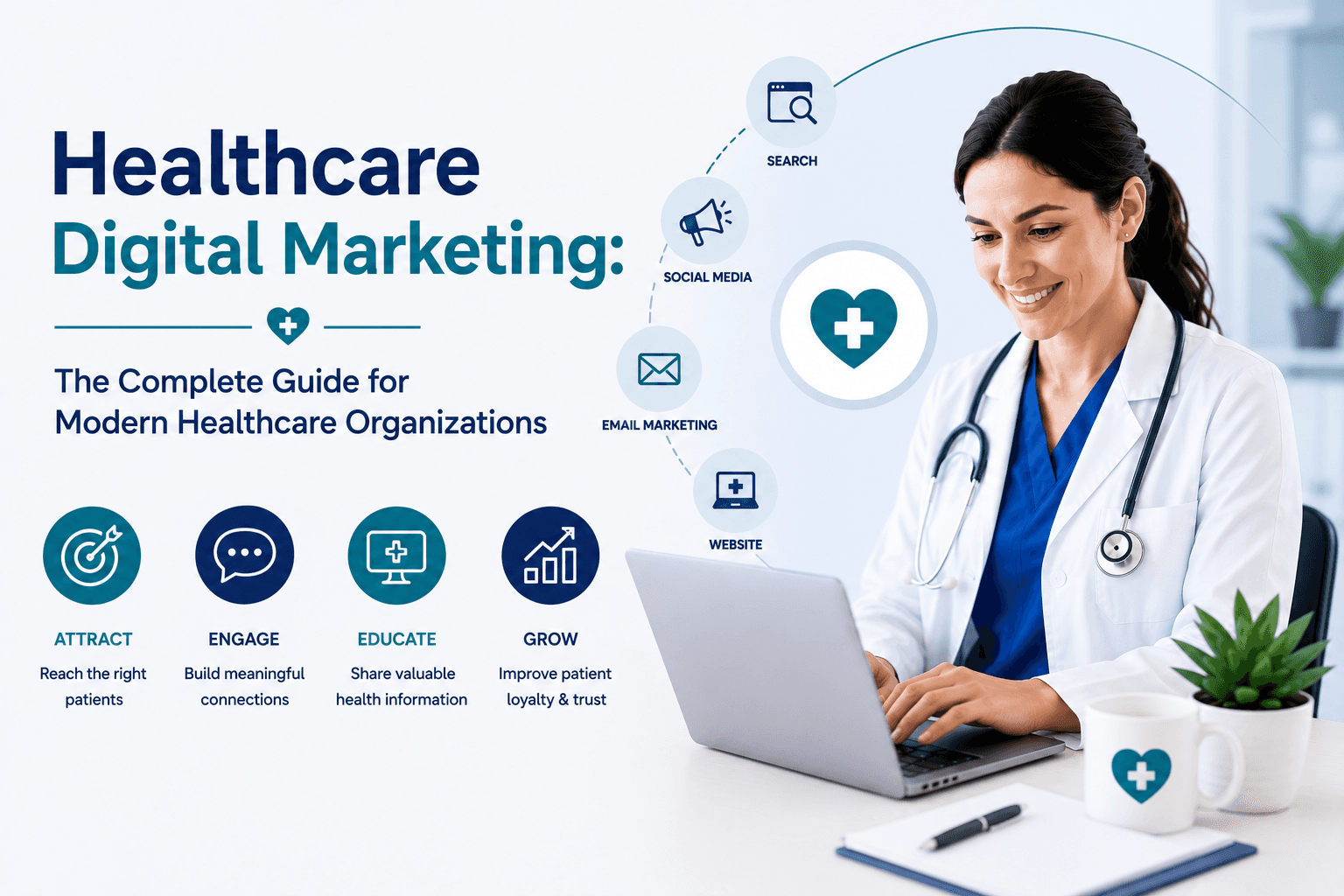
Most healthcare organizations still market like it is 2005. Billboards. Radio spots. Newspaper ads. Referral relationships that have not been actively managed in years. These channels still produce some results. But they are increasingly expensive, decreasingly effective, and completely invisible to the growing segment of patients who find healthcare providers the same way they find everything else: through digital channels.
Healthcare digital marketing is not about abandoning traditional approaches. It is about building a marketing operation that reaches patients where they actually spend time, answers the questions they actually ask, and converts interest into appointments through pathways that patients increasingly prefer.
This guide covers how to build a healthcare digital marketing strategy that attracts patients, builds trust, and produces measurable results. No theory. Just practical frameworks your team can implement starting this week.
Key Takeaways
Healthcare digital marketing encompasses all online channels and strategies used to attract, engage, and convert patients, including SEO, content marketing, social media, email, paid advertising, and website optimization.
A healthcare digital marketing strategy must connect every marketing activity to specific organizational goals and measurable outcomes rather than operating as a collection of disconnected tactics.
The patient journey now begins online for most healthcare decisions. Organizations without strong digital presence are invisible during the critical research phase when patients evaluate options.
Different digital channels serve different purposes. Search captures active demand. Social media builds relationships. Email nurtures existing connections. Paid advertising accelerates results while organic channels mature.
Healthcare marketing strategy succeeds when content is built around patient questions and search intent rather than organizational promotion. Educational content consistently outperforms promotional content.
Multi-location organizations need centralized brand governance with localized implementation flexibility to maintain consistency while serving distinct community needs.
Measurement must connect marketing activity to patient acquisition and revenue. Impressions and clicks matter less than appointments booked and new patient visits.
What Healthcare Digital Marketing Actually Means
Healthcare digital marketing is the strategic use of online channels and digital technologies to attract, engage, educate, and convert prospective patients while building lasting relationships with existing ones. It includes search engine optimization, content marketing, social media marketing, email marketing, paid digital advertising, video marketing, and website optimization.
This definition establishes that digital marketing is not just having a website and posting occasionally on Facebook. It is a coordinated system of channels and tactics working together to guide patients from initial awareness through appointment booking and ongoing engagement.
The definition also clarifies that digital marketing serves the full patient relationship lifecycle, not just new patient acquisition. Digital channels educate existing patients between visits. They support treatment adherence. They build the ongoing trust that drives patient retention and referral behavior. Organizations that use digital marketing only for acquisition miss significant value.
For healthcare organizations, digital marketing operates within constraints that other industries do not face. Regulatory compliance requirements. Medical accuracy standards. The heightened trust requirements that come with health-related communication. These constraints do not prevent effective digital marketing. They require thoughtful strategy that integrates compliance into marketing operations rather than treating it as a barrier.
Why Healthcare Digital Marketing Matters Now
Patient behavior has fundamentally changed. The transformation accelerated during the pandemic but was underway long before and continues to deepen.
People now research health symptoms online before deciding whether to see a doctor. They compare provider options through search engines, review sites, and social media. They evaluate organizational credibility based on website quality and digital presence. They book appointments online when possible and choose providers who offer that convenience.
This behavioral shift means digital presence is now the primary front door to healthcare organizations. Before a patient calls your office, they have probably visited your website. Before they request an appointment, they have probably read your reviews. Before they trust you with their care, they have probably evaluated your digital footprint.
Organizations with strong digital marketing capture this patient behavior. They show up in search results when prospective patients look for care. They provide the information patients need to make confident decisions. They make booking convenient. Organizations without strong digital marketing lose these patients to competitors before ever knowing the patients existed.
There is also a significant efficiency advantage. Digital marketing costs less per patient acquisition than most traditional channels when executed well. It provides measurement that traditional channels cannot match, allowing organizations to understand exactly which marketing investments produce returns and which do not.
Building a Healthcare Digital Marketing Strategy
Strategy must precede tactics. Here is how to build one that works.
Start With Organizational Goals
Healthcare digital marketing strategy should connect directly to organizational priorities. Growing specific service lines. Increasing patient volume. Improving patient retention. Building brand awareness in new markets. Supporting community health improvement goals.
Translate these priorities into specific, measurable marketing objectives. Increase orthopedic appointment requests by 30% within six months. Grow new patient visits from digital channels to 40% of total new patient volume. Generate 500 mammogram bookings during Breast Cancer Awareness Month. Specific objectives guide tactical decisions and provide criteria for measuring success.
Understand the Patient Journey
Patients move through predictable stages when making healthcare decisions. Initial awareness of a health concern or need. Information gathering about conditions and treatment options. Evaluation of specific providers and organizations. Decision and action to book an appointment. Ongoing relationship and potential advocacy.
Different digital channels serve different journey stages. Search engine optimization and educational content capture patients during awareness and information gathering. Website content and reviews influence evaluation. Online booking and clear calls to action enable decision. Email and social media nurture ongoing relationships.
Map your digital marketing activities across this journey. Identify gaps where patients lack the information or pathways they need to move toward booking. Most organizations discover significant gaps in awareness-stage content while overinvesting in decision-stage promotion.
Choose Channels Based on Patient Behavior
Channel selection should follow patient behavior rather than marketing trends. Where do your specific patients spend time online? How do they search for health information? What formats do they prefer?
Search engines capture patients actively looking for care. This makes SEO and search advertising foundational for most healthcare digital marketing strategies. Content marketing supports search visibility while building trust through demonstrated expertise. Social media reaches patients in their daily digital environments and supports ongoing relationship building. Email nurtures connections with patients who have already expressed interest.
For organizations building comprehensive strategies, the healthcare content marketing guide covers content development and distribution frameworks.
Core Healthcare Digital Marketing Channels
Here is how each major channel contributes to healthcare marketing success.
Healthcare SEO and Local Search
Search engine optimization makes your organization visible when patients search for care. This matters enormously because search is where most patient journeys now begin.
Healthcare SEO includes optimizing website content for relevant search terms, building topical authority through comprehensive content, ensuring technical site quality, and managing local search presence through Google Business Profile optimization.
Local SEO deserves particular attention for healthcare. When someone searches for a provider, Google typically shows a map with three local results. Appearing in that Local Pack generates significant patient volume. Optimization includes complete and accurate business profiles, consistent name and address information across the web, active review presence, and location-specific website content.
For organizations building SEO foundations, the healthcare social media marketing guide covers content strategies that support search visibility.
Content Marketing
Content marketing attracts and engages patients through valuable health information. Blog posts answering patient questions. Educational videos explaining conditions and treatments. Downloadable guides for specific health concerns. Interactive tools like symptom checkers or risk assessments.
Effective healthcare content targets real patient questions rather than organizational promotion priorities. Topic selection should follow keyword research that reveals what patients actually search for. Content should be medically accurate, accessible in reading level, and designed to guide readers toward appropriate next steps.
Content also supports every other digital channel. Blog posts improve search visibility. Educational content provides substance for social media and email. Comprehensive content builds the authority that supports conversion when patients are ready to book.
Social Media Marketing
Social media builds ongoing patient relationships and community connection. It reaches patients where they spend time daily. It provides channels for health education, provider features, community engagement, and patient communication.
Healthcare social media succeeds when it prioritizes value over promotion. Educational content that answers patient questions. Provider content that builds familiarity and trust. Community content that demonstrates organizational commitment. Interactive content that invites participation and conversation.
Platform selection should follow patient demographics. Facebook reaches older adults effectively. Instagram connects with younger demographics. YouTube serves patients seeking detailed health information. LinkedIn supports professional audiences. Most organizations should prioritize two or three platforms rather than attempting presence everywhere.
For organizations building social media programs, the healthcare social media strategy guide covers platform selection and content planning.
Paid Digital Advertising
Paid advertising accelerates results while organic channels mature. Search advertising captures patients actively looking for care. Social media advertising reaches patients based on demographics and interests. Display advertising builds awareness in specific geographic areas. Retargeting re-engages website visitors who did not book initially.
Healthcare advertising requires careful targeting to reach appropriate patient populations while avoiding wasted spending. Geographic targeting keeps advertising focused on service areas. Demographic targeting reaches patient populations relevant to specific services. Keyword targeting captures active search demand.
The key to cost-effective healthcare advertising is disciplined measurement. Track exactly which ads generate which patient actions. Calculate cost per lead and cost per patient acquisition. Pause underperforming campaigns quickly. Scale what works.
Email Marketing
Email nurtures relationships with patients who have already expressed interest. It keeps your organization present between visits. It provides educational content that supports health management. It introduces new services to existing patients. It encourages preventive care and appropriate follow-up.
Effective healthcare email segments audiences based on patient characteristics and interests. New patients receive welcome sequences. Condition-specific groups receive relevant educational content. Preventive care candidates receive screening reminders. This segmentation improves relevance and engagement dramatically.
Marketing Technology and Automation
Technology enables consistent execution and efficient operations for healthcare marketing teams.
Marketing automation platforms manage email campaigns, lead nurturing, and patient communication at scale. Social media management tools support content planning, scheduling, collaboration, and analytics across platforms and locations. Analytics platforms connect marketing activities to patient acquisition and revenue data.
For healthcare organizations, technology selection must consider HIPAA compliance, data security requirements, and integration with existing systems. Purpose-built healthcare marketing platforms provide necessary protections that general-purpose tools often lack.
Measuring Digital Marketing Performance
Measurement connects marketing investment to organizational outcomes and guides continuous improvement.
Key Performance Indicators
Track metrics that connect to organizational goals. New patient acquisition from digital channels. Cost per new patient by channel. Appointment requests generated. Conversion rates from website visits to bookings. Service line growth attributable to marketing. Patient retention and repeat visit rates.
These outcome metrics matter more than activity metrics like page views and follower counts. Activity metrics provide useful diagnostic information. They should not be the primary measures of marketing success.
Attribution and Reporting
Attribution connects patient actions to the marketing channels that influenced them. This is challenging in healthcare where patient journeys often involve multiple touchpoints across online and offline channels.
Practical attribution approaches include tracking source-specific phone numbers for different campaigns, using tracked links for digital channels, adding how did you hear about us questions to intake processes, and analyzing first-touch and last-touch attribution patterns.
Regular reporting should connect marketing activity to patient volume and revenue. Monthly reports for operational decision making. Quarterly reports for strategic review. Annual reports for planning and budgeting.
Common Healthcare Digital Marketing Mistakes
Tactics without strategy. Executing digital marketing tactics without connecting them to organizational goals produces activity without results.
Promotional content over educational content. Patients engage with content that serves their needs. Content that serves organizational promotion gets ignored.
Neglecting local SEO. Most healthcare decisions have geographic constraints. Organizations that neglect local search optimization are invisible to nearby patients actively seeking care.
Inconsistent execution. Digital marketing builds results through consistent effort over time. Sporadic activity does not produce compounding returns.
Measuring activity instead of outcomes. Impressions and clicks can grow while patient volume does not. Measure what connects to organizational goals.
Treating digital marketing as separate from operations. Marketing generates patient interest. Operations delivers patient experience. These must align.
Frequently Asked Questions
What is healthcare digital marketing?
Healthcare digital marketing uses online channels and technologies to attract, engage, and convert patients while building ongoing relationships. It includes search engine optimization, content marketing, social media, email, paid advertising, and website optimization. The goal is reaching patients where they spend time and guiding them toward care.
Why is digital marketing important for healthcare organizations?
Patients now research providers online before booking. Organizations without strong digital presence are invisible during this research process. Digital marketing captures patient demand, builds trust through educational content, and provides measurable patient acquisition at lower cost than many traditional channels.
How do you build a healthcare digital marketing strategy?
Start with organizational goals. Define specific, measurable marketing objectives. Understand your patient journey and where digital channels can influence decisions. Select channels based on patient behavior rather than marketing trends. Create content that serves patient needs. Measure outcomes connected to organizational goals. Improve based on data.
What digital marketing channels work best for healthcare?
Search engine optimization captures patients actively seeking care. Content marketing builds trust and search visibility. Social media maintains ongoing patient relationships. Email nurtures existing connections. Paid advertising accelerates results. The optimal channel mix depends on organizational goals, patient demographics, and available resources.
How much does healthcare digital marketing cost?
Costs vary significantly based on organization size, market competitiveness, and channel mix. Organic channels like SEO and content marketing require upfront investment with compounding returns. Paid channels require ongoing investment. Most organizations should invest in both organic and paid approaches balanced against patient acquisition goals.
How do you measure healthcare digital marketing ROI?
Track new patient acquisition from digital channels. Calculate cost per new patient by channel. Measure appointment requests and conversion rates. Connect marketing activity to service line growth. Use source tracking to attribute patient acquisition to specific marketing investments.
What are common healthcare digital marketing mistakes?
Executing tactics without strategy. Creating promotional rather than educational content. Neglecting local SEO. Inconsistent execution across channels. Measuring activity rather than patient acquisition outcomes. Treating marketing as separate from patient experience operations.
How is healthcare digital marketing different from general digital marketing?
Healthcare digital marketing operates within regulatory constraints including HIPAA. Content must maintain medical accuracy. Patient trust considerations are more significant. The purchase decision involves more vulnerability and higher stakes. Marketing must serve both patient education and organizational growth objectives simultaneously.
Building Digital Marketing That Drives Sustainable Growth
Healthcare digital marketing succeeds when it shifts from disconnected tactics to coordinated strategy. Every channel should serve defined objectives. Every piece of content should serve patient needs. Every marketing dollar should connect to measurable patient acquisition outcomes.
Start with strategy grounded in organizational goals. Build channel presence based on patient behavior. Create content that educates and builds trust. Measure what connects to patient volume and revenue. Improve continuously based on what you learn.
The organizations seeing the strongest digital marketing results share a common characteristic. They treat digital marketing as a strategic function deserving of proper planning, resourcing, and measurement. They build systems that produce consistent results rather than depending on occasional campaigns.
For healthcare marketing teams ready to build comprehensive digital marketing operations, Sociali.ai provides a purpose-built healthcare platform for planning, scheduling, collaborating on, publishing, and analyzing marketing content across multiple social channels and locations. From content strategy to team coordination to performance measurement, the platform supports the consistent execution that drives sustainable patient acquisition and practice growth.
Free resource
Get the checklist


