How to Create a Healthcare Social Media Strategy That Drives Patient Engagement in 2026
|
7
min read

How to Create a Healthcare Social Media Strategy That Drives Patient Engagement in 2026

Most healthcare organizations post on social media. Very few actually have a strategy behind it. There is a real difference between the two, and that difference shows up in the numbers every single time, from follower growth to patient bookings.
Posting without a plan usually looks like this: a photo from a staff birthday, a generic health tip copied from another page, then silence for two weeks. It feels like effort, but it rarely moves the needle because there is no goal attached to any of it.
A real healthcare social media strategy connects your content to specific outcomes, like new patient inquiries, appointment bookings, referral growth, or stronger community trust. It gives your team a reason to post, a plan for what to post, and a way to know if any of it is working.
This guide walks through everything you need to build one from scratch, whether you run marketing for a hospital system, a single dental practice, or a group of specialty clinics. You will find a framework, a checklist, a platform comparison, and answers to the questions healthcare marketers ask most often.
What Is a Healthcare Social Media Strategy
A healthcare social media strategy is a documented plan that outlines who you are trying to reach, what platforms you will use, what type of content you will publish, and how you will measure whether that content is helping your organization grow.
It is not the same thing as a content calendar. A calendar tells you what to post on Tuesday. A strategy tells you why that post exists, who it is meant for, and what you want that person to do after seeing it.
Organizations that treat social media as a real marketing channel, rather than a side project, tend to build this out as part of a broader healthcare marketing strategy that ties social content to website traffic, search visibility, and patient acquisition goals.
At minimum, a solid strategy answers five questions: who is your audience, what platforms matter most for reaching them, what topics will you consistently cover, how often will you publish, and how will you know it is working.
Why Every Healthcare Organization Needs One
Patients research providers online before they ever pick up the phone. A 2025 Pew survey pattern that healthcare marketers see repeated year after year shows that a majority of adults check a provider’s online presence, including social profiles, before booking an appointment.
If your last post was six months ago, that silence sends a message, even if it is not the message you intend. It can read as closed, understaffed, or simply not paying attention. A strategy prevents that gap by keeping a steady, intentional presence in front of the people deciding whether to trust you with their care.
There is also a competitive piece to this. Healthcare is a crowded market in most cities, and patients frequently choose between three or four similar options. The practice that shows up consistently, answers questions, and shares real patient outcomes tends to win that comparison, even when the clinical quality is roughly equal across providers.
This is why so many organizations are now building out full healthcare social media marketing programs instead of leaving social media to whoever has a spare hour in the front office.
Benefits of Having a Healthcare Social Media Strategy
A clear strategy pays off in ways that go beyond vanity metrics like follower counts. Here is what healthcare organizations typically see once they move from random posting to a planned approach.

Stronger Patient Trust
Consistent, accurate content positions your organization as a reliable source of health information, which matters more than ever with so much medical misinformation circulating online.
More Qualified Leads
Content built around real patient concerns, like insurance questions or what to expect during a first visit, tends to attract people who are closer to actually booking, rather than just browsing.
Better Staff Recruitment
A strong social presence showing team culture and patient impact makes hiring easier, especially for nursing and clinical roles where candidates have options.
Faster Reputation Recovery
Organizations with an active, engaged following can respond to a negative review or a piece of bad press much faster, because they already have an audience paying attention and a channel to speak through.
Reduced Marketing Spend Over Time
Organic reach built through a real strategy reduces how much you need to rely on paid ads to reach the same number of people, which matters a great deal for smaller practices with tight budgets.
How to Define Healthcare Social Media Goals
Every strategy should start with goals that are specific enough to measure. Vague goals like grow our following do not give your team anything to work toward or a way to judge success.
Instead, tie your healthcare social media goals to business outcomes your leadership actually cares about. A few examples that work well across specialties:
Increase new patient appointment requests generated from social media by a set percentage each quarter
Grow email newsletter sign ups collected through social content and bio links
Improve response time to patient comments and messages to under four hours during business hours
Build a library of patient testimonial videos to use across the website and paid ads
Increase engagement rate on educational posts to show the algorithm your content is worth distributing
Once goals are set, work backward into content themes. If the goal is appointment requests, your content needs clear calls to action and easy booking links. If the goal is trust building, your content should lean more heavily on education and provider expertise.
It helps to set both a primary goal and one or two supporting goals per quarter, rather than trying to chase five things at once with a small team.
Understanding Your Ideal Patient Audience
Healthcare audiences are rarely one single group. A pediatric clinic is really talking to parents, not children. An orthopedic practice might be speaking to both active adults recovering from injury and older patients considering joint replacement, and those two groups want very different content.
Build a simple patient persona for each major group you serve. Include their main health concerns, the questions they are likely searching for online, the platforms they spend time on, and what would make them trust a provider enough to book a first visit.
A useful exercise is to sit down with your front desk or intake team once a quarter and ask what questions patients keep asking. Those recurring questions are almost always strong content ideas, because they prove real demand rather than a guess about what might be interesting.
Do not skip caregivers as an audience segment. For pediatric, geriatric, and chronic condition care in particular, the person managing the social media research and the booking decision is often a family member rather than the patient themselves.
Choosing the Right Social Media Platforms
Not every platform deserves equal investment. The right mix depends on your specialty, your patient demographics, and how much content production your team can realistically sustain without burning out.
Platform | Best For | Content Style | Watch Out For |
|---|---|---|---|
Community building, older patients, local awareness | Announcements, patient stories, event updates, reviews | Declining organic reach without paid support | |
Visual branding, younger patients, aesthetic and wellness services | Reels, before and after visuals, behind the scenes clips | Requires consistent visual quality and editing effort | |
Provider recruitment, B2B partnerships, thought leadership | Clinical insights, staff spotlights, industry commentary | Lower reach for consumer facing patient content | |
TikTok | Reaching younger demographics, myth busting, viral education | Short educational clips, day in the life content, trends | Compliance review needed before posting anything clinical |
YouTube | In depth patient education, procedure walkthroughs | Longer explainer videos, provider interviews, FAQs | Higher production time investment |
A general rule that holds up across most healthcare verticals: pick two platforms to do well before adding a third. A practice posting high quality content twice a week on Instagram and Facebook will usually outperform one spreading thin, low quality content across five platforms.
For practices leaning into short form video, our Instagram strategy guide breaks down exactly how smaller healthcare brands have grown and engaged following from zero without a large production budget.
Creating Content That Builds Trust
Trust is the actual currency of healthcare marketing. Patients are handing over sensitive information about their bodies and their families, so the content that works best is the content that makes them feel safe doing that.
Show Real People
Content featuring your actual providers and staff consistently outperforms stock photos and generic graphics. Patients want to see who will be treating them before they ever walk through the door.
Answer Real Questions
Content built directly around common patient questions, like what a procedure feels like or how long recovery takes, performs better than generic wellness tips that could apply to any practice in any city.
Be Transparent About Limitations
Being upfront about wait times, insurance restrictions, or when a condition needs a specialist referral builds more credibility than pretending your organization can solve everything for everyone.
Share Outcomes, Not Just Promises
Before and after results, recovery milestones, and patient testimonials carry far more weight than marketing copy describing how caring or advanced your practice is.
A well planned healthcare content marketing approach ties these trust building posts back to blog articles and landing pages, so social media becomes a doorway into deeper content rather than a dead end.
Patient Education Through Social Media
Education is one of the strongest content categories in healthcare, both for building authority and for actual search visibility, since educational posts often get saved, shared, and screenshotted far more than promotional content.
Good educational content breaks a complex topic into something a non-medical person can understand in under a minute. Think in terms of small, specific topics rather than broad overviews. A post titled five signs your child’s cough needs a doctor visit will usually beat a broad post about general pediatric wellness.
Video tends to perform best for education because it lets a provider explain something in their own words, with their own face and voice attached to it, which builds far more credibility than a static graphic with bullet points.
Always run educational content through a compliance check before it goes live. It is easy for a well-meaning simplification to accidentally cross into something that sounds like specific medical advice for an individual situation rather than general information.
Building Patient Engagement
Engagement is not just a vanity metric. Platforms use engagement signals to decide how many people see your content in the first place, so a post that gets comments and shares early tends to reach a much wider audience than one that gets ignored.
Ask genuine questions in captions instead of only announcing information
Respond to every comment within your stated response window, even a simple thank you
Use polls and quick questions in Stories to make responding effortless for patients
Feature user generated content, like a patient’s own recovery post, with permission
Run small, low cost campaigns around awareness months relevant to your specialty
For a deeper breakdown of tactics that consistently move engagement numbers in healthcare specifically, see our full guide on patient engagement on social media, which covers response scripts and comment moderation in more detail.
One habit worth building early: assign a specific team member to monitor comments and messages daily. A patient question that sits unanswered for three days does more damage to trust than almost any other mistake on this list.
Managing Online Reputation
Social media and online reviews are deeply connected, even when they live on different platforms. A patient who has a bad experience with a comment reply is just as likely to leave a negative review as one who had a bad clinical experience.
Set clear internal guidelines for how staff respond to negative comments. In most cases, the right move is a brief, empathetic public reply that moves the conversation to a private channel, rather than a lengthy public defense or, worse, silence.
Never argue with a patient publicly, even when you believe they are wrong or exaggerating. It rarely changes their mind, and it is being read by every other person considering your practice at the same time.
Build a simple monthly habit of reviewing mentions, tags, and comments across all platforms, not just the ones your team posts to directly. Patients often tag or mention a practice in unrelated posts, and catching those early gives you a chance to build a relationship before an issue ever becomes public.
Healthcare Compliance and Privacy Considerations
This is the section healthcare marketers cannot afford to skim. Compliance mistakes on social media create real legal exposure, not just a bad look.
HIPAA and Patient Privacy
Never post identifiable patient information, images, or stories without a signed release specific to social media use. This includes before and after photos, testimonials, and even comment replies that confirm someone is a patient.
Advertising and Claims Rules
Avoid language that promises specific outcomes, like guaranteed pain relief or guaranteed results, since this can violate both platform advertising policies and state healthcare advertising regulations.
Provider Credentialing
Make sure any provider featured on social content is licensed and credentialed to discuss the specific topic being covered, particularly for specialty content like mental health or cosmetic procedures.
Employee Social Media Policy
Have a written policy covering what staff can and cannot share about patients, workplace incidents, or clinical opinions on their personal accounts, since a single employee post can create liability for the entire organization.
When in doubt, loop in your compliance or legal team before a post goes live, not after. It is a far cheaper conversation to have on the front end.
Measuring Success Using KPIs
The KPIs that matter depend on the goals you set earlier, but most healthcare organizations should track a mix of the following on a monthly basis.
Follower growth rate, tracked as a percentage change rather than a raw number
Engagement rate, calculated as total engagements divided by reach
Click through rate on links to booking pages or the website
Number of appointment requests or calls attributed to social media
Average response time to patient comments and direct messages
Sentiment of comments, tracked qualitatively during monthly reviews
Avoid fixating on vanity metrics like total follower count in isolation. A practice with three thousand highly engaged local followers will usually generate more appointments than one with thirty thousand followers scattered across the wrong geography.
Set a simple monthly reporting rhythm. A one page summary comparing this month to last month, tied back to your stated goals, is more useful to leadership than a dense analytics export nobody reads past page one.
Common Mistakes to Avoid
Posting inconsistently, then disappearing for weeks after a busy period
Using generic stock content that could belong to any practice in any city
Ignoring comments and messages for days at a time
Ignoring compliance review to move faster on a trending topic
Chasing every new platform instead of mastering one or two
Never revisiting the strategy once it is written, even as goals change
The most common mistake by far is treating social media as an afterthought rather than a real channel with its own plan, budget, and accountability. Practices that assign clear ownership over the channel see dramatically better results than those where it gets passed between whoever has free time that week.
Future Trends in Healthcare Social Media Strategy
A few shifts are already reshaping how healthcare organizations approach social media heading further into 2026.
Short Form Video Stays Dominant
Short, authentic video continues to outperform static posts across nearly every platform, and patients increasingly expect to see a provider’s face and voice before booking.
AI Assisted Content Support
More teams are using AI tools to speed up drafting, repurpose long form content into shorter formats, and stay consistent with posting schedules, while keeping final review firmly in human hands for accuracy and compliance.
Search and Social Are Merging
Patients increasingly use social platforms as a search engine, typing questions directly into TikTok or Instagram search bars, which means content needs to be written with the same keyword thinking used for a website.
Micro Communities Over Mass Reach
Smaller, highly engaged local communities are proving more valuable than broad national reach for most healthcare organizations, since almost every patient decision is ultimately a local one.
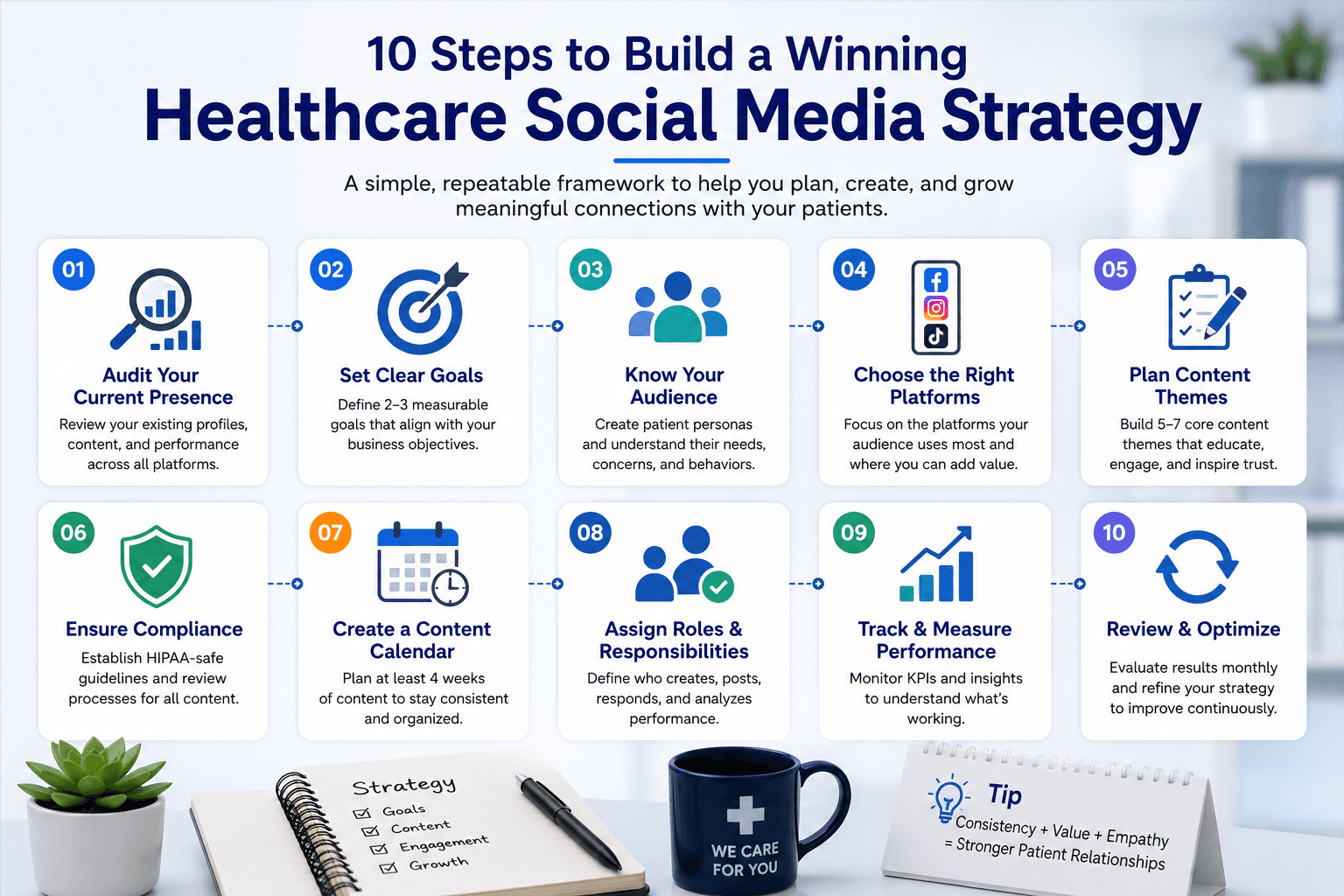
A Step by Step Planning Framework
Use this framework as a working session with your marketing team, whether that is a single person or a full department.
Audit your current presence across every platform, including old or forgotten accounts
Set two to three specific, measurable goals for the next quarter
Build patient personas for each major service line or department
Choose two primary platforms based on where those personas actually spend time
Map out five to seven recurring content themes tied to real patient questions
Draft a compliance checklist with input from your legal or risk team
Build a four week content calendar as a working template, not a one-time document
Assign clear ownership for posting, responding, and monthly reporting
Review performance against your goals every thirty days and adjust
Treat this as a living framework. Revisit it every quarter, since patient behavior, platform algorithms, and your organization’s own priorities will keep shifting throughout the year.
Checklist for Building a Healthcare Social Media Strategy
Defined at least two measurable goals for the quarter
Documented patient personas for each key audience segment
Selected primary platforms based on audience research, not guesswork
Built a recurring content theme list tied to real patient questions
Created a compliance review step before any post goes live
Assigned an owner for posting and an owner for responding to comments
Set a response time standard for comments and direct messages
Scheduled a recurring monthly reporting review against KPIs
Written an employee social media policy covering patient privacy
Planned a quarterly strategy review to adjust goals and tactics
Conclusion
A healthcare social media strategy is not about posting more often. It is about posting with intention, tied to real goals, built around the actual patients you want to reach, and backed by a compliance process that protects your organization.
Start small if you need to. Two platforms, a clear set of goals, and a monthly review habit will outperform a scattered presence across every network every single time.
If your team needs support turning this framework into a running system, Sociali’s healthcare solution was built specifically for healthcare marketers who need consistent, compliant content without adding headcount. From content planning to compliance friendly drafting and reporting, it is designed to take this exact framework and put it on autopilot for hospitals, clinics, and private practices.
For a broader look at how all of these pieces fit together across a full year of planning, our complete healthcare social media strategy guide goes even deeper into annual planning and budget allocation.
Frequently Asked Questions
How often should a healthcare organization post on social media?
Most practices see solid results posting three to five times per week per platform, focused on two primary platforms. Consistency matters far more than volume, so a sustainable three posts a week beats seven posts that stop after a month.
Which social media platform is best for healthcare marketing?
There is no single best platform for every organization. Facebook tends to work well for community building and older patients, while Instagram and TikTok reach younger audiences with visual and video heavy content. The right choice depends on your specialty and patient demographics.
How do you stay HIPAA compliant on social media?
Never share identifiable patient information, images, or stories without a signed release specific to social media use, avoid confirming someone is a patient in public comments, and route any content involving real patients through a compliance review before publishing.
What kind of content works best for patient engagement?
Educational content answering specific patient questions, real staff and provider features, and patient testimonials with proper consent tend to outperform generic wellness posts or purely promotional content.
How much should a healthcare practice budget for social media marketing?
Budgets vary widely by organization size, but many small to mid sized practices allocate somewhere between five hundred and three thousand dollars a month when combining content production, paid promotion, and management tools.
Should physicians and providers be personally active on social media?
Provider involvement, even in a limited capacity like short video clips or occasional posts, tends to significantly boost trust and engagement compared to content that never features a real clinical voice.
How do you measure ROI from healthcare social media efforts?
Track appointment requests, booking page clicks, and new patient inquiries that can be attributed to social channels, alongside engagement and follower growth, and compare these numbers against the specific goals set at the start of each quarter.
What is the biggest mistake healthcare organizations make on social media?
Inconsistency is the most common issue, followed closely by skipping compliance review in the interest of moving faster. Both mistakes are avoidable with a documented strategy and clear internal ownership of the channel.
Free resource
Get the checklist


