Patient Engagement on Social Media: The Complete Healthcare Guide (2026)
|
8
min read

HEALTHCARE SAAS CONTENT
Patient Engagement on Social Media: The Complete Healthcare Guide (2026)
Primary Keyword: Patient Engagement on Social Media
SEO Title: Patient Engagement on Social Media: What Works in 2026
URL Slug: /blog/patient-engagement-social-media
Meta Description: Learn proven patient engagement strategies on social media. Build trust, grow communities, and improve patient communication with HIPAA-conscious tactics.
Table of Contents
1. What Is Patient Engagement on Social Media?
2. Why Patient Engagement Matters in Healthcare
3. Benefits of Social Media Patient Engagement
4. Common Patient Engagement Challenges
5. Healthcare Community Building Best Practices
6. Patient Communication Strategies That Actually Work
7. Content Types That Increase Engagement
8. Social Media Platforms Explained
9. Mistakes That Hurt Patient Engagement
10. Measuring Patient Engagement
11. AI and the Future of Healthcare Patient Engagement
12. Improve Patient Engagement Without Adding More Work
13. Frequently Asked Questions
14. SEO Deliverables & Publishing Checklist
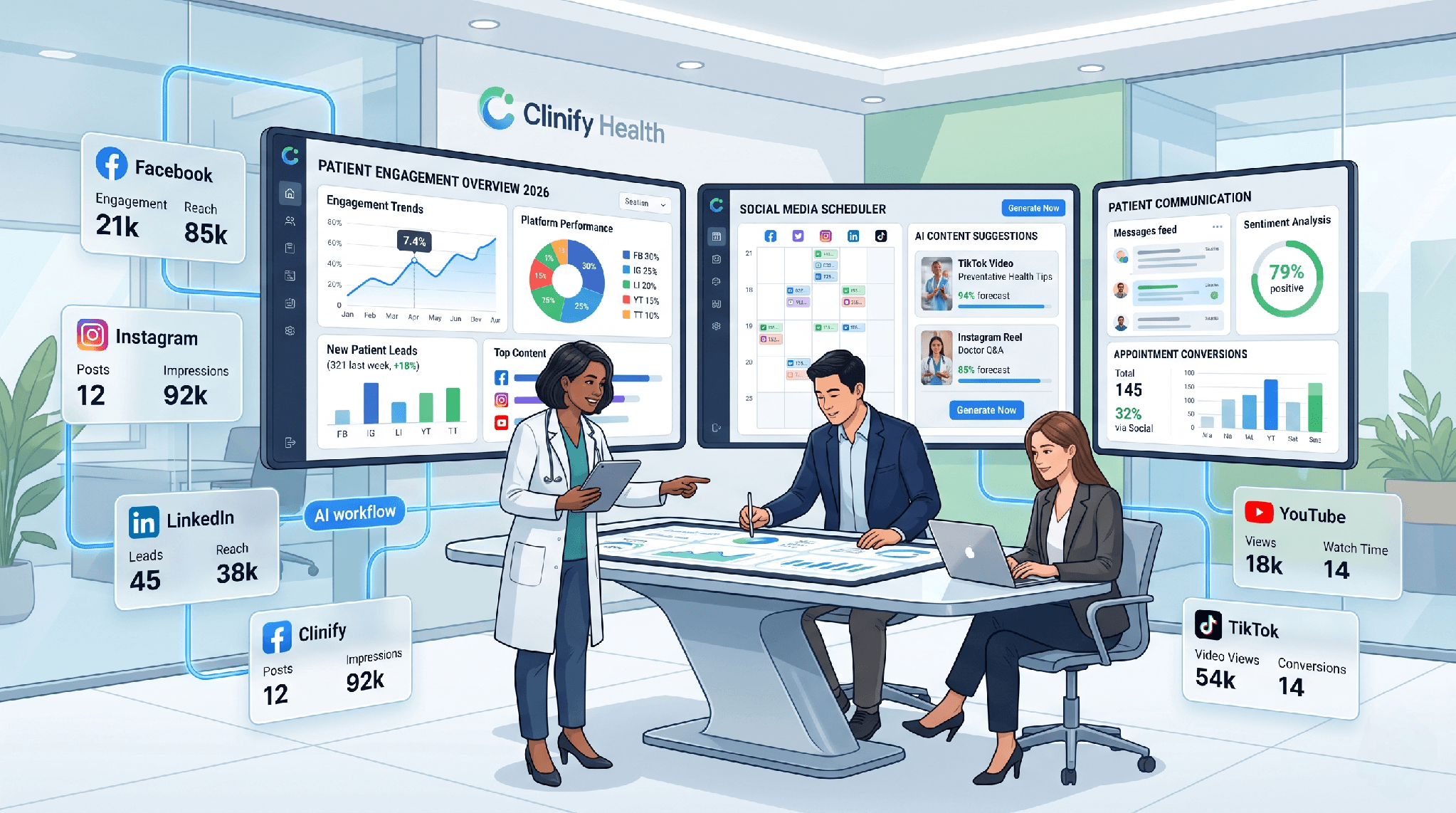
Most healthcare organizations treat social media like a notice board. They post visiting hours, announce a new physician, maybe share a health tip every few weeks, and call it done. Then they wonder why nobody’s engaging.
The truth is, patient engagement on social media is one of the most underutilized assets in healthcare marketing. When done right, it builds the kind of trust that keeps patients coming back, drives referrals, and positions your organization as a genuine community health partner rather than a faceless institution.
This guide breaks down everything that actually works, from platform strategy and content types to HIPAA-conscious communication and the metrics that tell you whether any of it is making a difference. Whether you’re running a multi-location hospital system, a DSO, a behavioral health group, or a single-specialty clinic, the principles here apply.
Quick Answer
Patient engagement on social media is the ongoing interaction between healthcare organizations and patients through educational content, meaningful conversations, timely responses, and online communities. When done consistently, it improves patient trust, strengthens communication, increases retention, and supports better health outcomes.
What Is Patient Engagement on Social Media?
Patient engagement on social media refers to the ongoing, intentional communication between healthcare organizations and their patient communities across platforms like Facebook, Instagram, LinkedIn, YouTube, and others. It goes well beyond broadcasting health content.
True engagement means patients are reading, reacting, sharing, and responding to what you post. It means they feel informed, respected, and connected to the brand. It also means your organization is listening, not just talking.
Social media patient engagement sits at the intersection of healthcare digital engagement and relationship management. It’s not a marketing gimmick. It’s a long-term strategy for retention, reputation, and community health impact.
Why Patient Engagement Matters in Healthcare
Patient retention is one of the biggest business challenges facing healthcare organizations today. Studies consistently show that acquiring a new patient costs significantly more than retaining an existing one. Social media is one of the most cost-effective tools for staying top-of-mind between appointments.
Patient engagement is only one part of a successful digital strategy. Healthcare organizations looking to build long-term growth should also develop a comprehensive Healthcare Social Media Marketing Strategy that aligns content planning, community engagement, compliance, and performance measurement across every platform.
Beyond retention, engaged patients make better health decisions. When you regularly share educational content and preventive care reminders, you’re actively supporting patient outcomes, not just marketing to them. That shift in framing changes everything about how your audience responds.
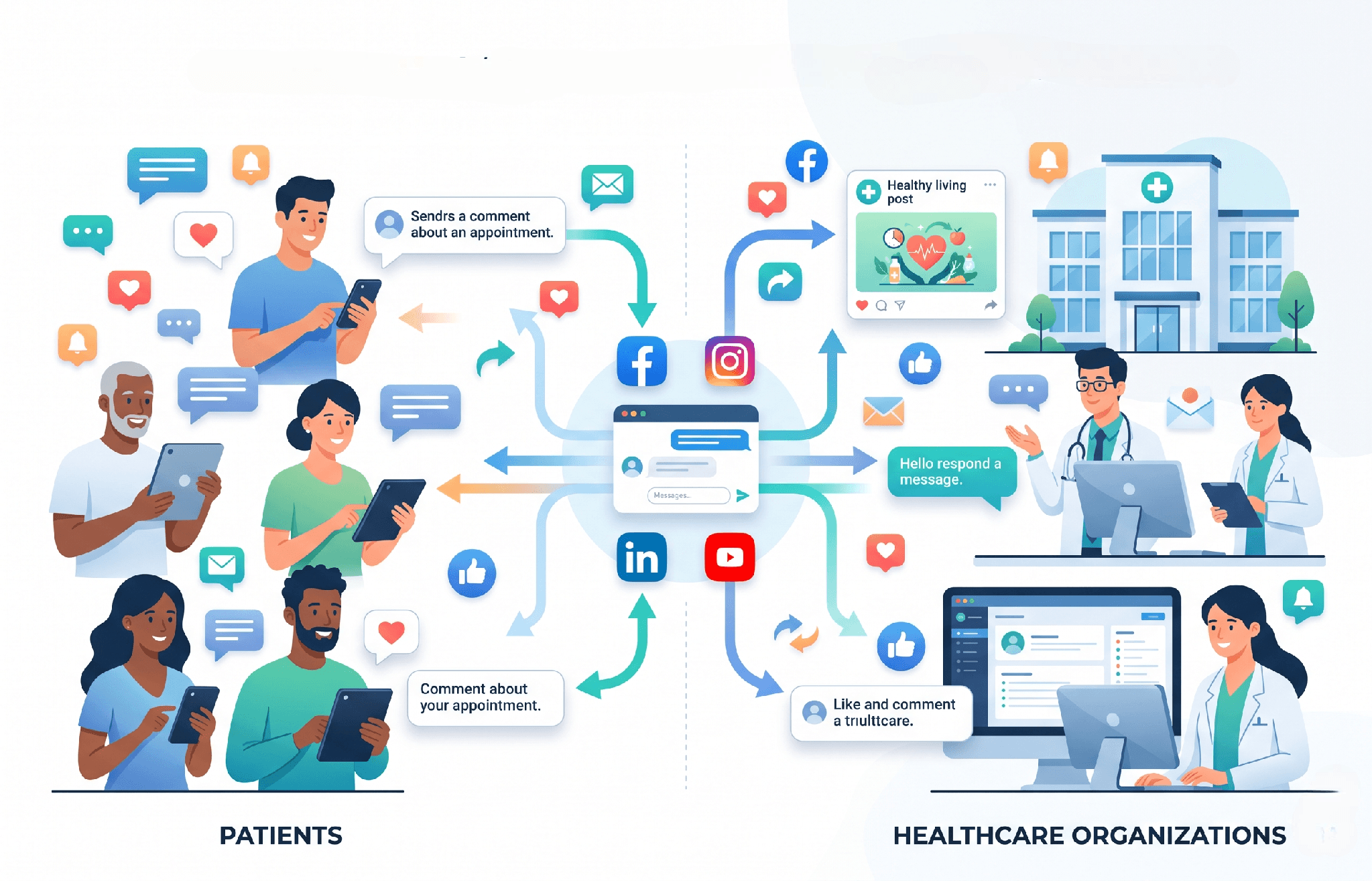
Healthcare brand trust is also increasingly built online. A 2023 Accenture survey found that over 60% of patients research healthcare providers on social media before scheduling an appointment. What they find, or fail to find, directly affects your conversion rate.
For behavioral health organizations especially, authentic digital engagement breaks down stigma and creates accessible entry points for patients who might otherwise never pick up the phone.
Benefits of Social Media Patient Engagement
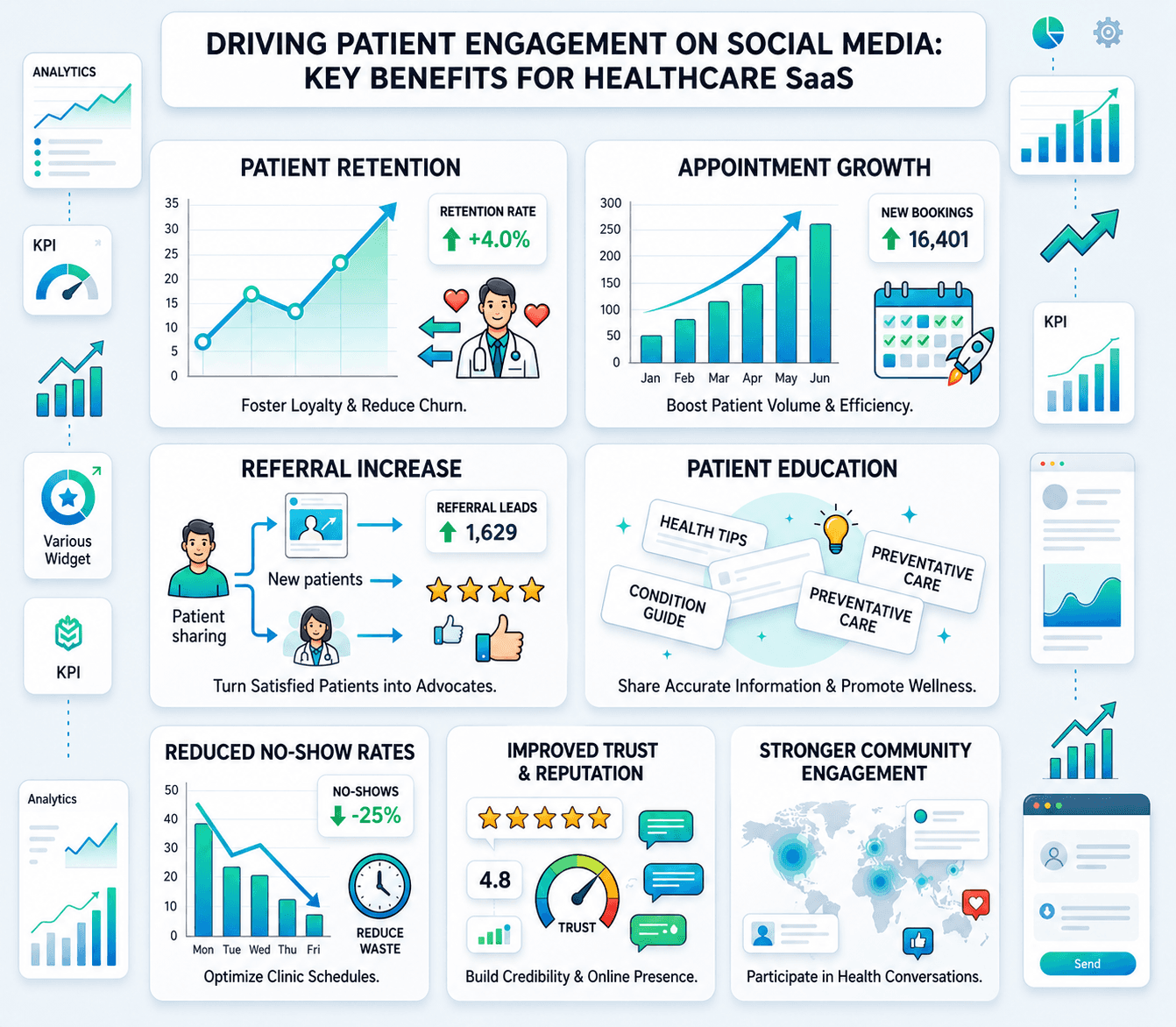
The returns are measurable and diverse when you run a real patient engagement strategy on social media:
Stronger brand recognition across your service area
More appointment requests generated from organic content
Higher patient retention rates due to ongoing communication
Better patient education and health literacy outcomes
Reduced no-show rates when reminders are reinforced socially
Increased referral traffic from patients who share your content
Faster reputation recovery during organizational challenges
Improved access for underserved communities through accessible digital communication
These outcomes do not happen by accident. They are the result of consistent, audience-first content strategy, not sporadic posting.
Common Patient Engagement Challenges
Healthcare organizations face real barriers to effective social engagement that other industries do not. Knowing them upfront helps you build a strategy that accounts for them.
HIPAA Compliance Concerns
Many marketing teams become overly cautious on social media because of HIPAA, and rightly so. Patient privacy is non-negotiable. The challenge is that compliance fears often lead to generic, lifeless content that nobody engages with. The solution is not to ignore compliance but to build a content framework that is engaging by design within those boundaries.
You can share general health information, highlight your team, celebrate community events, and respond to public comments without ever touching protected health information. The line is clear once you understand it.
Inconsistency and Content Gaps
Many healthcare organizations start strong and fade. Campaigns launch, a few weeks pass, then the social feed goes quiet. Inconsistency erodes trust faster than bad content does. Patients notice when organizations go dark.
Resource Constraints
Hospitals and clinics are not media companies. Marketing teams are often lean, and creating a steady stream of valuable healthcare content while managing everything else is genuinely difficult. This is where tools and systems make or break a strategy.
Engaging Without Sounding Generic
Healthcare content has a tendency to be safe to the point of being boring. Nobody shares a post that says ‘Remember to wash your hands.’ Authentic storytelling, real team voices, and patient-centered narratives are what actually move audiences.
Healthcare Community Building Best Practices
Building an online patient community is not just about gaining followers. It is about creating a space where patients feel informed, supported, and heard. Here is what distinguishes organizations that build real communities from those with large, disengaged audiences.
Post With a Clear Voice
Your social presence should have a recognizable personality. Warm, informative, and accessible works for most healthcare brands. Formal and stiff does not. Decide what you stand for and let that come through consistently.
Respond to Everything
Comments, direct messages, reviews, and even negative feedback deserve timely responses. Ignoring comments signals to your community that the account is automated or unmanned. Quick, thoughtful responses are among the highest-impact engagement tactics available.
Feature Your People
Physicians, nurses, front desk staff, and administrators are your strongest brand assets. Behind-the-scenes content and team spotlights consistently outperform generic health tips because they humanize your organization. Patients choose providers they feel they know.
Make Content Accessible
Use plain language. Include captions on videos. Add image descriptions where possible. Write at a reading level that works for a broad audience, not just healthcare professionals. Inclusive communication is both ethically important and strategically smart since it expands your reach.
Build Around Patient Journeys
Map your content to the stages patients move through: awareness, consideration, scheduling, treatment, recovery, and ongoing relationship. Different content types work at different stages. Educational posts drive awareness. FAQs help patients make decisions. Post-care content supports retention.
Patient Communication Strategies That Actually Work
Patient communication tools have changed dramatically. Social media is now a primary channel for many patients, particularly younger demographics. Here are the strategies that move the needle.
Direct Messaging for Non-Clinical Support
Many patients prefer sending a DM over calling a main line. While clinical questions must be handled through appropriate channels, social DMs are excellent for appointment inquiries, directions, general questions, and routing patients to the right contact. Enabling and monitoring this channel is a meaningful service improvement.
Live Q&A Sessions
Live sessions with physicians, dietitians, mental health professionals, or other specialists give patients real-time access that feels valuable and personal. These work particularly well on Facebook and Instagram. Promote them in advance, keep sessions to 30-45 minutes, and repurpose the recording afterward.
Preventive Care Reminders
Seasonal flu shot reminders, annual wellness visit prompts, and screening deadline posts are highly useful to patients and serve a genuine public health function. These consistently perform well because they are timely and immediately actionable.
Patient Stories
With appropriate consent and a careful process for handling privacy, patient stories are the most compelling content you can produce. A brief account of someone’s experience navigating care, managing a chronic condition, or recovering from a procedure builds emotional connection that no infographic can match.
Content Types That Increase Engagement
Not all content performs equally. These formats have consistently demonstrated strong engagement in the healthcare space.
Educational Posts
Short explanations of health conditions, treatment options, or care processes perform well when written in plain language and focused on patient questions rather than clinical details. Think ‘What is an HbA1c test and why does your doctor order it?’ rather than a medical journal abstract.
Preventive Care Reminders
Timely, seasonal, and condition-specific reminders that prompt action are among the most shared content in healthcare. They work because they are genuinely useful.
Doctor Q&A and FAQ Content
Short video or carousel posts where a physician answers a common patient question are highly effective. They build physician brand recognition and reduce repetitive phone inquiries at the same time.
Behind-the-Scenes Content
Tours of facilities, a day-in-the-life of a care team member, preparation for a community health event. This content works because it makes abstract healthcare organizations feel real and accessible.
Patient Stories
As mentioned above, authentic, privacy-compliant patient narratives are among your most powerful assets. A short written testimonial with a photo, or a brief video clip, can reach thousands and trigger emotional responses that drive scheduling decisions.
Short Videos
Video content outperforms static images on nearly every platform. Even simple, low-production clips, whether it is a physician explaining a procedure or a nurse offering a tip, see stronger reach and engagement than text posts alone. Aim for 60 to 90 seconds for most platforms.
Infographics
Well-designed visual data, such as statistics about a condition, treatment comparison charts, or step-by-step care guides, are highly shareable and drive saves. They also perform well in featured snippet placement when the same content is on your website.
Community Campaigns
Cause-driven campaigns around awareness months, fundraising drives, or local health initiatives generate organic participation and press. They also align your brand with values that matter to patients.
Social Media Platforms Explained
Choosing the right platform matters as much as creating good content. Here is a breakdown of where healthcare organizations should focus.
Still the most important platform for healthcare social media marketing, especially for reaching patients over 40. Facebook supports long-form posts, live video, event promotion, and community groups. Multi-location healthcare groups and hospitals should maintain strong, active Facebook presences. Community groups around chronic disease management, parenting health, or local wellness can be transformative engagement tools.
Best for visual storytelling, team highlights, and lifestyle health content. It skews toward a younger demographic and is effective for dental practices, aesthetic medicine, wellness brands, and any organization with strong visual assets. Reels consistently outperform standard image posts for reach.
If Instagram is one of your primary patient engagement channels, having a structured growth strategy matters just as much as creating quality content. Our Zero to 10K Followers Instagram Strategy (2026) explains practical techniques for growing an engaged audience while maintaining a consistent publishing schedule.
The right platform for B2B healthcare content, executive thought leadership, and recruiting. Hospitals, DSOs, and healthcare SaaS companies use LinkedIn effectively for industry positioning, partnership development, and sharing clinical research. It is not primarily a patient-facing channel but plays an important role in healthcare brand trust among professionals.
YouTube
YouTube is the second largest search engine in the world, which makes it critical for healthcare organizations that produce video content. Patient education series, procedure explanations, facility tours, and physician Q&A content perform well here. Videos also appear in Google search results, which makes YouTube a strong SEO asset.
X (Twitter)
Useful for healthcare organizations that want to participate in clinical conversations, respond to public health news, or build physician thought leadership. The general patient audience is smaller here than on Facebook or Instagram, but the professional credibility signals are strong.
TikTok
Growing rapidly among under-35 demographics and showing particular traction in behavioral health, primary care, and preventive health content. Short educational videos from clinicians, myth-busting content, and day-in-the-life format perform well. Organizations serving younger populations should test TikTok. Compliance considerations require a clear review process before posting.
Mistakes That Hurt Patient Engagement
These are the patterns that undermine healthcare social media strategies most reliably.
Mistake: Posting only promotional content
Patients scroll past ads. If your feed reads like a product catalogue, engagement will stagnate. A healthy ratio is roughly 70% educational or community content to 30% organizational promotion.
Mistake: Ignoring comments and DMs
An unanswered comment tells every future reader that your organization does not care. Response time matters. For high-volume accounts, a moderation tool or assigned community manager is essential.
Mistake: Inconsistent posting
Gaps of two or more weeks in posting frequency signal inactivity to both your audience and platform algorithms. Consistency beats frequency. Three strong posts per week outperform seven average ones.
Mistake: Sharing unverified health information
Misinformation is a serious reputational and liability risk in healthcare. Every factual claim should be verified before posting. Cite sources where appropriate and have clinical staff review health content before it goes live.
Mistake: Overly clinical language
Content written for healthcare professionals rarely connects with patients. Plain language, real examples, and accessible explanations are what drive engagement in patient-centered healthcare marketing.
Measuring Patient Engagement
Healthcare social media strategy without measurement is guesswork. These are the KPIs that matter and what they tell you.
KPI | What It Measures | Why It Matters |
Engagement Rate | Likes, comments, shares vs. total reach | Core measure of content resonance |
Reach | Unique accounts that saw your post | Tracks brand awareness growth |
Saves | Content bookmarked by users | Signals high-value educational content |
Shares | Content redistributed by followers | Amplifies word-of-mouth reach |
Comments | Written responses to posts | Deepest engagement signal |
Direct Messages | Private conversations initiated | Indicates service interest or need |
Website Clicks | Traffic driven from social | Connects content to conversion |
Appt. Requests | Scheduling actions from social | Direct revenue attribution |
Patient Retention | Return visit rate for social-acquired patients | Long-term loyalty measure |
Track these monthly at minimum. Quarterly reviews that map social performance to appointment volume and patient retention give you the business case to invest more in what works.
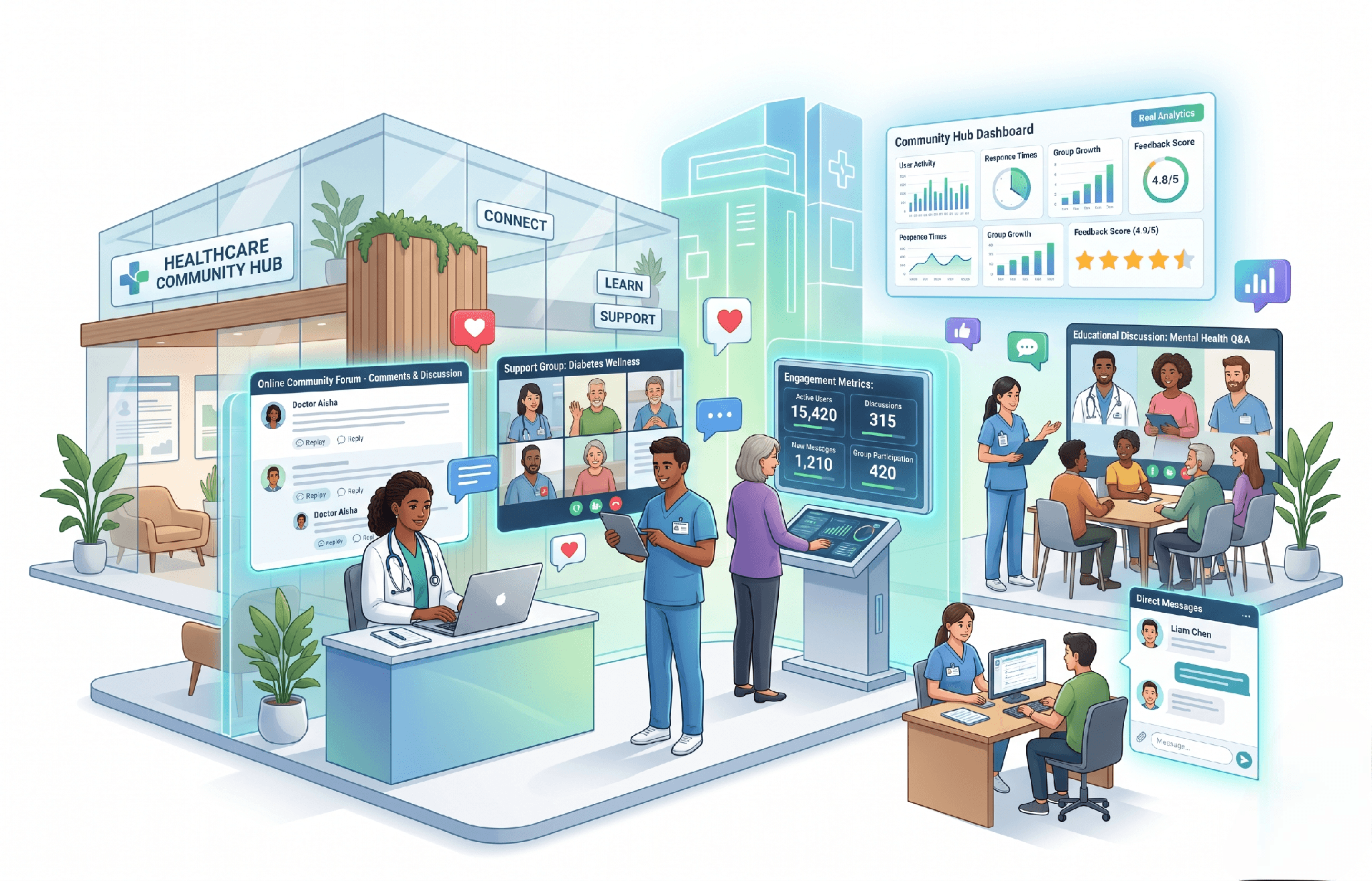
AI and the Future of Healthcare Patient Engagement
Artificial intelligence is changing the mechanics of healthcare social media marketing in ways that make consistent, high-quality engagement more achievable for lean marketing teams.
AI Content Planning
AI tools can now analyze engagement data across your accounts and identify which topics, formats, and posting times perform best with your specific audience. Instead of guessing what to post next week, you can work from data-backed recommendations.
Automated Scheduling
Scheduling tools powered by AI go beyond setting a time for posts. They now optimize publish times based on when your audience is most active and adjust dynamically as patterns shift. For multi-location healthcare organizations managing multiple accounts, this reduces significant administrative burden.
Smart Moderation
AI-assisted moderation can flag potentially sensitive comments, filter spam, and route urgent patient messages to the appropriate team member. This is especially valuable for behavioral health organizations managing high comment volumes where thoughtful responses are essential.
Personalized Communication
Personalization in healthcare social media is an emerging capability. AI can help segment audiences and tailor messaging for different patient demographics, service lines, or geographic locations, making content feel more relevant to the people who see it.
Analytics and Performance Optimization
Reporting dashboards powered by AI surface insights faster than manual analysis. Instead of spending hours compiling spreadsheets, marketing teams get clear visualizations of what is working, where engagement is declining, and which content investments are driving the most value.
One platform built specifically for healthcare organizations navigating this landscape is Sociali.ai. Its Healthcare Social Media Management Solution combines AI-powered content planning, scheduling, analytics, and collaboration tools designed specifically for hospitals, clinics, DSOs, behavioral health organizations, and multi-location healthcare brands. Instead of relying on disconnected tools, healthcare teams can manage their entire social media workflow from one centralized platform while maintaining compliance and brand consistency.
For teams managing multiple social accounts across a DSO, a hospital network, or a multi-location behavioral health group, having a centralized tool that maintains brand consistency while allowing location-specific customization is a meaningful operational improvement.
Improve Patient Engagement Without Adding More Work
The biggest reason healthcare organizations fail at social media is not lack of ideas. It is lack of a sustainable system. Most teams start with ambition and hit a wall when the content queue runs dry and nobody has time to refill it.
The answer is not to hire a full content team, though that eventually makes sense at scale. The answer is to build a workflow that produces consistent output without requiring heroic effort every week.
AI-powered automation handles the scheduling, timing optimization, and performance reporting. Your clinical and marketing staff focus on what only humans can do: sharing genuine expertise, capturing real stories, and making sure content reflects your organization’s voice.
Consistency matters more than perfection. A reliable cadence of thoughtful, patient-centered content, maintained week after week, builds more trust than a viral post followed by three weeks of silence.
Sociali.ai was built for exactly this kind of healthcare marketing operation. If your team is stretched thin and your social presence reflects it, explore how Sociali.ai’s Healthcare Social Media Solution helps healthcare organizations create, schedule, publish, and analyze social media content while maintaining consistent communication with patients.
Frequently Asked Questions
What is patient engagement on social media?
Patient engagement on social media is the ongoing two-way communication between healthcare organizations and their patients through platforms like Facebook, Instagram, LinkedIn, and YouTube. It includes sharing educational content, responding to comments and messages, and building community around health topics relevant to your patient population.
How can healthcare organizations stay HIPAA-compliant on social media?
HIPAA compliance on social media means never sharing any protected health information (PHI) in public posts or comments. Avoid referencing specific patient situations, never respond to health inquiries with clinical advice in public comments, and ensure any staff involved in social media understands what information is off-limits. Redirect clinical questions to secure channels.
Which social media platform is best for healthcare patient engagement?
Facebook remains the strongest platform for most healthcare organizations given its broad demographic reach and support for community groups, long-form content, and events. Instagram works well for visual storytelling. YouTube is critical for video education content. LinkedIn suits executive and professional audiences. Platform choice should align with your specific patient demographics.
How often should a healthcare organization post on social media?
Three to five posts per week is a strong target for most healthcare organizations. Consistency matters more than volume. A reliable posting schedule with high-quality content consistently outperforms sporadic bursts of activity followed by long gaps.
What content works best for patient engagement?
Educational posts, physician Q&A content, patient stories with consent, short videos, preventive care reminders, and behind-the-scenes team features consistently drive strong engagement. The common thread is authenticity and relevance to real patient concerns.
How can I measure the success of our healthcare social media strategy?
Key metrics include engagement rate, reach, saves, shares, comments, direct messages, website clicks, appointment requests generated from social, and patient retention rates for social-acquired patients. Review these monthly and connect social performance to actual appointment and retention data quarterly.
What are the biggest mistakes healthcare organizations make on social media?
Over-promotion, ignoring comments and messages, posting inconsistently, using clinical language that patients cannot connect with, and sharing unverified health information are the most common and damaging mistakes. A content strategy built around patient value rather than organizational promotion avoids most of these.
How can AI help with healthcare social media marketing?
AI tools can assist with content planning and scheduling optimization, performance analytics, audience segmentation, moderation of high-volume comment threads, and maintaining brand consistency across multiple accounts or locations. Platforms like Sociali.ai are built specifically for healthcare marketing teams that need these capabilities without adding significant administrative overhead.
How do I build patient trust on social media?
Trust is built through consistency, authenticity, and responsiveness. Post regularly with content that genuinely helps patients. Respond quickly and thoughtfully to comments and messages. Feature real team members and real patient perspectives where consent allows. Avoid promotional language in educational content. Engagement volume follows trust.
Is social media worth investing in for healthcare organizations?
Yes, when done with a clear strategy. Social media supports patient acquisition, retention, education, and reputation management simultaneously. It is one of the few marketing channels where a consistent, audience-first approach can generate compounding returns over time. The cost of inaction is increasingly visible as patients conduct more of their healthcare provider research online.
Free resource
Get the checklist


