Healthcare Social Media Strategy: The Complete Guide for Healthcare Organizations in 2026
|
8
min read

Healthcare Social Media Strategy:
The Complete Guide for Healthcare Organizations in 2026

Introduction
Most healthcare organizations post on social media. Few of them have a healthcare social media strategy.
The difference is significant. Posting content is an activity. A strategy is a plan that connects every piece of content to a specific business goal, whether that is building brand awareness, attracting new patients, educating your community, or strengthening your reputation in a competitive market.
Patient expectations have shifted. Before scheduling an appointment, a large share of prospective patients research providers online. They check your website, read reviews, and scroll through your social media profiles. What they find, or do not find, directly influences their decision to call your clinic or walk through your doors.
Healthcare markets have also grown more competitive. Whether you operate a single hospital, a network of behavioral health clinics, or a multi-state dental group, the organizations that capture patient attention online are the ones investing in a structured, consistent social media presence.

This guide covers every component of a successful healthcare social media strategy, from audience research and goal setting to platform selection, content planning, compliance, and performance measurement. Use it to build a strategy from the ground up or to strengthen the one you already have.
While this guide focuses specifically on building an effective healthcare social media strategy, social media is only one component of a larger digital marketing framework. Organizations looking for a broader perspective on patient engagement, healthcare content marketing, platform selection, AI adoption, and social media trends should also read our Healthcare Social Media Marketing: The Complete Guide for Healthcare Organizations in 2026. Together, these resources provide a complete framework for building and scaling healthcare marketing efforts.
What Is a Healthcare Social Media Strategy?
A healthcare social media strategy is a documented plan that defines how a healthcare organization uses social media platforms to achieve specific marketing, communication, and patient engagement goals.
It covers what content you create, where you publish it, who your audience is, how often you post, how you respond to comments and messages, how you measure results, and how you ensure every piece of content meets compliance requirements.
The key distinction is the word strategy. Posting a photo of your team on Monday and an awareness graphic on Friday without any underlying framework is not a strategy. A true healthcare social media strategy connects platform activity to organizational objectives. It answers questions like:
What do we want social media to accomplish for our organization?
Who are we trying to reach and what do they care about?
Which platforms give us the best access to that audience?
What content formats will drive the most engagement?
How will we measure success and improve over time?
Social media for healthcare serves multiple purposes simultaneously. It supports patient acquisition by increasing your visibility and driving appointment requests. It supports retention by keeping existing patients connected to your organization and informed about services. It builds community trust by positioning your physicians and care teams as credible, accessible sources of health information.
Why Healthcare Organizations Need a Social Media Strategy in 2026
The argument for investing in social media for healthcare is no longer theoretical. The behavior data is clear.
Research consistently shows that patients use search engines and social media to evaluate healthcare providers before booking appointments. A significant share of people say online information influenced their choice of hospital or physician. Your social media presence is part of the decision-making process for potential patients, whether you manage it deliberately or not.
Beyond patient acquisition, here is why a formal healthcare marketing strategy for social media matters right now:
Increased Digital Competition
Independent practices, hospital systems, telehealth providers, and specialty clinics are all competing for attention in the same digital space. Organizations with a consistent, high-quality social presence outperform those that post inconsistently or without purpose.
Reputation Management
Patients leave reviews, ask questions, and sometimes raise concerns on social platforms. Organizations with an active social media presence can monitor these conversations, respond promptly, and protect their reputation in real time. Organizations without a strategy often miss these moments entirely.
Patient Education and Trust
Healthcare consumers want to understand their health options before they arrive at a clinic. Social media gives organizations a direct channel to share preventive care information, explain procedures, address common concerns, and build the kind of trust that turns a social media follower into a patient.
Brand Awareness in Competitive Markets
For multi-location healthcare groups and hospital systems, social media is a cost-effective way to maintain visibility across service areas. Consistent branding and messaging across platforms reinforces recognition and makes your organization the first call when a patient needs care.
Community Engagement
Local presence matters in healthcare. Social platforms allow organizations to participate in community conversations, promote local health events, recognize team members, and demonstrate that they are invested in the communities they serve.
The Core Components of a Successful Healthcare Social Media Strategy
A well-built healthcare social media strategy has seven core components. Each one serves a distinct purpose, and they work together to create a system rather than a random collection of posts.
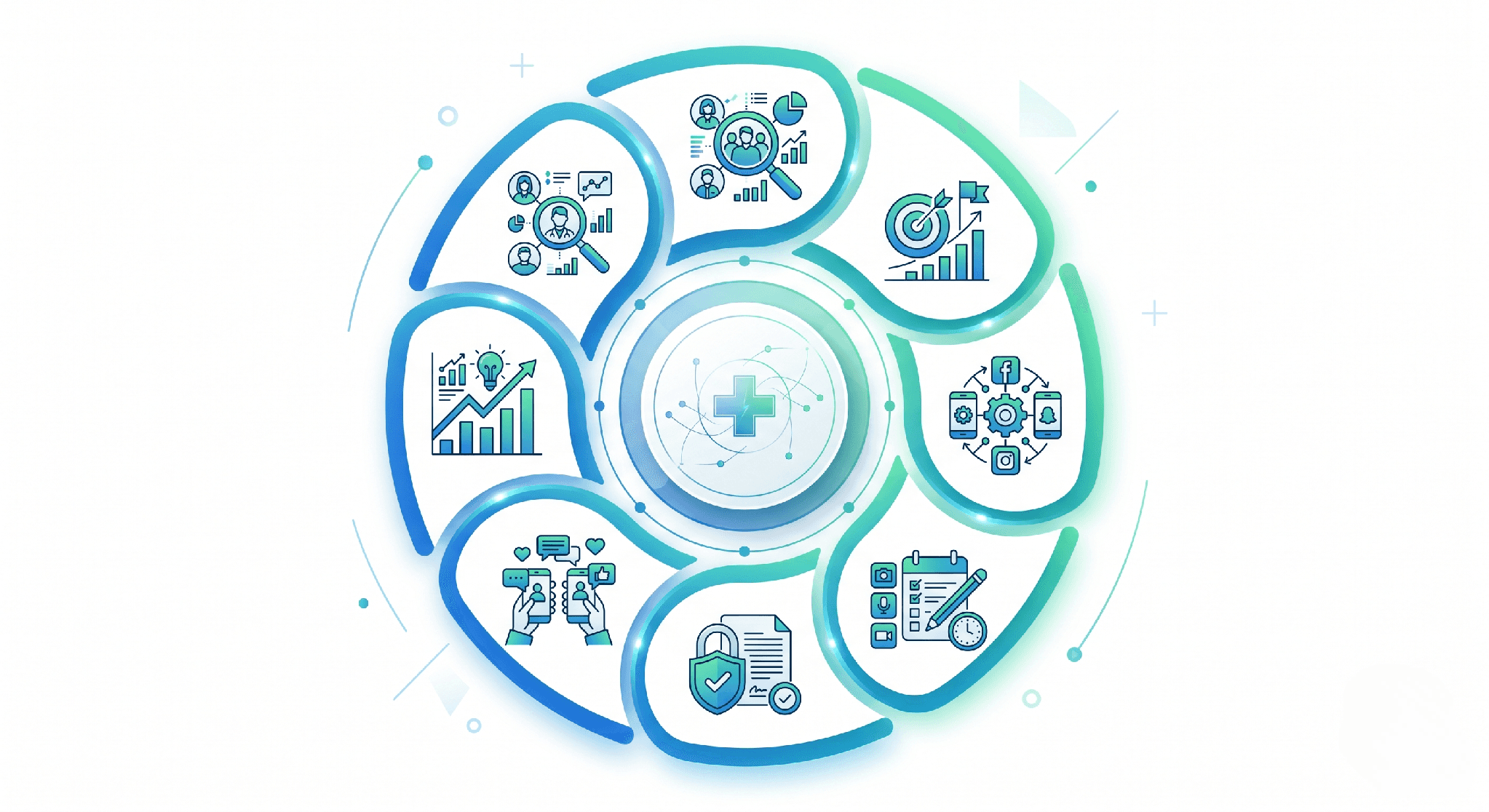
1. Audience Research
Before creating a single piece of content, you need to understand who you are trying to reach. Audience research in healthcare includes defining patient demographics, understanding their health concerns, identifying where they spend time online, and learning what types of content they find valuable. Your audience may differ significantly by service line, location, or specialty.
2. Goal Setting
Every healthcare social media strategy needs clearly defined goals. Goals give your team direction and provide the benchmark against which you measure success. Healthcare social media goals typically include brand awareness, patient engagement, website traffic, appointment requests, and community growth. Goals should be specific, measurable, and tied to organizational priorities.
3. Platform Selection
Not every social platform is right for every healthcare organization. Platform selection should be guided by where your audience is, what content formats you can produce consistently, and what your goals require. Spreading resources across every platform rarely works. Focus on two to three platforms and do them well.
4. Content Planning
A healthcare content strategy defines what you will post, how often, and in what format. It includes a content mix that balances education, community, behind-the-scenes content, patient stories, and promotional material. A content calendar keeps your team aligned and ensures consistency.
As healthcare organizations grow, managing content creation, approvals, scheduling, and publishing across multiple locations can become increasingly complex. Many healthcare marketing teams are adopting AI-powered platforms such as Sociali.ai to simplify content planning, streamline approval workflows, generate healthcare-focused content, and maintain consistent brand messaging across every social channel. This helps teams spend less time on manual tasks and more time on strategic initiatives that drive patient engagement.
5. Compliance Guidelines
Healthcare organizations operate under strict privacy regulations, including HIPAA. Your social media strategy must include clear guidelines on what can and cannot be shared, how patient consent is obtained for any content featuring patients, and how staff should behave on organizational and personal social accounts.
6. Patient Engagement
Social media is a two-way channel. A successful healthcare social media strategy includes a plan for responding to comments, direct messages, and reviews in a timely, appropriate, and compliant manner. Ignoring engagement is a missed opportunity and can harm your reputation.
7. Performance Measurement
Without measurement, you cannot know what is working. Your strategy should define which healthcare social media KPIs you track, how frequently you review performance, and how you use data to improve content and tactics over time.
Defining Healthcare Social Media Goals and KPIs
Setting clear goals is what separates organizations that use social media strategically from those that simply post and hope for results. Healthcare social media goals should align with broader marketing and organizational objectives.
Common Healthcare Social Media Goals
Brand Awareness: Increase visibility of your organization, services, and care teams among target patient populations.
Patient Engagement: Build an active, responsive community that interacts with your content and feels connected to your organization.
Website Traffic: Drive visitors to your website to learn more about services, read blog content, or book appointments.
Appointment Requests: Generate a measurable number of appointment inquiries or form submissions directly attributed to social media.
Community Growth: Grow your follower base among prospective and current patients in your service area.
Patient Education: Deliver health information that helps followers make informed decisions about their care.
Each goal requires a corresponding set of healthcare social media KPIs. Here is a reference framework:
Goal | KPI | Measurement Tool | Review Cadence |
|---|---|---|---|
Brand Awareness | Reach, Impressions | Native analytics | Monthly |
Patient Engagement | Engagement Rate, Comments | Social dashboard | Weekly |
Website Traffic | CTR, Sessions | Google Analytics | Monthly |
Appointment Requests | Conversion Rate, Form Fills | CRM + UTM tracking | Monthly |
Community Growth | Follower Growth Rate | Native analytics | Monthly |
Patient Education | Video Views, Save Rate | Platform Insights | Quarterly |
Tracking these KPIs consistently is what enables healthcare organizations to make informed decisions about content, budget, and platform investment. Without KPI tracking, you are making strategy decisions based on guesswork.
Choosing the Right Social Media Platforms for Healthcare Organizations
Platform selection is one of the most important decisions in building a healthcare social media strategy. The right platforms depend on your audience demographics, the content formats your team can produce, your goals, and your available resources.
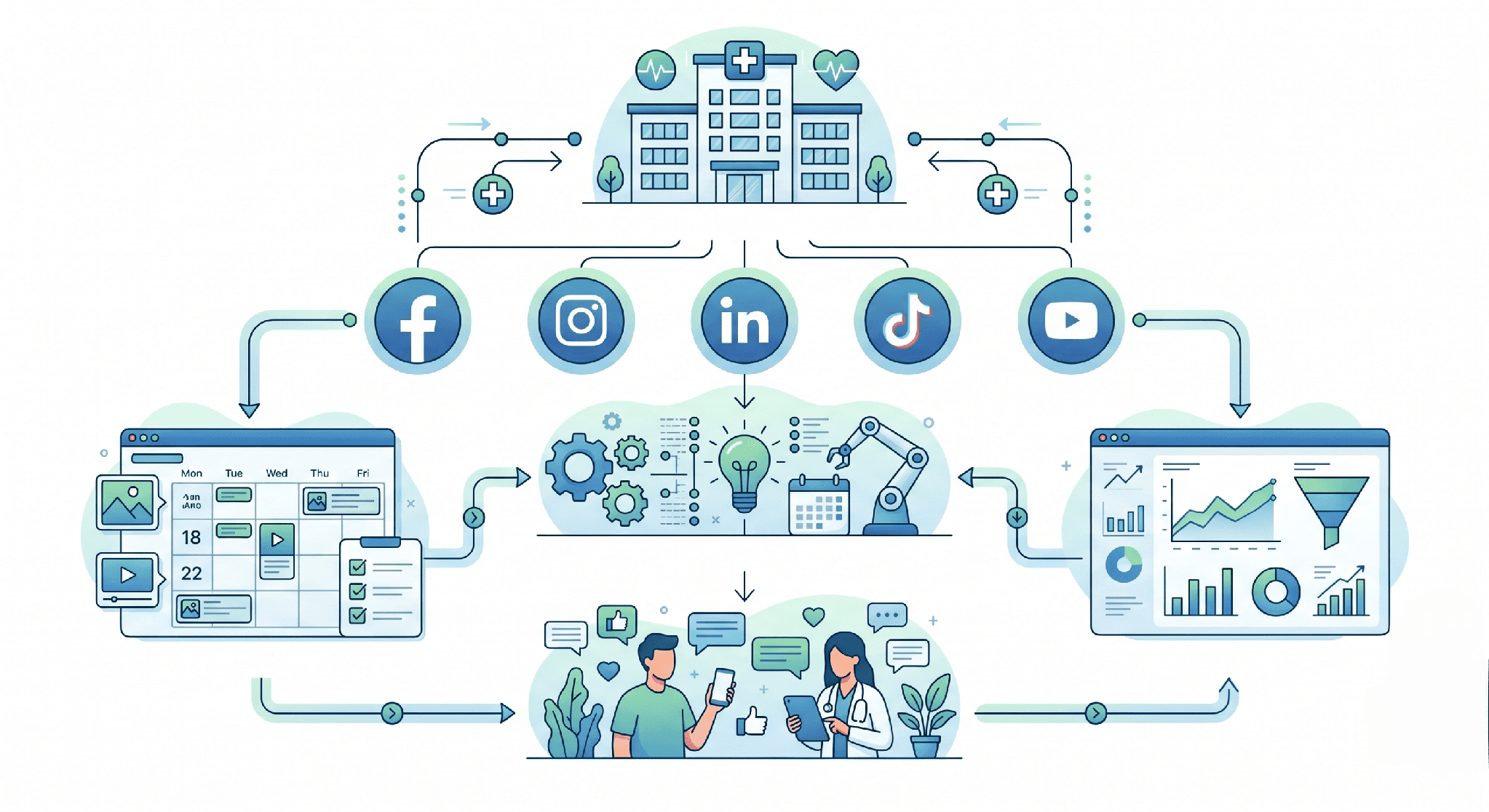
Platform | Primary Audience | Best Content | Key Benefit | Priority | Ad Options |
|---|---|---|---|---|---|
35-65+ | Articles, videos, events | Community building | High | Yes | |
18-45 | Reels, carousels, Stories | Visual storytelling | High | Yes | |
Professionals | Thought leadership | B2B referrals | Medium | Yes | |
YouTube | All ages | Long-form video, explainers | SEO & education | High | Yes |
TikTok | 18-35 | Short-form video | Brand awareness | Growing | Yes |
X (Twitter) | 25-50 | Updates, news, advocacy | Real-time engagement | Low-Medium | Yes |
Recommended Platform Priorities
For most healthcare organizations, Facebook and Instagram should be the foundation. Both platforms offer large, diverse audiences, strong ad targeting capabilities, and content formats suited to healthcare storytelling.
YouTube is a strong investment for organizations that can produce video content, particularly patient education videos, procedure explainers, and physician introductions. YouTube content also improves organic search visibility.
LinkedIn is valuable for hospital systems, behavioral health organizations, and multi-location groups that want to build professional credibility, recruit talent, and engage referring physicians or B2B partners.
TikTok is growing in reach for healthcare, particularly among younger patient populations. It rewards creativity and authentic content. Organizations with capacity to experiment with short-form video should consider it, particularly for awareness and health education campaigns.
Building a Healthcare Content Strategy
A healthcare content strategy defines what your organization publishes, how often, and with what intent. Content should serve your audience first and your organization second. The most effective content educates, informs, or connects, rather than selling.
Core Content Categories
Educational Content: Posts that explain health conditions, treatment options, preventive care practices, or wellness tips. This type of content builds credibility and provides genuine value to followers. Examples include posts about managing chronic conditions, nutrition advice tied to seasonal health themes, or mental health awareness during awareness months.
Preventive Care Tips: Regularly sharing reminders about screenings, vaccinations, and health checks positions your organization as a proactive partner in patient health. These posts perform well because they are actionable and shareable.
Patient Success Stories: Testimonials and patient journey stories are among the most powerful content types in healthcare, when handled with proper consent and sensitivity. They provide social proof and humanize your organization. Written stories, video testimonials, or anniversary posts all work well.
Doctor and Staff Spotlights: Introducing physicians, nurses, therapists, and administrative staff makes your organization approachable. Patients want to know who will care for them. Spotlights build familiarity and trust before a patient ever walks through the door.
Behind-the-Scenes Content: Showing your facility, your team at work, or your organization’s culture gives followers a window into the patient experience. This type of content performs well organically and builds authenticity.
Community Events: Promoting health fairs, free screenings, educational seminars, and community partnerships demonstrates your organization’s investment in the community. It also drives real-world engagement with prospective patients.
FAQs and Myth-Busting: Addressing common patient questions or healthcare misconceptions is highly shareable content. It positions your team as trusted experts and helps patients navigate health decisions more confidently.
Healthcare Awareness Campaigns: Aligning content with national health observances, such as Heart Health Month, Mental Health Awareness Month, or Breast Cancer Awareness Month, provides a built-in editorial calendar and connects your content to broader public health conversations.
Content Mix Recommendation
A balanced content mix for most healthcare organizations should follow roughly this distribution:
40% educational and preventive health content
25% community and culture content (staff spotlights, events, behind-the-scenes)
20% patient engagement content (questions, polls, awareness campaigns)
15% promotional content (services, locations, appointment CTAs)
Healthcare Social Media Best Practices
Knowing what to post is only part of the equation. How you manage your social media presence matters just as much. These healthcare social media best practices apply across platforms and organization types.
Consistency Over Volume
Posting daily for two weeks and then going silent for a month is worse than posting three times a week without interruption. Consistent frequency signals reliability to both your audience and platform algorithms. Build a schedule your team can actually sustain.
Maintaining a consistent publishing schedule can be challenging for busy healthcare marketing teams. Centralized social media management platforms can help organizations plan campaigns, organize content calendars, coordinate stakeholder approvals, and automate publishing. Healthcare-specific solutions like Sociali.ai are designed to support compliance-focused workflows while helping teams maintain a reliable and professional social media presence.
Authenticity Builds Trust
Stock photos and generic graphics perform poorly compared to real photography and video of your actual team, facilities, and patients. Authenticity resonates in healthcare because patients are making trust-based decisions. Invest in real content, even if it is less polished.
Brand Guidelines
Every post should reflect your organization’s visual identity and voice. Inconsistent branding, whether in color, tone, logo usage, or typography, undermines professional credibility. Create a social media brand guide and make sure every content creator follows it.
Community Management
Respond to comments, questions, and direct messages promptly. A 24-hour response window is reasonable for most organizations. Slow or absent responses signal indifference. Timely, helpful engagement builds loyalty and demonstrates that your organization is accessible.
Accessibility
Healthcare audiences include people with visual impairments, hearing loss, and other disabilities. Use alt text for images, captions for videos, and sufficient contrast in graphics. Accessible content is not only inclusive, it is also better indexed by search engines.
Mobile Optimization
The majority of social media consumption happens on mobile devices. Design graphics for vertical formats, keep captions scannable, and ensure any links you share lead to mobile-friendly landing pages on your website.
Video Content
Video consistently outperforms static images across every major social platform. Short-form video for Reels and TikTok, mid-length video for Facebook and LinkedIn, and long-form video for YouTube all serve different purposes within a healthcare content strategy. Organizations that invest in video production see significantly stronger reach and engagement.
Employee Advocacy
Physicians, nurses, and staff who share organizational content on their personal accounts dramatically extend your reach without paid promotion. Build an employee advocacy program with clear guidelines on what staff can share and how to share it compliantly.
Healthcare Compliance and Social Media Governance
Compliance is the dimension of healthcare social media that has no margin for error. HIPAA regulations govern what patient information can be shared, by whom, and under what circumstances. A single non-compliant post can expose your organization to regulatory penalties, legal liability, and reputational damage.
This section provides an overview of key compliance considerations. It is not legal advice. Always consult qualified legal counsel and your compliance officer for guidance specific to your organization.
HIPAA and Patient Privacy
HIPAA prohibits sharing any Protected Health Information (PHI) without explicit patient authorization. PHI includes names, photos, dates of birth, geographic identifiers, medical record numbers, and any other information that could be used to identify a patient.
Social media posts that mention patients, feature patient images, or include patient stories require signed, HIPAA-compliant authorization forms. Even seemingly anonymous details can constitute PHI if they could reasonably be used to identify an individual.
Consent Requirements
Before featuring a patient in any social media content, your organization must obtain written consent that specifies how the content will be used, where it will be published, and how long it may remain visible. Consent forms should be reviewed by your legal team and updated regularly.
Content Approval Workflows
All social media content should pass through an internal review process before publication. For most healthcare organizations, this means clinical review for medical accuracy, compliance review for HIPAA adherence, and marketing review for brand alignment. Document your approval workflow and apply it consistently.
Staff Social Media Policies
Employees who post about their work on personal social accounts can inadvertently create compliance violations. A clear staff social media policy should define what information is prohibited, how to handle patient interactions online, and the consequences of policy violations. All staff should be trained on this policy during onboarding and annually thereafter.
Risk Management
Designate a social media compliance lead within your marketing or compliance team. Conduct periodic audits of your social media presence to identify any content that may need to be removed or modified. Establish a protocol for responding to compliance incidents quickly and transparently.
Common Healthcare Social Media Mistakes to Avoid
Most healthcare social media failures are preventable. They result from the same patterns: posting without direction, ignoring data, or underestimating the complexity of operating in a regulated industry.
Posting Without a Strategy
Problem: Content is created reactively, without clear goals, audience alignment, or brand consistency. Solution: Build your healthcare social media strategy before you publish another post. Define goals, audience, platforms, and content guidelines. Every post should have a purpose.
Ignoring Analytics
Problem: Organizations post consistently but never review performance data, so they repeat what does not work and miss opportunities to scale what does. Solution: Establish a monthly analytics review cadence. Track your healthcare social media KPIs and use insights to adjust content types, posting times, and platform priorities.
Over-Promotional Content
Problem: Feeds dominated by promotional posts drive follower disengagement and reduce organic reach. Solution: Follow the content mix framework outlined earlier in this guide. Keep promotional content to no more than 15 to 20 percent of your total publishing volume.
Inconsistent Branding
Problem: Content created by multiple team members or agencies lacks visual and tonal consistency, undermining brand recognition. Solution: Create a social media brand guide with templates, approved fonts, color palettes, logo usage rules, and tone-of-voice guidelines. Apply it to every piece of content.
Slow Response Times
Problem: Comments and direct messages go unanswered for days, signaling indifference to patients and prospective patients. Solution: Assign community management responsibility to a specific team member or role. Set a maximum response time target and monitor it.
Compliance Risks
Problem: Content is published without proper compliance review, creating HIPAA exposure. Solution: Implement a formal content approval workflow as described in the compliance section of this guide. No content should go live without review.
Poor Content Quality
Problem: Low-resolution images, typos, and generic graphics make your organization appear unprofessional. Solution: Invest in a library of professional photography, branded templates, and basic video production capabilities. Quality signals credibility in healthcare.
How AI Is Transforming Healthcare Social Media Strategy
Artificial intelligence is reshaping how healthcare marketing teams create, manage, and optimize social media content. Organizations that integrate AI tools into their workflows are seeing meaningful improvements in efficiency, content quality, and strategic performance.
AI Content Creation
AI-powered writing tools help healthcare marketers generate first drafts of captions, educational posts, and campaign copy faster than traditional workflows allow. This is particularly valuable for multi-location healthcare organizations that need to produce high volumes of content while maintaining consistency across accounts.
Content Scheduling and Automation
AI scheduling tools analyze platform data to identify optimal posting times for each audience and automatically queue content for publication. This removes guesswork and ensures consistent publishing even during busy periods.
Social Listening
AI-powered social listening tools monitor mentions of your organization, competitors, and relevant health topics across social platforms. This gives healthcare marketing teams real-time visibility into patient sentiment, emerging concerns, and reputation-related conversations they need to respond to.
Performance Insights
AI analytics platforms surface actionable insights from large datasets that would take human analysts hours to process manually. They can identify which content types are driving the most engagement, which audiences are most responsive, and where your social media KPIs are underperforming.
Workflow Automation
For healthcare organizations managing multiple locations and social accounts, AI automation reduces the manual burden of content creation, approval routing, scheduling, and reporting. It frees marketing teams to focus on strategy and creative direction rather than administrative tasks.
Platforms built specifically for healthcare social media are combining these AI capabilities with features designed for the unique compliance and workflow requirements of healthcare organizations. Sociali.ai, for example, is an AI-powered healthcare social media platform that helps healthcare organizations create compliant content, streamline approval workflows, and manage multi-location social media programs more efficiently. You can learn more at sociali.ai/solution/healthcare.
Measuring Success and Optimizing Your Strategy
A healthcare social media strategy is not a document you write once and file away. It is a living framework that should be reviewed, measured, and refined on a regular cadence.
Monthly Reporting
Every month, your team should review performance against the KPIs defined in your strategy. A monthly report should include:
Reach and impressions across platforms
Engagement rate by content type
Follower growth by platform
Website traffic from social media (tracked via UTM parameters in Google Analytics)
Appointment requests or form submissions attributed to social media
Top-performing posts and what made them succeed
Underperforming posts and what might be adjusted
Quarterly Reviews
Every quarter, step back from the weekly and monthly data to assess whether your strategy is working at a higher level. A quarterly review should address:
Are we making progress toward our annual goals?
Which platforms are delivering the best return on our time investment?
Is our content mix aligned with audience preferences?
Are there new content formats or platform features we should test?
Do we need to adjust our posting frequency or team resources?
Content Performance Analysis
Go beyond overall engagement metrics to understand performance at the content category level. Compare how educational posts perform versus community content versus promotional posts. Identify the formats, topics, and posting times that consistently outperform benchmarks and build more of that content.
Audience Insights
Use platform analytics to understand how your audience is changing over time. Are you reaching the demographics you intended to reach? Are followers in your target service area? Audience insights should inform both your content strategy and any paid social advertising you run alongside organic efforts.
Continuous Improvement Framework
Adopt a test-and-learn mindset. Run controlled experiments with content formats, posting times, captions, and visual styles. Document what you test and what you learn. Apply those learnings to your editorial calendar and report on the impact at your next monthly review.
Future Trends in Healthcare Social Media
Healthcare social media marketing is evolving quickly. Organizations that understand where the space is heading can position themselves ahead of shifts rather than reacting to them.
AI-Generated Content at Scale
The volume and quality of AI-generated content will continue to improve. Healthcare organizations that establish clear standards for AI content, including clinical review and brand voice guidelines, will be able to scale content production without proportional increases in headcount. Those that ignore these tools will fall behind in content output and consistency.
Personalized Patient Communication
Social media platforms are expanding their capabilities for personalized content delivery. Healthcare organizations will increasingly be able to serve different content to different audience segments based on demographics, interests, and behaviors. This enables more relevant, effective communication with distinct patient populations.
Video-First Content Strategy
The shift toward video content is not a trend. It is a structural change in how people consume information online. Short-form video on Reels and TikTok, longer educational video on YouTube, and live video for real-time patient Q&A sessions will dominate healthcare social media in the years ahead. Organizations that have not yet invested in video production capabilities need to start.
Healthcare Influencers and Physician Content Creators
A growing number of physicians, nurses, and other healthcare professionals are building substantial social media followings by sharing educational health content. Partnerships with these healthcare creators, whether through formal influencer relationships or employee advocacy programs, will become a standard component of hospital social media marketing.
Community-Led Engagement
Healthcare organizations are beginning to build private online communities, patient support groups, and condition-specific forums on platforms like Facebook Groups. These community spaces drive stronger engagement than broadcast social media and create a sense of belonging among patients. Expect this model to grow significantly.
Predictive Analytics
AI-powered analytics will increasingly shift from describing past performance to predicting future outcomes. Healthcare marketing teams will be able to forecast which content types will perform best with which audiences, when to post for maximum reach, and how social media activity correlates with downstream patient volume. This will make social media investment decisions far more data-driven.
Conclusion
A healthcare social media strategy is not a luxury. It is a prerequisite for any healthcare organization that wants to compete for patient attention, build community trust, and grow in an increasingly digital market.
The organizations winning on social media in 2026 are not the ones posting the most. They are the ones with a clear audience understanding, defined goals, consistent content, disciplined compliance practices, and a commitment to measuring and improving their results over time.
Whether you are building your healthcare social media strategy from scratch or refining an existing approach, the framework in this guide gives you the structure to do it systematically. Define your goals, choose your platforms, build your content strategy, establish your compliance processes, and measure everything.
If your current social media effort relies on inconsistent posting and reactive content creation, this is the time to change that. A structured strategy pays dividends in patient awareness, community engagement, and long-term brand strength that ad spending alone cannot replicate.
Healthcare organizations ready to elevate their social media programs should also evaluate whether their current tools support the compliance, workflow, and multi-location needs that come with managing social media at scale. AI-powered platforms designed specifically for healthcare can dramatically reduce the time burden on your marketing team while improving content quality and compliance consistency.
Healthcare organizations that want to strengthen their overall digital marketing performance should view social media as part of a broader healthcare marketing strategy. For a deeper look at how social media supports patient acquisition, reputation management, content marketing, and long-term growth, explore our Healthcare Social Media Marketing: The Complete Guide for Healthcare Organizations in 2026.
Published 2026 | Sociali.ai | sociali.ai/solution/healthcare
Free resource
Get the checklist


