Technology

Technology

AI for Patient Education Content: Complete Guide

|

8

min read

AI for Patient Education Content: A Complete Guide for Healthcare Organizations   Most patient education materials are either too complex or too generic. The discharge instructions use medical terminology patients cannot follow. The condition guide reads like a textbook entry. The FAQ page answers questions nobody actually asks. The result is predictable. Patients leave confused. They skip medications. They miss follow-up appointments. They return to the emergency department with complications that proper education could have prevented. Good patient education changes health outcomes. It helps people understand their conditions, follow treatment plans, and make informed decisions about their care. Yet most healthcare organizations struggle to produce enough quality educational content. Clinical teams are stretched thin. Communication staff are overwhelmed. The demand for clear, accessible health information keeps growing while the resources to create it stay flat. AI for patient education content helps close this gap. It speeds up creation, supports personalization, and helps maintain consistency across large volumes of material. This guide covers how to use AI effectively for patient education while keeping clinical accuracy and human connection at the center of everything you produce. Key Takeaways AI for patient education content works best as a drafting and adaptation tool, generating initial versions that clinical experts review and refine before patients see them. The most practical AI applications include simplifying complex medical language, creating content variations for different reading levels, and translating materials into multiple languages. Health literacy standards should guide all patient education content. Materials written above a sixth-grade reading level exclude large portions of the intended audience. AI-generated patient education always requires human clinical review. No AI tool can verify medical accuracy or understand the specific context of your patient population. Content personalization through AI helps patients receive information relevant to their specific condition, treatment stage, and learning preferences rather than generic materials. Organizations seeing the strongest results use AI to increase content output while maintaining rigorous review processes that ensure quality and safety. Effective patient education content improves adherence, reduces complications, and strengthens the patient-provider relationship. AI supports these outcomes by making quality content creation more sustainable. What AI for Patient Education Content Actually Means AI for patient education content refers to using artificial intelligence tools to support the creation, adaptation, and management of educational materials for patients. This includes drafting articles and handouts, simplifying medical language, translating content into other languages, generating visual aids, and personalizing materials for specific patient groups. The phrase "support" matters here. AI does not replace clinical judgment in patient education. It handles the operational work of content creation so clinicians and educators can focus on review, accuracy verification, and the personal communication that builds patient understanding. Think of AI as a first-draft generator and content adapter. A clinician provides the key points about a condition or procedure. AI drafts a patient-friendly explanation. The clinician reviews, corrects, and approves. The communication team formats and distributes. This workflow produces accurate content faster than traditional processes while keeping clinical expertise at the center. Why Patient Education Content Matters Patient education directly influences health outcomes. Research consistently shows that patients who understand their conditions and treatment plans have better adherence, fewer complications, and lower readmission rates. They also report higher satisfaction with their care experience. Despite this importance, patient education often receives inadequate attention. Clinical teams prioritize direct patient care. Communication budgets focus on marketing. Educational content gets created reactively when someone notices a gap rather than proactively as part of a comprehensive strategy. The consequences of poor patient education are measurable. Medication errors increase when patients do not understand dosing instructions. Preventable complications rise when patients cannot recognize warning signs. Follow-up appointments get missed when patients do not understand why they matter. These failures cost the healthcare system billions annually and cause unnecessary patient suffering. Investing in quality patient education content is both a care quality decision and a financial one. Organizations that educate patients effectively see better outcomes and lower costs. AI tools make this investment more feasible by reducing the resource burden of content creation. How AI Supports Patient Education Content Creation AI can assist at multiple stages of the content creation process. Here is where the technology adds the most practical value. Simplifying Complex Medical Information Medical knowledge is inherently complex. Clinicians spend years learning terminology and concepts that most patients have never encountered. Translating that knowledge into accessible language requires skill and time. AI tools can take clinical descriptions of conditions, procedures, or treatments and rewrite them at specified reading levels. A surgeon's description of a laparoscopic cholecystectomy becomes a clear explanation of gallbladder removal surgery that a patient can understand. Key medical terms get defined in plain language. Complex processes get broken into logical steps. This simplification capability is particularly valuable for organizations producing large volumes of patient materials. Instead of communication staff manually rewriting every clinician-authored document, AI handles the first pass of simplification. Human reviewers then refine for accuracy, tone, and patient-appropriateness. Creating Content Variations for Different Audiences Different patients need different versions of the same information. A newly diagnosed diabetic patient needs foundational education. A patient managing diabetes for years needs advanced self-management guidance. A parent of a child with diabetes needs content focused on pediatric considerations. Producing multiple versions of educational content for every condition and procedure has been impractical for most organizations. AI makes it feasible by generating variations from a single comprehensive source document. The workflow works like this. A clinical team approves a master document covering all aspects of a condition or treatment. AI generates variations tailored for different patient segments, reading levels, or learning preferences. Clinical reviewers approve each variation. The organization can now serve diverse patient needs without multiplying creation effort. Translating Content Into Multiple Languages Language barriers create significant health disparities. Patients with limited English proficiency receive less health education, understand less of what they are told, and experience worse outcomes as a result. AI translation tools have improved substantially. They can translate patient education materials into dozens of languages quickly and at low cost. The translations are not perfect and require review by native speakers for nuance and cultural appropriateness. But they provide a starting point that dramatically reduces the time and cost of producing multilingual materials. Organizations serving diverse communities can use AI translation to ensure their patient education reaches everyone, not just those who speak English fluently. For broader content strategy frameworks, the healthcare content marketing guide covers planning and distribution approaches that complement patient education efforts. Formats for Patient Education Content Patient education works through multiple formats. AI can support creation across all of them. Written Handouts and Guides Printed and digital handouts remain the most common patient education format. They cover pre-procedure preparation, post-treatment care, medication instructions, condition management, and preventive health guidance. AI can draft these materials from clinical outlines. It can ensure consistent formatting and reading level across your entire library of patient handouts. It can update existing materials when clinical guidelines change by identifying sections that need revision based on new source information. The key workflow involves clinicians providing accurate source content, AI drafting patient-friendly versions, and clinical reviewers approving the final materials. This process maintains accuracy while dramatically reducing creation time. Video Scripts and Storyboards Video education is increasingly popular. Patients watch videos explaining procedures before scheduling them. They follow along with physical therapy exercise demonstrations. They learn about medication management through short educational clips. AI can draft video scripts that explain medical concepts clearly and conversationally. It can suggest visual elements that would help patients understand. It can structure content for different video lengths. Short social media versions. Longer website versions. Step-by-step instructional formats. The scripts require clinical review before production. AI provides the structural work so educators and communication teams can focus on accuracy and patient connection. Email Education Sequences Email nurtures patient education over time. A series of emails before a scheduled procedure can explain preparation steps, describe what to expect, and reduce anxiety. A sequence after discharge can reinforce care instructions and flag warning signs that warrant a call to the provider. AI can draft complete email sequences from a clinical outline of key teaching points. It can adjust tone and detail level based on where the patient is in their care journey. It can generate subject lines that encourage opens without resorting to clickbait. The drafting efficiency allows organizations to create educational email sequences for every major procedure and condition rather than just the highest-volume ones. Social Media Educational Posts Social platforms reach patients where they already spend time. Brief educational posts about common health concerns, preventive care, and condition management can reach audiences who never visit your website or read printed handouts. AI can generate social media educational content from longer-form patient education materials. A comprehensive guide about managing high blood pressure becomes a series of social posts highlighting key points. A pre-surgery preparation handout becomes several posts about what to expect. For healthcare organizations building their social media presence, the healthcare social media marketing guide covers platform strategies and content formats that complement educational campaigns. Health Literacy Best Practices Patient education content only works if patients can understand it. Health literacy principles should guide every piece of content your organization creates. Reading Level Standards Health literacy organizations recommend writing patient materials at a fifth to sixth-grade reading level. This is not about dumbing down information. It is about making it accessible to the broadest possible audience. Many healthcare organizations discover that their "patient-friendly" materials are written at a tenth-grade level or higher. This happens because clinicians and professional writers naturally use more complex language than they realize. AI tools can analyze reading level and suggest simplifications that maintain meaning while improving accessibility. Plain Language Principles Plain language means writing in a way that readers can find what they need, understand what they find, and use that information. Key principles include using common words instead of medical terminology, writing short sentences, organizing information with clear headings, using active voice, and defining necessary technical terms in context. AI can apply these principles to clinical content automatically. It can identify complex terms that need definition. It can restructure long, dense paragraphs into shorter, scannable sections. It can flag passive constructions that make instructions harder to follow. Visual Communication Many patients learn better from images than text. Diagrams, illustrations, infographics, and videos can explain concepts that paragraphs of text cannot convey clearly. AI tools can suggest visual concepts to accompany written explanations. They can generate descriptions for illustrators or identify sections of content that would benefit from visual support. Some tools can even generate draft illustrations, though these require particularly careful review for medical accuracy. The Human Review Requirement The most important principle for AI in patient education is this. Every piece of content must receive human clinical review before reaching patients. AI can draft, simplify, translate, and format. It cannot verify medical accuracy. It cannot ensure that information reflects current clinical guidelines. It cannot catch subtle errors that could harm patients. It cannot understand the specific context of your patient population and their particular needs. Build clinical review into every content workflow. Define who reviews what types of content. Set turnaround time expectations so review does not become a bottleneck. Train reviewers to focus on accuracy verification rather than stylistic preferences that can be addressed earlier in the process. Organizations that skip or rush clinical review risk distributing inaccurate health information to patients. The consequences range from patient confusion to genuine clinical harm. No efficiency gain justifies that risk. For organizations establishing content workflows, the healthcare social media strategy guide covers approval processes and team coordination approaches. HIPAA and Regulatory Considerations Patient education content distributed through public channels like websites and social media generally does not involve protected health information. This makes compliance straightforward for most educational materials. Content distributed through patient portals, email to identified patients, or other private channels may involve PHI. These situations require HIPAA-compliant tools and processes. Consumer AI tools are not appropriate for content that will reach identified patients through private channels. Establish clear guidelines about which content workflows involve PHI and which do not. Use compliant platforms for any workflow that touches patient data. Train everyone creating patient education content on these distinctions. Measuring Patient Education Content Performance Patient education should be measured by its impact, not just its production volume. Here are metrics that indicate whether educational content is working. For written materials: Page views, time on page, scroll depth, and return visits indicate whether patients are actually reading content. Comments and questions submitted about materials indicate engagement and highlight areas needing clarification. For video content: View count, average watch time, and completion rate show whether patients find videos valuable enough to watch through. Comments and questions indicate engagement. For email sequences: Open rates, click rates on embedded resources, and actions taken after reading show whether email education influences patient behavior. For clinical outcomes: Where systems allow tracking, connect educational content exposure to adherence rates, readmission rates, complication rates, and patient satisfaction scores. These connections demonstrate the clinical value of patient education investment. Common Mistakes in Patient Education Content Learning from common failures improves your own approach. Writing for peers instead of patients. Content filled with medical jargon fails its purpose. Always verify reading level and terminology. Covering too much information at once. Patients retain a fraction of what they read. Focus each piece of content on the few points that matter most. Neglecting to explain why something matters. Patients follow instructions better when they understand the reason behind them. Do not just say what to do. Explain why it matters. Creating content without patient input. Ask patients what confuses them. Test materials with patient reviewers. Content created without patient perspective often misses the mark. Failing to update content regularly. Clinical guidelines change. Outdated patient education materials can provide harmful advice. Schedule regular content reviews. Measuring production instead of impact. Producing many educational pieces means little if patients do not understand or use them. Track consumption and comprehension metrics. For organizations focused on building patient relationships through content, the patient engagement on social media guide covers strategies for interactive education and community building. Frequently Asked Questions What is AI for patient education content? AI for patient education content uses artificial intelligence tools to draft, simplify, translate, and adapt health education materials for patients. It supports content creation by handling operational tasks like language simplification and format adaptation. Clinical experts review all AI-generated content for accuracy before patients receive it. The technology increases production capacity while maintaining clinical standards. Can AI replace clinical review of patient education materials? No. AI cannot verify medical accuracy or ensure content reflects current clinical guidelines. It cannot understand the specific context of your patient population. Clinical review remains essential for every piece of patient education content before distribution. AI reduces drafting time so clinicians can focus their limited availability on review rather than creation. How does AI improve healthcare patient communication? AI helps produce more content, in more formats, at more reading levels, and in more languages than manual processes allow. This means patients receive educational materials that are more accessible and more personalized to their needs. Better content availability supports better communication between providers and patients during clinical encounters. What reading level should patient education materials target? Health literacy standards recommend a fifth to sixth-grade reading level for most patient education materials. This ensures broad accessibility. Some audiences may benefit from even simpler materials. Others may want more detailed explanations. Creating content at multiple reading levels allows patients to choose the depth that matches their needs and literacy. How can healthcare organizations ensure AI-generated content is accurate? Build clinical review into every content workflow. Have qualified clinicians review all AI-generated content before publication. Establish clear review criteria focused on medical accuracy. Train content creators to provide AI with accurate source material so drafts start from correct information. Maintain version control so materials can be updated when clinical guidelines change. What types of patient education content benefit most from AI support? High-volume, standardized materials benefit most. Pre-procedure instructions, post-treatment care guides, medication information sheets, condition overviews, and frequently asked questions. These content types follow predictable patterns that AI can draft efficiently. Highly specialized or rare-condition content may require more intensive clinical involvement. Is AI-generated patient education content HIPAA compliant? Content created for public distribution through websites or social media generally does not involve protected health information, making AI use acceptable with proper clinical review. Content for private channels like patient portals requires HIPAA-compliant AI tools. Organizations should establish clear policies about which workflows can use which tools. How do you measure the effectiveness of patient education content? Track consumption metrics like page views, video completion rates, and time on page. Track comprehension through patient questions and feedback. Where systems allow, connect educational content exposure to clinical outcomes like adherence rates, readmission rates, and patient satisfaction scores. The most meaningful measures connect education to health outcomes. Creating Patient Education That Makes a Difference AI for patient education content helps healthcare organizations fulfill a fundamental responsibility. Every patient deserves to understand their health, their conditions, and their care. Clear education is not a nice addition to clinical care. It is an essential component of it. Use AI to handle the operational work of content creation. Drafting. Simplifying. Translating. Formatting. Free your clinical and communication teams to focus on what requires human expertise. Verifying accuracy. Understanding patient needs. Building the trust that makes education effective. Build rigorous review into every workflow. Measure impact rather than output. Update content as clinical knowledge evolves. Treat patient education as an ongoing commitment rather than a one-time project. The organizations that do this well see the results in their outcomes data and their patient relationships. Better adherence. Fewer complications. Stronger satisfaction. Patients who feel informed and supported rather than confused and alone. For healthcare teams ready to build a comprehensive patient education operation, Sociali.ai provides a purpose-built healthcare platform that supports content planning, creation, review workflows, multi-channel distribution, and performance measurement. From individual practices to multi-location health systems, the platform helps organizations produce patient education content that improves understanding, supports better outcomes, and strengthens the patient-provider relationship.
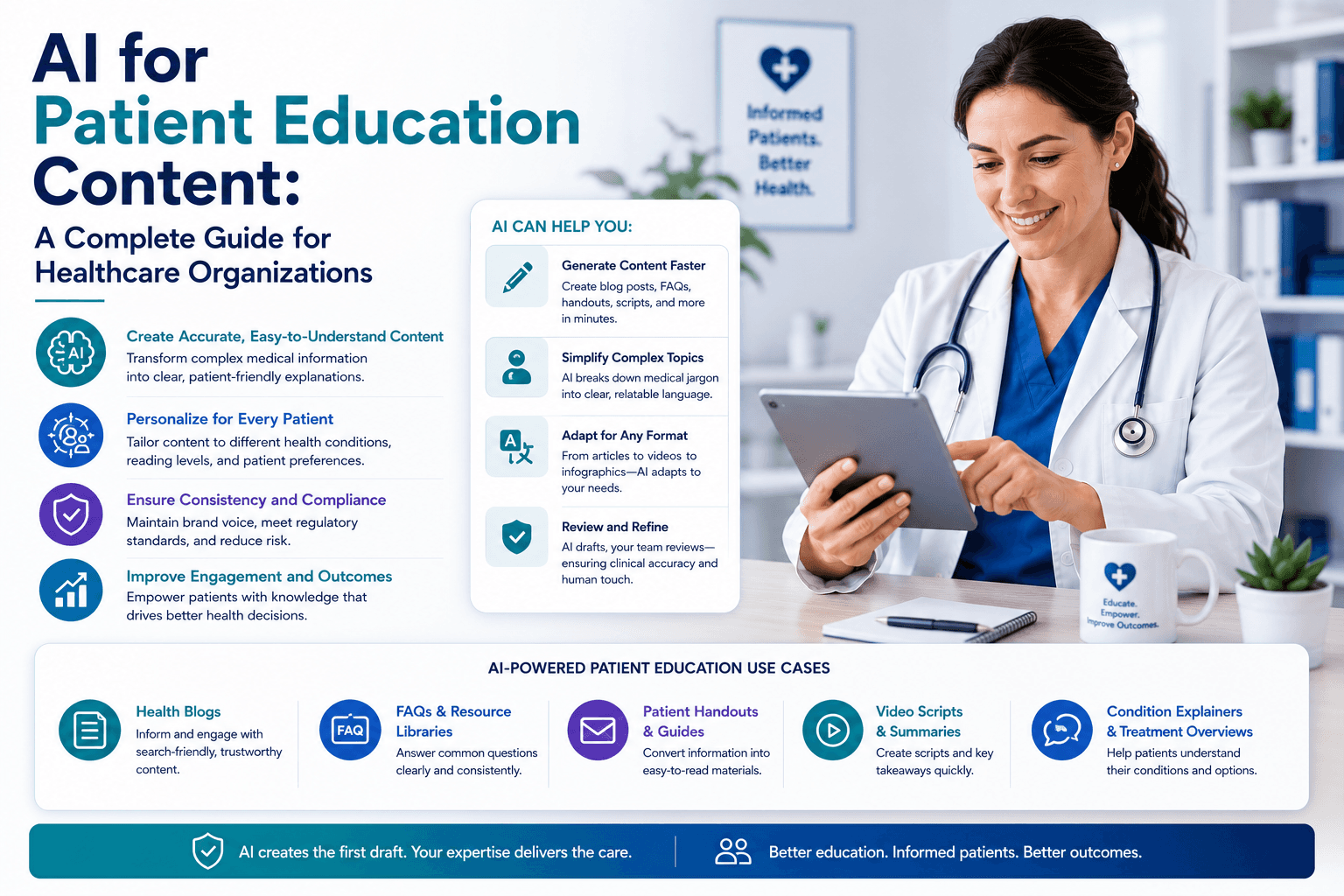
AI for Patient Education Content: A Complete Guide for Healthcare Organizations


Most patient education materials are either too complex or too generic. The discharge instructions use medical terminology patients cannot follow. The condition guide reads like a textbook entry. The FAQ page answers questions nobody actually asks.

The result is predictable. Patients leave confused. They skip medications. They miss follow-up appointments. They return to the emergency department with complications that proper education could have prevented.

Good patient education changes health outcomes. It helps people understand their conditions, follow treatment plans, and make informed decisions about their care. Yet most healthcare organizations struggle to produce enough quality educational content. Clinical teams are stretched thin. Communication staff are overwhelmed. The demand for clear, accessible health information keeps growing while the resources to create it stay flat.

AI for patient education content helps close this gap. It speeds up creation, supports personalization, and helps maintain consistency across large volumes of material. This guide covers how to use AI effectively for patient education while keeping clinical accuracy and human connection at the center of everything you produce.

Key Takeaways

  • AI for patient education content works best as a drafting and adaptation tool, generating initial versions that clinical experts review and refine before patients see them.

  • The most practical AI applications include simplifying complex medical language, creating content variations for different reading levels, and translating materials into multiple languages.

  • Health literacy standards should guide all patient education content. Materials written above a sixth-grade reading level exclude large portions of the intended audience.

  • AI-generated patient education always requires human clinical review. No AI tool can verify medical accuracy or understand the specific context of your patient population.

  • Content personalization through AI helps patients receive information relevant to their specific condition, treatment stage, and learning preferences rather than generic materials.

  • Organizations seeing the strongest results use AI to increase content output while maintaining rigorous review processes that ensure quality and safety.

  • Effective patient education content improves adherence, reduces complications, and strengthens the patient-provider relationship. AI supports these outcomes by making quality content creation more sustainable.

What AI for Patient Education Content Actually Means

AI for patient education content refers to using artificial intelligence tools to support the creation, adaptation, and management of educational materials for patients. This includes drafting articles and handouts, simplifying medical language, translating content into other languages, generating visual aids, and personalizing materials for specific patient groups.

The phrase "support" matters here. AI does not replace clinical judgment in patient education. It handles the operational work of content creation so clinicians and educators can focus on review, accuracy verification, and the personal communication that builds patient understanding.

Think of AI as a first-draft generator and content adapter. A clinician provides the key points about a condition or procedure. AI drafts a patient-friendly explanation. The clinician reviews, corrects, and approves. The communication team formats and distributes. This workflow produces accurate content faster than traditional processes while keeping clinical expertise at the center.

Why Patient Education Content Matters

Patient education directly influences health outcomes. Research consistently shows that patients who understand their conditions and treatment plans have better adherence, fewer complications, and lower readmission rates. They also report higher satisfaction with their care experience.

Despite this importance, patient education often receives inadequate attention. Clinical teams prioritize direct patient care. Communication budgets focus on marketing. Educational content gets created reactively when someone notices a gap rather than proactively as part of a comprehensive strategy.

The consequences of poor patient education are measurable. Medication errors increase when patients do not understand dosing instructions. Preventable complications rise when patients cannot recognize warning signs. Follow-up appointments get missed when patients do not understand why they matter. These failures cost the healthcare system billions annually and cause unnecessary patient suffering.

Investing in quality patient education content is both a care quality decision and a financial one. Organizations that educate patients effectively see better outcomes and lower costs. AI tools make this investment more feasible by reducing the resource burden of content creation.

How AI Supports Patient Education Content Creation

AI can assist at multiple stages of the content creation process. Here is where the technology adds the most practical value.

Simplifying Complex Medical Information

Medical knowledge is inherently complex. Clinicians spend years learning terminology and concepts that most patients have never encountered. Translating that knowledge into accessible language requires skill and time.

AI tools can take clinical descriptions of conditions, procedures, or treatments and rewrite them at specified reading levels. A surgeon's description of a laparoscopic cholecystectomy becomes a clear explanation of gallbladder removal surgery that a patient can understand. Key medical terms get defined in plain language. Complex processes get broken into logical steps.

This simplification capability is particularly valuable for organizations producing large volumes of patient materials. Instead of communication staff manually rewriting every clinician-authored document, AI handles the first pass of simplification. Human reviewers then refine for accuracy, tone, and patient-appropriateness.

Creating Content Variations for Different Audiences

Different patients need different versions of the same information. A newly diagnosed diabetic patient needs foundational education. A patient managing diabetes for years needs advanced self-management guidance. A parent of a child with diabetes needs content focused on pediatric considerations.

Producing multiple versions of educational content for every condition and procedure has been impractical for most organizations. AI makes it feasible by generating variations from a single comprehensive source document.

The workflow works like this. A clinical team approves a master document covering all aspects of a condition or treatment. AI generates variations tailored for different patient segments, reading levels, or learning preferences. Clinical reviewers approve each variation. The organization can now serve diverse patient needs without multiplying creation effort.

Translating Content Into Multiple Languages

Language barriers create significant health disparities. Patients with limited English proficiency receive less health education, understand less of what they are told, and experience worse outcomes as a result.

AI translation tools have improved substantially. They can translate patient education materials into dozens of languages quickly and at low cost. The translations are not perfect and require review by native speakers for nuance and cultural appropriateness. But they provide a starting point that dramatically reduces the time and cost of producing multilingual materials.

Organizations serving diverse communities can use AI translation to ensure their patient education reaches everyone, not just those who speak English fluently.

For broader content strategy frameworks, the healthcare content marketing guide covers planning and distribution approaches that complement patient education efforts.

Formats for Patient Education Content

Patient education works through multiple formats. AI can support creation across all of them.

Written Handouts and Guides

Printed and digital handouts remain the most common patient education format. They cover pre-procedure preparation, post-treatment care, medication instructions, condition management, and preventive health guidance.

AI can draft these materials from clinical outlines. It can ensure consistent formatting and reading level across your entire library of patient handouts. It can update existing materials when clinical guidelines change by identifying sections that need revision based on new source information.

The key workflow involves clinicians providing accurate source content, AI drafting patient-friendly versions, and clinical reviewers approving the final materials. This process maintains accuracy while dramatically reducing creation time.

Video Scripts and Storyboards

Video education is increasingly popular. Patients watch videos explaining procedures before scheduling them. They follow along with physical therapy exercise demonstrations. They learn about medication management through short educational clips.

AI can draft video scripts that explain medical concepts clearly and conversationally. It can suggest visual elements that would help patients understand. It can structure content for different video lengths. Short social media versions. Longer website versions. Step-by-step instructional formats.

The scripts require clinical review before production. AI provides the structural work so educators and communication teams can focus on accuracy and patient connection.

Email Education Sequences

Email nurtures patient education over time. A series of emails before a scheduled procedure can explain preparation steps, describe what to expect, and reduce anxiety. A sequence after discharge can reinforce care instructions and flag warning signs that warrant a call to the provider.

AI can draft complete email sequences from a clinical outline of key teaching points. It can adjust tone and detail level based on where the patient is in their care journey. It can generate subject lines that encourage opens without resorting to clickbait.

The drafting efficiency allows organizations to create educational email sequences for every major procedure and condition rather than just the highest-volume ones.

Social Media Educational Posts

Social platforms reach patients where they already spend time. Brief educational posts about common health concerns, preventive care, and condition management can reach audiences who never visit your website or read printed handouts.

AI can generate social media educational content from longer-form patient education materials. A comprehensive guide about managing high blood pressure becomes a series of social posts highlighting key points. A pre-surgery preparation handout becomes several posts about what to expect.

For healthcare organizations building their social media presence, the healthcare social media marketing guide covers platform strategies and content formats that complement educational campaigns.

Health Literacy Best Practices

Patient education content only works if patients can understand it. Health literacy principles should guide every piece of content your organization creates.

Reading Level Standards

Health literacy organizations recommend writing patient materials at a fifth to sixth-grade reading level. This is not about dumbing down information. It is about making it accessible to the broadest possible audience.

Many healthcare organizations discover that their "patient-friendly" materials are written at a tenth-grade level or higher. This happens because clinicians and professional writers naturally use more complex language than they realize. AI tools can analyze reading level and suggest simplifications that maintain meaning while improving accessibility.

Plain Language Principles

Plain language means writing in a way that readers can find what they need, understand what they find, and use that information. Key principles include using common words instead of medical terminology, writing short sentences, organizing information with clear headings, using active voice, and defining necessary technical terms in context.

AI can apply these principles to clinical content automatically. It can identify complex terms that need definition. It can restructure long, dense paragraphs into shorter, scannable sections. It can flag passive constructions that make instructions harder to follow.

Visual Communication

Many patients learn better from images than text. Diagrams, illustrations, infographics, and videos can explain concepts that paragraphs of text cannot convey clearly.

AI tools can suggest visual concepts to accompany written explanations. They can generate descriptions for illustrators or identify sections of content that would benefit from visual support. Some tools can even generate draft illustrations, though these require particularly careful review for medical accuracy.

The Human Review Requirement

The most important principle for AI in patient education is this. Every piece of content must receive human clinical review before reaching patients.

AI can draft, simplify, translate, and format. It cannot verify medical accuracy. It cannot ensure that information reflects current clinical guidelines. It cannot catch subtle errors that could harm patients. It cannot understand the specific context of your patient population and their particular needs.

Build clinical review into every content workflow. Define who reviews what types of content. Set turnaround time expectations so review does not become a bottleneck. Train reviewers to focus on accuracy verification rather than stylistic preferences that can be addressed earlier in the process.

Organizations that skip or rush clinical review risk distributing inaccurate health information to patients. The consequences range from patient confusion to genuine clinical harm. No efficiency gain justifies that risk.

For organizations establishing content workflows, the healthcare social media strategy guide covers approval processes and team coordination approaches.

HIPAA and Regulatory Considerations

Patient education content distributed through public channels like websites and social media generally does not involve protected health information. This makes compliance straightforward for most educational materials.

Content distributed through patient portals, email to identified patients, or other private channels may involve PHI. These situations require HIPAA-compliant tools and processes. Consumer AI tools are not appropriate for content that will reach identified patients through private channels.

Establish clear guidelines about which content workflows involve PHI and which do not. Use compliant platforms for any workflow that touches patient data. Train everyone creating patient education content on these distinctions.

Measuring Patient Education Content Performance

Patient education should be measured by its impact, not just its production volume. Here are metrics that indicate whether educational content is working.

For written materials: Page views, time on page, scroll depth, and return visits indicate whether patients are actually reading content. Comments and questions submitted about materials indicate engagement and highlight areas needing clarification.

For video content: View count, average watch time, and completion rate show whether patients find videos valuable enough to watch through. Comments and questions indicate engagement.

For email sequences: Open rates, click rates on embedded resources, and actions taken after reading show whether email education influences patient behavior.

For clinical outcomes: Where systems allow tracking, connect educational content exposure to adherence rates, readmission rates, complication rates, and patient satisfaction scores. These connections demonstrate the clinical value of patient education investment.

Common Mistakes in Patient Education Content

Learning from common failures improves your own approach.

Writing for peers instead of patients. Content filled with medical jargon fails its purpose. Always verify reading level and terminology.

Covering too much information at once. Patients retain a fraction of what they read. Focus each piece of content on the few points that matter most.

Neglecting to explain why something matters. Patients follow instructions better when they understand the reason behind them. Do not just say what to do. Explain why it matters.

Creating content without patient input. Ask patients what confuses them. Test materials with patient reviewers. Content created without patient perspective often misses the mark.

Failing to update content regularly. Clinical guidelines change. Outdated patient education materials can provide harmful advice. Schedule regular content reviews.

Measuring production instead of impact. Producing many educational pieces means little if patients do not understand or use them. Track consumption and comprehension metrics.

For organizations focused on building patient relationships through content, the patient engagement on social media guide covers strategies for interactive education and community building.

Frequently Asked Questions

What is AI for patient education content?

AI for patient education content uses artificial intelligence tools to draft, simplify, translate, and adapt health education materials for patients. It supports content creation by handling operational tasks like language simplification and format adaptation. Clinical experts review all AI-generated content for accuracy before patients receive it. The technology increases production capacity while maintaining clinical standards.

Can AI replace clinical review of patient education materials?

No. AI cannot verify medical accuracy or ensure content reflects current clinical guidelines. It cannot understand the specific context of your patient population. Clinical review remains essential for every piece of patient education content before distribution. AI reduces drafting time so clinicians can focus their limited availability on review rather than creation.

How does AI improve healthcare patient communication?

AI helps produce more content, in more formats, at more reading levels, and in more languages than manual processes allow. This means patients receive educational materials that are more accessible and more personalized to their needs. Better content availability supports better communication between providers and patients during clinical encounters.

What reading level should patient education materials target?

Health literacy standards recommend a fifth to sixth-grade reading level for most patient education materials. This ensures broad accessibility. Some audiences may benefit from even simpler materials. Others may want more detailed explanations. Creating content at multiple reading levels allows patients to choose the depth that matches their needs and literacy.

How can healthcare organizations ensure AI-generated content is accurate?

Build clinical review into every content workflow. Have qualified clinicians review all AI-generated content before publication. Establish clear review criteria focused on medical accuracy. Train content creators to provide AI with accurate source material so drafts start from correct information. Maintain version control so materials can be updated when clinical guidelines change.

What types of patient education content benefit most from AI support?

High-volume, standardized materials benefit most. Pre-procedure instructions, post-treatment care guides, medication information sheets, condition overviews, and frequently asked questions. These content types follow predictable patterns that AI can draft efficiently. Highly specialized or rare-condition content may require more intensive clinical involvement.

Is AI-generated patient education content HIPAA compliant?

Content created for public distribution through websites or social media generally does not involve protected health information, making AI use acceptable with proper clinical review. Content for private channels like patient portals requires HIPAA-compliant AI tools. Organizations should establish clear policies about which workflows can use which tools.

How do you measure the effectiveness of patient education content?

Track consumption metrics like page views, video completion rates, and time on page. Track comprehension through patient questions and feedback. Where systems allow, connect educational content exposure to clinical outcomes like adherence rates, readmission rates, and patient satisfaction scores. The most meaningful measures connect education to health outcomes.

Creating Patient Education That Makes a Difference

AI for patient education content helps healthcare organizations fulfill a fundamental responsibility. Every patient deserves to understand their health, their conditions, and their care. Clear education is not a nice addition to clinical care. It is an essential component of it.

Use AI to handle the operational work of content creation. Drafting. Simplifying. Translating. Formatting. Free your clinical and communication teams to focus on what requires human expertise. Verifying accuracy. Understanding patient needs. Building the trust that makes education effective.

Build rigorous review into every workflow. Measure impact rather than output. Update content as clinical knowledge evolves. Treat patient education as an ongoing commitment rather than a one-time project.

The organizations that do this well see the results in their outcomes data and their patient relationships. Better adherence. Fewer complications. Stronger satisfaction. Patients who feel informed and supported rather than confused and alone.

For healthcare teams ready to build a comprehensive patient education operation, Sociali.ai provides a purpose-built healthcare platform that supports content planning, creation, review workflows, multi-channel distribution, and performance measurement. From individual practices to multi-location health systems, the platform helps organizations produce patient education content that improves understanding, supports better outcomes, and strengthens the patient-provider relationship.

Free resource

Get the 30-day social media content calendar

Get the 30-day social media content calendar

Get the 30-day social media content calendar

Use it to plan posts, offers, and follow-ups before your next campaign — built for busy teams that need consistent publishing without extra meetings.

Use it to plan posts, offers, and follow-ups before your next campaign — built for busy teams that need consistent publishing without extra meetings.

Get the checklist

Share It On: