Healthcare Reputation Management: The Complete Guide to Building Patient Trust and Brand Credibility
|
9
min read

Healthcare Reputation Management: The Complete Guide to Building Patient Trust and Brand Credibility
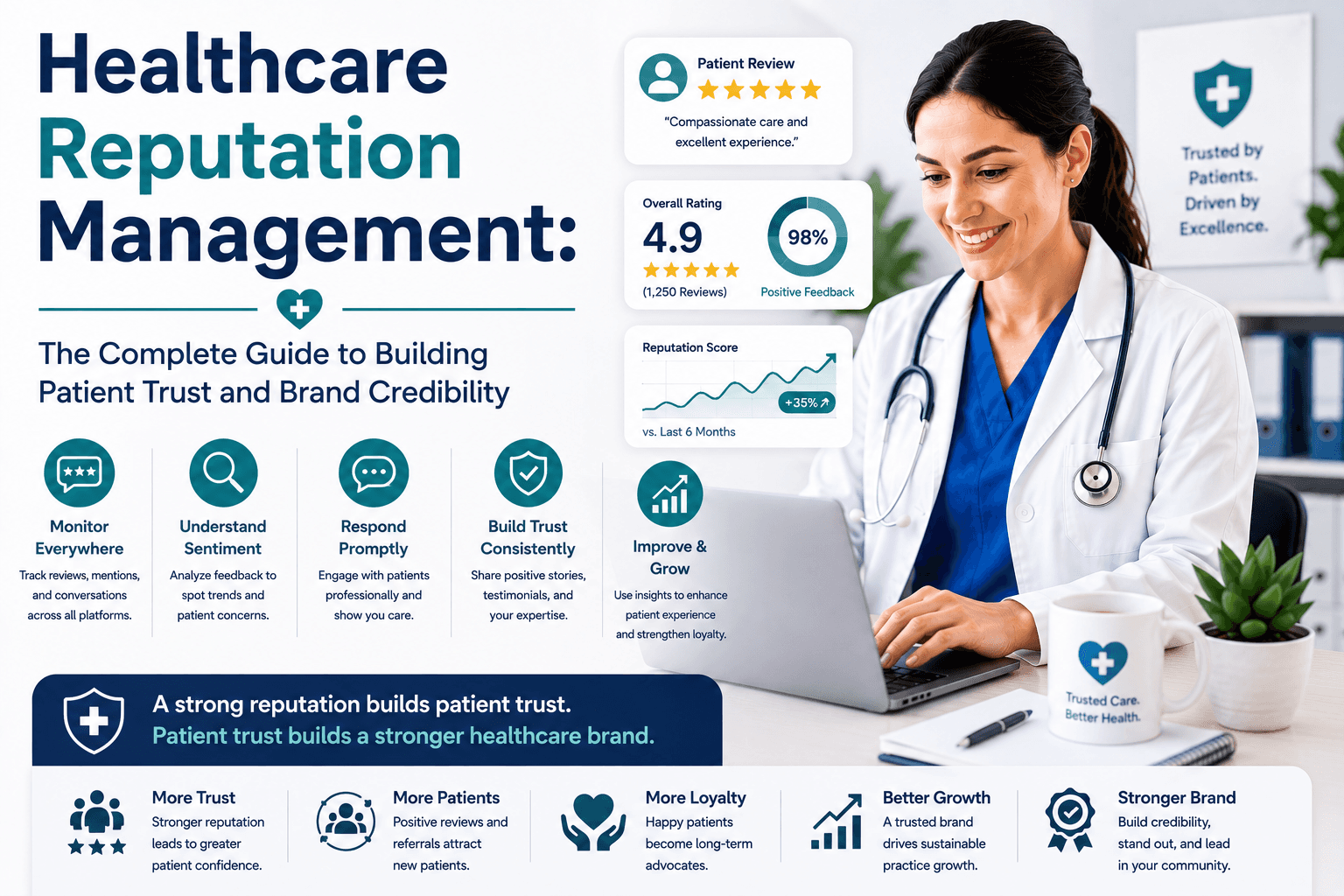
A patient searches for a new primary care provider. They find three options in their area. One has a dated website, no social media presence, and reviews that mention long wait times. Another has minimal online presence entirely. The third has an informative website, active social media accounts sharing health education, and numerous reviews praising the communication style of the providers.
The patient chooses the third option. Not because they verified clinical credentials. Not because they compared outcome data. They chose based on reputation signals that suggested trustworthiness and competence.
Healthcare reputation management is the discipline of understanding, building, and protecting the perceptions that drive these decisions. It encompasses everything that shapes how patients and communities view your organization. This guide covers how to build a reputation that attracts patients, strengthens trust, and supports long-term organizational growth.
Key Takeaways
Healthcare reputation management is the ongoing work of shaping how patients and communities perceive your organization across every touchpoint, not just responding to reviews when problems arise.
Patient trust is built through consistent demonstration of competence, compassion, and reliability over time. Marketing can communicate promises. Only consistent delivery fulfills them.
Healthcare brand management connects organizational identity to patient perception. Strong brands simplify patient decisions by making organizations feel familiar and credible before direct experience.
Reputation is shaped by every patient interaction, every social media post, every community engagement, and every moment of organizational behavior. Consistency across these touchpoints matters enormously.
Proactive reputation building through educational content, community involvement, and authentic communication creates reserves of goodwill that help organizations weather inevitable challenges.
Multi-location organizations need centralized brand standards with localized implementation to maintain consistent reputation while serving distinct communities.
Reputation measurement should assess awareness, perception, trust, and loyalty rather than just tracking review ratings or complaint volumes.
What Healthcare Reputation Management Actually Means
Healthcare reputation management is the strategic discipline of understanding, building, monitoring, and protecting how patients and communities perceive a healthcare organization. It encompasses everything from patient experience and clinical outcomes to digital presence, community engagement, and crisis response.
This definition matters because it establishes scope. Reputation management is not review management. Reviews are one reputation input among many. Reputation management is not crisis communication. Crisis response is what you do when reputation is threatened. Reputation management is the ongoing work that builds sufficient trust to survive crises when they occur.
The definition also clarifies that reputation is perception, not reality. An organization can deliver excellent clinical care and still have a poor reputation if that care is not communicated effectively or if other reputation inputs create negative impressions. Similarly, an organization can have a strong reputation built on perception that eventually crumbles if not supported by genuine care quality.
Effective healthcare reputation management aligns reality and perception. It ensures that organizational quality is accurately reflected in community perception. It identifies gaps between the care you deliver and what patients believe about you. It builds communication strategies that close those gaps.
Why Healthcare Reputation Determines Organizational Success
Healthcare decisions involve trust, vulnerability, and significant personal stakes. Patients making these decisions rely heavily on reputation because they lack the clinical knowledge to evaluate care quality directly.
When someone needs a cardiologist, they cannot assess the physician's diagnostic accuracy or treatment skill. They evaluate reputation signals instead. Online reviews. Recommendations from trusted sources. The professionalism of the website. The helpfulness of educational content. The overall impression of competence and compassion the organization projects.
These signals drive patient choice. Organizations with strong reputations attract patients actively seeking care and retain existing patients who might otherwise explore alternatives. Organizations with weak or negative reputations lose patients to competitors before ever having the opportunity to demonstrate clinical quality.
Reputation also influences dimensions beyond patient acquisition. Clinical talent recruitment. Strong clinicians prefer organizations with strong reputations. Payer negotiations. Market preference strengthens negotiating position. Community support. Bond ratings, philanthropic contributions, and regulatory relationships all connect to reputation. Crisis resilience. Organizations with deep reserves of community trust weather problems that destroy organizations without it.
How Patients Evaluate Healthcare Providers
Understanding how patients form reputation judgments helps organizations invest reputation-building resources effectively.
Patients evaluate healthcare providers through multiple information sources. Online reviews on platforms like Google, Healthgrades, and Facebook. Recommendations from family, friends, and other trusted sources. Digital presence including website quality, social media activity, and search results. Personal experience during clinical encounters. Word of mouth within community networks.
These sources interact. A patient hears a recommendation from a friend, searches the practice online, reads reviews that confirm the positive impression, visits a professional website, and arrives for their appointment already trusting the provider. Alternatively, they search online, find negative reviews or no presence at all, and choose a different provider before the organization ever knows they existed.
The implication for reputation strategy is clear. You must manage reputation across every channel where patients form impressions. A strong recommendation from a trusted physician can be undermined by a weak website. Positive reviews can be outweighed by unresponsive social media accounts. Every touchpoint contributes to the overall perception that drives patient decisions.
Building a Reputation Strategy
Reputation strategy must be proactive rather than reactive. Here is how to build one.
Define the Reputation You Want
What do you want patients and communities to associate with your organization? Clinical excellence in specific specialties? Exceptional patient experience and communication? Innovation and advanced treatment options? Deep community commitment and accessibility?
The answer should reflect genuine organizational identity, not aspirational wishes. Patients detect gaps between claimed identity and actual experience. Reputation built on authentic strengths is sustainable. Reputation built on marketing claims unsupported by operations collapses when tested.
Document your desired reputation attributes. These become the standard against which you measure current perception and the guide for reputation-building activities.
Assess Current Perception
Before investing in reputation improvement, understand current perception. What do patients currently associate with your organization? What do referring providers believe about you? What does the community think?
Assessment methods include patient satisfaction surveys, online review analysis, social media sentiment monitoring, community perception research, and referring provider feedback. Each source provides different insight. Combined, they reveal the gap between desired reputation and current reality.
Close the Gap Between Reality and Perception
Gap analysis identifies two types of reputation challenges. Reality gaps exist when the organization does not actually deliver what it wants to be known for. These require operational improvement before communication can help. Communication gaps exist when the organization delivers well but patients do not perceive it. These require better communication strategies.
Most organizations have both types of gaps. The key is addressing them honestly and in the right order. Operational improvement comes first. Communication amplification follows. Promoting strengths you do not actually have creates reputation risk that eventually causes damage worse than having no reputation strategy at all.
Healthcare Brand Management and Reputation
Healthcare brand management is the proactive work of defining and expressing organizational identity. It creates the foundation on which reputation is built.
Brand Identity and Positioning
Brand identity is who you are as an organization. Your purpose. Your values. Your distinctive approach to patient care. Brand positioning is how you want patients to perceive you relative to alternatives.
Effective healthcare brand marketing communicates this identity consistently. It does not create identity through advertising. It expresses genuine organizational character through every communication channel and patient touchpoint.
Positioning must be specific enough to differentiate. "Quality care" is not positioning. Every healthcare organization claims quality care. "The region's only comprehensive stroke center with outcomes exceeding national benchmarks for ten consecutive years" is positioning. It is specific, provable, and meaningful to patients making neurology decisions.
Brand Voice and Consistency
Patients should recognize your organization's communication whether they encounter it on your website, social media, printed materials, or in clinical settings. Consistent voice builds familiarity. Familiarity builds trust.
Define brand voice characteristics. Is your organization warm and approachable? Professional and authoritative? Compassionate and patient-centered? Document voice standards with examples. Train everyone creating patient-facing content. Audit periodically to ensure consistency.
This consistency extends to visual identity. Logo usage. Color palette. Typography. Photography style. These elements should be documented in brand guidelines and applied consistently across every channel and location.
For organizations building brand presence through content, the healthcare content marketing guide covers content strategies that express brand values and build reputation.
Patient Experience as Brand Delivery
Patient experience is where brand promises meet reality. Marketing communicates what patients should expect. Experience delivers what they actually receive. When these align, reputation strengthens. When they diverge, reputation suffers.
This means reputation management must extend into operations, not just marketing. Marketing and patient experience teams need aligned understanding of brand promises. Both need accountability for delivering them.
The strongest healthcare brands are built by organizations where every department understands its role in reputation building. Clinical teams understand that their communication style shapes reputation. Front desk staff understand that check-in experience shapes reputation. Billing departments understand that financial communication shapes reputation. Reputation is everyone's responsibility because every patient interaction contributes to it.
Proactive Reputation Building
The strongest reputations are built through consistent positive action over time, not through reactive management of problems.
Educational Content and Thought Leadership
Publishing educational health content builds reputation by demonstrating expertise and genuine commitment to patient wellbeing. Every helpful blog post, informative video, and educational social media update contributes to the perception that your organization is knowledgeable and patient-centered.
Content should address real patient questions and concerns. Topics that match what patients search for. Information that helps people understand their health and make better decisions. This content serves patients while simultaneously building the expertise associations that strengthen reputation.
Thought leadership extends this principle to professional audiences. Research publications. Conference presentations. Professional community contributions. These activities build reputation among referring providers and clinical colleagues in ways that support both patient acquisition and recruitment.
Community Engagement
Organizational involvement in community health demonstrates commitment beyond business interests. Health fairs. Free screenings. Educational workshops. Community partnerships. Support group facilitation. These activities build reputation as a community asset.
Community engagement also provides opportunities for positive interactions that strengthen relationships outside clinical settings. When community members encounter your organization in helpful, non-commercial contexts, their trust deepens in ways that influence future healthcare decisions.
Consistent Social Media Presence
Social media provides daily opportunities for reputation building. Educational content demonstrates expertise. Provider features humanize your organization. Community engagement shows values in action. Responses to comments and messages demonstrate organizational character.
The key is consistency. Organizations that post sporadically or abandon platforms for extended periods signal disorganization. Organizations that maintain consistent, valuable presence signal reliability. Both signals contribute to reputation.
For organizations building social media programs that support reputation, the healthcare social media strategy guide covers planning and execution frameworks.
Handling Feedback Professionally
How organizations respond to feedback shapes reputation as much as the feedback itself. A thoughtful response to a negative comment impresses observers more than a collection of exclusively positive interactions.
Respond to feedback promptly. Acknowledge specific concerns. Express genuine commitment to improvement. Move detailed clinical discussions to private channels. Never discuss individual patient situations publicly. Never become defensive or dismissive.
This approach demonstrates organizational character. It shows that you listen, care, and improve. Prospective patients observing these interactions form positive impressions even when the original feedback was negative.
Reputation Management Across Multiple Locations
Health systems with multiple hospitals, clinics, and care sites face reputation complexity that single-location organizations do not.
Each location serves a distinct community with distinct expectations. Each has its own providers, services, and patient experience characteristics. Yet all contribute to overall brand reputation. A negative experience at one location can damage perception of the entire system.
The solution involves centralized brand standards with localized implementation flexibility. Central marketing establishes reputation standards, brand guidelines, and communication policies. Local teams adapt implementation to their specific communities while maintaining brand consistency.
This approach requires clear governance, consistent training, and technology that supports both central oversight and local autonomy. Regular auditing identifies inconsistencies before they create reputation problems.
For organizations managing reputation across multiple locations, the multi-location social media management guide covers operational frameworks.
Crisis Communication Planning
Reputation crises happen. Medical errors. Negative media coverage. Public health emergencies. Leadership controversies. Preparation determines whether these events cause temporary reputation damage or lasting reputation destruction.
Develop crisis communication plans before crises occur. Identify potential crisis types. Establish response protocols for each. Designate crisis response teams with clear authority. Prepare template communications that can be adapted quickly. Identify channels for rapid communication with patients, staff, and community.
Crisis communication should be honest, timely, and aligned with organizational values. Attempts to minimize, deflect, or delay typically worsen reputation damage. Acknowledging problems, communicating corrective actions, and demonstrating genuine commitment to improvement often strengthen reputation over time.
Measuring Reputation Performance
Reputation measurement connects investment to outcomes and guides strategy refinement.
Reputation Metrics
Track brand awareness in your service area. Measure brand perception and association strength. Monitor patient satisfaction and likelihood to recommend. Assess patient retention and loyalty patterns. Track share of voice in community conversation. Monitor review volume, ratings, and sentiment trends.
Leading and Lagging Indicators
Review ratings and satisfaction scores are lagging indicators. They reflect reputation built over extended periods. They change slowly.
Content engagement, social media sentiment, and community feedback are leading indicators. They show whether current activities are building toward stronger reputation before rating changes appear.
Track both. Leading indicators guide daily decisions. Lagging indicators confirm whether strategy is working.
Common Healthcare Reputation Management Mistakes
Focusing only on reviews while neglecting broader reputation inputs. Reviews matter. They are not the whole picture.
Promising more than operations consistently delivers. Marketing claims unsupported by patient experience create reputation damage worse than making no claims.
Responding defensively to criticism. Defensive responses to negative feedback amplify reputation harm. Acknowledge, address, and improve.
Neglecting proactive reputation building. Reputation management that only activates during problems is crisis communication, not strategy.
Allowing brand inconsistency across touchpoints. Different experiences across channels and locations fragment perception and reduce trust.
Failing to prepare crisis communication plans. Improvising during crises makes situations worse.
Frequently Asked Questions
What is healthcare reputation management?
Healthcare reputation management is the strategic process of understanding, building, monitoring, and protecting how patients and communities perceive a healthcare organization. It encompasses patient experience, digital presence, community engagement, brand communication, and crisis response. It extends far beyond review management to include every touchpoint that shapes organizational perception.
Why is reputation important in healthcare?
Healthcare decisions involve significant trust and vulnerability. Patients rely on reputation signals because they cannot evaluate clinical quality directly. Strong reputations attract patients, support recruitment, strengthen payer negotiations, and provide resilience during challenges. Weak reputations drive patients to competitors before organizations ever have the opportunity to demonstrate care quality.
How do patients evaluate healthcare providers?
Patients use multiple information sources including online reviews, personal recommendations, website quality, social media presence, search results, and personal experience during clinical encounters. These sources interact to form overall perception. Organizations must manage reputation across every channel where patients form impressions.
How do you improve healthcare reputation?
Start by defining desired reputation attributes based on authentic organizational strengths. Assess current perception to identify gaps. Address operational gaps before communication gaps. Build proactive reputation through educational content, community engagement, and consistent social media presence. Respond professionally to all feedback. Maintain consistency across every patient touchpoint.
What is the difference between reputation management and brand management?
Brand management is the proactive work of defining and expressing organizational identity. It creates the foundation on which reputation is built. Reputation management includes monitoring and responding to how patients actually perceive the organization. Brand management shapes what you project. Reputation management assesses and influences what patients receive and believe.
How does social media affect healthcare reputation?
Social media provides daily opportunities for reputation building and damage. Consistent educational content, authentic provider features, and responsive engagement build positive reputation. Inconsistent presence, unresponsive accounts, or tone-deaf content damage it. Social media also surfaces patient feedback and community concerns that influence broader reputation.
How do you measure healthcare reputation?
Track brand awareness and perception in your service area. Monitor patient satisfaction and recommendation likelihood. Assess review volume, ratings, and sentiment trends. Measure patient retention and loyalty. Track share of community conversation. Use both leading indicators that show current trajectory and lagging indicators that confirm long-term results.
How do you handle a healthcare reputation crisis?
Prepare crisis communication plans before crises occur. Identify potential crisis types and establish response protocols. Communicate honestly and promptly when crises happen. Acknowledge problems. Explain corrective actions. Demonstrate genuine commitment to improvement. Attempts to minimize or deflect typically worsen reputation damage.
Building a Reputation That Reflects Your Care
Healthcare reputation management succeeds when organizations align what they promise, what they deliver, and what patients perceive. The website matters. The social media presence matters. The community engagement matters. But what matters most is the cumulative impression created by every patient interaction, every staff communication, and every moment of organizational behavior.
Start with authentic identity. Define the reputation you want based on genuine organizational strengths. Assess current perception honestly. Address operational gaps before communication gaps. Build proactive reputation through consistent education, engagement, and communication. Respond to feedback professionally. Prepare for crises before they occur. Measure what matters.
The strongest healthcare reputations share a common characteristic. They are built from the inside out, with organizational behavior driving external perception rather than marketing creating perception that operations cannot sustain. Patients trust these organizations because the reputation reflects reality.
For healthcare teams building the consistent brand presence that supports strong reputation, Sociali.ai provides a purpose-built healthcare platform for planning, scheduling, collaborating on, publishing, and analyzing social media content. From brand consistency to multi-location coordination, the platform helps organizations maintain the professional, educational, and engaging presence that builds lasting patient trust.
Free resource
Get the checklist


