Healthcare Social Media Content Ideas to Educate Patients
|
7
min read

50 Healthcare Social Media Content Ideas to Educate and Engage Patients

Introduction
Most healthcare marketing teams know they should be posting on social media every week. Fewer of them know what to actually say once the blank content calendar is staring back at them.
A hospital marketing coordinator might post an award announcement one week, then go silent for ten days because nobody had time to write anything else. A private practice might share the same “book your appointment today” graphic so often that patients stop noticing it. A physical therapy clinic might want to post daily but worry about sounding too clinical, too salesy, or accidentally giving medical advice that should come from a licensed provider instead.
This is the real challenge behind healthcare content marketing. It is not a lack of things to talk about. It is knowing which ideas are safe, useful, and genuinely worth a patient’s attention, and having a repeatable system so content does not depend on one person’s inspiration.
This guide gives you both. You will find 50 content ideas organized into categories you can pull from any week, a framework for building a real content strategy, a sample 30 day calendar, and the mistakes that quietly hurt healthcare accounts on social media. If you want the fuller strategic picture first, our healthcare content marketing guide covers the planning side in more depth.
Why Healthcare Content Marketing Matters
Patients research before they book. Someone with a new knee pain complaint will search symptoms, read reviews, and scroll through a clinic’s Instagram before ever calling the front desk. If that account looks abandoned or only posts promotions, it sends a signal, whether fair or not, that the practice itself might feel outdated or impersonal.
Healthcare content marketing also does something insurance ads and billboards cannot do well. It builds familiarity over time. A patient who has watched a dietitian answer nutrition questions for six months on Instagram walks into that first appointment already trusting the provider’s judgment. That trust shortens the distance between a first visit and a patient who actually follows through on treatment plans.
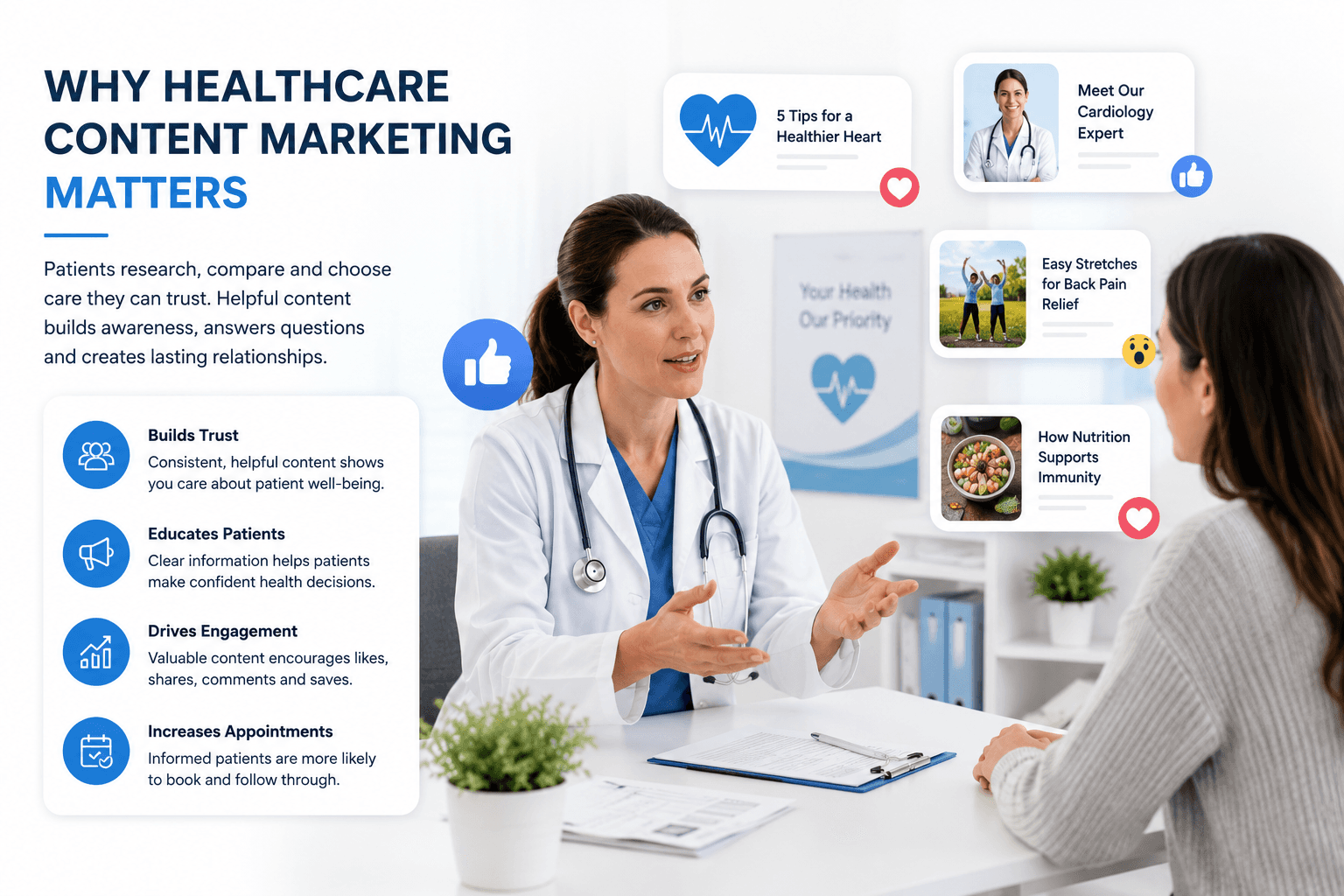
There is a public health angle too. Misinformation about vaccines, supplements, and home remedies spreads quickly online. Healthcare organizations that show up consistently with clear, accurate information give patients a reliable source to check against the noise. A clinic that answers “is it safe to mix ibuprofen and acetaminophen” honestly and simply is doing real patient education, not just marketing.
Practices that treat content as a side project usually see it fade after a few months. Practices that treat it as part of patient care, something owed to the community they serve, tend to stick with it. For a deeper look at why this consistency pays off, the healthcare social media marketing guide breaks down the return on investment in more detail.
What Makes Healthcare Social Media Content Successful
Not every post that gets likes actually helps a practice. A funny meme might perform well and mean nothing for patient trust. Successful healthcare content usually shares a few traits.
It answers a real question. The best performing healthcare posts often mirror what patients already type into Google or ask at check in. “Why does my knee hurt more in the morning” or “how long after a filling can I eat” are questions people are already searching for. Answering them on social media meets patients where they already are.
It respects clinical boundaries. Good content educates without diagnosing. A post can explain what a symptom might indicate in general terms and then direct the reader to book a consultation, without pretending to replace an actual exam.
It shows real people. Stock photos of smiling models in white coats do not build trust the way a genuine photo of your own physical therapist explaining a stretch does. Patients can usually tell the difference, and they respond better to the real thing.
It is easy to understand. Medical terminology has its place in a chart note. It does not belong in a caption meant for a general audience. Content written at a plain, conversational level performs better because more people can actually use it.
It is consistent, not just occasional. One excellent post a month will not build the kind of recognition that ten decent posts a month will. Patients need to see a practice show up regularly before it becomes part of their mental map of trusted sources.
How to Build a Healthcare Content Strategy
A content strategy does not need to be complicated to work. It needs four things: a clear audience, a set of content pillars, a realistic cadence, and a way to measure whether it is working.
Define who you are actually talking to. A pediatric dental practice is talking to parents, not children. A cardiology group might be speaking to patients recently diagnosed as well as their adult children who help manage care. Naming this audience specifically changes the tone and topics you choose.
Pick three to five content pillars. These are recurring themes you will return to again and again, such as preventive care tips, patient stories, provider expertise, and practical office information like insurance or scheduling. Pillars keep a calendar from feeling random.
Set a cadence you can actually sustain. Three solid posts a week beat seven rushed ones. It is better to under promise and post reliably than to burn out a team trying to hit daily output.
Build in a review step. Any post that touches symptoms, treatments, or medication should pass by a clinical team member before it goes live, even if it is just a two minute check. This protects both the patient and the practice.
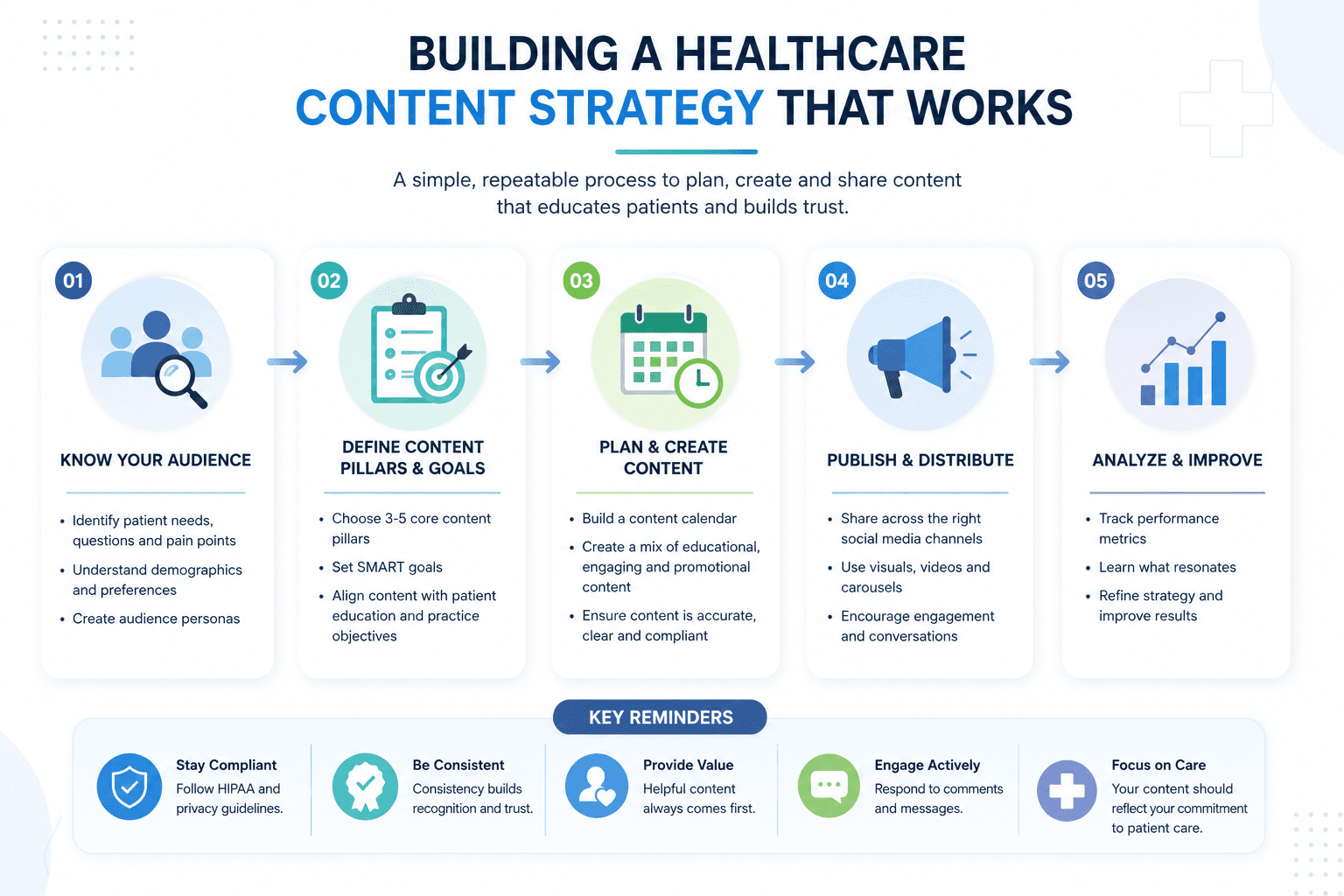
Track what actually matters. Follower count is the least useful metric here. Saves, shares, comments asking real questions, and appointment inquiries that mention social media are far better signals that the content is doing its job. Our healthcare social media strategy guide walks through building this kind of measurement plan step by step.
50 Practical Healthcare Social Media Content Ideas
Use these as a rotating menu rather than a rigid checklist. Mix categories throughout the month so the feed does not feel repetitive.
Patient Education Posts
Explain a common symptom and when it warrants a visit
Break down a diagnosis in plain language
Walk through what to expect during a first visit
Answer a frequently asked insurance or billing question
Compare two treatment options patients often confuse
Behind the Scenes and Team Spotlights
Introduce a new team member with a short bio
Show a typical day for a nurse, technician, or front desk staff
Share how equipment or a treatment room is prepared for patients
Highlight a long tenured staff member’s story
Give a quick tour of a new or renovated facility area
Preventive Care and Wellness Tips
Share a seasonal wellness tip, such as flu prevention in autumn
Post a simple home exercise or stretch demonstration
Explain screening guidelines for a specific age group
Offer a quick nutrition tip tied to a common condition
Share sleep hygiene advice relevant to your specialty
Patient Stories and Testimonials
Share a recovery story with the patient’s permission
Post a short video testimonial about a specific service
Highlight a milestone, like a cancer patient reaching remission
Share a before and after story for elective procedures, where appropriate
Feature a long term patient relationship spanning years of care
Myth Busting and Fact Checking
Correct a common misconception about a condition
Address a trending health claim seen on social media
Clarify confusion between two similar sounding conditions
Explain why a popular home remedy does or does not work
Break down what a lab result actually means in simple terms
Seasonal and Awareness Campaign Content
Post around national health observance months relevant to your specialty
Share back to school health checklists
Post allergy season tips in spring
Share holiday season stress or nutrition guidance
Recognize awareness days like World Mental Health Day with practical tips
Interactive and Engagement Content
Run a quick poll about a health habit or preference
Ask followers to submit questions for a provider Q&A
Post a true or false quiz about a common condition
Host a live video answering patient questions
Ask an open ended question about patient experiences
Provider Spotlight and Expertise Content
Share a provider’s recent continuing education or certification
Post a short video of a provider explaining their approach to care
Highlight a provider’s specialty focus within a broader practice
Share a provider’s perspective on a recent health headline
Feature a provider answering the question they hear most often
Community Involvement Content
Share participation in a local health fair or screening event
Highlight a charity partnership or fundraiser
Post about sponsoring a local youth sports team or school event
Share volunteer work done by staff outside the clinic
Recognize a local organization your practice partners with
Practical and Administrative Content
Share updated office hours around holidays
Explain how to use the patient portal
Post a reminder about how to prepare for a specific appointment type
Share telehealth availability and how to book it
Explain what to bring to a first visit, such as insurance cards or referrals
How to Repurpose One Healthcare Blog Into Multiple Social Posts
A single well researched blog post can fuel two to three weeks of social content if it is broken down properly.
Start by pulling out the core statistic or finding from the blog and turning it into a standalone graphic. Numbers tend to stop the scroll better than general statements.
Next, take each major subheading from the blog and turn it into its own short post. A blog with five sections on managing high blood pressure becomes five separate Instagram captions or LinkedIn posts, each focused on one practical tip.
Pull a direct quote from the provider interviewed for the blog and post it as a simple quote graphic. This adds a human voice to information that might otherwise read as generic.
Turn any list format, such as “five signs you should see a specialist,” into a carousel post where each slide covers one item. Carousels tend to keep people on the post longer, which social platforms often reward with more reach.
Finally, record a 30 to 60 second video of the provider summarizing the blog’s main takeaway in their own words. Video adds a layer of trust that text alone cannot always deliver, and it gives you a piece of content that works across Instagram, Facebook, and even as a short form video on other platforms.
Sample 30 Day Healthcare Content Calendar
Week | Monday | Wednesday | Friday |
|---|---|---|---|
Week 1 | Patient education post on a common symptom | Team spotlight introducing a staff member | Preventive care tip for the season |
Week 2 | Myth busting post correcting a common misconception | Patient story or testimonial | Interactive poll or quiz |
Week 3 | Provider spotlight video | Practical office reminder, such as portal use | Community involvement highlight |
Week 4 | Repurposed blog carousel | Behind the scenes look at the clinic | Awareness day or seasonal post |
This structure gives each week a mix of education, connection, and practical information, which keeps the feed balanced instead of leaning too heavily on any single content type.
Healthcare Content Creation Best Practices
Write captions the way you would explain something to a patient in the waiting room, not the way you would write a clinical note. If a ninth grader could not follow the sentence, it needs to be simplified.
Get written consent before posting any patient story, photo, or testimonial, even when the patient offers it enthusiastically. This protects the patient and the practice, and it should be a standing policy rather than a case by case decision.
Keep a running list of questions patients ask at the front desk and during visits. This list is often a better content source than any keyword research tool, because it reflects exactly what your specific patient population wants to know.
Batch content creation instead of writing one post at a time. Set aside two hours every two weeks to draft several posts at once, then schedule them out. This reduces the pressure of needing a new idea every single day.
Always have a clinical reviewer sign off on medical claims before publishing, even for posts that seem straightforward. A single inaccurate statement about medication or symptoms can do lasting damage to a practice’s credibility.
Common Mistakes to Avoid
Posting only promotions is one of the fastest ways to lose an audience. If every post is asking for a booking, patients stop paying attention, because there is nothing in it for them beyond a sales pitch.
Using stock photography exclusively instead of real staff and real facilities makes an account feel generic. Patients are choosing a specific practice, and content should reflect that specific place and the people in it.
Ignoring comments and messages sends the wrong signal, especially in healthcare where people may be asking sensitive questions. Even a simple acknowledgment, directing them to call the office for anything specific, shows the account is actively monitored.
Skipping legal and compliance review to move faster is a mistake that tends to surface at the worst possible time. HIPAA considerations apply to what appears in the background of photos and videos, not just what is written in captions.
Chasing every trending audio or format without checking if it fits the practice’s tone can undercut credibility. A cosmetic surgery practice might reasonably use a trending format that would feel out of place for an oncology center.
Future Trends in Healthcare Content Marketing
Short form video continues to grow as the format patients engage with most, particularly for quick educational content under 60 seconds. Practices that invest in a simple, consistent video setup will likely see this pay off over the next few years.
Patients increasingly expect a personal connection to the providers they choose, not just the institution. Content that puts an actual clinician’s voice and face in front of the audience tends to outperform institutional messaging alone.
Search behavior is shifting toward more conversational, question based queries, which lines up closely with how people already search on social platforms. Content built around specific patient questions is likely to keep gaining an advantage over generic promotional posts.
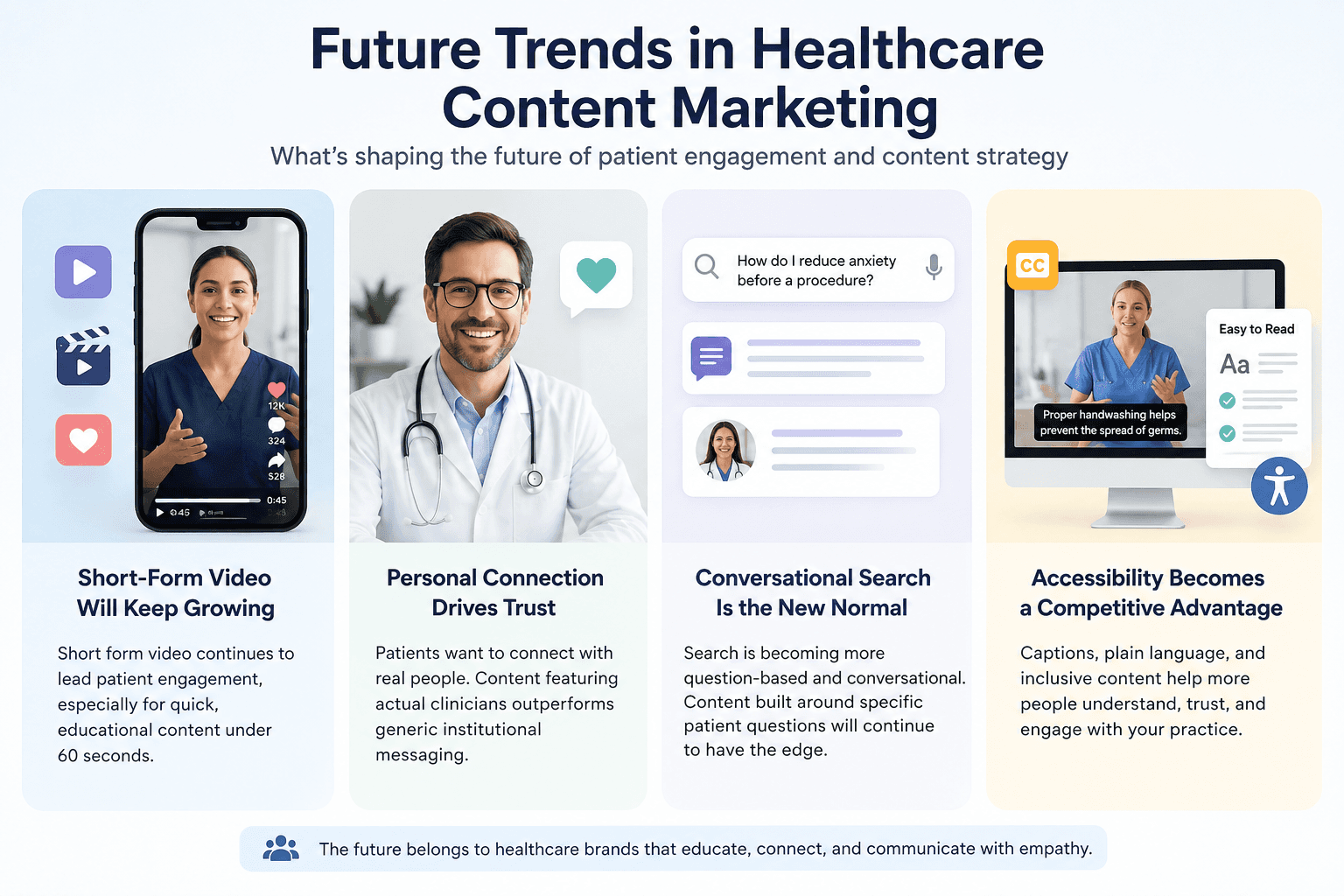
Practices are also paying closer attention to accessibility, including captions on video content and plain language writing, both of which widen the audience that can actually use the content being created.
Conclusion
Consistent healthcare content marketing is less about creativity on demand and more about having a repeatable system, a clear sense of what patients are actually asking, and enough structure that content does not depend on one overworked team member. The 50 ideas and calendar in this guide give you a starting framework, but the real work is in sustaining it week after week.
This is where a tool like Sociali.ai can help. It supports healthcare marketing teams in planning, drafting, and organizing social content around the kind of patient focused topics covered in this guide, so the calendar stays full without adding hours of extra work to a clinical team’s week. If you want to see how it fits into a healthcare content workflow, our healthcare solution page walks through the specifics. For readers looking to grow a newer account from the ground up, our Instagram growth guide and patient engagement guide are good next reads
FAQs
1. What is healthcare content marketing? It is the practice of creating educational and trust building content, such as social posts, blogs, and videos, that helps patients understand conditions, treatments, and services offered by a healthcare organization.
2. How many times a week should a healthcare practice post on social media? Three to five times a week is a realistic and sustainable cadence for most practices, prioritizing consistency over volume.
3. Is it safe to post patient testimonials on social media? Yes, as long as written consent is obtained beforehand and the content complies with applicable privacy regulations such as HIPAA.
4. What type of healthcare content performs best on social media? Short educational videos, myth busting posts, and real patient or staff stories tend to perform best because they combine usefulness with authenticity.
5. How can a small practice keep up with content creation? Batching content creation every two weeks, reusing blog content across multiple posts, and using tools built for healthcare marketing can make the workload manageable.
6. Should a clinical team member review social media posts before publishing? Yes, any post referencing symptoms, treatments, or medication should be reviewed by a clinical team member to ensure accuracy.
7. How can healthcare organizations avoid sounding too promotional? Balancing promotional posts with educational, community, and behind the scenes content keeps the account from feeling like a constant sales pitch.
8. What is the biggest mistake healthcare accounts make on social media? Posting inconsistently or relying only on stock imagery instead of real staff and patients, both of which reduce trust and engagement.
Free resource
Get the checklist


