How to Build a Personal Brand on Social Media Using AI (2026 Guide)
|
9
min read
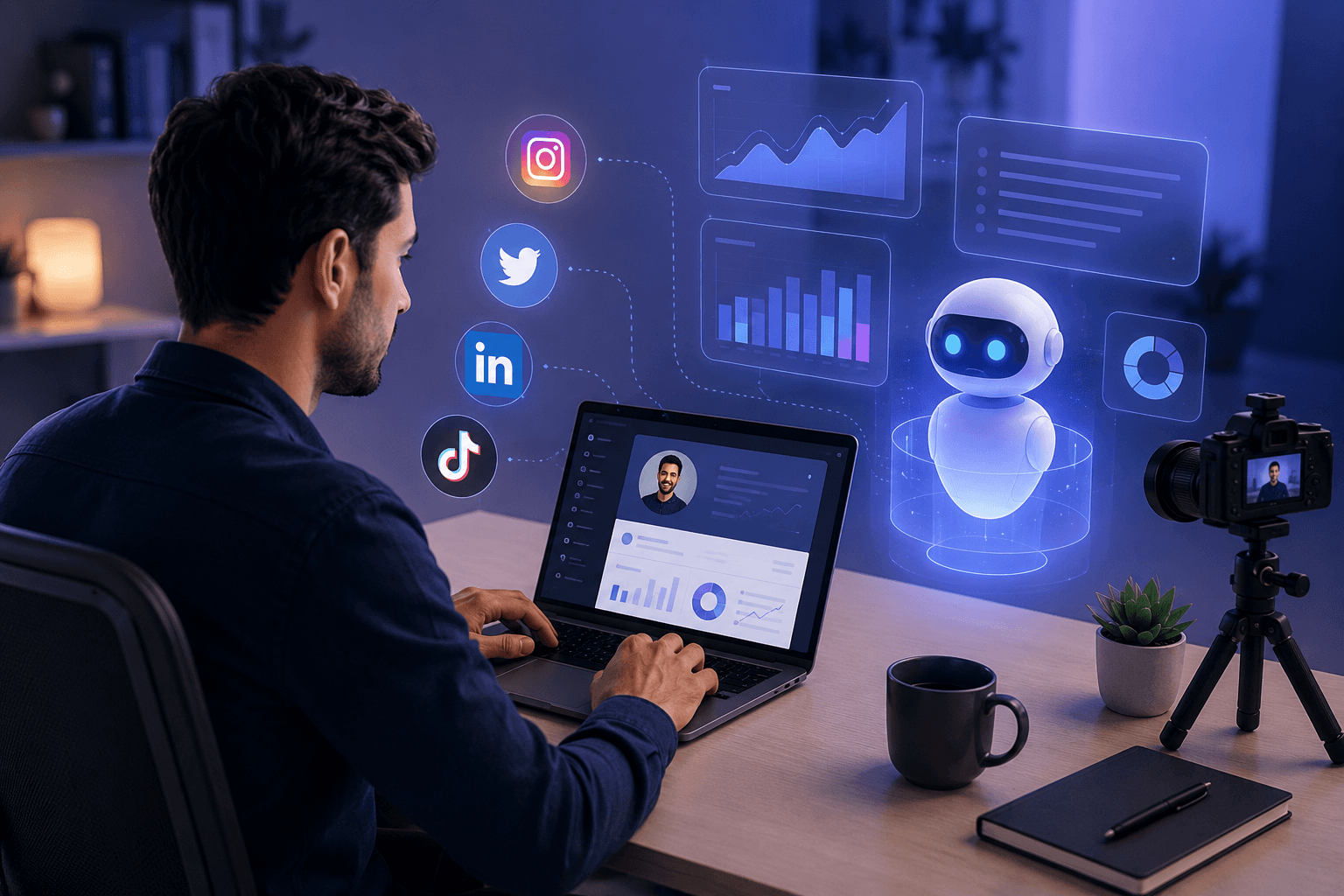
How to Build a Personal Brand on Social Media Using AI (2026 Guide)
The Honest Truth Nobody Tells You About Personal Branding in 2026
Let me be straight with you.
Three years ago, building a personal brand meant showing up every single day, writing content from scratch, and staying consistent for months before seeing any real traction. Even then, most people burned out before they ever hit 1,000 followers.
Today? The game has completely changed.
AI has not just made personal branding easier -it has made the gap between people who use it and people who do not absolutely massive. The creators who understood this early are now pulling 10x the reach with half the effort. The ones ignoring AI are slowly becoming invisible.
And if you are wondering whether AI-created content even performs as well as content written by a real person, that is a genuinely important question. We explored it in depth in our master guide -AI vs Human Content: Which Drives Better Results in 2026? -and the answer is more nuanced than most people expect.
This guide, however, is about something more practical. It is not about handing your brand over to a robot. It is about using AI the smart way -as a tool that amplifies your voice, your story, and your expertise, so you can finally build the brand you have been meaning to build for years.
Let’s get into it.
Why Personal Branding on Social Media Actually Matters in 2026
Before we talk about AI, let’s talk about what has changed on social media itself.
Organic reach is not dead -but it has shifted significantly. LinkedIn’s algorithm now heavily rewards consistent thought leadership. Instagram is pushing Reels from smaller accounts harder than ever. X (Twitter) threads with genuine opinions are outperforming polished brand accounts. TikTok is increasingly becoming a search engine for Gen Z and Millennials.
People are tired of corporate-sounding content. They want to hear from real humans who actually know what they are talking about.
That is your opportunity.
Here is where AI comes in: the biggest bottleneck in personal branding has never been ideas -it has always been execution. Most people know what they want to say. They just do not have the time to write it, format it, repurpose it, and show up consistently across multiple platforms. AI solves exactly that problem.
Step 1: Get Crystal Clear on Your Brand Identity (AI Can Help Here Too)
Before you open ChatGPT or any other AI tool, you need to be clear on three things:
Who you are -Your professional background, what you have lived through, and what makes your perspective different from the other people in your niche.
Who you are talking to -Not just “small business owners.” Get specific. Something like “first-generation immigrant entrepreneurs building product-based businesses in the $100K to $500K revenue range.” That level of specific.
What you want them to do, think, or feel -After someone reads your content for 30 days, what should they believe about you? What should they believe about themselves?
Once you have this clarity, AI becomes genuinely powerful. Without it, AI just helps you produce more generic noise at a faster rate.
How to use AI for brand clarity:
Try this prompt in any AI tool: “I am a [job title or background] who helps [specific audience] achieve [specific outcome]. I want to build a personal brand on LinkedIn and Instagram. Based on this, what three to five content pillars would make me memorable and valuable to my audience?”
The answers will not be perfect, but they will force you to react -and that reaction will tell you a great deal about what you actually believe.
Step 2: Choose Your Primary Platform (Stop Trying to Be Everywhere)
One of the biggest mistakes people make is trying to build a presence on every platform at once. The result is mediocre content everywhere and a real audience nowhere.
Here is a simple 2026 platform guide:
LinkedIn -Best for B2B professionals, coaches, consultants, corporate executives, HR and recruitment professionals, and SaaS founders. If your audience works a 9-to-5 or runs a business, LinkedIn is your highest-leverage platform right now.
Instagram -Best for lifestyle brands, creative professionals, and anyone in fitness, fashion, food, travel, or any space with a strong visual identity. Reels are your growth engine; carousels are your retention engine.
TikTok and Instagram Reels -Best for anyone willing to show their face and teach on camera. Short-form video is still the fastest way to grow from zero in 2026. The algorithm genuinely does not care how many followers you have -it only cares whether people keep watching your video.
X (Twitter) -Best for real-time takes, strong opinions, and building in public. If you are in tech, finance, media, or politics, X is where the important conversations are happening.
YouTube -Best for long-form education, tutorials, product reviews, and building an audience that trusts you deeply over time. YouTube content has the longest shelf life of any platform -videos published three years ago still drive consistent traffic today.
Pick one primary platform. Use AI to help you repurpose that content everywhere else.
Step 3: Build Your AI Content System (This Is Where the Magic Happens)
Here is the content system that is working for personal brands in 2026:
The Core Idea Method
Every week, you need one “core idea” -a genuine insight, story, opinion, or lesson drawn from your actual experience. This is the one thing AI cannot give you. It has to come from you.
One thing worth understanding here: there is a real and meaningful difference between content that is fully written by AI and content where a human brings the idea and AI helps with execution. If you want to understand exactly how that difference plays out in terms of reach, engagement, and conversions, read our master article -AI vs Human Content: Which Drives Better Results in 2026? -before building your content system.
Examples of strong core ideas:
“I made a $40,000 mistake by hiring too fast. Here is what I learned.”
“Three things I wish someone had told me before my first product launch.”
“Why the ‘10,000 hours’ rule is actually misleading for most people.”
Once you have your core idea, AI takes over the heavy lifting.
The Repurposing Workflow
Give your core idea to an AI tool using a prompt like this:
“Turn this core idea into: (1) a LinkedIn post in my voice -conversational, direct, and free of buzzwords; (2) a Twitter/X thread with 8 to 10 punchy tweets; (3) a three-slide carousel concept for Instagram with a hook, a main point, and a call to action; (4) a short-form video script under 60 seconds.”
You will get a solid first draft of four pieces of content from a single idea in about three minutes. You will need to edit, add your personal examples, and adjust the tone -but the structure is already done.
That is your entire week of content, built in under an hour.
Best AI Tools for Personal Branding in 2026
For writing and ideation:
Claude (Anthropic) -Best for long-form thinking, nuanced takes, and content that does not sound robotic
ChatGPT -Great for brainstorming, research summaries, and quick first drafts
Notion AI -Excellent if you already use Notion to manage your content calendar
For visuals:
Canva AI -Still the go-to option for non-designers creating branded graphics and carousels
Adobe Firefly -Better suited for professional-quality imagery and brand consistency
Midjourney -Best for creating unique, editorial-style visuals that stand out in a crowded feed
For video:
Descript -AI-powered video editing with automatic captions and filler word removal
CapCut -Excellent for short-form social video, especially Reels and TikToks
HeyGen -AI avatars and video translation for creators who want to publish content in multiple languages
For scheduling and analytics:
Buffer or Later -Solid options for scheduling posts and tracking basic analytics
Sprout Social -Better suited for advanced teams and agencies; includes excellent AI-powered sentiment and engagement tracking
Too Many AI Tools Confusing You? Use One Platform Instead
One of the biggest problems creators face in 2026 is tool overload.
You use one platform for ideation, another for writing, another for graphics, another for video editing, and yet another for scheduling and analytics. Eventually, the workflow becomes more exhausting than the content creation itself.
That is exactly why all-in-one AI content platforms are becoming increasingly popular.
With Sociali.ai, you can brainstorm ideas, write content, generate visuals and videos, maintain brand consistency, and create content in your own voice -all from a single platform without constantly switching between tools.
For creators, agencies, founders, and personal brands trying to stay consistent without burning out, simplifying the workflow is often more valuable than adding more tools.
Step 4: Write Content That Actually Sounds Like You (Not a Robot)
This is where most people go wrong with their AI-assisted content strategy.
They take the AI’s first draft, change three words, and hit publish. Then they wonder why nobody engages. The reason is simple: AI writes in a voice that is competent but completely generic. It does not know about the time you almost quit your job. It does not know what your best client said that changed the way you think. It does not carry your opinions or your history.
Your job is to inject all of that into the AI’s draft.
Practical rules for keeping your content human:
Always write your own first sentence. Do not use the AI’s hook -write yours first, then let AI continue from there. Your opening line is your personality on display.
Add at least one specific, personal detail that AI could not have known. A number, a name, a location, a real conversation. Something concrete and true.
Read it out loud before posting. If you would never say it in an actual conversation, cut it or rewrite it. Phrases like “In today’s fast-paced digital landscape…” should never survive your final edit.
Find something in the AI’s draft that you disagree with and push back on it. This forces you to add your actual perspective, which is exactly what makes the content worth reading.
Step 5: Build Consistency With an AI-Powered Content Calendar
The number one reason personal brands fail is not bad content -it is inconsistency.
People post enthusiastically for three weeks, disappear for a month, come back with an apology post, and then disappear again. Your audience forgets you exist, the algorithm stops showing your content, and you are back to square one.
AI can help you solve this problem permanently.
Here is a simple system that works:
Once a month, spend 90 minutes doing a “content brain dump.” Write down every experience, opinion, lesson, story, and idea you have had over the past 30 days. Do not filter anything -just write freely.
Then take that list to an AI tool and say: “I have 30 days of content to plan. Here are my raw ideas: [paste your list]. Please organize these into a content calendar with one post per day, varied between storytelling, education, opinion, and engagement-based formats. My primary platform is [platform] and my audience is [audience].”
You will get a full month of content ideas, organized and ready to execute. You still have to write each piece -but you will never stare at a blank page again.
Step 6: Engage Smarter, Not Just More Often
Growing a personal brand is not only about posting. It is about engaging. And this is one area where most people never think to use AI -but they absolutely should.
AI-assisted engagement strategies that work in 2026:
Use AI to draft thoughtful replies to comments on your posts. Instead of simply liking a comment or writing “Great point!”, ask AI to help you craft a response that genuinely adds to the conversation. It takes about 30 seconds and builds your reputation as someone worth following.
Monitor conversations in your niche using social listening tools. When someone in your space asks a question that you are well-positioned to answer, go ahead and answer it. AI can help you draft a solid, informed response quickly.
Identify potential collaborators in your field. Ask AI to help you research and write outreach messages to creators, podcast hosts, or newsletter writers who serve a similar audience. A genuine, well-crafted collaboration request converts far better than a generic copy-paste DM.
Step 7: Track What Is Working (And Let AI Help You Interpret the Data)
One of the most underrated uses of AI in personal branding is analytics. Most people glance at their follower count and call it a day. That is simply not enough.
Here is what you actually want to track:
Impressions - How many people are seeing your content? This is your core reach metric.
Engagement rate -Likes, comments, shares, and saves divided by total impressions. Aim for 3 to 5 percent or higher on LinkedIn, and 1 to 3 percent on Instagram for organic content.
Profile visits -This tells you how many people were curious enough to click on your name after seeing your content. If your impressions are high but profile visits are low, your content is interesting but you as a person are not yet compelling enough to make people want to know more.
Follower growth rate -Do not just track the raw number. Track the trend. Are you accelerating, plateauing, or declining?
You can paste your monthly analytics data directly into an AI tool and ask it to identify patterns, highlight what is working, and suggest what to prioritize next month. This turns a spreadsheet full of numbers into a real strategy conversation.
Once you are tracking consistently, the next question most creators face is: how do I actually prove this is generating business value? That is exactly what we cover in Social Media ROI Calculator: How to Measure Real Business Impact in 2026 -the second article in this series.
The Personal Branding Mistakes You Must Avoid in 2026
Even with AI in your toolkit, these mistakes will quietly kill your growth:
Posting AI-generated content without editing it. Readers can feel the emptiness. The writing is competent, smooth, and completely devoid of personality. Edit every draft ruthlessly before anything goes live.
Chasing trends that do not fit your brand. If you are a finance professional, you do not need to learn a trending dance on TikTok. Stay in your lane and own it fully.
Talking at your audience rather than with them. Ask questions. Run polls. Reply to every comment within the first hour of posting -the algorithm rewards this behavior heavily on most major platforms.
Broadening your message in an attempt to appeal to everyone. “Everyone” is not an audience. The more specific your content is, the more powerfully it resonates with the right people.
Giving up too early. Building a sustainable personal brand takes 6 to 12 months of consistent effort before meaningful momentum builds. If you are not seeing results at three months, the answer is almost always to get more specific and more consistent -not to quit.
A Real-World Example: What This Looks Like in Practice
Let’s say you are an HR professional who wants to build a personal brand on LinkedIn.
Your core idea this week: “I have interviewed over 400 people in my career. Here is the one question that tells me more about a candidate than anything else.”
You write that opening line yourself.
Then you paste it into an AI tool and say: “Turn this into a LinkedIn post. My tone is direct, warm, and non-corporate. My audience is hiring managers and job seekers. Maximum 250 words. No bullet points. No clichés.”
You receive a solid draft in about 45 seconds. You then add the actual question you ask in interviews, a short story about a candidate who answered it brilliantly, and your genuine perspective on why it works so well.
You publish it on Tuesday at 8 AM, which is LinkedIn’s most effective window for B2B content.
You reply to every comment for the next two hours.
You repeat this process twice a week.
By month four, you are recognized as a credible voice worth following in the HR space. By month eight, people are reaching out to you for speaking opportunities, consulting work, and podcast appearances.
That is the system. It is not magic. It is consistent, intentional, and -with AI -genuinely manageable for one person working alone.
Quick Summary: Your Personal Brand Action Plan
Here is everything you need to get started this week:
Day 1: Define your brand identity -your audience, your content pillars, and your goal. Use AI to challenge and pressure-test your thinking.
Day 2: Choose your primary platform. Set up your profile with a clear bio, a professional photo, and a relevant link.
Day 3: Do your first content brain dump. Write down 10 to 15 raw ideas drawn from your real experience.
Day 4: Use AI to turn your strongest idea into a post for your chosen platform. Edit it until it genuinely sounds like you.
Day 5: Publish it. Reply to every comment. Pay attention to what resonates.
Week 2 and beyond: Repeat the process. Build out your monthly content calendar. Start engaging consistently with others in your niche.
The personal brands that win in 2026 are not the ones with the most followers. They are the ones that show up consistently with a clear point of view and enough genuine humanity that people actually want to hear from them again.
AI gives you the leverage to do exactly that -without burning out.
Now it is your turn.
If you are a beginner -or if all of these tools feel overwhelming -there is a simpler option.
Instead of juggling separate platforms for writing, visuals, scheduling, analytics, and ideation, you can use Sociali.ai as your complete AI-powered workflow system.
Once your setup is done, you work alongside your AI co-pilot to brainstorm ideas, craft content, generate visuals, and stay consistent across platforms. Sociali handles the heavy lifting while you stay focused on strategy, creativity, and your authentic voice.
The biggest advantage is that the system gradually learns your preferences, tone, brand style, and content patterns over time -which means your workflow becomes significantly faster and more personalized after just a few weeks of use.
Frequently Asked Questions
How long does it take to build a personal brand on social media? Most people begin seeing meaningful traction between three and six months of consistent posting, at a cadence of three to five times per week. A recognizable brand with solid engagement typically takes nine to twelve months to properly establish. The people who appear to “blow up overnight” almost always had six to eighteen months of quiet, invisible work behind them before their breakthrough moment arrived.
Which AI tool is best for personal branding content? It depends on your platform and the type of content you create. For writing, Claude and ChatGPT are the strongest options available in 2026. For visuals, Canva AI is the most accessible starting point. For video editing, Descript is difficult to beat. Most successful creators use a combination of two to three tools rather than relying on just one.
Can I build a personal brand without showing my face? Yes, but it is harder. Faceless brands work well on LinkedIn through written content, on X through text-based posts, and on YouTube through voiceover combined with screen recordings or animations. On TikTok and Instagram Reels, showing your face significantly accelerates growth -but it is not a strict requirement.
How much of my content should be AI-generated versus human-written? Think of it as a division of labor. AI should handle structure, formatting, and initial drafting -roughly 40 to 60 percent of the work. But the ideas, opinions, stories, and personality behind the content? That is 100 percent you. The final edit should always be done by a human. If someone who knows you personally cannot hear your voice in the writing, it needs more work. For a deeper look at how this balance affects real-world content performance, see our master guide: AI vs Human Content: Which Drives Better Results in 2026?
Does AI-assisted content hurt SEO? Not inherently. Google has clearly stated that it evaluates content based on quality and genuine helpfulness, not on whether AI was involved in the writing process. What does hurt SEO is thin, generic content that offers no original perspective or real value. As long as your content is truly useful and reflects a clear point of view, using AI as part of your process will not negatively affect your search rankings.
How do I measure whether my personal brand is actually generating business results? Follower count and engagement rate are a starting point, but they do not tell the full business story. To properly connect your social media activity to leads, revenue, and real ROI, read our companion article: Social Media ROI Calculator: How to Measure Real Business Impact in 2026
What to Read Next
This article is part of a three-part series on AI-powered content strategy. Here is where each piece fits:
Free resource
Get the checklist


