Sociali.ai vs Sprout Social: Which Is Better for Hospitals, Healthcare Clinics & DSOs in 2026?
|
7
min read
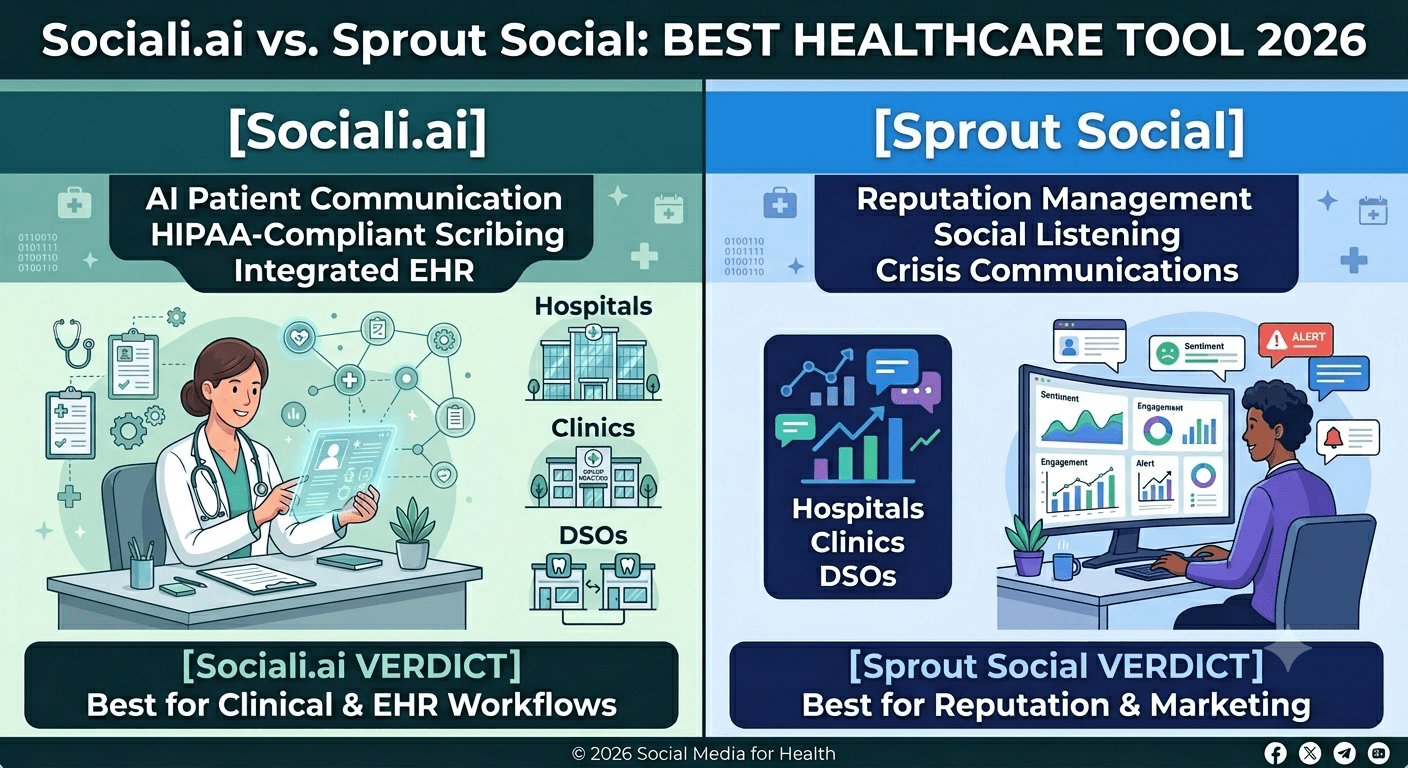
Which Is Better for Hospitals, Healthcare Clinics & DSOs in 2026?
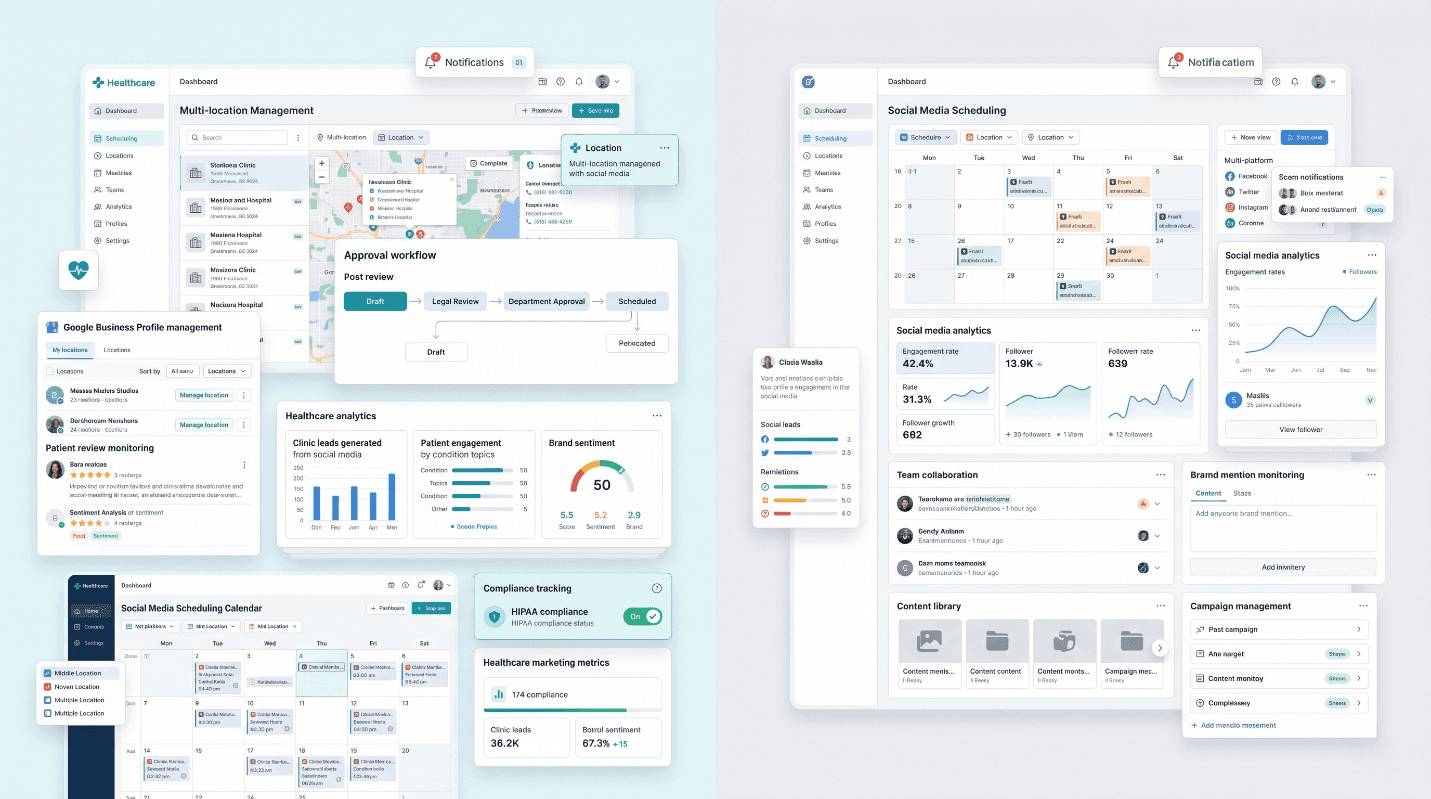
Managing social media for a healthcare organization is not the same as managing it for a retail brand or a software company. The workflows are different. The compliance requirements are different. And the stakes of getting it wrong are genuinely higher.
Yet most healthcare marketing teams still try to run their operations on platforms built for general-purpose social media management. The result is a daily friction tax: manual workarounds for approval chains, disconnected tools for review management, and constant tension between what the platform can do and what the organization actually needs.
This comparison looks at two platforms on opposite ends of that spectrum. Sprout Social is one of the most established social media management tools in the market, built for broad business use. Sociali.ai is purpose-built for healthcare, designed around the specific workflows, compliance requirements, and multi-location complexity that healthcare organizations deal with every day.
Neither tool is wrong. But they are built for different operational realities, and that difference matters more than most feature comparisons will tell you.
Why Healthcare Organizations Need More Than a Generic Social Media Tool
Healthcare social media management involves layers of complexity that don’t exist in most other industries.
A regional hospital system might manage social profiles for its main brand, six specialty departments, three outpatient campuses, and a handful of affiliated physician groups. Each location has different patient populations, different content needs, and potentially different compliance requirements. The marketing team coordinating all of this might be small, distributed, and working across time zones.
Layered on top of that is the approval reality. Content that touches patient outcomes, treatment claims, or provider credentials often needs clinical review before it goes live. A post about a new oncology program isn’t just a marketing decision. It needs to pass through compliance, clinical leadership, and sometimes legal, before anyone schedules it.
Then there’s reputation management. Patient reviews on Google Business Profile, Healthgrades, Yelp, and other platforms aren’t optional noise, they’re a direct factor in how patients choose providers. A multi-location healthcare organization needs to monitor, respond to, and report on reviews at scale, without letting anything slip through.
Generic social media tools can technically handle some of these tasks. But the friction involved in making them work for healthcare operations is significant, and it compounds across every location you manage.

Why Healthcare Organizations Look for Sprout Social Alternatives
Sprout Social is a genuinely capable platform. It handles scheduling, publishing, social listening, analytics, and team collaboration well. For a mid-size brand with a straightforward content calendar and a marketing team that can operate with minimal approval complexity, it works effectively.
The friction shows up when healthcare organizations try to scale it for their actual operational needs.
Approval workflows in Sprout Social exist, but they’re not designed around the multi-tiered, role-specific review processes that healthcare organizations require. Getting a post through a compliance officer, a department head, and a marketing director, in that specific order, takes configuration that the platform wasn’t built to make easy.
Google Business Profile management, which is critical for healthcare local visibility, has had limited native functionality in Sprout Social. For a hospital system trying to manage GBP posts, updates, and review responses across dozens of locations, this is a recurring operational gap.
Patient review management across platforms beyond social media, the full stack of Healthgrades, Google, Yelp, and others, isn’t a core Sprout Social function. Healthcare organizations end up running separate tools, which creates reporting fragmentation and operational overhead.
For teams managing five or fewer social accounts with standard approval needs, these gaps may be acceptable. For organizations with real multi-location complexity, they tend to become the defining friction point.
What Is Sociali.ai?
Sociali.ai is a healthcare social media and reputation management platform designed specifically for the operational complexity of healthcare organizations. It was built with hospital systems, multi-location clinic groups, dental DSOs, behavioral health networks, and similar organizations in mind, not adapted from a general-purpose tool.
The platform covers social media publishing and scheduling, multi-location management, approval workflows designed for healthcare compliance structures, Google Business Profile management at scale, and patient review management across major platforms. The architecture reflects how healthcare marketing teams actually operate, with role-based permissions, location hierarchies, and compliance-first workflow design built into the core product rather than added as options.
What Is Sprout Social?
Sprout Social is one of the leading social media management platforms in the market, used by brands across industries including retail, financial services, media, and healthcare. It offers a broad feature set covering publishing, scheduling, social listening, engagement, analytics, and team collaboration.
The platform is well-regarded for its reporting capabilities, its clean interface, and the quality of its customer support. It serves everything from small businesses to enterprise brands and has invested significantly in AI-powered features for content creation and analytics.
Its strength is breadth. Sprout Social is designed to serve many types of organizations well, which means it builds for common workflows rather than industry-specific ones.
What Features Matter Most in Healthcare Social Media Software?
For healthcare organizations evaluating social media platforms, the most operationally significant features tend to fall into a few categories.
Multi-location management capability determines whether a marketing team can realistically oversee content across dozens or hundreds of locations without resorting to manual coordination. Approval workflow design determines whether compliance requirements can actually be enforced within the platform, or whether they require external processes. Google Business Profile management determines whether local healthcare visibility can be managed centrally. And patient review management determines whether reputation workflows are unified or fragmented across tools.
Role-based permissions matter significantly in healthcare, where the line between who can draft content, who can approve it, and who can publish it needs to be enforced consistently. Analytics that roll up across locations matter for healthcare marketing directors who need to report on brand performance at scale.
These are the lenses through which the comparison below is organized.
Sociali.ai vs Sprout Social: Feature Comparison
Feature | Sociali.ai | Sprout Social |
|---|---|---|
Multi-location management | Built-in, purpose-designed | Available, general-purpose |
Approval workflows | Healthcare-specific, multi-tier | Standard team approval |
Healthcare-specific workflows | Core functionality | Not purpose-built |
Google Business Profile management | Native, multi-location | Limited |
Patient review management | Multi-platform, unified | Social reviews only |
Reporting | Multi-location rollup | Strong, general analytics |
Role-based permissions | Healthcare role hierarchy | Standard role management |
Ease of use for healthcare teams | Optimized for healthcare workflows | Requires configuration |
Healthcare compliance fit | Purpose-built | Adaptable with friction |
Scalability for healthcare | Designed for enterprise healthcare | Designed for general enterprise |
Multi-Location Healthcare Marketing Management
Managing social media for a multi-location healthcare organization requires more than a list view of accounts. It requires the ability to create content at the brand level, adapt it for individual locations, enforce brand standards without micromanaging every post, and give local teams enough control to stay relevant to their specific patient communities.
Sociali.ai is built around this model. Location hierarchies, centralized content libraries, and location-level customization are core to how the platform works, not configuration options you have to piece together.
A regional health system with fifteen outpatient clinics, for example, can push a brand-approved campaign to all locations while still allowing individual clinic coordinators to adjust timing, add location-specific captions, or respond to local community events. The brand team maintains control without creating a bottleneck for every piece of content.
Sociali.ai takes this a step further with AI-powered localization. Teams can create a campaign once and instantly adapt it for each location with customized branding, imagery, messaging, provider information, and local details. AI scheduling automatically distributes content across calendars to prevent locations from publishing identical posts at the same time, ensuring each clinic maintains a unique and authentic social presence. The result is that every location receives its own distinct content calendar while still staying aligned with the organization’s brand standards.
The platform also surfaces location-specific content opportunities, such as patient testimonials, community events, staff celebrations, and user-generated content (UGC), helping each location showcase its individuality and strengthen local engagement without requiring additional manual effort from central marketing teams.
Sprout Social can manage multiple accounts and has features for organizing teams around those accounts, but the platform architecture is not built around healthcare’s location hierarchy model. Replicating this kind of centralized-but-flexible structure requires significant manual configuration and ongoing workflow management.
Approval Workflows and HIPAA-Compliant Marketing Processes
Approval complexity is one of the clearest operational differences between the two platforms.
In behavioral health, for instance, a post about a treatment program might need to pass through a clinical director before a compliance officer reviews it, and only then reach the marketing manager for final scheduling. That sequence needs to be enforced consistently, logged for audit purposes, and visible to everyone involved in the chain.
Sociali.ai’s approval workflows are designed around exactly this kind of sequential, role-specific review process. The platform supports multi-tier approval chains, role-based review assignments, and audit trail visibility, reflecting the reality that healthcare marketing compliance is not a one-step checkbox. Sociali.ai’s approval workflows are designed around exactly this kind of sequential, role-specific review process. The platform supports multi-tier approval chains, role-based review assignments, and audit trail visibility, reflecting the reality that healthcare marketing compliance is not a one-step checkbox. You can also upload your custom disclaimer and compliance policies to help ensure regulatory adherence when collecting and publishing user-generated content (UGC) and employee-generated content (EGC), creating a more consistent and compliant content approval process across the organization.
Sprout Social has approval workflow capabilities, but they’re built for marketing team coordination rather than clinical compliance processes. Getting Sprout Social to enforce a specific sequence of clinical, compliance, and marketing review requires significant workflow design and often external documentation to back it up.
This gap tends to be most visible in behavioral health organizations and hospital systems, where content approval requirements are most stringent.
Google Business Profile Management for Healthcare Organizations
For healthcare organizations, Google Business Profile is patient acquisition infrastructure. A hospital network or dental DSO with dozens of locations needs consistent GBP management: accurate hours, updated service information, prompt responses to reviews, and regular posts to maintain local search visibility.
Doing this manually across dozens of locations is unsustainable. And Sprout Social’s native GBP functionality has historically been limited compared to its social media capabilities.
Sociali.ai treats GBP management as a core healthcare marketing function rather than an add-on. Healthcare organizations can manage GBP posts, updates, and responses from a central platform, apply updates across location groups, and track GBP performance alongside social media activity. For a dental DSO or regional clinic group where local search visibility directly drives patient volume, this is a meaningful operational advantage.
The best part? Your 5-star reviews can be transformed into social media testimonial posts in just one click, creating a seamless workflow that turns patient feedback into engaging social proof. This helps healthcare organizations maximize the value of positive reviews, strengthen trust with prospective patients, and maintain a steady stream of authentic content across their social channels.
Healthcare Reputation Management and Patient Reviews
Patient review management is a persistent operational challenge for healthcare marketing teams. Reviews arrive across Google, Yelp, Healthgrades, and other platforms, often at high volume for multi-location organizations, and the speed and quality of response affects both patient trust and search ranking.
Sociali.ai consolidates patient review monitoring and response management across these platforms within the same system used for social media management. This means the marketing team isn’t toggling between multiple tools to stay on top of reputation activity, and reporting on review performance is integrated with broader marketing analytics.
Sprout Social handles review management for social platforms but is not built to aggregate and manage patient reviews across the full healthcare reputation landscape. For organizations that need a unified view of their reputation across social and clinical review platforms, this requires a separate tool.
Healthcare Social Media Scheduling and Publishing
Both platforms handle scheduling and publishing competently. The differences here are more about workflow fit than raw capability.
Sociali.ai’s publishing interface is designed around healthcare content calendars, with awareness of location-level scheduling needs, content approval status, and the workflow states that content moves through in a compliance-sensitive organization.
Sprout Social’s publishing tools are well-built and have strong AI-assisted content features. For general social media scheduling, it’s a polished experience. The limitation for healthcare teams is that the scheduling workflow doesn’t have native awareness of compliance states or location hierarchies, so healthcare-specific coordination has to happen around the tool rather than inside it.
Role-Based Permissions for Healthcare Teams
Healthcare organizations have clear role distinctions in their marketing operations. A clinic coordinator can draft and respond. A regional marketing manager can approve location-level content. A compliance officer needs review access without publishing permissions. The brand team needs oversight visibility across all locations.
Sociali.ai’s permission model is built around these role archetypes, making it straightforward to assign access that matches actual job function without granting unnecessary permissions or creating security gaps.
Sprout Social has role-based access control, but the role model is built for general marketing team structures. Mapping healthcare-specific role requirements onto it requires custom configuration, and it’s not always a clean fit.
Analytics and Multi-Location Reporting
For hospital marketing directors and healthcare operations leaders, the analytics question is usually about roll-up: how is the brand performing across all locations, where are the engagement gaps, and which locations need attention.
Sociali.ai is built for this reporting model. Multi-location dashboards, location group reporting, and healthcare-relevant metrics are part of the core analytics architecture. At the center of the platform is the Central Dashboard, designed specifically for multi-brand and multi-location organizations. It brings operations, insights, reporting, and actions into one place, allowing teams to manage every brand, location, campaign, and workflow from a single view. This centralized approach makes it easier to monitor performance across the organization, identify opportunities, maintain brand consistency, and scale social media operations without losing visibility into individual locations.
Sprout Social has strong analytics capabilities and is widely regarded as one of the better reporting platforms in the social media management space. For general social media performance analysis, it’s excellent. Where it falls short for healthcare is in the multi-location roll-up model and the integration of reputation data alongside social performance data.
Ease of Use for Hospital and Clinic Marketing Teams
Healthcare marketing teams are often stretched. A marketing coordinator managing social for a network of behavioral health clinics may not have the bandwidth to learn a complex platform or build custom workflows from scratch.
Sociali.ai is designed for the realities of healthcare marketing. Because the platform is built around healthcare workflows, teams spend less time configuring the tool to match their operations and more time executing campaigns. Onboarding is faster, and the terminology within the platform aligns with how healthcare organizations actually work.
For busy healthcare teams, Sociali.ai also offers managed services that reduce the need for a dedicated in-house social media team. Our team helps translate complex medical expertise into engaging, patient-friendly social content designed to educate, build trust, and drive meaningful engagement. This allows providers, clinics, and healthcare organizations to maintain a consistent social presence without adding additional workload to clinical or marketing staff.
Sprout Social is a well-designed platform and is not difficult to use. But onboarding a healthcare organization onto Sprout Social typically involves more customization work than onboarding onto Sociali.ai, simply because healthcare-specific workflows require deliberate setup in a general-purpose tool.
Is Sprout Social Worth It for Healthcare Organizations?
For healthcare organizations with straightforward social media needs, a small number of locations, and limited compliance workflow requirements, Sprout Social is a capable platform. The reporting quality, the social listening tools, and the overall polish of the product are genuinely strong.
The calculus changes for organizations with multi-location complexity, stringent approval requirements, or significant Google Business Profile and reputation management needs. In those cases, the configuration work required to make Sprout Social function like a healthcare-specific tool is ongoing rather than one-time, and the gaps in GBP and reputation management typically require additional tools that add cost and complexity.
Pricing and Scalability for Multi-Location Healthcare Systems
Sprout Social pricing is structured around seat counts and tiers, with enterprise pricing available for larger organizations. For healthcare organizations managing many locations, the cost model can scale quickly as team size and account volume grow.
Sociali.ai’s pricing is structured around the multi-location healthcare model, with account and location-based packaging that aligns more directly with how healthcare organizations think about their footprint. Unlike many social media platforms, Sociali.ai does not charge per seat, so organizations can include marketing teams, regional managers, practice leaders, and other stakeholders without worrying about additional user costs.
Instead, pricing is based on the features you use and the volume of content you need, giving organizations greater flexibility as they grow. For large health systems, dental DSOs, and multi-location healthcare groups, this approach can deliver meaningful cost efficiency while ensuring everyone who needs visibility or involvement can stay in the loop.
Organizations evaluating both platforms should request detailed pricing based on their specific location count, team size, and feature requirements, as both platforms have enterprise pricing that varies significantly from list pricing.
Which Platform Is Better for Hospitals?
For hospital systems, the key requirements are multi-location management, multi-tier approval workflows, and brand governance across departments. These are the areas where Sociali.ai’s purpose-built architecture creates a clear operational advantage. Hospital marketing teams typically don’t have the capacity to build complex workarounds in a general-purpose tool, and the compliance stakes for healthcare content are high enough that workflow gaps carry real risk.
Which Platform Is Better for Healthcare Clinics?
For independent or small-group healthcare clinics, the choice depends on complexity. A single-location clinic with minimal approval requirements and a simple social media calendar could operate effectively on either platform. Clinics that are part of larger networks, or that have clinical review requirements for their content, will find Sociali.ai’s workflow design a better operational fit.
Which Platform Is Better for Behavioral Health Organizations?
Behavioral health marketing has some of the most sensitive content requirements in healthcare. Posts about treatment programs, patient outcomes, and clinical services require careful clinical and compliance review. Sociali.ai’s approval workflow design, combined with its HIPAA-compliant process architecture, makes it the stronger operational choice for behavioral health organizations managing any significant content volume.
Which Platform Is Better for Dental DSOs?
Dental DSOs have a specific combination of needs: high location counts, local visibility management through Google Business Profile, patient review management at scale, and brand consistency across independently operated practices. This combination maps almost exactly to Sociali.ai’s core feature set. For dental DSOs, Sociali.ai is the more purpose-fit platform by a significant margin.
Why Healthcare Organizations Are Moving Away From Generic Social Media Platforms
The shift toward healthcare-specific platforms reflects a broader operational maturity in healthcare marketing. As healthcare organizations have grown their digital marketing investments, the limitations of general-purpose tools have become more visible and more costly.
The manual workarounds required to enforce compliance workflows in a generic platform don’t just create friction. They create audit exposure, because compliance that lives outside the system is compliance that’s harder to document and verify.
The fragmentation required to manage social media in one tool, GBP in another, and patient reviews in a third doesn’t just add cost. It adds reporting complexity and reduces the marketing team’s ability to see the full patient experience picture.
Healthcare organizations moving to purpose-built platforms typically describe the transition in operational terms: fewer tools, less coordination overhead, better compliance visibility, and marketing teams that can focus on strategy rather than workflow management.
Final Verdict: Sociali.ai vs Sprout Social
Sprout Social is a strong platform for what it was designed to do. For organizations with general-purpose social media management needs, it’s one of the better options in the market.
For healthcare organizations, the operational fit question matters more than the feature list. Sociali.ai was built around the workflows, compliance requirements, and multi-location complexity that define healthcare social media management. Sprout Social was built for a broader audience, which means healthcare teams spend more time adapting the platform to their needs rather than the other way around.
For hospitals managing multiple campuses, behavioral health organizations with clinical approval requirements, healthcare clinic networks coordinating brand and local content, and dental DSOs managing local visibility at scale, Sociali.ai is the stronger operational choice.
The comparison isn’t really about which platform has more features. It’s about which platform was designed to match how healthcare marketing actually works.
If your organization is evaluating social media platforms and wants to see how a purpose-built healthcare solution compares to your current setup, Sociali.ai offers a guided demo built around your specific organization type and location structure.
Frequently Asked Questions
What is the best social media management platform for healthcare organizations?
The best platform depends on the organization’s specific needs. For healthcare organizations with multi-location complexity, compliance approval requirements, and integrated reputation management needs, a purpose-built healthcare platform like Sociali.ai is typically the stronger operational fit. General-purpose platforms like Sprout Social are effective for organizations with simpler social media operations.
Is Sprout Social good for hospitals?
Sprout Social is a capable social media management platform, but it is not purpose-built for healthcare. Hospital systems with multi-location management needs, multi-tier clinical and compliance approval workflows, and integrated Google Business Profile and patient review management requirements will typically find that Sprout Social requires significant configuration to match healthcare operational reality.
How do hospitals manage multiple social media accounts?
Hospitals managing multiple social media accounts typically need a platform with location hierarchy management, centralized content libraries, brand-level content distribution, location-level customization, and role-based permissions that match clinical and administrative role structures. Purpose-built healthcare platforms like Sociali.ai are designed around this model; general-purpose tools require custom configuration to approximate it.
Why do healthcare organizations need specialized social media software?
Healthcare social media management involves compliance requirements, multi-tier approval workflows, clinical content review, HIPAA-sensitive process design, Google Business Profile management at scale, and patient review management across clinical and consumer review platforms. These requirements are specific to healthcare and are not addressed adequately by general-purpose social media tools built for standard marketing teams.
What is the best social media software for dental DSOs?
Dental DSOs have a specific combination of needs including high location counts, centralized brand management, Google Business Profile management across practices, patient review management at scale, and local marketing flexibility for individual practices. Sociali.ai is purpose-built for this operational profile and is a strong fit for dental DSOs managing significant location portfolios.
What is the difference between Sociali.ai and Sprout Social for healthcare?
The core difference is operational fit. Sprout Social is a general-purpose social media management platform built for broad business use. Sociali.ai is a healthcare-specific platform built around the multi-location management, compliance workflow, Google Business Profile management, and patient reputation management needs of hospitals, clinics, behavioral health organizations, and dental DSOs. Healthcare teams typically require less configuration and fewer external tools when using Sociali.ai.
Can Sprout Social handle HIPAA-compliant social media workflows?
Sprout Social can be configured to support compliant marketing workflows, but the platform is not purpose-designed for HIPAA-compliant process architecture. Healthcare organizations that need documented, auditable approval workflows with clinical and compliance review stages will typically find purpose-built healthcare platforms better suited to enforcing and logging these processes consistently.
Free resource
Get the checklist


