AI Healthcare Content Creation: Complete Guide
|
8
min read
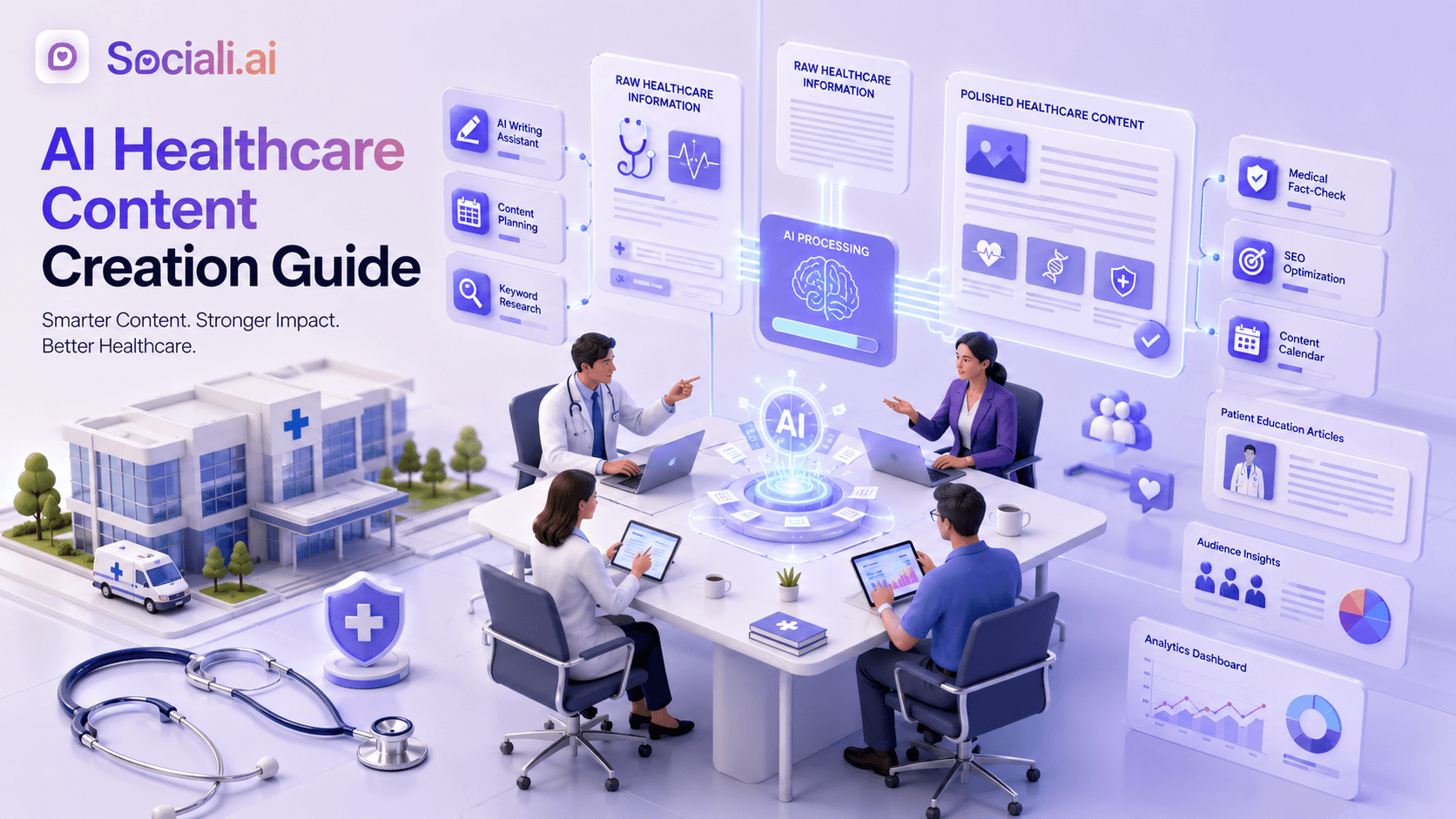
AI Healthcare Content Creation Guide
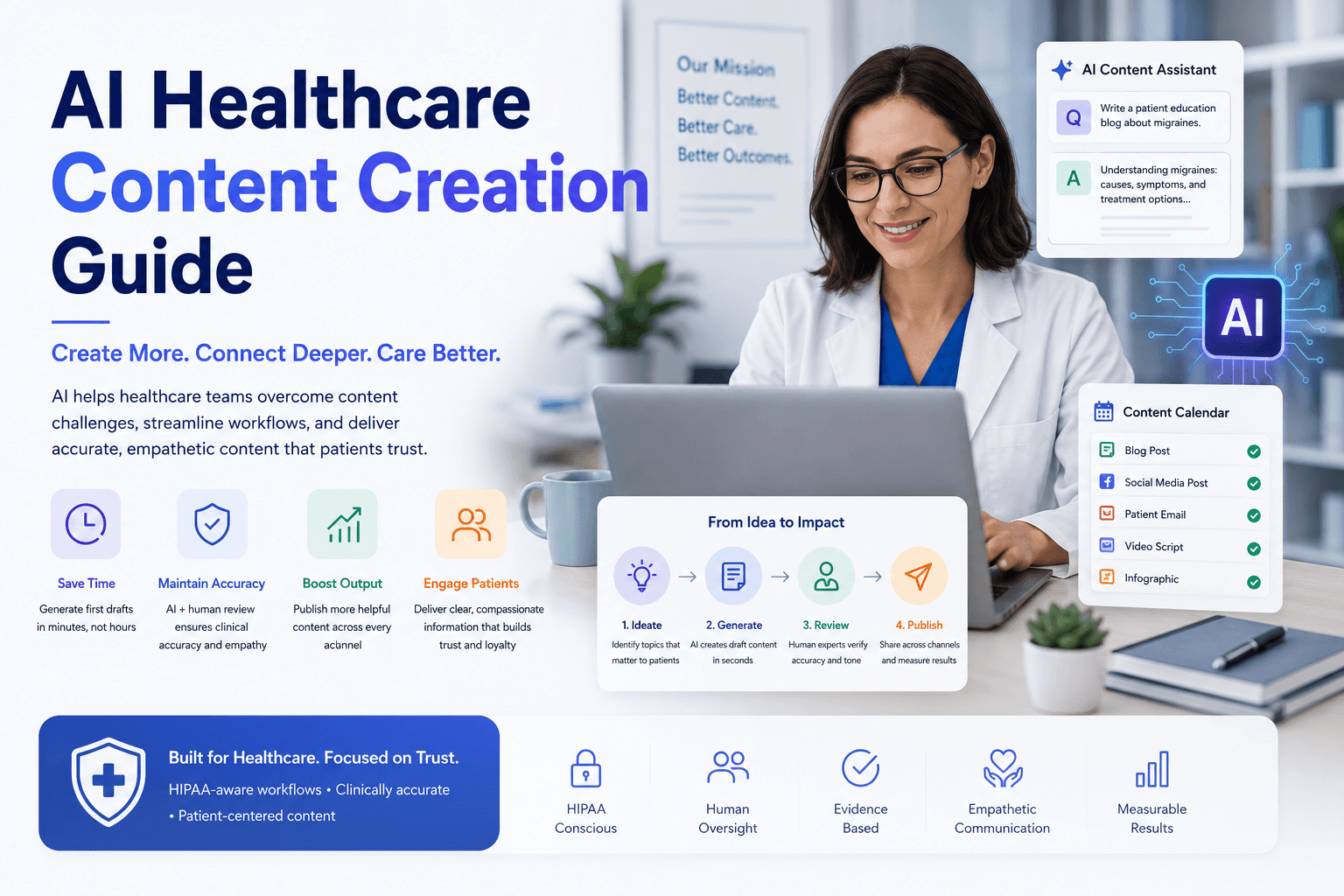
A hospital marketing team stares at a blank content calendar with 47 slots to fill by Friday. Blog posts, social updates, patient education emails, video scripts for a new service line. The workload is crushing. AI healthcare content creation steps in not as a replacement for human writers, but as the teammate who never sleeps and handles first drafts so your team can focus on strategy, accuracy, and empathy. Used correctly, it helps healthcare organizations publish more helpful content without sacrificing the clinical voice patients trust.
Key Takeaways
AI content creation for healthcare works best when a qualified human reviews every piece for medical accuracy, tone, and compliance before publishing.
First drafts, content repurposing, social media captioning, and SEO optimization are the highest-value starting points, not fully automated publishing.
Public-facing marketing content does not usually contain PHI, but protecting patient stories and respecting consent remains a hard requirement.
A documented AI workflow with defined review stages prevents brand voice drift, factual errors, and compliance slip-ups.
Healthcare teams using AI strategically produce more consistent content without adding headcount, while maintaining the empathetic quality patients expect.
Generic AI phrasing destroys credibility; prompt the tool with your organization's tone, style guide, and medical guardrails every time.
What AI Healthcare Content Creation Actually Means
AI healthcare content creation is the practice of using artificial intelligence tools to draft, outline, repurpose, or optimize marketing and educational content under human supervision. The key words are "under human supervision." It does not mean pressing a button and publishing whatever the machine spits out.
The tool might generate a blog post outline on diabetes management, then a clinical reviewer checks every fact. It might turn a long-form article into five social media captions that a marketer adjusts for each platform. It might suggest subject lines for an email campaign that a coordinator tests against brand voice. AI accelerates the grunt work. The final call always stays with a person who understands healthcare context.
This distinction matters because medical content carries responsibility. A typo in a retail email is embarrassing. A factual error in a post about blood pressure medication is dangerous. That is why ai content creation for healthcare looks different from general content generation. Guardrails, review steps, and clinical oversight are built into the process from day one.
Why Healthcare Marketing Teams Are Adopting AI Content Tools
Content demand in healthcare keeps climbing. Patients research symptoms, compare providers, read reviews, and expect educational material before they book an appointment. Search engines reward sites that publish comprehensive, frequently updated content. Social media algorithms favor consistent posting. The math is simple: more content is needed, but marketing teams are not growing.
AI fills the gap between what teams can produce manually and what the digital landscape demands. A two-person marketing department at a community hospital can now maintain an active blog, weekly newsletter, and daily social presence without working weekends. A dental group with three locations can spin up localized content for each office without hiring a copywriter.
Speed is not the only benefit. AI also helps with ideation when creative fatigue hits. It can analyze existing content and suggest underserved topics. It can rewrite a single patient success story five different ways for different channels. These efficiencies let healthcare marketing teams spend more time on strategy, community engagement, and patient relationships, the work that actually drives growth.
Types of Healthcare Content AI Can Help Create
Different content types need different levels of AI involvement. Here is where the technology adds the most practical value across healthcare organizations.
Blog posts and articles. AI drafts a structure and initial copy based on a target keyword and subject matter. A clinician or content strategist then edits for accuracy, adds patient-centered language, and ensures the advice aligns with current guidelines. Many hospital marketing teams start with blog content because the review process is already built into existing editorial workflows. When paired with a solid healthcare content marketing plan, AI-assisted drafts speed up production without reducing quality.
Social media content. AI turns one blog post into a week's worth of social posts adapted for LinkedIn, Facebook, and Instagram. It suggests hashtags, writes short-form captions, and repurposes patient education points into visual text overlays. The human marketer adjusts each post for the platform's voice and adds real-time relevance. This works especially well for small marketing teams at behavioral health centers and private clinics that cannot staff a full social team.
Patient education materials. AI can draft plain-language summaries of medical procedures, medication guides, or post-treatment instructions. This content must then pass a clinical review to catch any oversimplification or ambiguity. For hospitals, this accelerates the creation of condition-specific handouts that would otherwise take weeks to produce.
Email campaigns. AI writes subject lines, body copy, and segmentation suggestions. A healthcare email coordinator personalizes the final version, checks links, and ensures the tone matches the patient relationship. Automated welcome sequences, newsletter drafts, and re-engagement emails all benefit from AI's ability to generate variations quickly.
Video scripts. Short-form video dominates social media. AI can draft 60-second explainer scripts for a cardiologist discussing heart health or a dentist explaining crown procedures. The clinician reviews the script for accuracy, then records. This lowers the barrier for providers who dislike writing but are comfortable on camera.
Content repurposing. A long-form service line page becomes a downloadable guide, a podcast outline, and a series of infographic bullet points. AI handles the reformatting heavy lifting. Multi-location healthcare groups use this to maintain consistent messaging across markets while allowing each location to localize the final piece.
Building an AI Content Workflow That Stays Safe and Consistent
Without a process, AI-generated content drifts off-brand fast. Here is a practical four-step workflow that works for healthcare teams of any size.
Step 1: Set clear parameters before the AI writes anything.
Write a prompt that includes your organization's name, target audience, tone, and medical disclaimers required. For example: "You are writing for a hospital blog. Audience is patients aged 40 to 65. Tone is warm, educational, and never alarmist. Include a disclaimer that this is not medical advice." This upfront instruction cuts editing time by half.
Step 2: Always generate, never publish directly.
Treat AI output as a research assistant's rough draft. Every claim about a condition, treatment, or statistic gets a fact check against a reputable medical source. The Society for Healthcare Strategy and Market Development recommends that clinical content be reviewed by a licensed professional when it touches on diagnosis or treatment.
Step 3: Run content through a brand voice filter.
AI writing can feel generic. Have a senior marketer or editor read the piece aloud. If it sounds like a corporate white paper instead of a human conversation, rewrite those sections. This is where the real expertise shines. Tools can draft; humans give the content soul.
Step 4: Route through your existing approval process.
Marketing approval, clinical review if needed, compliance check. The fact that AI assisted does not shorten the approval chain. It simply makes the draft arriving at that chain much cleaner and faster to review.
A checklist sits at the heart of this workflow: Prompt set? Medical facts checked? Brand voice approved? Compliance signed off? If you answer no anywhere, do not publish.
Maintaining Medical Accuracy and Patient Trust
AI models are trained on vast data, not medical school. They confuse correlation with causation, cite outdated guidelines, and occasionally fabricate study findings. These hallucinations pose real risk in healthcare content creation.
The fix is non-negotiable human review by someone who knows the clinical material. For a behavioral health center, that might be a clinical director reading any post about therapy modalities. For a dental practice, the lead dentist verifies any claim about whitening or restorative procedures. For a hospital, a subject matter expert from the relevant department signs off on the specific content.
Beyond accuracy, patient trust hangs on empathy. AI does not understand the emotional weight of a cancer diagnosis, the fear of a child's surgery, or the vulnerability of seeking mental health care. Only a human writer can infuse content with the right tone. That is why even the most advanced AI remains a tool, not an author, in healthcare. This is the central thesis of responsible AI healthcare marketing, and it applies just as strictly to content.
Common AI Content Mistakes That Hurt Healthcare Brands
Some mistakes surface again and again when teams first adopt AI for healthcare content. Spot them early.
Publishing without clinical review. The biggest error. A single wrong drug interaction or outdated screening recommendation can cause harm and legal liability.
Using obvious AI phrasing. Sentences that start with "In the ever-evolving landscape of healthcare" or "Moreover, it is crucial to understand" scream machine-generated. Patients tune out. Rewrite every transition and clunky phrase until the content sounds like it came from a trusted clinician, not a template.
Neglecting consent in patient stories. If a piece includes a patient's experience, written consent is mandatory. AI cannot verify consent, so any draft containing identifiable patient details must be flagged and held until documentation is confirmed.
Over-optimizing for SEO at the cost of readability. Stuffing keywords into AI prompts produces copy that ranks temporarily but drives visitors away. Google's 2026 algorithms are skilled at spotting content written for bots instead of humans. Focus on helpfulness first.
Skipping the brand voice step. Every healthcare organization has a distinct voice. A children's hospital sounds different from a spine surgery center. If your AI prompts do not specify that voice, the output will read like anonymous internet text. This erodes the brand trust you have spent years building.
Real-World AI Content Creation Across Healthcare Settings
Hospitals. The content team uses AI to draft initial versions of service line pages, physician bio blurbs, and community health articles. Clinical department heads review for accuracy. The team publishes two to three times more content quarterly while reducing overtime.
Private clinics. A family medicine practice uses AI to write patient education emails about flu shots, annual physicals, and chronic disease management. The office manager personalizes each message and sends through their patient portal. Patient engagement rates rise without extra staff time.
Dental practices. A dentist prompts AI to generate Instagram caption ideas for smile transformations, hygiene tips, and team introductions. The front desk coordinator picks the best drafts, edits lightly, and publishes. The feed stays active even during busy clinic weeks. For more structured social planning, teams often look to a healthcare social media strategy that prioritizes patient engagement.
Behavioral health centers. Sensitivity is everything. AI drafts blog topics like "How to support a partner with anxiety" but the final version goes through the clinical director for tone and therapeutic accuracy. The center publishes consistent, helpful content without burning out clinical staff on writing duties.
Healthcare startups. Speed matters. AI helps a small marketing team draft product announcement posts, email nurture sequences, and explainer content. Founders review the technical details, and the content ships in days instead of weeks.
Multi-location groups. A central marketing team uses AI to create a bank of approved content modules. Each location manager pulls relevant modules, localizes with provider names and regional touches, and publishes. Brand consistency stays intact while each office feels locally relevant. Managing this across many locations is simpler when built on a unified platform; managing social media for 10+ locations without an agency becomes feasible with the right process and tooling.
Healthcare SMBs. Solo marketers or practice managers wear every hat. AI acts as a force multiplier, drafting website copy, blog posts, and social content that would otherwise never get written. The owner applies their medical knowledge in review, and the organization finally shows up online consistently.
How AI Supports Healthcare Content Teams Without Replacing Them
No one loses their job because their hospital adopted AI for content. What changes is how time gets spent. The marketer who used to stare at a cursor for two hours on a blog intro now starts with a solid draft and spends those two hours polishing, fact-checking, and improving the patient call to action. The social media coordinator who manually retyped the same post for four platforms now focuses on community engagement and responding to comments.
Content quality improves because human energy shifts to the parts machines cannot do: empathy, storytelling, clinical judgment, and strategic thinking. Burnout decreases when the daily word count pressure lifts. Team members report feeling more creative and less like assembly-line workers. This shift mirrors what has already happened in other industries. Accounting teams use software for calculations but apply human judgment to tax strategy. Healthcare content teams are reaching the same milestone.
The Future of AI in Healthcare Content Creation
AI will get better at understanding medical nuance, but it will never replace clinical judgment. The next few years will bring tighter integration between content tools and electronic health record systems, enabling hyper-personalized patient communication at scale while keeping data secure. Voice and video AI will help clinicians capture their expertise conversationally and turn those recordings into polished content with minimal editing. The teams that thrive will treat AI as a permanent, trainable member of the content department, not as a temporary experiment.
Healthcare content creation has always been about educating, connecting, and guiding patients. AI makes that mission possible at the speed modern healthcare demands. The organizations pairing smart tools with unwavering human oversight will dominate search results, build patient loyalty, and grow without burning out their people.
If your team is ready to streamline how content gets planned, created, and published across all your locations, see how Sociali.ai helps healthcare organizations collaborate smarter. Visit the Sociali.ai Healthcare Solution to explore a platform built specifically for the way healthcare teams work.
Frequently Asked Questions
Can AI write accurate healthcare content?
AI can draft content that appears accurate, but it occasionally introduces factual errors or outdated guidelines. A subject matter expert must verify every clinical claim, treatment detail, and statistic before publication. Accuracy depends entirely on the human review process.
Is AI healthcare content HIPAA compliant?
Most AI writing tools are not HIPAA compliant because they are not designed to handle protected health information. However, public-facing marketing content usually does not contain PHI. If a draft includes any patient data, remove it before processing through an AI tool and confirm written consent before use.
What is the best way to use AI for medical blog writing?
Start by giving the AI a detailed prompt with your topic, audience, tone, and required disclaimers. Use the output as a first draft. Verify medical facts, rewrite generic phrasing to match your brand voice, and route through your standard clinical and compliance review process.
Will AI replace healthcare content writers?
No. AI handles repetitive drafting and reformatting, but it cannot replace clinical judgment, emotional intelligence, or brand storytelling. Content writers who learn to use AI effectively become more productive and strategic, shifting their focus from word generation to high-value editorial work.
How do I make AI-generated healthcare content sound human?
Avoid prompts that accept generic output. Instruct the AI to write conversationally, use patient-friendly language, and avoid jargon. Then, edit aggressively. Read every sentence aloud and rewrite anything that does not sound like a real person talking to another real person.
What types of healthcare content should not be AI-generated?
Content involving urgent medical advice, individualized treatment plans, diagnostic guidance, or crisis intervention information should never rely on AI drafting. These require direct clinician authorship and oversight. AI can assist with supplementary educational context but not the core clinical communication.
Can AI create patient education materials safely?
AI can draft plain-language summaries of procedures or conditions, but these drafts must be reviewed by a licensed clinician for accuracy, appropriate tone, and completeness. Patient education carries direct health implications, so the review standard must be higher than for general marketing content.
How does AI affect healthcare SEO content?
AI can accelerate the creation of optimized, semantically rich content that covers topics comprehensively. However, search engines penalize low-value, generic AI content. Success comes from using AI to structure helpful, authoritative material that a qualified editor refines with clinical expertise and genuine patient insight.
Free resource
Get the checklist


