AI Healthcare Marketing: A Practical Guide for Modern Healthcare Teams
|
7
min read

AI Healthcare Marketing: A Practical Guide for Modern Healthcare Teams
Most healthcare marketing teams are running on fewer hands than they need. A hospital system might have two or three people covering social media, email, blog content, and review responses for a dozen departments. A private practice often has one person doing marketing between front desk duties and patient calls. That gap between what needs to get done and who is available to do it is the real reason AI healthcare marketing has moved from a buzzword to a daily tool.
This is not about replacing marketers or writing patient facing content without a human ever reading it. It is about using AI to handle the repetitive, time consuming parts of marketing so people can spend more time on strategy, patient relationships, and the judgment calls that software cannot make. A chatbot can draft a social caption. It should not decide how a clinic talks about a sensitive diagnosis.
This guide walks through what AI healthcare marketing actually looks like in practice, where it earns its keep, where it needs a human check, and how to build a workflow that holds up over time. If you manage marketing for a hospital, a specialty practice, or a healthcare agency juggling several clients, the goal here is to give you something you can use this week, not just concepts to think about later.
What AI Healthcare Marketing Actually Means
AI healthcare marketing is the use of artificial intelligence tools to plan, create, schedule, and analyze marketing content for healthcare organizations. That includes hospitals, clinics, private practices, dental offices, mental health providers, and the agencies that support them.
In practice, it usually shows up in a few specific places. Drafting social media posts and captions. Turning a physician’s notes into a patient education article. Writing email subject lines that actually get opened. Suggesting a content calendar based on seasonal health topics. Summarizing patient reviews to spot patterns. None of this is exotic. It is the same marketing work healthcare teams have always done, done faster and with fewer blank page moments.
It is worth separating this from clinical AI. Diagnostic tools, clinical decision support, and patient triage systems are a different category with different rules and different risk levels. Marketing AI deals with public facing content, not treatment decisions, though it still needs to respect patient privacy and stay within the standards healthcare organizations are held to.
Why Healthcare Teams Are Using AI
Three things are pushing healthcare marketing teams toward AI at the same time.
The first is staffing. Marketing departments in healthcare are typically small relative to the number of services and locations they support. A regional hospital system might market cardiology, orthopaedics, paediatrics, and urgent care with a team of four people. There simply is not enough time to write everything from scratch every week.
The second is patient expectation. Patients now research providers the way they research restaurants or hotels. They check Google reviews, look at Instagram before booking a dermatology appointment, and expect a practice’s website to answer basic questions without a phone call. A practice that posts once a month and never responds to reviews looks out of touch compared to competitors who show up consistently.
The third is content volume. Between blog posts, social platforms, email newsletters, patient education material, and review responses, a single practice can need dozens of pieces of content a month. AI does not remove the need for strategy, but it removes a lot of the friction of getting words on a page.
If you want a wider view of how these pressures are reshaping the field, our Healthcare Solutions page walks through how organizations are adjusting their marketing structure to keep up.
Where AI Saves Time without Losing the Human Touch
The honest answer is that AI is good at first drafts and repetition, and it is weak at judgment, empathy, and clinical accuracy. Healthcare marketing needs both, so the smart approach is to let AI handle the mechanical parts and keep a person in charge of anything that touches patient trust.
Think about a dermatology practice preparing content for a new acne treatment. AI can draft the social caption, suggest three headline options for the blog post, and format the same message for Instagram, Facebook, and an email newsletter. A staff member still needs to confirm the treatment details are accurate, the tone matches how the practice actually talks to patients, and nothing in the copy could be read as a medical guarantee.
That division of labor is where AI healthcare marketing works best. It is a drafting partner, not an editor in chief.
Manual Marketing vs AI Assisted Marketing
Task | Manual Approach | AI Assisted Approach |
|---|---|---|
Writing a week of social captions | 1 to 2 hours per platform, written from scratch | Drafted in minutes, then edited and approved by staff |
Turning a physician interview into a blog post | Half a day of transcription and writing | First draft ready in under an hour, then reviewed |
Repurposing one blog into social and email content | Rewritten manually for each format | Reformatted automatically, tone checked by a person |
Tracking what content performed well | Manual spreadsheet review at month end | Ongoing pattern spotting with human interpretation |
Responding to patient reviews | Written one by one, often delayed | Draft responses ready quickly, still personally reviewed |
AI Healthcare Content Creation for Blogs, Social Media, Emails, and Patient Education
Content creation is where most healthcare teams feel the AI difference first, mostly because it is the task that used to eat the most hours.
For blogs, AI works well when it is given a clear starting point. A paediatric clinic writing about flu season does not need AI to invent facts. It needs AI to take the practice’s existing talking points, a physician’s quick notes, and last year’s patient questions, and turn them into an organized, readable article. The clinic still fact checks every claim before it goes live, which is exactly how it should work.
Social media is a slightly different job. Captions need to be short, platform appropriate, and consistent with the practice’s voice. An orthopaedic clinic posting about a new joint replacement technique needs a different tone on LinkedIn than on Instagram. AI can generate several versions quickly, which gives the marketing team options instead of a blank page.
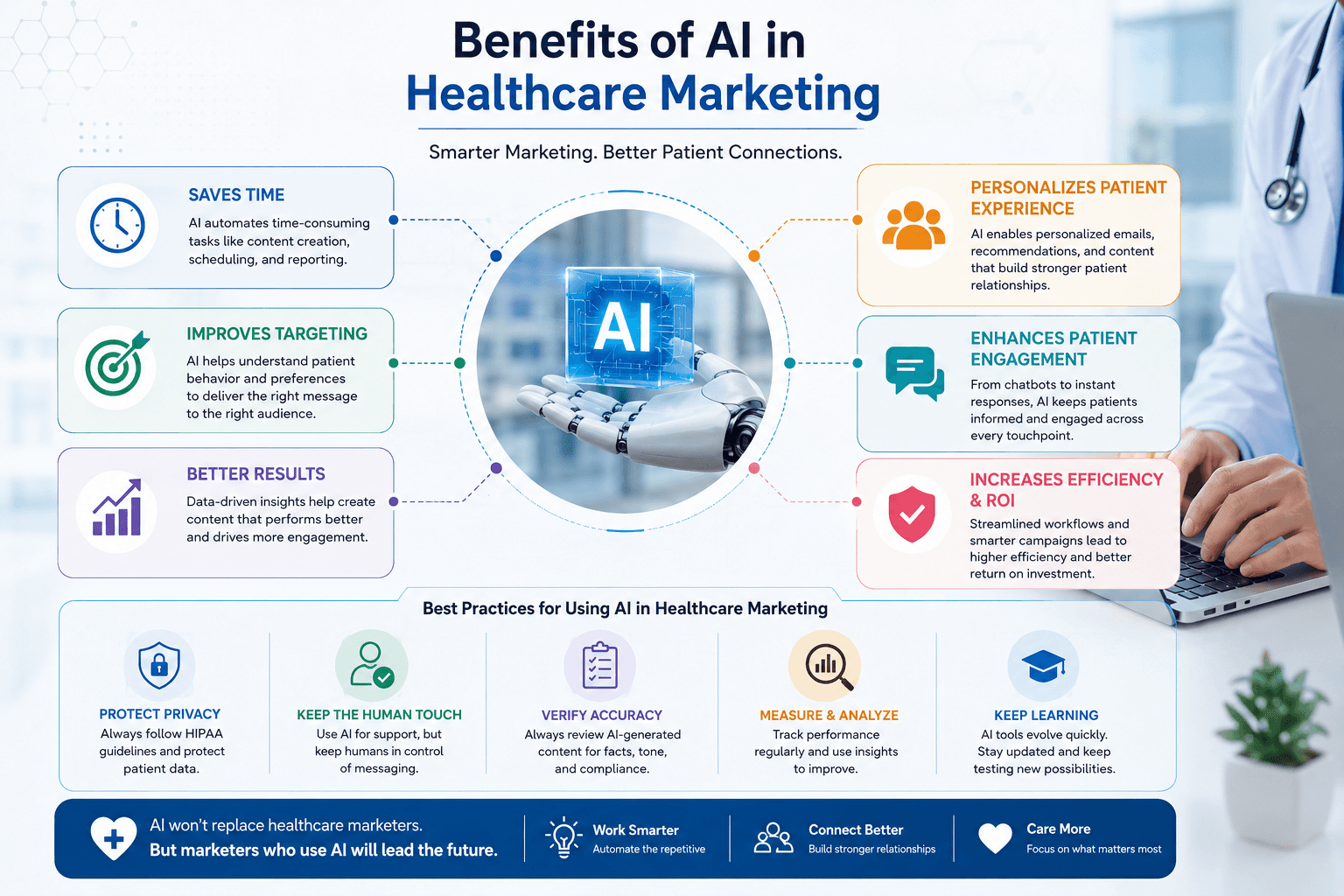
Email is where personalization matters most. A mental health clinic sending appointment reminders and a hospital sending a quarterly newsletter have very different goals, but both benefit from AI drafted subject lines that get tested against open rates rather than guessed at.
Patient education material carries the highest bar for accuracy. A private physician writing about medication side effects cannot let AI improvise. The safest pattern is to feed AI the physician’s actual clinical notes or existing patient handouts, then have it organize that information into plain language content, with a clinician reviewing the final version before publishing.
For a deeper look at building this out across a full content calendar, our Healthcare Content Marketing Guide breaks down planning and topic selection in more detail. And if social platforms specifically are your focus, the Healthcare Social Media Marketing Guide covers platform by platform strategy for providers.
Traditional Content Workflow vs AI Workflow
Step | Traditional Workflow | AI Assisted Workflow |
|---|---|---|
Topic research | Marketer brainstorms alone or waits on physician input | AI suggests seasonal and patient question based topics for review |
First draft | Written entirely by staff, often over several sittings | AI produces a working draft from notes or an outline |
Formatting for channels | Rewritten by hand for each platform | Reformatted quickly, then adjusted for tone |
Fact and compliance check | Done by staff, sometimes rushed under deadline | Still done by staff, with more time available since drafting is faster |
Publishing and scheduling | Manually posted across platforms | Scheduled in batches through a marketing platform |
Healthcare Marketing Automation That Improves Daily Workflows
Content creation gets most of the attention, but automation is where healthcare marketing teams often see the bigger day to day relief.
Scheduling is the obvious one. Instead of logging into four platforms every morning, a practice can batch a month of content in one sitting and let it publish on its own. A dental clinic with two locations can keep both Instagram accounts active without anyone remembering to post daily.
Review management is another. Automation can flag new reviews the moment they post and draft a response for staff to approve, which matters because response speed affects how reviews are perceived by other prospective patients. A hospital fielding hundreds of reviews across departments cannot realistically respond manually to all of them within a reasonable window without some help.
Reporting is the quieter benefit. Instead of pulling numbers from five different dashboards, automated reporting can consolidate engagement and reach data into one view, so a marketing director can see what is working without spending an afternoon on spreadsheets.
None of this replaces strategy. A clinic still needs to decide what to post about and how to talk about sensitive topics. Automation just removes the manual labour around execution. For a broader strategic view of how these pieces fit together, the Healthcare Social Media Strategy Guide is a useful next read.
How Healthcare Organizations Can Maintain HIPAA Friendly Marketing Practices While Using AI
This is the section healthcare marketers cannot skip. Marketing content is public facing, but the process behind it can still touch protected health information if teams are not careful.
The core rule is simple. Never enter identifiable patient information into an AI tool. That includes patient names, specific case details, photos where a patient could be recognized, or any combination of details that could point to a real person, even if the intent is harmless.
Testimonials need particular care. A glowing patient story is valuable marketing content, but it should only be used with clear, documented consent, and even then it is safer to generalize details rather than include specifics like exact procedure dates or unique circumstances.
Photos are another common slip. A pediatric clinic sharing a photo from a wellness visit needs signed release forms on file, not just a verbal okay from a parent in the moment.
AI tools themselves are not the risk. The risk is what gets typed into them. A practice that trains its team to keep any AI drafted content free of real patient identifiers is already most of the way to staying compliant.
Common Mistakes Healthcare Teams Make With AI
The mistakes tend to repeat across organizations, regardless of size.
The first is publishing AI drafts without review. A busy marketing coordinator under deadline pressure posts a caption straight from a tool without reading it closely enough, and it turns out to overstate what a treatment can do. That single post can undo months of careful, trustworthy messaging.
The second is losing the practice’s voice. AI defaults to a fairly generic, polished tone unless it is guided otherwise. A family practice that has always sounded warm and plain spoken can start to sound like every other clinic online if nobody adjusts the output.
The third is treating AI as a replacement for a content plan. Tools can draft fast, but fast drafting of the wrong topics does not help anyone. A clinic still needs to know what its patients actually want to read about.
The fourth is ignoring platform differences. A caption that works on LinkedIn rarely works unedited on Instagram. Copying and pasting the same AI output everywhere is a shortcut that show
Building an AI Assisted Marketing Workflow
A workable AI healthcare marketing workflow usually has four stages: plan, draft, review, and schedule.
Planning stays human led. Someone on the team decides the month’s themes based on the practice’s services, seasonal health topics, and questions patients actually ask at the front desk.
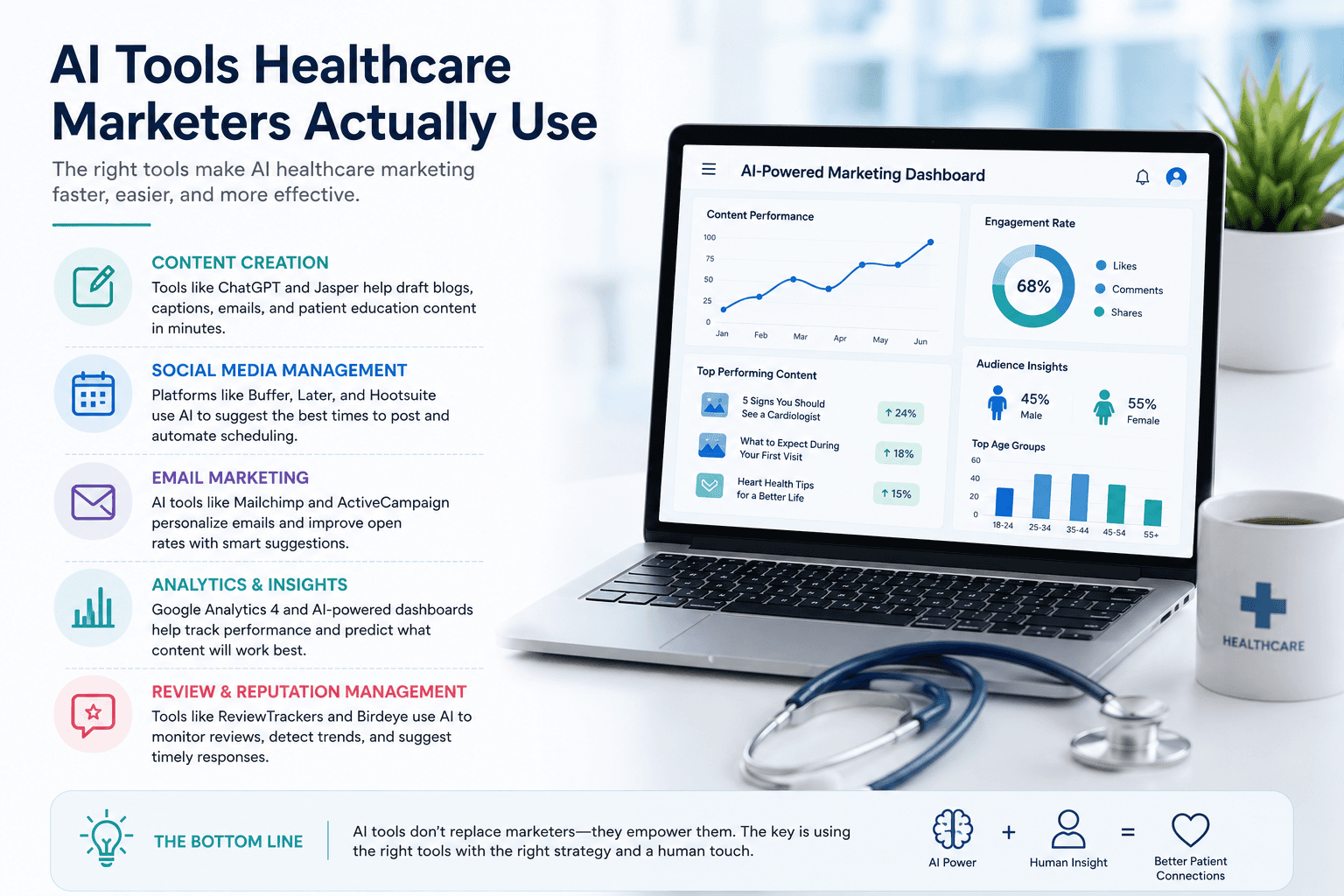
Drafting is where AI does the heavy lifting. Blog outlines, social captions, email copy, and first pass patient education content can all start here, using the practice’s own notes and prior content as reference material.
Review is non-negotiable. A staff member checks accuracy, tone, and compliance before anything goes out. This step is faster than writing from scratch, but it should never be skipped.
Scheduling closes the loop. Once approved, content gets batched and scheduled across channels so the team is not logging in daily to manage it manually.
Marketing Tasks Suitable for AI vs Tasks That Need Human Review
Suitable for AI | Needs Human Review |
|---|---|
Drafting social captions | Approving anything mentioning treatment outcomes |
Suggesting blog topics and outlines | Confirming clinical accuracy of health claims |
Repurposing healthcare content for multiple platforms | Creating compliant healthcare content |
Drafting review responses | Approving testimonials and patient stories |
Summarizing engagement data | Interpreting what the data means strategically |
How Sociali.ai Helps Healthcare Organizations Create Better Content Faster
Sociali.ai was built around the workflow described above, not around replacing the people who run healthcare marketing. It gives teams a single place to plan a content calendar, draft social posts and captions with AI assistance, schedule across platforms, and keep track of what is actually performing well.
For a hospital marketing team managing several departments, that means one calendar instead of five spreadsheets. For a private practice with a single marketer, it means drafts are ready in minutes instead of hours, leaving more time for the review step that actually protects the practice’s reputation.
The goal is straightforward. Healthcare organizations should be able to show up consistently for patients online without marketing becoming a second full time job for someone who already has one. If you are researching how other practices are building visual content strategy, our Instagram Strategy Guide is worth a look, and our Patient Engagement Guide covers how to turn that visibility into actual patient relationships.
Frequently Asked Questions
Is AI healthcare marketing HIPAA compliant?
AI marketing tools themselves are not automatically HIPAA compliant or non-compliant. Compliance depends on how they are used. As long as no protected health information, such as patient names or identifiable case details, is entered into the tool, and content is reviewed before publishing, AI can be used safely within a HIPAA aware marketing process. The responsibility sits with the organization’s internal policy, not the tool alone.
Can AI write medically accurate patient education content?
AI can organize and draft patient education content clearly, but it should always work from information a clinician has provided or approved, such as existing notes or handouts. It should not be used to generate original medical claims. Every piece of AI drafted health content needs a clinical review before it reaches patients, the same way any patient facing material would.
Will AI content sound generic instead of like our practice?
It can, if the output is used without editing. AI tends to default to a neutral, polished tone unless it is given examples of how a practice actually communicates. Feeding it past content, common phrases staff use, and specific tone guidance helps keep the voice consistent. Treat AI drafts as a starting point that still needs a human pass for personality.
How much time can AI actually save a small practice’s marketing?
It varies by practice, but the biggest time savings usually come from first drafts and repurposing content across channels, since those tasks used to take the most manual writing time. Instead of writing a caption from scratch for each platform, a marketer can generate several options quickly and spend remaining time on review and strategy rather than typing.
What healthcare marketing tasks should never be automated?
Anything involving clinical claims, patient testimonials, or sensitive health topics needs a human decision maker, not just automation. Automation is well suited to scheduling, formatting, and reporting. Judgment calls about tone, accuracy, and what is appropriate to publish should always stay with trained staff or clinicians.
Do patients trust AI assisted healthcare content?
Patients generally are not evaluating whether content was AI assisted. They are evaluating whether it is accurate, helpful, and consistent with how the practice treats them in person. Content that is well reviewed and genuinely useful builds trust regardless of how the first draft was created. Content that feels generic or inaccurate damages trust regardless of who or what wrote it.
What is the difference between AI healthcare marketing and healthcare marketing automation?
AI healthcare marketing usually refers to using artificial intelligence to help create content, such as drafting captions or blog posts. Healthcare marketing automation refers to the systems that handle repetitive execution, like scheduling posts or triggering review requests. In practice, most healthcare teams use both together as part of one workflow.
How do we start using AI in our healthcare marketing without overhauling everything at once?
Start with one task that already takes too much time, such as drafting social captions or reformatting a blog into email content. Get comfortable with the review step before adding more tasks. Most practices find it easier to expand gradually once the team trusts the review process, rather than automating everything on day one.
Can small practices use AI marketing tools, or is this only for large hospital systems?
Small practices often benefit the most, since they typically have the least staff time available for marketing. A single marketer at a private practice can use AI to handle drafting and scheduling, which frees up time that would otherwise go entirely to content production instead of patient facing strategy.
Final Thoughts
AI healthcare marketing is not a shortcut around good strategy, and it is not a replacement for the people who understand a practice’s patients better than any tool can. It is a way to close the gap between how much content healthcare organizations need and how much time their teams actually have.
The organizations getting the most out of it treat AI as a drafting partner with clear boundaries. Plan with people. Draft with AI. Review with people. Schedule with automation. That order matters more than which specific tool a practice chooses.
Ready to Simplify Healthcare Marketing?
If your team is spending more time formatting posts and hunting for content ideas than actually talking with patients, it might be worth looking at how a single platform could simplify that work. Sociali.ai’s Healthcare Solution brings content planning, AI assisted drafting, social scheduling, and patient engagement tracking into one place built with healthcare organizations in mind.
Free resource
Get the checklist


