AI Healthcare Marketing: Complete Guide for 2026
|
8
min read

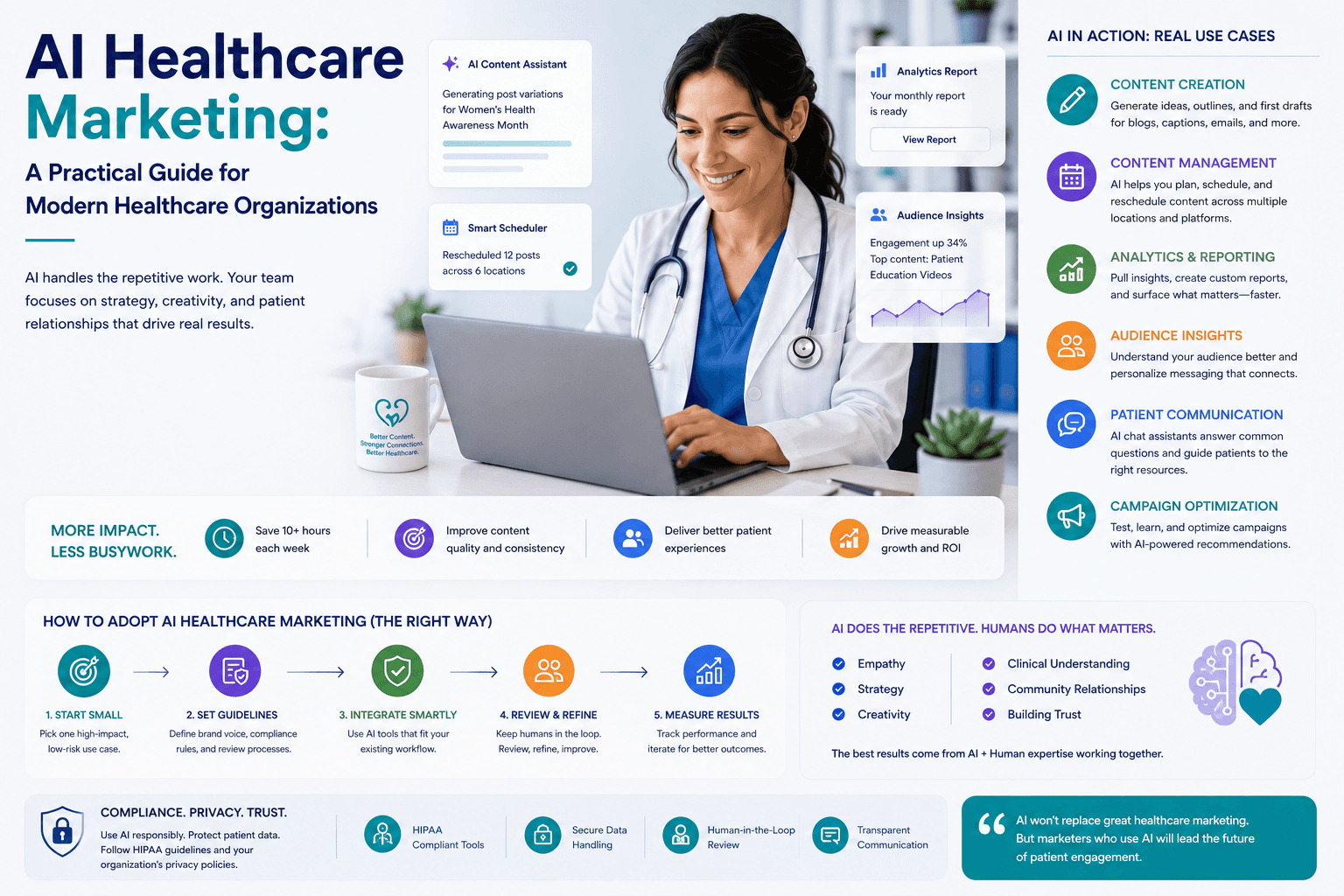
Most healthcare marketing teams are drowning in tasks they should not be doing manually. Writing five variations of a social post. Rescheduling content across six locations. Pulling analytics reports that take three hours to compile. The work matters, but the process wastes time that could go toward strategy and patient connection.
AI healthcare marketing changes that equation. Not by replacing marketers. Not by generating robotic content that patients scroll past. But by handling the repetitive operational work so teams can focus on what humans do best: building genuine relationships with patients and communities.
This guide covers what AI can actually do for healthcare marketing today, where it fits naturally, and how to adopt it without compromising compliance or patient trust.
Key Takeaways
AI healthcare marketing works best as an operational assistant, handling scheduling, analytics, and content drafting while human teams focus on strategy, approval, and patient connection.
The strongest use case for AI in healthcare right now is social media management at scale, especially for organizations managing multiple locations or service lines.
AI-generated content still requires human review for clinical accuracy, brand voice, and compliance before anything goes live.
HIPAA compliance and AI can coexist when organizations use purpose-built healthcare platforms rather than consumer AI tools.
Predictive analytics through AI helps healthcare marketing teams identify which content topics and posting times will likely perform best before investing resources.
Organizations seeing the best results from AI are those that integrate it into existing workflows rather than treating it as a separate initiative.
The goal of AI in healthcare marketing is not automation for its own sake. It is freeing up time for the human work that builds patient trust.
What AI Healthcare Marketing Actually Means
AI healthcare marketing refers to using artificial intelligence tools to support, streamline, or enhance marketing activities within healthcare organizations. This includes content generation, campaign scheduling, audience analysis, performance reporting, and patient communication.
The key word is support. AI does not replace the strategic thinking, clinical knowledge, or relationship building that effective healthcare marketing requires. It handles the repetitive operational work that consumes too much of a marketing team’s week.
Think of it as adding capacity to your existing team. A solo marketing manager at a multi-location dental practice suddenly has bandwidth to plan campaigns instead of spending hours manually publishing posts. A hospital marketing department can analyze which content topics drive actual patient appointments rather than guessing. These are not theoretical benefits. They represent real shifts happening in healthcare marketing teams right now.
Why Healthcare Marketing Teams Are Adopting AI
Healthcare marketing has always been resource-constrained relative to its importance. Organizations expect marketing to drive patient volume, build community trust, and manage reputation. But they rarely staff teams large enough to do all three well.
AI helps close this gap. A team of two can operate with the output closer to a team of five, not because anyone works harder, but because the tool handles the administrative weight.
There is also a competitive reality emerging. Healthcare organizations using AI-powered marketing tools are publishing more consistently, responding to patient inquiries faster, and learning from their data more effectively. Organizations that delay adoption risk falling behind in ways patients will notice, even if patients never know AI was involved behind the scenes.
The organizations approaching AI thoughtfully see another benefit. Their marketing teams report higher job satisfaction because they spend more time on creative and strategic work and less time on repetitive tasks. Retention improves. Burnout decreases. These internal benefits translate directly into better patient-facing marketing.
Where AI Fits in Healthcare Marketing Today
Some AI applications sound impressive but deliver little practical value. Others quietly transform daily operations. Here is where the real impact lives right now.
AI for Hospital Social Media Management
Social media management at healthcare organizations involves an enormous amount of operational overhead. Content calendars need maintenance. Posts need scheduling across platforms. Responses need monitoring. Analytics need pulling and interpretation.
AI tools designed for healthcare social media can handle scheduling, suggest optimal posting times based on historical engagement data, generate initial content drafts for human review, and compile performance reports automatically. This category represents the most immediately practical AI application for most healthcare organizations.
A hospital managing social media for multiple service lines can use AI to maintain consistent posting schedules without expanding headcount. A healthcare system with ten locations can ensure each facility page stays active without a dedicated social media manager at each site.
For organizations looking to implement this approach systematically, the complete healthcare social media management guide covers workflows, compliance considerations, and platform selection criteria.
AI-Assisted Content Creation
Content remains the foundation of healthcare marketing. Blog posts, social media updates, patient education materials, email newsletters. The demand for content always exceeds the capacity to create it.
AI tools can generate first drafts of many content types. Social media post copy. Blog post outlines. Email subject lines. Patient education summaries. These drafts require human review for accuracy and voice, but they eliminate the blank page problem that slows down content creation.
The realistic workflow looks like this. A marketer defines the topic, audience, and key points. AI generates a draft. The marketer edits for clinical accuracy, brand voice, and patient-appropriate language. A clinical reviewer approves anything with medical content. Then it publishes. The AI handles the heavy lifting of initial composition. Humans handle everything that requires judgment.
This approach works well for healthcare organizations that have invested in developing their brand voice and content standards. If your team can clearly articulate what makes your content sound like you, AI can approximate that voice in first drafts. If you cannot articulate your voice, AI will produce generic content that feels disconnected from your organization.
Predictive Analytics and Audience Insights
Healthcare marketing generates enormous amounts of data. Post performance metrics. Audience demographic information. Engagement patterns. Conversion tracking. Most organizations use a fraction of what they collect.
AI tools can process this data to surface patterns humans miss. Which content topics consistently drive appointment requests among women ages 35 to 50? What posting times generate the highest engagement for different service lines? Which email subject line patterns produce the strongest open rates?
These insights help marketing teams allocate resources more effectively. Instead of guessing what content will resonate, teams can make decisions based on actual performance patterns. The AI surfaces the insight. Humans decide how to act on it.
Patient Communication and Chatbots
AI-powered chatbots on healthcare websites can handle common patient questions around the clock. Appointment scheduling questions. Insurance inquiries. Directions to facilities. Forms that need downloading.
These tools work best when they have clearly defined boundaries. They handle the straightforward, repetitive questions that consume front desk and call center time. When a question exceeds their capability, they escalate to a human team member.
The patient experience benefit is immediate availability. Someone searching for a provider at 10 PM on a Sunday gets their question answered rather than waiting until Monday morning. The operational benefit is reduced strain on phone lines and front desk staff during business hours.
Chatbots in healthcare require particular attention to data security. Any tool handling patient information must meet HIPAA requirements. Consumer-grade chatbot tools generally do not. Purpose-built healthcare solutions do.
Building an AI Healthcare Marketing Strategy
Adopting AI without a strategy leads to scattered tool purchases and inconsistent results. Here is a framework for thoughtful implementation.
Start With a Workflow Audit
Before evaluating any AI tools, document where your team spends time today. Track activities for two weeks. Note which tasks consume the most hours and which require the most human judgment.
Most healthcare marketing teams discover that 40 to 60 percent of their time goes to operational tasks that do not require strategic thinking. Content scheduling. Analytics compilation. Draft writing. Approval routing. These tasks represent the highest-return targets for AI support.
Choose Problems Before Tools
The AI marketing tool landscape is overwhelming. Hundreds of platforms make ambitious claims. Many will not fit healthcare workflows or compliance requirements.
Start by identifying two or three specific problems to solve. Maybe your social media publishing process takes too long. Maybe your team cannot produce enough content to maintain consistency across platforms. Maybe your analytics reporting consumes an entire day each week.
With problems clearly defined, evaluate tools based on how well they solve those specific challenges. This approach prevents the common mistake of purchasing impressive AI tools that your team never fully adopts because they do not address real workflow pain points.
Integrate Into Existing Systems
AI tools work best when they connect to the platforms your team already uses. Social media management tools should integrate with the social platforms where you maintain active accounts. Analytics tools should pull data from your existing marketing stack.
Standalone AI tools that require separate logins and disconnected workflows create friction that undermines adoption. The goal is making AI support invisible within existing processes, not adding another system for your team to manage.
For healthcare organizations managing marketing across multiple locations, this integration becomes even more critical. The guide to managing social media across 10 locations covers the operational requirements for multi-location consistency.
Build Human Review Into Every Workflow
AI makes mistakes. It produces content that sounds plausible but contains clinical inaccuracies. It suggests posting times based on general patterns that may not apply to your specific audience. It generates copy that misses important context about your community or organization.
Every AI workflow in healthcare marketing needs a human review step before anything reaches patients. This is not optional. It is the standard that separates responsible AI adoption from reckless implementation.
The review requirement should be built into workflows from the beginning, not added after a mistake occurs. Define who reviews what. Set clear approval criteria. Document the process so team members can follow it consistently.
HIPAA Compliance and AI Tools
The intersection of AI and healthcare compliance creates legitimate concerns. Here is what organizations need to understand.
Consumer AI tools like general-purpose chatbots and content generators typically do not meet HIPAA requirements. Entering patient information into these tools creates compliance risk. Many healthcare organizations address this by establishing clear policies about what information can and cannot be shared with AI tools.
Purpose-built healthcare AI platforms operate under different standards. They incorporate HIPAA-compliant data handling, encryption, and access controls. They may offer business associate agreements that define data protection responsibilities.
The practical approach for most organizations involves using compliant platforms for any workflow that touches patient data and consumer tools only for activities like general content ideation where no protected information is involved.
Common Mistakes in AI Healthcare Marketing
Learning from others’ missteps accelerates your own implementation. Here are the patterns that cause problems.
Deploying AI without team training. Handing your team new AI tools without proper training guarantees low adoption and high frustration. Invest time in showing people how the tools fit their daily work.
Publishing AI-generated content without human review. This mistake damages credibility quickly. Patients may not know the content was AI-generated, but they notice when information feels generic, lacks specific detail, or contains subtle inaccuracies.
Over-automating patient communication. AI chatbots work well for straightforward questions. They fail badly when patients express fear, confusion, or complex medical concerns. Keep escalation paths to human team members clear and immediate.
Choosing tools based on features rather than workflow fit. A tool with impressive capabilities that does not integrate with your existing systems will gather dust. Evaluate tools based on how they work within your actual daily processes.
Neglecting to measure impact. Deploy AI tools, then track whether they actually save time, improve consistency, or enhance performance. If you cannot measure the benefit, you cannot justify the investment or optimize your approach.
For teams building their broader social media presence alongside AI adoption, the healthcare social media strategy guide provides frameworks that complement AI-powered execution.
What AI Healthcare Marketing Cannot Do
Setting realistic expectations prevents disappointment and poor implementation decisions.
AI cannot understand your specific community the way a local marketing team member does. It does not know which local events matter, which community concerns are most pressing, or which communication approaches feel authentic to your patient population.
AI cannot build genuine relationships with patients. It can schedule the post that starts a conversation, but it cannot have the conversation. The human connection that builds trust in healthcare still requires humans.
AI cannot make strategic decisions. It can surface data to inform decisions. It can generate options for consideration. But deciding which service lines to promote, which audiences to target, and which messages will resonate requires human judgment informed by organizational priorities and community understanding.
The most successful healthcare marketing teams treat AI as a capable assistant rather than a replacement for strategic thinking. They use it to handle operational work so they can invest more energy in the human elements that differentiate their organizations.
A Practical AI Implementation Roadmap
Here is a sequenced approach for bringing AI into healthcare marketing operations.
Month one: Document current workflows and identify the two highest-impact opportunities for AI support. Evaluate purpose-built healthcare marketing platforms against your specific needs.
Month two: Implement AI support for one workflow. Social media scheduling and content drafting is often the best starting point because it offers immediate time savings with manageable risk.
Month three: Review results. Measure time saved, consistency improved, and any quality concerns that emerged. Refine your review processes based on what you learn. Plan expansion to a second workflow.
Months four through six: Expand to analytics and reporting if the initial implementation succeeded. Consider patient communication tools if your team has capacity to manage them properly.
This measured approach builds organizational confidence in AI while minimizing risk. It also generates specific results you can share with leadership to support continued investment.
Frequently Asked Questions
What is AI healthcare marketing?
AI healthcare marketing uses artificial intelligence tools to support healthcare marketing activities including content creation, social media scheduling, audience analytics, and patient communication. These tools handle operational tasks while human teams manage strategy, clinical review, and relationship building. The approach increases team capacity without replacing the human judgment essential to healthcare marketing.
How is AI used in healthcare social media management?
AI assists with content scheduling, suggests posting times based on engagement data, generates draft social copy for human review, and compiles performance reports automatically. For multi-location organizations, AI helps maintain consistent posting across facility pages. All AI-generated content requires human review before publication to ensure clinical accuracy and appropriate brand voice.
Can AI help with HIPAA-compliant healthcare marketing?
Yes, when organizations use purpose-built healthcare AI platforms rather than consumer tools. Compliant platforms offer encryption, access controls, and business associate agreements. Organizations should establish clear policies about what information can enter AI tools and build human review into every workflow that involves patient-facing content.
What are the risks of using AI in healthcare marketing?
Primary risks include publishing clinically inaccurate content when human review is skipped, using consumer AI tools that lack HIPAA compliance, over-automating patient communication in situations requiring human empathy, and creating generic content that fails to reflect organizational voice. Each risk is manageable with proper workflows and oversight.
How much does AI healthcare marketing cost?
Costs vary widely. Some AI features come included in existing marketing platforms. Standalone tools range from roughly $50 to $500 monthly for basic capabilities to enterprise pricing for comprehensive platforms supporting multiple locations. The primary investment is often team time for training and workflow integration rather than software cost.
Will AI replace healthcare marketing jobs?
AI changes healthcare marketing roles rather than replacing them. It automates repetitive operational tasks like scheduling and report generation. This shifts marketer time toward strategy, creative work, community engagement, and clinician collaboration. Organizations using AI effectively typically report higher job satisfaction among marketing team members who spend less time on administrative work.
What AI tools work best for hospital marketing?
Hospitals benefit most from integrated platforms that combine social media management, content scheduling, analytics, and compliance features specifically designed for healthcare. General-purpose marketing AI tools often lack HIPAA compliance and healthcare-specific workflows. The best tools reduce operational overhead while maintaining the clinical oversight hospitals require.
How do I get my healthcare team to adopt AI tools?
Start with a specific workflow where time savings are immediately obvious, like social media scheduling. Provide hands-on training focused on how the tool improves daily work. Share early results showing time reclaimed. Build adoption gradually rather than requiring immediate full-team implementation. Success with one workflow builds enthusiasm for broader adoption naturally.
Making AI Work for Your Healthcare Marketing
AI healthcare marketing succeeds when organizations focus on practical applications rather than technological sophistication. The goal is not implementing AI for its own sake. It is giving your marketing team time back for the work that matters most.
Start with the operational tasks consuming your team’s hours. Content scheduling. Analytics compilation. First-draft writing. These represent immediate opportunities for AI support with manageable risk.
Build human review into every workflow. Train your team thoroughly. Measure results consistently. Expand thoughtfully based on what you learn.
The organizations seeing the greatest benefit from AI in healthcare marketing share a common approach. They use technology to handle repetitive work so their people can focus on what technology cannot do: understanding their community, building genuine patient relationships, and creating marketing that makes healthcare feel more human.
For healthcare marketing teams ready to bring AI support into their social media and content operations, Sociali.ai provides a purpose-built healthcare solution that combines AI-assisted content planning, multi-location scheduling, team collaboration, and compliance workflows in one platform. See how AI can give your team time back for the work that truly grows patient trust.
Free resource
Get the checklist


