Healthcare Social Media Management: The Complete Guide for Healthcare Organizations 2026
|
8
min read

Healthcare Social Media Management:
The Complete Guide for Healthcare Organizations (2026)
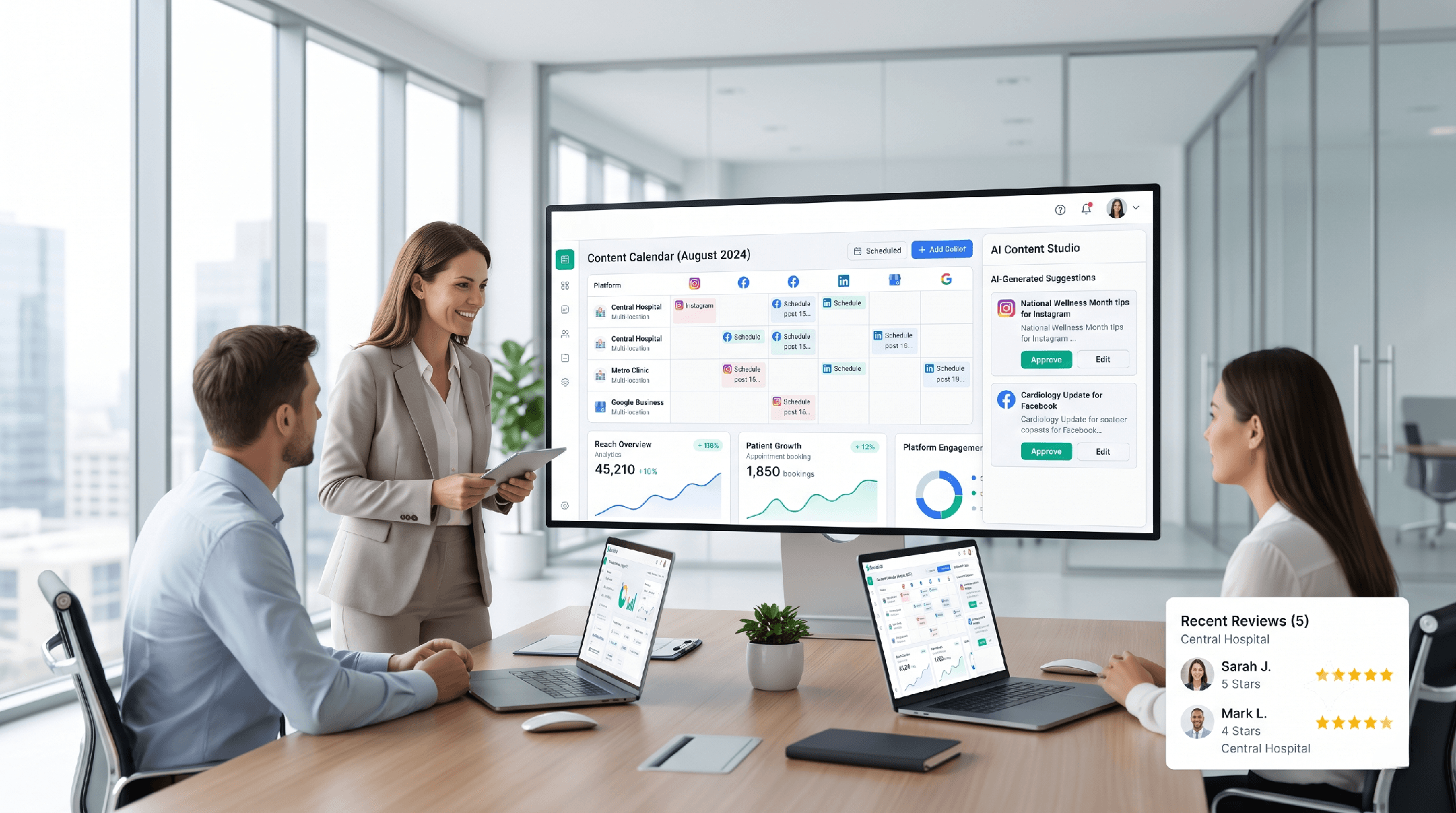
Healthcare Social Media Management: The Complete Guide for Healthcare Organizations (2026)
Running a hospital, clinic, or multi-location practice is demanding enough without also trying to keep up with Instagram trends, Facebook algorithm changes, and a steady stream of patient reviews. Yet social media has become one of the most important channels healthcare organizations have for building trust, attracting new patients, and communicating with their communities. The problem isn’t whether healthcare organizations should be active on social media. It’s how to manage it without burning out a small marketing team or risking a compliance misstep.
Ask any healthcare marketer what makes their job harder than social media management in other industries, and you’ll hear a familiar list: strict privacy regulations, multiple locations with their own local pages, credentialed providers who need to approve their own content, and patients who expect fast, empathetic responses around the clock. A single missed comment or an off-brand post isn’t just a marketing hiccup. It can affect patient trust in a way that’s hard to rebuild.
This is exactly why healthcare social media marketing has evolved from a nice-to-have into a core operational function. Organizations that treat it as an afterthought tend to post inconsistently, miss reputation issues, and struggle to prove marketing ROI to leadership. Organizations that build a real system around it, one that combines a clear healthcare social media strategy with the right processes and technology, see measurable gains in patient acquisition, retention, and brand trust.
That system is what we mean by healthcare social media management. In this guide, we’ll break down exactly what it involves, why it matters more than ever in 2026, the tools healthcare organizations rely on, the analytics that actually move the needle, and how to protect your reputation while scaling across locations. Whether you’re a solo practice manager or a CMO overseeing a health system with dozens of clinics, you’ll find a practical framework you can put to work right away.
Three shifts have made this more urgent than it was even a few years ago. First, patients now research providers the same way they research restaurants or hotels, scrolling through photos, reading reviews, and watching short videos before ever picking up the phone. Second, platforms themselves have multiplied: a practice that once needed to maintain a Facebook page now juggles Instagram, LinkedIn, TikTok, and a Google Business Profile, each with its own format, audience, and posting rhythm. Third, healthcare marketing teams have not grown at the same pace as these demands. Most are still small, generalist teams expected to do the work of a much larger department.
The result is a widening gap between what patients expect from a healthcare organization’s online presence and what most marketing teams can realistically produce by hand. Closing that gap doesn’t require a bigger team. It requires a better system. That’s the promise of healthcare social media management done well: fewer hours spent on manual, repetitive tasks, and more consistent, higher-quality results across every platform and location.
What Is Healthcare Social Media Management?
Healthcare social media management is the ongoing process of planning, creating, publishing, monitoring, and analyzing a healthcare organization’s presence across social platforms such as Facebook, Instagram, LinkedIn, TikTok, and Google Business Profile. It covers everything from a single dental practice posting patient testimonials to a regional hospital system coordinating dozens of location pages, physician profiles, and service lines.
Unlike social media management in retail or consumer tech, healthcare social media management has to account for patient privacy, clinical accuracy, and regulatory oversight at every step. A caption that would be perfectly fine for a restaurant brand might raise compliance concerns for a behavioral health provider. That added layer of responsibility is what makes dedicated management, not just occasional posting, so important.
At its core, effective medical social media management is built around a few consistent goals:
Building patient trust through consistent, accurate, and empathetic content
Growing visibility for services, providers, and locations in the communities they serve
Turning social engagement into phone calls, appointment requests, and new patients
Protecting the organization’s reputation across public reviews and comments
Keeping every post compliant with privacy and advertising regulations
Day to day, a healthcare social media manager (or the team responsible for this function) typically handles a mix of the following responsibilities:
Responsibility | What It Involves |
|---|---|
Content Planning | Building a monthly or quarterly calendar aligned to service lines, seasonal health topics, and campaigns |
Publishing | Scheduling and posting content across every platform and location page |
Monitoring | Tracking comments, mentions, and direct messages in real time |
Analytics | Measuring reach, engagement, and conversions against organizational goals |
Reputation Management | Responding to reviews and addressing patient feedback publicly and privately |
Compliance | Ensuring every post meets HIPAA and platform advertising requirements |
Patient Engagement | Answering questions, encouraging reviews, and building community online |
When these responsibilities are handled reactively, squeezed in between other duties, quality suffers. When they’re managed with a defined Healthcare Marketing Platform, a documented process, and clear ownership, social media becomes a predictable growth channel instead of a constant source of stress.
Why Healthcare Organizations Need Social Media Management
Some healthcare leaders still view social media as optional, a channel for younger patients or a place to post the occasional staff photo. That view is increasingly out of step with how patients actually choose providers. Most people now check a practice’s social presence and online reviews before they ever call for an appointment. A healthcare organization without an active, well-managed presence is effectively invisible to a large share of prospective patients.
Here’s what a structured approach to social media management delivers that ad hoc posting cannot:
Time Savings for Lean Teams
Most healthcare marketing teams are small, sometimes a single person covering an entire hospital system. Batching content creation, using approval workflows, and scheduling posts in advance can cut weekly time spent on social media by more than half.
Consistent Branding Across Every Location
Patients should recognize your organization whether they’re looking at the main hospital page or a satellite clinic three towns over. Centralized management keeps voice, visuals, and messaging aligned system-wide.
Higher Patient Trust and Engagement
Consistent, helpful content, not just promotional posts, builds the kind of trust that turns followers into patients. Organizations that post educational content regularly see noticeably higher engagement than those that post sporadically.
Lead Generation and Appointment Growth
Social platforms increasingly function as a discovery and referral channel. Clear calls to action, review generation, and responsive messaging translate directly into appointment requests.
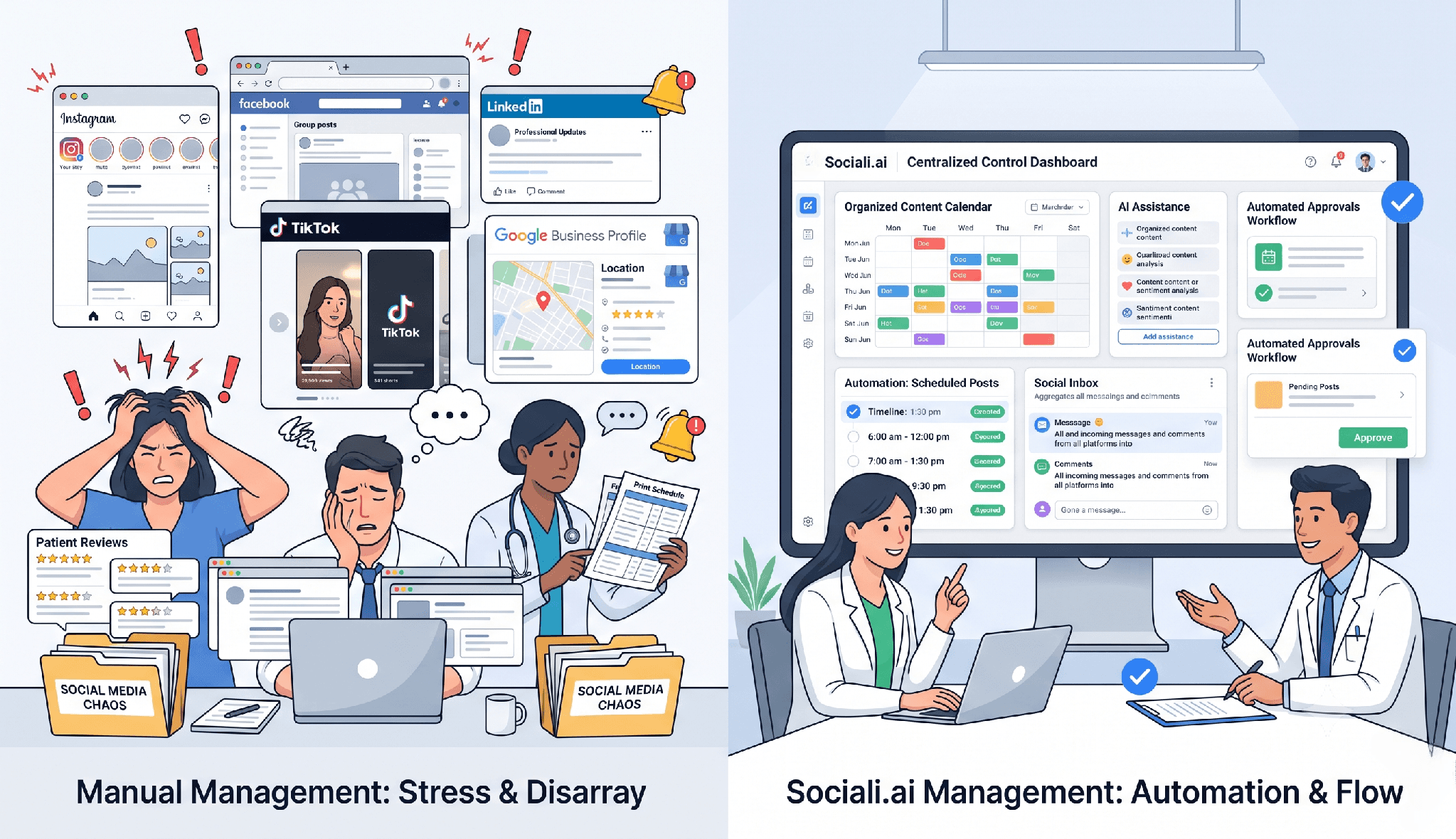
Workflow Automation and Scalability
As organizations grow from one location to ten, manual posting breaks down fast. Automation and centralized Healthcare AI Platform tools let a small team support dozens of locations without proportionally growing headcount.
Regulatory Peace of Mind
Built-in approval steps and compliance checks reduce the risk of a post that inadvertently shares protected health information or makes an unsubstantiated clinical claim.
Key Components of Healthcare Social Media Management
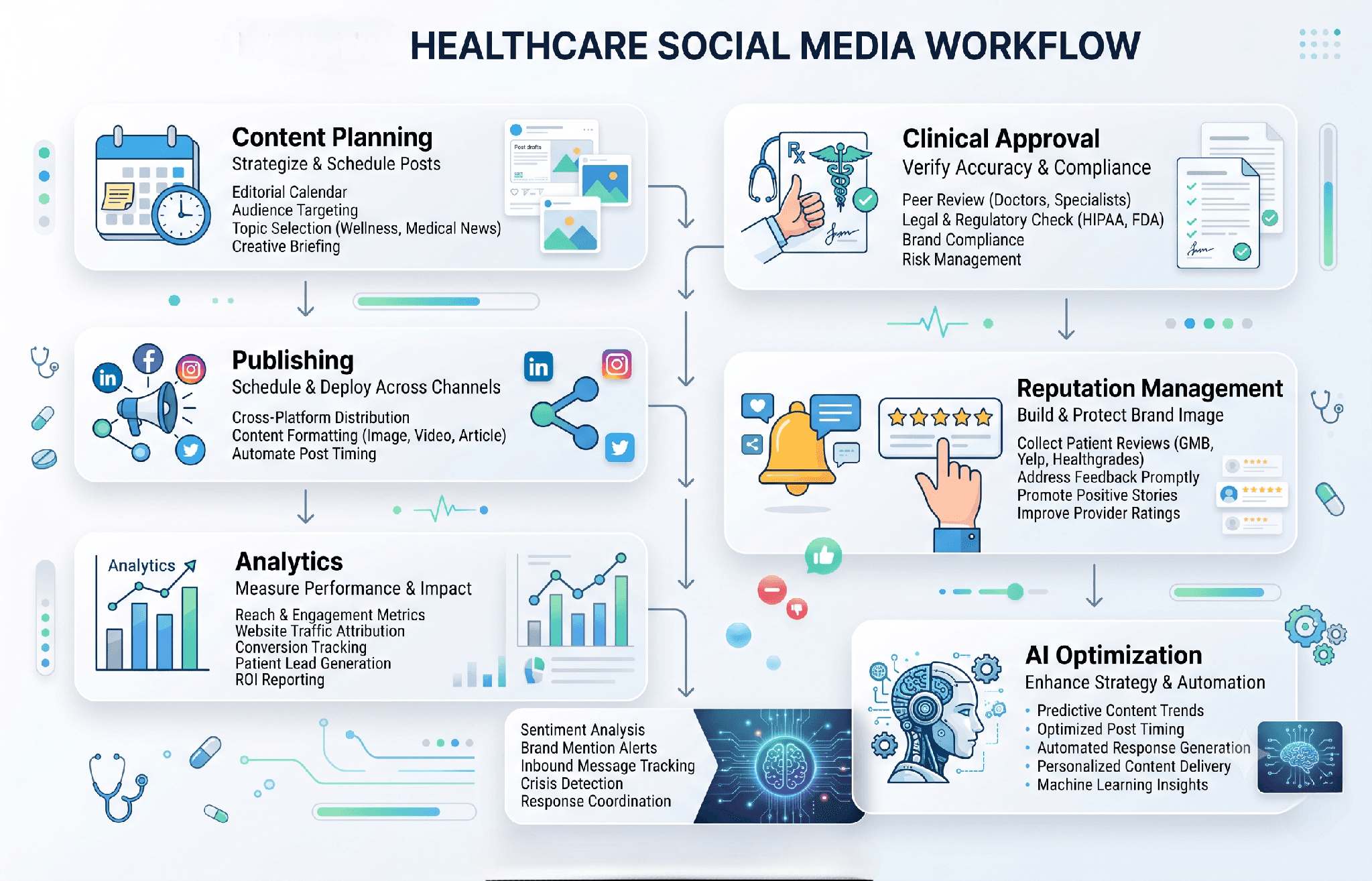
A mature healthcare social media program is really a collection of interconnected processes. Missing any one of them creates a bottleneck somewhere else. A great content calendar is wasted if approvals take a week, and a fast approval process doesn’t matter if no one is tracking whether the content actually performs. Here’s a closer look at each component and how it fits into the larger system.
Content Planning
Everything starts with a calendar that maps content to service lines, awareness months, provider spotlights, and seasonal health topics. A documented Healthcare Content Strategy prevents last-minute scrambling and keeps messaging aligned with organizational priorities.
Publishing
Scheduling tools let teams queue content in advance across every platform and location, rather than manually logging into each account every day. This is especially critical for organizations managing more than one physical location.
Approval Workflows
Because clinical accuracy matters, many organizations require a compliance officer, provider, or marketing director to review posts before they go live. A structured approval workflow keeps this from becoming a bottleneck by routing content automatically and tracking sign-off.
Social Listening
Monitoring mentions, hashtags, and relevant conversations helps healthcare teams catch questions, complaints, or misinformation early, before they escalate.
Analytics
Data on reach, engagement, and conversions tells teams what’s working and what isn’t, replacing guesswork with evidence-based decisions.
Reputation Monitoring and Review Management
Tracking and responding to reviews on Google, Facebook, and other platforms is one of the highest-impact activities in healthcare marketing, given how heavily patients weigh reviews when choosing a provider.
Community Management
Responding to comments and direct messages promptly, with empathy and clinical appropriateness, turns passive followers into engaged patients and advocates. This also means having a plan for sensitive questions asked publicly, such as someone describing symptoms in a comment. A good policy directs those conversations to a private channel rather than answering clinically in public.
Multi-Location Management
Health systems need the ability to publish system-wide content while still giving individual clinics or providers room for local posts, without duplicating effort or losing brand consistency. This typically means a hub-and-spoke structure: corporate marketing sets the brand standards and produces core content, while local teams add location-specific posts like staff announcements or community events, all visible from one central dashboard.
Team Collaboration
Marketing, clinical staff, and leadership all have a stake in what gets posted. Shared calendars, comment threads, and role-based permissions keep everyone aligned without endless email chains.
Compliance Checks
Every post should be checked against privacy and advertising standards before publishing, an area where guidance from the HHS and resources like the HIPAA Journal are useful references for marketing teams building internal policies.
AI Assistance
AI tools now help healthcare marketers draft captions, repurpose long-form content into social posts, and suggest optimal posting times, dramatically reducing the time spent on content creation.
A Sample Weekly Workflow
To see how these components fit together in practice, here’s what a typical week can look like for a healthcare marketing team using a structured process:
Day | Activity |
|---|---|
Monday | Review weekly analytics from the prior week and adjust the content plan if needed |
Tuesday | Draft new posts using AI-assisted content tools and internal templates |
Wednesday | Route drafted content through the approval workflow for clinical or compliance review |
Thursday | Schedule approved content across all platforms and locations for the coming week |
Friday | Monitor comments, messages, and new reviews; respond to outstanding items |
This kind of repeatable rhythm is what separates organizations that treat social media as a strategic channel from those that treat it as an afterthought squeezed in between other tasks.
Best Healthcare Social Media Tools
The right software can be the difference between a social media program that scales smoothly and one that constantly feels behind. When evaluating healthcare social media tools, organizations should look for platforms that combine scheduling, analytics, approval workflows, reporting, AI-assisted content, reputation management, and multi-platform publishing in one place, rather than stitching together five separate tools.
Many healthcare organizations start with whatever free scheduling tool a platform like Meta or LinkedIn provides natively. These native tools work fine for a single account, but they fall apart quickly once an organization has more than one location, needs an approval step, or wants to see performance data across platforms in one report. At that point, teams typically end up paying for two or three separate subscriptions (one for scheduling, one for analytics, one for review monitoring), which adds cost and creates more places for information to get lost.
Capability | Why It Matters for Healthcare |
|---|---|
Scheduling | Plan and queue content across every location and platform in advance |
Analytics | Measure reach, engagement, and conversion against real business goals |
Approval Workflows | Route content to compliance or clinical reviewers before it goes live |
Reporting | Generate clear, shareable reports for leadership and stakeholders |
AI Content | Speed up caption writing and content repurposing without losing brand voice |
Reputation Management | Monitor and respond to reviews across Google, Facebook, and more |
Publishing | Push content to multiple platforms and locations from a single dashboard |
Generic social media tools built for retail or e-commerce brands often lack the approval workflows and compliance-minded features healthcare teams need. This is where a purpose-built Healthcare Social Media Platform like Sociali.ai fits in.Rather than requiring healthcare marketers to adapt a general purpose tool to their needs, Sociali.ai was designed around the realities of healthcare marketing, including clinical review processes, multi location organizations, and the need for accurate, patient focused content.
In practice, that means a single healthcare social media dashboard where teams can plan a social media calendar healthcare-wide, publish across locations, route posts for approval, generate AI-assisted drafts, and pull performance reports, without switching between five disconnected apps.
What to Look For When Choosing a Tool
Support for multiple locations and provider-level accounts
Built-in approval workflows for clinical and compliance review
Review monitoring across Google, Facebook, and healthcare-specific directories
AI content generation trained on healthcare-appropriate tone and language
Clear analytics dashboards that connect social activity to appointments
Reliable customer support that understands healthcare marketing challenges
Healthcare Social Media Analytics
You can’t improve what you don’t measure. Healthcare social media analytics turn vague impressions (“our Instagram seems to be doing fine”) into concrete evidence that either supports or challenges your current strategy. For marketing teams that need to justify budget to leadership, analytics are also the clearest way to demonstrate ROI.
The challenge in healthcare is knowing which metrics actually matter. Vanity metrics like follower count feel good but rarely tell you whether social media is generating patients. A more useful approach ties healthcare engagement analytics directly to business outcomes.
KPI | What It Tells You |
|---|---|
Reach | How many unique people saw your content |
Impressions | Total number of times your content was displayed |
Engagement Rate | How actively your audience interacts with your content (likes, comments, shares) |
Follower Growth | Whether your audience is expanding over time |
Click-Through Rate (CTR) | How effectively posts drive traffic to your website or landing pages |
Website Traffic from Social | The volume of visitors social media sends to your site |
Appointment Requests | How many scheduling actions originated from social channels |
Conversion Rate | The percentage of social visitors who take a desired action |
Return on Investment (ROI) | Whether the value generated exceeds the cost of the program |
A useful habit is reviewing this data on a consistent cadence: weekly for tactical adjustments, monthly for trend spotting, and quarterly for strategic planning. Over time, Healthcare Social Strategy Guide decisions like which content formats to prioritize or which platforms deserve more budget should be driven by this data rather than intuition alone.
For example, a hospital system might discover that short educational videos on Instagram consistently outperform static graphics for both engagement and website clicks. Rather than continuing to split budget evenly across formats, that insight can justify shifting more resources toward video production.
Healthcare Reputation Management
Reputation management deserves its own spotlight because, for most healthcare organizations, it has more direct influence on patient acquisition than any single social media post. Before booking an appointment, prospective patients routinely check Google Reviews, Facebook reviews, and other public feedback. A pattern of unanswered negative reviews can undo months of positive marketing work.
Effective medical reputation management involves three ongoing activities:
Monitoring reviews across every platform where patients might leave feedback, including Google, Facebook, and specialty directories
Responding promptly and professionally to both positive and negative reviews
Encouraging satisfied patients to share their experience, which naturally balances out occasional negative feedback
Negative reviews are inevitable in healthcare. Wait times, billing confusion, and miscommunication happen even at excellent practices. What separates organizations with strong reputations isn’t the absence of negative feedback, but how they respond to it. A calm, empathetic, HIPAA-conscious response (one that never confirms a patient’s treatment details publicly) shows prospective patients that the organization takes concerns seriously.
This is another area where patient reviews management benefits from being built into the broader social media workflow rather than handled separately. When review monitoring, response templates, and escalation paths live inside the same Healthcare Marketing Platform used for content and analytics, nothing falls through the cracks.
It’s also worth remembering that reputation management and social media content reinforce each other. A steady stream of helpful, human content builds the kind of goodwill that makes patients more forgiving when something does go wrong, and more likely to leave a positive review after a good experience without being asked twice. Organizations that only show up online when responding to complaints tend to have a much harder time building the kind of brand authority that earns new patients.
Common Challenges in Healthcare Social Media Management
Even organizations that understand the value of social media often struggle to execute consistently. Here are the challenges we hear most often from healthcare marketing teams, along with practical ways to address them.
Limited Staff and Bandwidth
Many healthcare marketing departments are one or two people covering everything from website updates to event planning. Solution: batch content creation into focused blocks, lean on AI drafting tools, and schedule a month of content in a single sitting rather than posting reactively.
Content Creation Fatigue
Coming up with fresh ideas week after week is genuinely difficult. Solution: build a repeatable content framework (provider spotlights, patient education, behind-the-scenes, awareness months, reviews) so you’re filling in a template instead of starting from a blank page every time.
Compliance Concerns
Fear of saying the wrong thing can lead to paralysis, or worse, posting without any review at all. Solution: build a simple, documented approval workflow so every post gets a quick compliance check without adding days of delay.
Approval Delays
When approvals rely on emailing a document back and forth, content calendars fall apart fast. Solution: use software with built-in approval workflows so reviewers can approve or request changes directly, with a clear audit trail.
Managing Multiple Clinics or Locations
Keeping dozens of location pages on-brand and up to date is a full-time job on its own. Solution: centralize publishing through a single dashboard that pushes system-wide content everywhere while still allowing local flexibility.
Reporting to Leadership
Translating social media activity into numbers leadership actually cares about is a common gap. Solution: standardize on a small set of KPIs tied to appointments and revenue, and automate report generation so it doesn’t eat into strategic time.
Scaling the Program
What works for one clinic often breaks down at ten. Solution: invest in a platform built to handle multi-location complexity from the start, rather than retrofitting a single-location tool later.
Healthcare Social Media Management Best Practices
Whether you’re just formalizing your approach or looking to refine an established program, these best practices reflect what consistently works across healthcare organizations of every size.
Build a documented content calendar at least one month in advance
Align content themes with service lines and seasonal health awareness moments
Establish a clear, fast approval workflow for compliance and clinical review
Never share identifiable patient information without explicit, documented consent
Use a consistent brand voice across every location and platform
Respond to comments and messages within 24 hours whenever possible
Monitor reviews daily, and respond to all of them, positive and negative
Track KPIs monthly and adjust strategy based on real performance data
Repurpose long-form content (blogs, videos) into multiple social formats
Feature real patient stories and testimonials whenever consent allows
Highlight providers and staff to build a human connection with your audience
Use short-form video, since it consistently outperforms static images
Keep captions clear, accurate, and free of unverified clinical claims
Maintain a crisis communication plan for handling public complaints
Standardize hashtags and location tags across all accounts
Audit each platform quarterly to confirm branding is consistent
Train new staff on your organization’s social media and compliance policies
Use scheduling tools to avoid gaps and maintain consistent posting frequency
Segment content by audience (patients, referring providers, community members)
Test posting times and formats regularly rather than assuming what works
Keep a running library of approved, compliant content templates
Review platform policy updates from Meta and LinkedIn periodically, since advertising and content rules change
How AI Is Transforming Healthcare Social Media Management
AI healthcare marketing tools have moved from novelty to necessity over the past two years. For lean marketing teams, AI social media healthcare tools now handle much of the repetitive work that used to consume entire days, freeing staff to focus on strategy and patient relationships instead.
Content Generation
AI can draft first versions of captions, blog-to-social repurposing, and provider bios in a fraction of the time it takes to write from scratch, giving marketers a strong starting point rather than a blank page.
Content Repurposing
A single patient education article can become a LinkedIn post, an Instagram carousel, and a short video script, all generated with AI assistance and then refined by a human editor.
Scheduling and Timing
AI-driven scheduling tools can recommend optimal posting times based on when a specific audience is most active, rather than relying on generic best-practice guides.
Performance Prediction
Some platforms now use historical data to estimate how a given post is likely to perform before it’s published, helping teams prioritize the content most likely to drive engagement.
Analytics and Reporting
AI can summarize weeks of performance data into plain-language insights, saving marketers from manually digging through spreadsheets to explain results to leadership.
Brand Consistency
AI tools trained on an organization’s tone and style guidelines help keep every post sound like the same brand, regardless of who wrote it.
The organizations getting the most value from AI aren’t replacing their marketing teams with it. They’re using it to eliminate the repetitive parts of the job so people can focus on strategy, relationships, and the kind of judgment calls AI still can’t make.
Why Healthcare Organizations Choose Sociali.ai
Sociali.ai was built specifically around the challenges outlined throughout this guide: limited marketing bandwidth, multi-location complexity, compliance sensitivity, and the need to prove ROI. Rather than asking healthcare marketing teams to piece together a scheduling tool, a review management tool, and a reporting tool separately, Sociali.ai brings these functions into a single Healthcare Marketing Platform.
Healthcare organizations using Sociali.ai typically rely on it for:
AI-assisted publishing that drafts on-brand captions in seconds
Centralized scheduling across every platform and location
Approval workflows that route content to the right reviewer automatically
Brand management tools that keep every location visually and tonally consistent
Content planning calendars built around service lines and awareness moments
Multi-location support designed for health systems, dental groups, and behavioral health networks
Performance insights that connect social activity to real business outcomes
Automation that reduces manual, repetitive publishing work
Compliance-minded workflows that support HIPAA-conscious content review
The goal isn’t to replace the judgment of healthcare marketers and clinical reviewers. It’s to remove the operational friction that keeps good strategy from being executed consistently. For organizations ready to formalize their approach, pairing this guide with a Patient Engagement Guide and a clear Healthcare Content Marketing plan provides a strong foundation to build on.
Conclusion
Healthcare social media management isn’t just about staying active online. It’s about building trust, protecting your reputation, and turning your online presence into a real source of new patients. The organizations that succeed treat it as a structured discipline: clear content planning, defined approval workflows, consistent monitoring, and analytics that guide every decision.
The complexity is real. Compliance, multiple locations, and limited staff all make this harder than social media management in almost any other industry. But with the right processes and the right Healthcare Social Media Platform, that complexity becomes manageable rather than overwhelming.
If your organization is ready to move from reactive posting to a genuine strategy, now is the time to build the systems that will support you as you grow. Explore how Sociali.ai’s Healthcare Solutions can help your team plan, publish, monitor, and report on social media from one place, without adding headcount or risking compliance.
Frequently Asked Questions
What is healthcare social media management?
It’s the process of planning, publishing, monitoring, and analyzing a healthcare organization’s presence on social platforms, while maintaining compliance and protecting patient trust.
Which social media tool is best for hospitals?
There isn’t a single tool that’s right for every healthcare organization. The best choice depends on your team’s goals, workflow, and content needs. Many hospitals use a combination of content planning, publishing, analytics, and collaboration tools. If your focus is creating healthcare-specific social media content efficiently, choose a solution that supports your content creation and marketing workflow.
How do healthcare organizations manage multiple social accounts?
Most use a centralized dashboard that allows system-wide publishing alongside location-specific posts, rather than logging into each account individually.
How do hospitals monitor social media performance?
They track KPIs like reach, engagement, website traffic, and appointment requests through built-in analytics dashboards, reviewed on a regular cadence.
What metrics should healthcare marketers track?
Reach, impressions, engagement rate, follower growth, click-through rate, website traffic, appointment requests, conversion rate, and overall ROI.
What is healthcare reputation management?
It’s the ongoing practice of monitoring and responding to reviews and public feedback across platforms like Google and Facebook to protect and strengthen patient trust.
What tools help healthcare marketing teams?
Purpose-built healthcare social media platforms that include scheduling, approval workflows, AI content assistance, and reputation monitoring in a single system.
How does AI improve healthcare social media?
AI speeds up content drafting, repurposes long-form content into social posts, suggests optimal posting times, and summarizes analytics into clear insights.
What is HIPAA-compliant social media management?
It refers to managing social media in a way that never exposes protected health information and follows guidance from resources like the HHS and HIPAA Journal.
How often should healthcare organizations post?
Most organizations see the best results posting three to five times per week per platform, with consistency mattering more than raw frequency.
Who should approve healthcare social media content before it’s published?
Typically a marketing lead and, where clinical claims are involved, a compliance officer or provider, using a documented approval workflow.
Can small practices benefit from social media management tools, or are they only for large health systems?
Small practices often benefit the most, since scheduling and AI-assisted content free up limited staff time that would otherwise go into manual posting.
Free resource
Get the checklist


