Technology

Technology

Healthcare Social Media Goals: Complete Guide to Strategy

|

9

min read

Healthcare Social Media Goals: A Complete Guide to Building a Results-Driven Strategy   Most healthcare organizations set social media goals that are too vague to be useful. "Increase engagement." "Grow our following." "Build community trust." These sound like goals. They are not. They are wishes dressed up in professional language. Real healthcare social media goals specify exactly what will change, by how much, and within what timeframe. They connect social media activity to organizational priorities like patient acquisition, service line growth, and community health improvement. They make success or failure obvious to everyone involved. This guide covers how to set goals that actually guide decisions, how to measure what matters, and how to build a healthcare social media strategy that delivers measurable results. No theory. Just frameworks you can implement immediately. Key Takeaways Healthcare social media goals work when they are specific, measurable, connected to organizational priorities, and time-bound. Vague aspirations like "increase engagement" fail to guide action or demonstrate value. Different organizational types need different goal frameworks. A community hospital's goals differ from a dental practice's goals, which differ from a multi-location health system's goals. Healthcare social media engagement metrics should connect to patient actions like appointment requests, class registrations, and resource downloads rather than vanity metrics like follower counts. Goal setting must precede content planning. When you know exactly what you need to accomplish, content decisions become faster and more aligned with purpose. Regular performance review against documented goals separates social media programs that improve over time from those that repeat the same approaches regardless of results. The strongest healthcare social media strategies balance multiple goal types including brand awareness, patient education, community engagement, and conversion-oriented objectives. Goals should be documented, shared with stakeholders, and reviewed quarterly. Undocumented goals are intentions. Documented goals are commitments. What Healthcare Social Media Goals Actually Are Healthcare social media goals are specific, measurable objectives that connect social media activities to organizational outcomes. They answer the question: what will be different because of our social media efforts? This definition distinguishes goals from activities. Posting three times weekly is an activity, not a goal. It describes what you will do, not what will change as a result. A goal describes the outcome: increase appointment requests from social channels by 25% within six months. Understanding this distinction transforms how organizations approach social media. Without clear goals, teams measure activity volume. Posts published. Impressions generated. These numbers can grow while social media contributes nothing to organizational success. With clear goals, teams measure outcomes. They know whether their work matters. Goals also simplify content decisions. When a proposed post aligns with documented goals, it moves forward. When it does not, it gets cut. This filter prevents the social media calendar from filling with content that keeps pages active but accomplishes nothing strategic. Why Goal Setting Matters for Healthcare Social Media Healthcare marketing teams face constant demands on their attention. Clinicians want their departments featured. Leadership wants competitor activity matched. Community partners want their events promoted. Without clear goals, every request feels equally urgent. Teams say yes to everything and accomplish nothing meaningful. Documented goals provide cover for saying no. When a request does not serve a defined goal, declining it is not uncooperative. It is strategic. This protects team focus and ensures that limited social media resources go toward activities that produce measurable results. Goals also enable the conversations that secure continued investment. When a healthcare marketing team can demonstrate that social media campaigns generated 200 mammogram appointments or 500 new patient inquiries in a quarter, budget discussions with leadership become straightforward. The data makes the case. For organizations building comprehensive social media programs, the healthcare social media strategy guide covers planning frameworks that complement goal-setting approaches. The SMART Framework for Healthcare Social Media The SMART framework transforms vague intentions into usable goals. SMART stands for Specific, Measurable, Achievable, Relevant, and Time-bound. Specific means the goal describes exactly what will change. "Increase engagement" is vague. "Increase appointment requests from Instagram by directing users to our online scheduling tool" is specific. Measurable means the goal includes numbers that make success or failure clear. "Grow our following" is not measurable. "Grow our Facebook page following from 2,500 to 4,000" is measurable. Achievable means the goal is realistic given your resources and timeframe. A solo marketing manager at a small practice cannot produce daily video content across five platforms. Set goals that stretch your team without breaking them. Relevant means the goal connects to something your organization actually needs. Growing TikTok followers is not relevant if your patient base is primarily over 65 and does not use TikTok. Goals should serve organizational priorities, not platform trends. Time-bound means the goal has a deadline. "Increase website traffic from social media" has no urgency. "Increase website traffic from social media by 30% within Q3" creates accountability. Applying the SMART framework consistently transforms how teams approach social media. Every campaign starts with a clear destination. Every review compares results to expectations. Every adjustment is guided by data rather than intuition. Categories of Healthcare Social Media Goals Healthcare organizations typically need goals across several categories. The specific mix depends on organizational priorities and maturity. Brand Awareness Goals Brand awareness goals focus on making more people familiar with your organization and what it offers. These goals matter for new practices, organizations entering new markets, and hospitals launching new service lines. Example: Increase reach of cardiology-related content by 40% among adults over 50 in our primary service area within six months. Brand awareness metrics include reach, impressions, video views, and brand mention volume. These metrics measure visibility rather than action. They are appropriate when the primary need is getting on the radar of prospective patients who do not yet know you exist. Patient Engagement Goals Patient engagement goals measure how audiences interact with your content and organization. These goals reflect relationship building rather than just visibility. Example: Increase average comments per post from 4 to 15 within four months by publishing content that asks questions and invites patient experiences. Healthcare social media engagement metrics include comments, shares, saves, direct messages, and post interactions relative to reach. Strong engagement indicates content resonates with audiences. It suggests trust building that will eventually influence patient decisions. For organizations focused on deepening patient connection, the patient engagement on social media guide covers strategies for building interactive relationships. Patient Education Goals Patient education goals measure how effectively your social media content informs and teaches your community about health topics. Example: Achieve 10,000 views on educational video content about preventive health topics within Q2 by publishing two educational videos weekly. Education goals track video completion rates, link clicks to educational resources, guide downloads, and time spent with educational content. These metrics indicate whether your content is actually teaching patients rather than just appearing in their feeds. Conversion Goals Conversion goals measure actions that directly connect to organizational revenue and patient care. These are the goals that matter most for demonstrating social media value. Example: Generate 75 appointment requests for orthopedic consultations through social media channels during the Q3 joint pain awareness campaign. Conversion metrics include appointment requests, phone calls, contact form submissions, class registrations, screening sign-ups, and new patient visits attributed to social media. These metrics transform social media from a communications cost center into a measurable contributor to organizational growth. Community Building Goals Community building goals measure how social media strengthens your organization's role as a community health resource. Example: Increase local audience percentage from 60% to 80% of total followers within eight months by focusing content on community-specific health topics and local partnerships. Community metrics include local follower percentage, event promotion engagement, community partner content performance, and local sentiment in comments. These metrics indicate whether your social media presence strengthens community ties or just collects distant followers. Goal Frameworks by Organization Type Different healthcare organizations need different goal priorities. Here are frameworks for common organization types. Community Hospital Goals Community hospitals typically need balanced goals across awareness, engagement, and conversion. Priorities often include promoting service lines that compete with regional competitors, building community trust that supports bond ratings and philanthropic support, and driving appointments for high-margin services that subsidize community benefit care. A community hospital might set goals like: Increase maternity service inquiries from social media by 30% year over year. Grow engagement on community health content to 5% engagement rate. Generate 500 event registrations for community health screenings annually. Specialty Practice Goals Specialty practices typically prioritize conversion and education goals. They need to attract patients with specific conditions and demonstrate expertise that justifies specialist referrals. A cardiology practice might set goals like: Generate 40 qualified new patient inquiries monthly from social channels. Achieve 25% video completion rate on educational content about heart disease prevention. Increase referring provider engagement with professional content on LinkedIn by 50%. Multi-Location Health System Goals Health systems need goals that balance central brand consistency with local relevance. Priorities include maintaining consistent brand presence across locations while allowing local content flexibility. Goals might include: Achieve minimum weekly posting frequency across all location pages with less than 5% variance. Generate system-wide appointment requests at 20% above previous year. Maintain local engagement rates within 10% of system average across all locations. For organizations managing social media across multiple sites, the guide to managing social media across locations covers operational frameworks for multi-location consistency. Measuring Goal Performance Goals require measurement systems to determine whether they are being achieved. Selecting the Right KPIs Each goal needs specific key performance indicators. Awareness goals need reach and impression metrics. Engagement goals need interaction metrics. Conversion goals need action metrics. The common mistake is tracking too many metrics that do not connect to goals. If a metric does not help answer whether a goal is being achieved, it is a distraction. Focus measurement on the indicators that matter for your specific objectives. Building a Measurement Dashboard Create a simple dashboard that tracks goal progress. Include current performance, target performance, and trend direction for each goal. Update monthly. Review quarterly with stakeholders. The dashboard should make goal progress visible to everyone involved in social media work. When progress is on track, teams feel motivated. When progress lags, teams can adjust before goals are missed entirely. Benchmarking Performance Benchmarks provide context for whether performance is strong or weak. Track your own historical performance to identify trends. Compare against industry benchmarks where available. Monitor competitor performance for competitive context. Internal benchmarks are most valuable because they reflect your specific situation. Improving against your own previous performance matters more than beating industry averages. Common Goal-Setting Mistakes Learning from common failures improves your own approach. Setting activity goals instead of outcome goals. "Post five times weekly" describes activity. "Increase appointment requests by 20%" describes outcome. Activity goals do not demonstrate value. Setting too many goals. Teams with ten goals achieve none of them well. Focus on three to five goals that matter most. Additional goals can be added when primary goals are consistently achieved. Setting goals disconnected from organizational priorities. Social media goals that leadership does not care about will not secure resources or recognition. Connect every goal to something the organization needs. Setting goals without baseline data. You cannot set realistic targets if you do not know current performance. Establish baselines before setting improvement goals. Failing to review and adjust. Goals set in January and ignored until December are useless. Review progress monthly. Adjust targets when circumstances change. Celebrate when goals are achieved and set new ones. Measuring vanity metrics. Follower counts can grow while social media contributes nothing to organizational success. Measure metrics that connect to outcomes. Adjusting Goals Based on Performance Data Goals should be ambitious but adjustable. When data shows a goal is unattainable, adjust it. When data shows a goal was too easy, raise it. Quarterly goal reviews provide natural adjustment points. Review what worked and what did not. Adjust targets for upcoming quarters based on what you learned. Share adjustments with stakeholders transparently. The goal is continuous improvement, not rigid adherence to targets set with incomplete information. Organizations that adjust goals thoughtfully outperform those that either abandon goals entirely or refuse to modify them regardless of what data shows. Frequently Asked Questions What are healthcare social media goals? Healthcare social media goals are specific, measurable objectives that connect social media activity to organizational outcomes. They define what will change because of social media efforts rather than just describing what activities will occur. Examples include increasing appointment requests, growing educational content reach, or improving engagement rates on health awareness content. Why is goal setting important for healthcare social media? Goals provide direction for content decisions, measurement frameworks for demonstrating value, and criteria for prioritizing competing requests. Without clear goals, teams measure activity volume rather than outcomes. With goals, teams know whether their work contributes to organizational success and can communicate that contribution to leadership. How do you measure healthcare social media success? Success measurement depends on your specific goals. Brand awareness goals use reach and impression metrics. Engagement goals use interaction metrics like comments and shares. Conversion goals use action metrics like appointment requests and form submissions. Track the metrics that connect to your defined goals rather than measuring everything possible. What are SMART goals in healthcare social media? SMART goals are Specific, Measurable, Achievable, Relevant, and Time-bound. Rather than setting vague goals like "increase engagement," a SMART goal specifies exactly what will change, by how much, and by when. This framework transforms intentions into actionable objectives with clear success criteria. What are good social media goals for a medical practice? Medical practices typically benefit from conversion-focused goals like increasing appointment requests from social channels, patient education goals like growing views on condition-related video content, and community presence goals like increasing local follower percentage. The specific mix depends on practice size, specialty, and growth priorities. How often should healthcare organizations review social media goals? Review goal progress monthly to catch underperformance early. Conduct thorough goal reviews quarterly to assess what is working, adjust targets based on data, and set goals for upcoming quarters. Annual reviews are appropriate for major strategy shifts but too infrequent for ongoing performance management. What are the most important healthcare social media metrics? The most important metrics are those connected to your specific goals. For conversion goals, track appointment requests and contact form submissions. For engagement goals, track comments and shares. For awareness goals, track reach and video views. Vanity metrics like follower counts matter less than metrics that connect to organizational outcomes. How do you align social media goals with organizational objectives? Start with organizational priorities. If the priority is orthopedic service line growth, social media goals should support that through appointment generation or educational content about joint health. If the priority is community health improvement, goals should focus on educational reach and screening event promotion. Every social media goal should trace back to something the organization needs. Setting Goals That Drive Results Healthcare social media goals transform social media from a communications activity into a strategic function. When goals are clear, content decisions become easier. Performance becomes measurable. Value becomes demonstrable. Start with your organization's priorities. Define what social media can contribute to those priorities. Set SMART goals that make success measurable. Track progress consistently. Adjust based on what you learn. The organizations seeing the strongest social media results share a common characteristic. They know exactly what they are trying to accomplish, they measure whether they are accomplishing it, and they adjust when the data suggests a better approach. Goals provide the foundation for this disciplined approach. For healthcare marketing teams ready to set and achieve measurable social media goals, Sociali.ai provides a purpose-built healthcare platform for planning, scheduling, tracking, and optimizing social media campaigns. From goal setting to performance analytics, the platform helps healthcare organizations connect social media activity to the outcomes that matter for patient care and organizational growth.
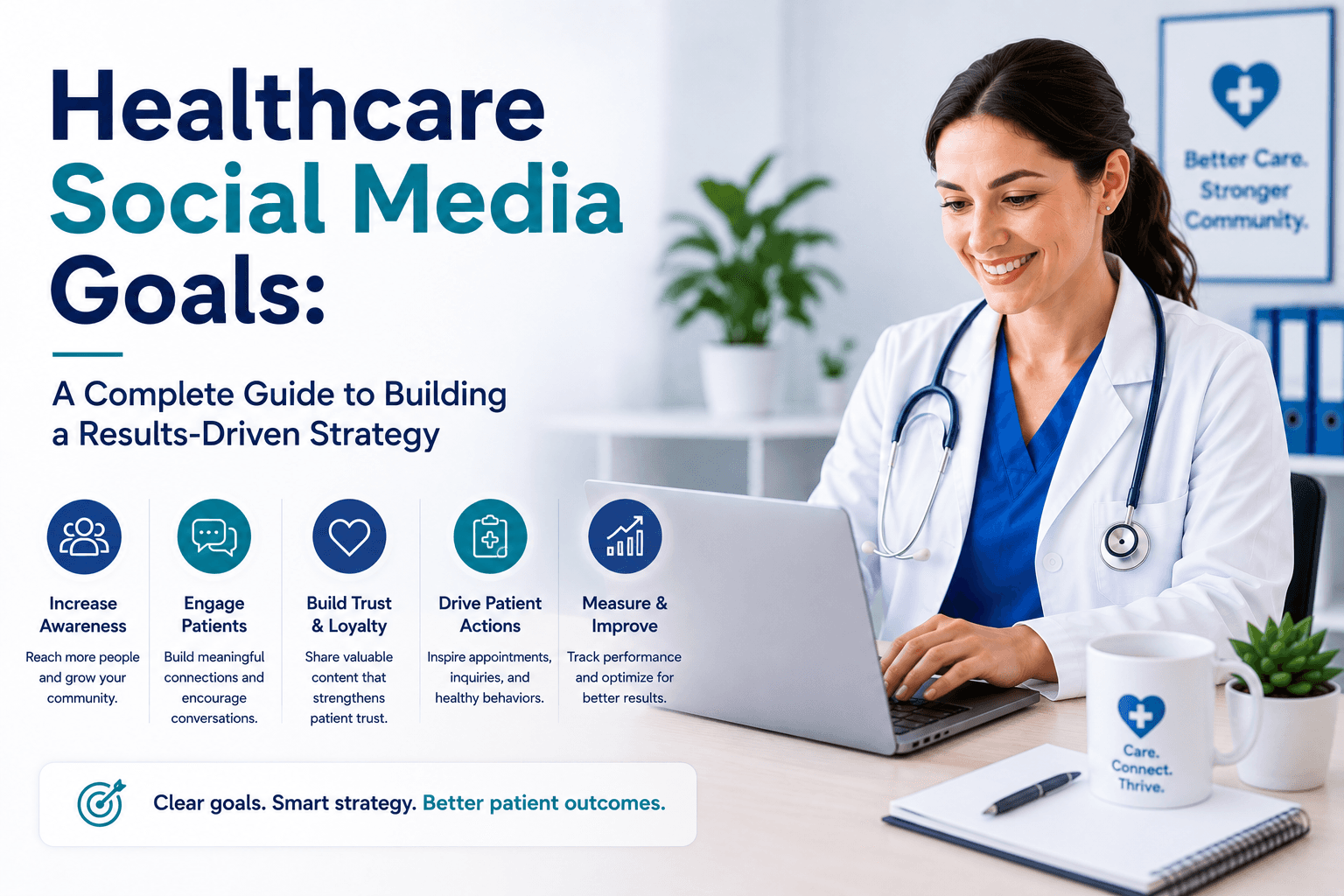
Healthcare Social Media Goals: A Complete Guide to Building a Results-Driven Strategy


Most healthcare organizations set social media goals that are too vague to be useful. "Increase engagement." "Grow our following." "Build community trust." These sound like goals. They are not. They are wishes dressed up in professional language.

Real healthcare social media goals specify exactly what will change, by how much, and within what timeframe. They connect social media activity to organizational priorities like patient acquisition, service line growth, and community health improvement. They make success or failure obvious to everyone involved.

This guide covers how to set goals that actually guide decisions, how to measure what matters, and how to build a healthcare social media strategy that delivers measurable results. No theory. Just frameworks you can implement immediately.

Key Takeaways

  • Healthcare social media goals work when they are specific, measurable, connected to organizational priorities, and time-bound. Vague aspirations like "increase engagement" fail to guide action or demonstrate value.

  • Different organizational types need different goal frameworks. A community hospital's goals differ from a dental practice's goals, which differ from a multi-location health system's goals.

  • Healthcare social media engagement metrics should connect to patient actions like appointment requests, class registrations, and resource downloads rather than vanity metrics like follower counts.

  • Goal setting must precede content planning. When you know exactly what you need to accomplish, content decisions become faster and more aligned with purpose.

  • Regular performance review against documented goals separates social media programs that improve over time from those that repeat the same approaches regardless of results.

  • The strongest healthcare social media strategies balance multiple goal types including brand awareness, patient education, community engagement, and conversion-oriented objectives.

  • Goals should be documented, shared with stakeholders, and reviewed quarterly. Undocumented goals are intentions. Documented goals are commitments.

What Healthcare Social Media Goals Actually Are

Healthcare social media goals are specific, measurable objectives that connect social media activities to organizational outcomes. They answer the question: what will be different because of our social media efforts?

This definition distinguishes goals from activities. Posting three times weekly is an activity, not a goal. It describes what you will do, not what will change as a result. A goal describes the outcome: increase appointment requests from social channels by 25% within six months.

Understanding this distinction transforms how organizations approach social media. Without clear goals, teams measure activity volume. Posts published. Impressions generated. These numbers can grow while social media contributes nothing to organizational success. With clear goals, teams measure outcomes. They know whether their work matters.

Goals also simplify content decisions. When a proposed post aligns with documented goals, it moves forward. When it does not, it gets cut. This filter prevents the social media calendar from filling with content that keeps pages active but accomplishes nothing strategic.

Why Goal Setting Matters for Healthcare Social Media

Healthcare marketing teams face constant demands on their attention. Clinicians want their departments featured. Leadership wants competitor activity matched. Community partners want their events promoted. Without clear goals, every request feels equally urgent. Teams say yes to everything and accomplish nothing meaningful.

Documented goals provide cover for saying no. When a request does not serve a defined goal, declining it is not uncooperative. It is strategic. This protects team focus and ensures that limited social media resources go toward activities that produce measurable results.

Goals also enable the conversations that secure continued investment. When a healthcare marketing team can demonstrate that social media campaigns generated 200 mammogram appointments or 500 new patient inquiries in a quarter, budget discussions with leadership become straightforward. The data makes the case.

For organizations building comprehensive social media programs, the healthcare social media strategy guide covers planning frameworks that complement goal-setting approaches.

The SMART Framework for Healthcare Social Media

The SMART framework transforms vague intentions into usable goals. SMART stands for Specific, Measurable, Achievable, Relevant, and Time-bound.

Specific means the goal describes exactly what will change. "Increase engagement" is vague. "Increase appointment requests from Instagram by directing users to our online scheduling tool" is specific.

Measurable means the goal includes numbers that make success or failure clear. "Grow our following" is not measurable. "Grow our Facebook page following from 2,500 to 4,000" is measurable.

Achievable means the goal is realistic given your resources and timeframe. A solo marketing manager at a small practice cannot produce daily video content across five platforms. Set goals that stretch your team without breaking them.

Relevant means the goal connects to something your organization actually needs. Growing TikTok followers is not relevant if your patient base is primarily over 65 and does not use TikTok. Goals should serve organizational priorities, not platform trends.

Time-bound means the goal has a deadline. "Increase website traffic from social media" has no urgency. "Increase website traffic from social media by 30% within Q3" creates accountability.

Applying the SMART framework consistently transforms how teams approach social media. Every campaign starts with a clear destination. Every review compares results to expectations. Every adjustment is guided by data rather than intuition.

Categories of Healthcare Social Media Goals

Healthcare organizations typically need goals across several categories. The specific mix depends on organizational priorities and maturity.

Brand Awareness Goals

Brand awareness goals focus on making more people familiar with your organization and what it offers. These goals matter for new practices, organizations entering new markets, and hospitals launching new service lines.

Example: Increase reach of cardiology-related content by 40% among adults over 50 in our primary service area within six months.

Brand awareness metrics include reach, impressions, video views, and brand mention volume. These metrics measure visibility rather than action. They are appropriate when the primary need is getting on the radar of prospective patients who do not yet know you exist.

Patient Engagement Goals

Patient engagement goals measure how audiences interact with your content and organization. These goals reflect relationship building rather than just visibility.

Example: Increase average comments per post from 4 to 15 within four months by publishing content that asks questions and invites patient experiences.

Healthcare social media engagement metrics include comments, shares, saves, direct messages, and post interactions relative to reach. Strong engagement indicates content resonates with audiences. It suggests trust building that will eventually influence patient decisions.

For organizations focused on deepening patient connection, the patient engagement on social media guide covers strategies for building interactive relationships.

Patient Education Goals

Patient education goals measure how effectively your social media content informs and teaches your community about health topics.

Example: Achieve 10,000 views on educational video content about preventive health topics within Q2 by publishing two educational videos weekly.

Education goals track video completion rates, link clicks to educational resources, guide downloads, and time spent with educational content. These metrics indicate whether your content is actually teaching patients rather than just appearing in their feeds.

Conversion Goals

Conversion goals measure actions that directly connect to organizational revenue and patient care. These are the goals that matter most for demonstrating social media value.

Example: Generate 75 appointment requests for orthopedic consultations through social media channels during the Q3 joint pain awareness campaign.

Conversion metrics include appointment requests, phone calls, contact form submissions, class registrations, screening sign-ups, and new patient visits attributed to social media. These metrics transform social media from a communications cost center into a measurable contributor to organizational growth.

Community Building Goals

Community building goals measure how social media strengthens your organization's role as a community health resource.

Example: Increase local audience percentage from 60% to 80% of total followers within eight months by focusing content on community-specific health topics and local partnerships.

Community metrics include local follower percentage, event promotion engagement, community partner content performance, and local sentiment in comments. These metrics indicate whether your social media presence strengthens community ties or just collects distant followers.

Goal Frameworks by Organization Type

Different healthcare organizations need different goal priorities. Here are frameworks for common organization types.

Community Hospital Goals

Community hospitals typically need balanced goals across awareness, engagement, and conversion. Priorities often include promoting service lines that compete with regional competitors, building community trust that supports bond ratings and philanthropic support, and driving appointments for high-margin services that subsidize community benefit care.

A community hospital might set goals like: Increase maternity service inquiries from social media by 30% year over year. Grow engagement on community health content to 5% engagement rate. Generate 500 event registrations for community health screenings annually.

Specialty Practice Goals

Specialty practices typically prioritize conversion and education goals. They need to attract patients with specific conditions and demonstrate expertise that justifies specialist referrals.

A cardiology practice might set goals like: Generate 40 qualified new patient inquiries monthly from social channels. Achieve 25% video completion rate on educational content about heart disease prevention. Increase referring provider engagement with professional content on LinkedIn by 50%.

Multi-Location Health System Goals

Health systems need goals that balance central brand consistency with local relevance. Priorities include maintaining consistent brand presence across locations while allowing local content flexibility.

Goals might include: Achieve minimum weekly posting frequency across all location pages with less than 5% variance. Generate system-wide appointment requests at 20% above previous year. Maintain local engagement rates within 10% of system average across all locations.

For organizations managing social media across multiple sites, the guide to managing social media across locations covers operational frameworks for multi-location consistency.

Measuring Goal Performance

Goals require measurement systems to determine whether they are being achieved.

Selecting the Right KPIs

Each goal needs specific key performance indicators. Awareness goals need reach and impression metrics. Engagement goals need interaction metrics. Conversion goals need action metrics.

The common mistake is tracking too many metrics that do not connect to goals. If a metric does not help answer whether a goal is being achieved, it is a distraction. Focus measurement on the indicators that matter for your specific objectives.

Building a Measurement Dashboard

Create a simple dashboard that tracks goal progress. Include current performance, target performance, and trend direction for each goal. Update monthly. Review quarterly with stakeholders.

The dashboard should make goal progress visible to everyone involved in social media work. When progress is on track, teams feel motivated. When progress lags, teams can adjust before goals are missed entirely.

Benchmarking Performance

Benchmarks provide context for whether performance is strong or weak. Track your own historical performance to identify trends. Compare against industry benchmarks where available. Monitor competitor performance for competitive context.

Internal benchmarks are most valuable because they reflect your specific situation. Improving against your own previous performance matters more than beating industry averages.

Common Goal-Setting Mistakes

Learning from common failures improves your own approach.

Setting activity goals instead of outcome goals. "Post five times weekly" describes activity. "Increase appointment requests by 20%" describes outcome. Activity goals do not demonstrate value.

Setting too many goals. Teams with ten goals achieve none of them well. Focus on three to five goals that matter most. Additional goals can be added when primary goals are consistently achieved.

Setting goals disconnected from organizational priorities. Social media goals that leadership does not care about will not secure resources or recognition. Connect every goal to something the organization needs.

Setting goals without baseline data. You cannot set realistic targets if you do not know current performance. Establish baselines before setting improvement goals.

Failing to review and adjust. Goals set in January and ignored until December are useless. Review progress monthly. Adjust targets when circumstances change. Celebrate when goals are achieved and set new ones.

Measuring vanity metrics. Follower counts can grow while social media contributes nothing to organizational success. Measure metrics that connect to outcomes.

Adjusting Goals Based on Performance Data

Goals should be ambitious but adjustable. When data shows a goal is unattainable, adjust it. When data shows a goal was too easy, raise it.

Quarterly goal reviews provide natural adjustment points. Review what worked and what did not. Adjust targets for upcoming quarters based on what you learned. Share adjustments with stakeholders transparently.

The goal is continuous improvement, not rigid adherence to targets set with incomplete information. Organizations that adjust goals thoughtfully outperform those that either abandon goals entirely or refuse to modify them regardless of what data shows.

Frequently Asked Questions

What are healthcare social media goals?

Healthcare social media goals are specific, measurable objectives that connect social media activity to organizational outcomes. They define what will change because of social media efforts rather than just describing what activities will occur. Examples include increasing appointment requests, growing educational content reach, or improving engagement rates on health awareness content.

Why is goal setting important for healthcare social media?

Goals provide direction for content decisions, measurement frameworks for demonstrating value, and criteria for prioritizing competing requests. Without clear goals, teams measure activity volume rather than outcomes. With goals, teams know whether their work contributes to organizational success and can communicate that contribution to leadership.

How do you measure healthcare social media success?

Success measurement depends on your specific goals. Brand awareness goals use reach and impression metrics. Engagement goals use interaction metrics like comments and shares. Conversion goals use action metrics like appointment requests and form submissions. Track the metrics that connect to your defined goals rather than measuring everything possible.

What are SMART goals in healthcare social media?

SMART goals are Specific, Measurable, Achievable, Relevant, and Time-bound. Rather than setting vague goals like "increase engagement," a SMART goal specifies exactly what will change, by how much, and by when. This framework transforms intentions into actionable objectives with clear success criteria.

What are good social media goals for a medical practice?

Medical practices typically benefit from conversion-focused goals like increasing appointment requests from social channels, patient education goals like growing views on condition-related video content, and community presence goals like increasing local follower percentage. The specific mix depends on practice size, specialty, and growth priorities.

How often should healthcare organizations review social media goals?

Review goal progress monthly to catch underperformance early. Conduct thorough goal reviews quarterly to assess what is working, adjust targets based on data, and set goals for upcoming quarters. Annual reviews are appropriate for major strategy shifts but too infrequent for ongoing performance management.

What are the most important healthcare social media metrics?

The most important metrics are those connected to your specific goals. For conversion goals, track appointment requests and contact form submissions. For engagement goals, track comments and shares. For awareness goals, track reach and video views. Vanity metrics like follower counts matter less than metrics that connect to organizational outcomes.

How do you align social media goals with organizational objectives?

Start with organizational priorities. If the priority is orthopedic service line growth, social media goals should support that through appointment generation or educational content about joint health. If the priority is community health improvement, goals should focus on educational reach and screening event promotion. Every social media goal should trace back to something the organization needs.

Setting Goals That Drive Results

Healthcare social media goals transform social media from a communications activity into a strategic function. When goals are clear, content decisions become easier. Performance becomes measurable. Value becomes demonstrable.

Start with your organization's priorities. Define what social media can contribute to those priorities. Set SMART goals that make success measurable. Track progress consistently. Adjust based on what you learn.

The organizations seeing the strongest social media results share a common characteristic. They know exactly what they are trying to accomplish, they measure whether they are accomplishing it, and they adjust when the data suggests a better approach. Goals provide the foundation for this disciplined approach.

For healthcare marketing teams ready to set and achieve measurable social media goals, Sociali.ai provides a purpose-built healthcare platform for planning, scheduling, tracking, and optimizing social media campaigns. From goal setting to performance analytics, the platform helps healthcare organizations connect social media activity to the outcomes that matter for patient care and organizational growth.

Free resource

Get the 30-day social media content calendar

Get the 30-day social media content calendar

Get the 30-day social media content calendar

Use it to plan posts, offers, and follow-ups before your next campaign — built for busy teams that need consistent publishing without extra meetings.

Use it to plan posts, offers, and follow-ups before your next campaign — built for busy teams that need consistent publishing without extra meetings.

Get the checklist

Share It On: