Technology

Technology

Hospital Social Media Marketing: Complete Guide

|

9

min read

Hospital Social Media Marketing: A Complete Guide for Modern Healthcare Organizations   Most hospitals treat social media like a digital version of their lobby bulletin board. Department announcements. Staff award photos. Visiting hour reminders. The content is polite, professional, and completely ignored by the communities it is supposed to reach. Hospital social media marketing can do so much more than announce news. It can educate entire communities about health risks. It can introduce providers in ways that build genuine trust. It can answer the questions patients are too embarrassed to ask in person. It can make a large institution feel human and accessible. This guide covers how to build a hospital social media presence that patients actually want to engage with. Practical strategies. Real examples. A framework your team can implement starting this week. Key Takeaways Hospital social media marketing succeeds when it prioritizes community education and patient connection over institutional promotion and internal announcements. Different hospital service lines need different content approaches. Cardiology content serves different patient needs than maternity content or emergency department information. Video content featuring real clinicians consistently outperforms other formats for hospitals, building provider familiarity and trust before patients ever schedule appointments. HIPAA compliance does not prevent authentic social media engagement. It requires clear internal workflows, staff training, and documented approval processes. Multi-location health systems need centralized brand guidance with localized content flexibility to maintain consistency while serving distinct community needs. Social media analytics for hospitals should track meaningful patient actions like appointment requests and class registrations rather than vanity metrics like follower counts. The hospitals building the strongest community trust through social media are those that respond to comments and messages promptly, treating social platforms as two-way communication channels. What Hospital Social Media Marketing Actually Means Hospital social media marketing is the strategic use of social platforms to connect hospitals with their communities, educate patients, build trust in providers and services, and support organizational goals like patient acquisition and community health improvement. This is fundamentally different from using social media as a broadcast channel for hospital news. Marketing implies strategy, measurement, and intentional connection to organizational outcomes. It means understanding who you need to reach, what they need from you, and how social media can deliver that value while supporting the hospital's mission. For most hospitals, social media serves three overlapping audiences. Current patients who need education and engagement. Prospective patients evaluating where to seek care. The broader community whose health perceptions and behaviors the hospital aims to influence. Effective hospital social media strategies address all three. Understanding this scope explains why hospital social media deserves dedicated strategy and resources rather than being treated as an add-on responsibility for an already-busy communications team. Why Social Media Matters for Hospitals Hospital marketing has traditionally relied on reputation, referrals, and broad-reach advertising like billboards and television spots. Those channels still matter. But they are increasingly insufficient on their own. Patients now research providers online before booking appointments. They read reviews. They visit social media profiles to get a sense of what a hospital values and how it treats people. A hospital with an inactive or unappealing social media presence is making a negative impression during this research process, even if the clinical care is excellent. Social media also serves functions that traditional hospital marketing cannot. It enables real-time community communication during public health emergencies. It provides channels for patient questions and feedback. It builds ongoing relationships rather than one-time impressions. It humanizes large institutions through provider features and behind-the-scenes content. There is a competitive dimension as well. When one hospital in a market uses social media effectively and another does not, the engaged hospital captures community attention and trust that the silent hospital forfeits. This competitive gap widens over time as engaged hospitals build content libraries that continue attracting patients indefinitely. Building a Hospital Social Media Strategy Effective social media for hospitals starts with strategy, not with posting. Here is how to build one. Define What Success Looks Like Hospital social media goals should connect to organizational priorities. Growing a specific service line. Improving community health metrics. Increasing patient acquisition through digital channels. Building reputation in a competitive market. Supporting recruitment of clinical staff. Translate these priorities into social media objectives with specific metrics. Increase cardiology appointment requests from social channels by 20% within six months. Drive 500 registrations for community health screening events annually. Generate 30 qualified job applications monthly from social media recruitment content. Goals this specific make content decisions easier. Every proposed post can be evaluated against whether it serves a defined objective. Understand Your Audiences Hospitals serve multiple distinct audiences with different needs. A community hospital might serve seniors managing chronic conditions, new parents seeking pediatric care, and adults considering elective procedures. Each group needs different content on different platforms with different messaging. Develop audience profiles that capture demographics, health concerns, platform preferences, and content needs. Use these profiles to guide content planning. When someone proposes a post, the question becomes which audience it serves and what need it addresses. For hospitals building comprehensive audience strategies, the healthcare social media strategy guide covers audience research and content planning frameworks in detail. Choose Platforms Strategically Different platforms reach different audiences and serve different content types. Facebook remains essential for reaching patients over 45 and for community engagement functions like event promotion. Instagram works well for provider features, patient stories, and visually oriented health education. YouTube serves patients searching for detailed health information and procedure explanations. LinkedIn supports professional audiences including referral development and recruitment. Most hospitals should maintain active presence on Facebook, Instagram, and YouTube at minimum. Additional platforms should be chosen based on specific audience and goal alignment rather than a desire to be everywhere. The common mistake is spreading limited resources across too many platforms. Better to excel on two or three platforms where your patients actually spend time than to maintain mediocre presence on six. Create Content Pillars Content pillars organize social media content around consistent themes that serve audience needs and organizational goals. Typical hospital content pillars include health education, provider features, patient stories, community engagement, hospital news, and behind-the-scenes content. Each pillar serves a distinct purpose. Health education builds visibility and trust. Provider features build familiarity. Patient stories build emotional connection. Community engagement builds local relevance. Together they create a balanced presence that serves multiple audience needs. Content pillars also simplify planning. Rather than starting from scratch each week, your team knows the categories that need content and can develop ideas within each pillar consistently. Content That Works for Hospitals Specific content types consistently outperform others for hospital social media. Here is what works and why. Educational Health Content Educational content is the foundation of effective hospital social media. It serves genuine patient needs. It builds search visibility. It demonstrates clinical expertise. It provides shareable value that extends reach through audience distribution. The most effective educational content answers specific patient questions. "When should I take my child to the emergency room versus urgent care." "What does cardiac rehab involve." "How to prepare for a colonoscopy." These topics match how patients actually search and think about health. They feel relevant and useful. Short-form video works particularly well for hospital education. A 60-second emergency physician explaining when chest pain warrants an ER visit will outperform a text post on the same topic. The format matches social media consumption patterns while building provider familiarity. Provider Introductions and Features Patients choose hospitals partly based on reputation, but they choose providers based on personal comfort. Provider introduction content builds that comfort before appointments happen. Effective provider content shows personality and communication style, not just credentials. A 90-second video of a new cardiologist explaining why they chose their specialty and what they enjoy about patient care gives prospective patients a sense of who they will be seeing. Written profiles can complement videos with more detailed background information. This content category performs double duty. It serves patients evaluating providers while also supporting physician recruitment by showcasing your hospital as a place where clinicians are valued and featured. Patient Success Stories Patient stories are consistently the highest-engagement content across hospital social media accounts. They create emotional connection. They demonstrate outcomes. They provide social proof that influences prospective patient decisions. The operational requirements matter. Written authorization from patients is non-negotiable. Patients should review and approve content before publication. The narrative should focus on the patient's experience and recovery rather than on praising the hospital. Authentic stories told in patient voices outperform polished marketing narratives. Video testimonials work best when patients are willing. Written stories with photos perform well too. The key is genuine patient expression rather than scripted marketing language. Behind-the-Scenes and Culture Content Hospitals can feel intimidating and impersonal. Behind-the-scenes content makes them feel human and accessible. Nursing team features. A day-in-the-life look at an emergency department. Staff celebrations and milestones. Community event participation. These posts show the people behind the care. They build community connection. They also support recruitment by showcasing workplace culture. This content category works because it answers an unspoken patient question. "Will I be treated as a person here?" When prospective patients see warmth, teamwork, and genuine care in behind-the-scenes content, they feel more confident choosing your hospital. Managing Social Media Across Multiple Locations Health systems with multiple hospitals, clinics, and care sites face additional complexity. Each location serves a distinct community. Each has its own providers, services, and local relevance. Yet all must maintain consistent brand standards and quality. The solution typically involves centralized brand guidance with localized content flexibility. Central marketing establishes brand standards, content policies, compliance requirements, and platform governance. Local teams or designated local contributors create content that reflects their specific community while adhering to central standards. Technology makes this manageable. Social media management platforms designed for multi-location healthcare allow central oversight while enabling local contribution. Content libraries provide pre-approved materials that local teams can adapt. Approval workflows ensure compliance without creating bottlenecks. For health systems managing this complexity, the guide to managing social media across multiple locations covers governance models and operational workflows. HIPAA Compliance for Hospital Social Media Compliance concerns prevent many hospitals from engaging authentically on social media. The restrictions are real. The solutions are manageable. The core principle is simple. Never share patient-identifiable information on social media without explicit written authorization. This includes names, photos, specific dates, detailed medical information, and any combination of details that could identify an individual. Within this constraint, extensive engagement is possible. Educational content. Provider features. Facility information. Community event coverage. Health awareness campaigns. Staff recognition. General responses to health questions. Build compliance into workflows rather than treating it as a barrier. Train everyone with social media access on HIPAA requirements. Create pre-approved content templates for common situations. Establish clear response protocols. When in doubt, consult your compliance officer before posting. The hospitals that manage compliance well typically have documented social media policies, regular staff training, and approval workflows that are prompt enough to allow timely engagement while thorough enough to catch potential issues. Handling Comments and Online Reputation Hospital social media accounts receive comments ranging from grateful patient messages to serious complaints. How your hospital responds shapes community perception. Positive Engagement Respond to positive comments with genuine appreciation. A personalized response that references something specific from the comment shows real attention. Generic responses feel automated and diminish goodwill. Share positive patient feedback when appropriate and authorized. Patient gratitude shared publicly reinforces your hospital's commitment to care quality. Managing Negative Feedback Negative comments require prompt, professional response. Acknowledge the concern. Express genuine desire to address it. Provide a direct contact method for follow-up discussion. Never discuss specific patient situations in public comments. Deleting negative comments should be reserved for posts containing profanity, personal attacks, or protected health information. Communities notice when hospitals remove criticism. They respect hospitals that address concerns openly and professionally. A thoughtful response to a complaint often impresses observers more than a collection of exclusively positive comments. It demonstrates that your hospital listens and cares about improvement. Measuring Hospital Social Media Performance Measurement connects social media activity to organizational value. Here is what hospitals should track. Engagement Metrics That Matter Track comments per post, shares, saves, direct message volume, and video completion rates. These metrics indicate whether content connects with audiences. High reach with low engagement suggests content is visible but not valuable. High engagement with modest reach indicates strong connection with your existing audience. Conversion Metrics Where systems allow, track actions that connect to organizational goals. Appointment requests originating from social channels. Event registrations. Class sign-ups. Newsletter subscriptions. Phone calls to numbers featured in social content. These conversion metrics transform social media from a communications cost center into a measurable contributor to hospital goals. Reputation Indicators Monitor sentiment in comments and messages. Track response times and rates. Review feedback themes that suggest operational issues needing attention. These indicators reveal how your hospital is perceived and where improvements might strengthen community trust. For hospitals building measurement frameworks, the healthcare social media management guide covers analytics approaches and reporting structures. Common Hospital Social Media Mistakes Learning from patterns prevents repeating them. Broadcasting without engaging. Social media used exclusively for one-way announcements misses the relationship-building opportunity. Respond to comments. Ask questions. Create conversation. Promoting services without providing value. Posts about service lines and technology matter occasionally. Posts that educate and connect matter consistently. Keep promotional content to a minority of your output. Posting inconsistently. A page that goes silent for weeks then posts heavily during a campaign signals disorganization. Maintain consistent presence. Quality and consistency build audience expectations and trust. Neglecting video content. Hospitals that rely exclusively on text and static images miss engagement opportunities. Video builds provider trust and content shareability that other formats cannot match. Centralizing all content creation. Health systems that produce every post from the central marketing office miss local relevance. Enable local contribution within brand guardrails. Failing to prepare for crisis communication. When public health emergencies or hospital incidents occur, social media becomes a critical communication channel. Prepare protocols and approval processes before crises happen. Measuring vanity metrics. Follower counts and impression volumes can grow while social media fails to influence patient decisions or community health. Track metrics that connect to organizational value. Frequently Asked Questions What is hospital social media marketing? Hospital social media marketing is the strategic use of platforms like Facebook, Instagram, YouTube, and LinkedIn to connect hospitals with their communities, educate patients, build provider trust, and support organizational goals. It differs from general social media use by connecting content to specific hospital objectives like service line growth, community health improvement, and patient acquisition. Why is social media important for hospitals? Social media allows hospitals to educate communities at scale, build provider trust before appointments, communicate during public health emergencies, gather patient feedback, and humanize large institutions. It reaches patients where they spend time and influences healthcare decisions during the research phase when prospective patients evaluate provider options. How do hospitals manage HIPAA compliance on social media? Hospitals manage compliance through documented social media policies, regular staff training, clear authorization requirements for patient content, and approval workflows that review content before publication. The key rule prohibits sharing patient-identifiable information without written authorization. Educational content, provider features, and community information can be shared freely within these guidelines. What content works best for hospital social media? Educational health content answering real patient questions consistently performs well. Provider introduction videos build familiarity and trust. Patient success stories generate the strongest emotional engagement. Behind-the-scenes content humanizes the hospital. Community involvement posts build local relevance. Video content outperforms static formats across all categories. How often should hospitals post on social media? Three to five posts per week per platform works well for most hospitals. Daily posting may work for larger teams. Consistency matters more than frequency. A sustainable schedule maintained over time builds more engagement than high-frequency bursts followed by silence. Quality should never be sacrificed for quantity. How do health systems manage social media across multiple locations? Successful multi-location management combines centralized brand governance with localized content flexibility. Central teams establish standards, policies, and pre-approved content. Local contributors create community-specific content within those guidelines. Purpose-built social media management platforms provide the oversight and workflow tools to make this model work at scale. What are the key social media platforms for hospitals? Facebook remains essential for reaching patients over 45 and for community engagement. Instagram serves visual content and younger demographics well. YouTube is critical for detailed health education content. LinkedIn supports professional audiences and recruitment. Most hospitals should prioritize Facebook, Instagram, and YouTube before expanding to additional platforms. How do hospitals measure social media ROI? Track conversion actions that connect to organizational goals including appointment requests, event registrations, class sign-ups, and newsletter subscriptions originating from social channels. Monitor engagement metrics that indicate relationship building. Report cost per conversion for paid social campaigns. Connect social media activity to patient acquisition data where systems allow. Building a Social Media Presence That Serves Your Community Hospital social media marketing succeeds when it shifts from institutional broadcasting to community connection. Every post should serve your audience. Every response should show genuine attention. Every campaign should connect to a purpose that matters for patient health and organizational mission. Start with strategy. Define your audiences and goals. Build content pillars that serve patient needs. Establish workflows that maintain compliance without preventing timely engagement. Measure what matters. Improve based on what you learn. The hospitals doing this well share a common characteristic. Their social media presence feels like an extension of their care mission rather than their marketing department. Patients respond with trust, engagement, and the kind of community loyalty that sustains hospitals through changing market conditions. For hospital marketing teams ready to build a comprehensive social media operation, Sociali.ai provides a purpose-built healthcare platform that combines content planning, multi-location management, compliance workflows, scheduling, and performance analytics. From community hospitals to multi-state health systems, the platform helps healthcare organizations create social media that educates, engages, and builds lasting patient trust.
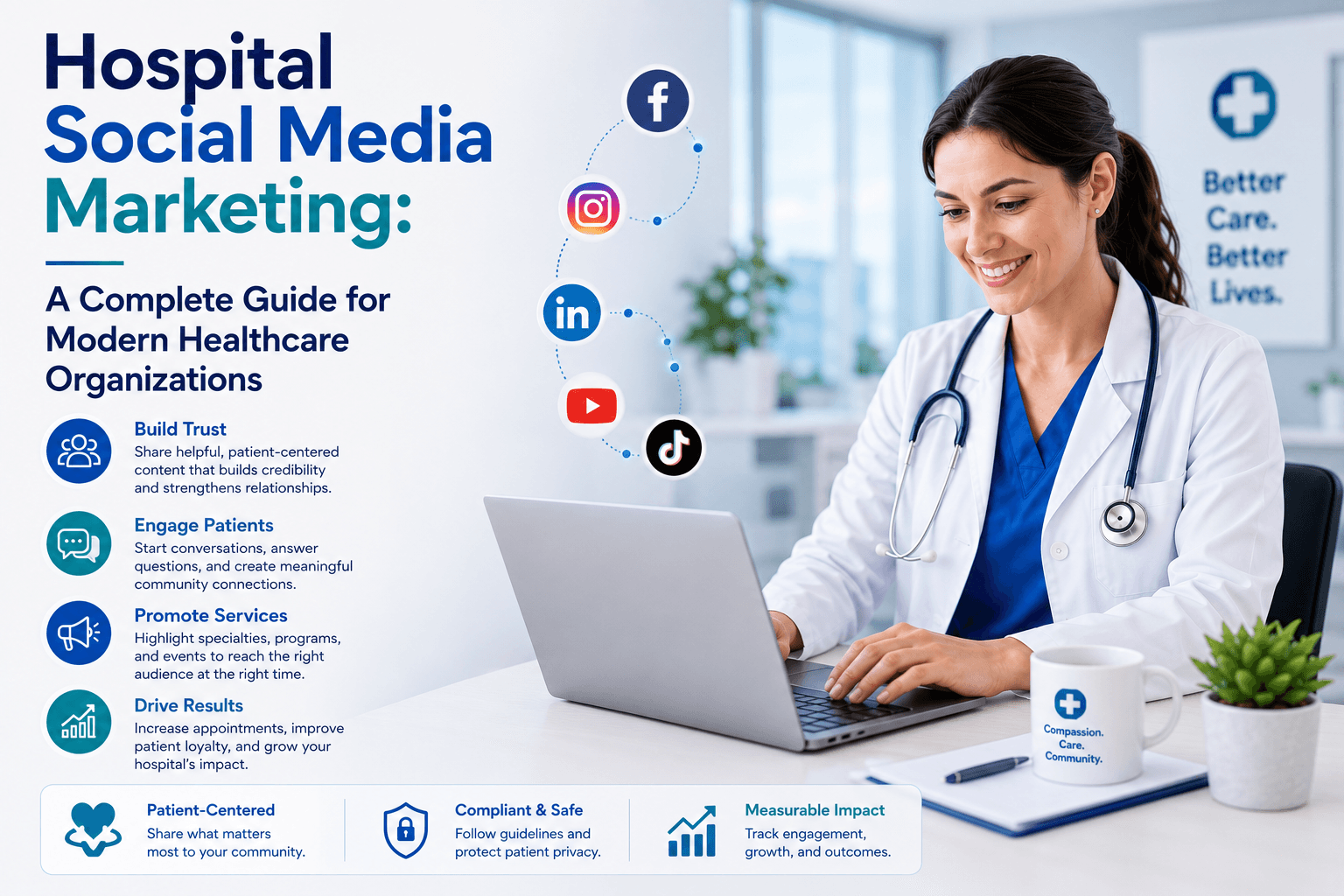
Hospital Social Media Marketing: A Complete Guide for Modern Healthcare Organizations


Most hospitals treat social media like a digital version of their lobby bulletin board. Department announcements. Staff award photos. Visiting hour reminders. The content is polite, professional, and completely ignored by the communities it is supposed to reach.

Hospital social media marketing can do so much more than announce news. It can educate entire communities about health risks. It can introduce providers in ways that build genuine trust. It can answer the questions patients are too embarrassed to ask in person. It can make a large institution feel human and accessible.

This guide covers how to build a hospital social media presence that patients actually want to engage with. Practical strategies. Real examples. A framework your team can implement starting this week.

Key Takeaways

  • Hospital social media marketing succeeds when it prioritizes community education and patient connection over institutional promotion and internal announcements.

  • Different hospital service lines need different content approaches. Cardiology content serves different patient needs than maternity content or emergency department information.

  • Video content featuring real clinicians consistently outperforms other formats for hospitals, building provider familiarity and trust before patients ever schedule appointments.

  • HIPAA compliance does not prevent authentic social media engagement. It requires clear internal workflows, staff training, and documented approval processes.

  • Multi-location health systems need centralized brand guidance with localized content flexibility to maintain consistency while serving distinct community needs.

  • Social media analytics for hospitals should track meaningful patient actions like appointment requests and class registrations rather than vanity metrics like follower counts.

  • The hospitals building the strongest community trust through social media are those that respond to comments and messages promptly, treating social platforms as two-way communication channels.

What Hospital Social Media Marketing Actually Means

Hospital social media marketing is the strategic use of social platforms to connect hospitals with their communities, educate patients, build trust in providers and services, and support organizational goals like patient acquisition and community health improvement.

This is fundamentally different from using social media as a broadcast channel for hospital news. Marketing implies strategy, measurement, and intentional connection to organizational outcomes. It means understanding who you need to reach, what they need from you, and how social media can deliver that value while supporting the hospital's mission.

For most hospitals, social media serves three overlapping audiences. Current patients who need education and engagement. Prospective patients evaluating where to seek care. The broader community whose health perceptions and behaviors the hospital aims to influence. Effective hospital social media strategies address all three.

Understanding this scope explains why hospital social media deserves dedicated strategy and resources rather than being treated as an add-on responsibility for an already-busy communications team.

Why Social Media Matters for Hospitals

Hospital marketing has traditionally relied on reputation, referrals, and broad-reach advertising like billboards and television spots. Those channels still matter. But they are increasingly insufficient on their own.

Patients now research providers online before booking appointments. They read reviews. They visit social media profiles to get a sense of what a hospital values and how it treats people. A hospital with an inactive or unappealing social media presence is making a negative impression during this research process, even if the clinical care is excellent.

Social media also serves functions that traditional hospital marketing cannot. It enables real-time community communication during public health emergencies. It provides channels for patient questions and feedback. It builds ongoing relationships rather than one-time impressions. It humanizes large institutions through provider features and behind-the-scenes content.

There is a competitive dimension as well. When one hospital in a market uses social media effectively and another does not, the engaged hospital captures community attention and trust that the silent hospital forfeits. This competitive gap widens over time as engaged hospitals build content libraries that continue attracting patients indefinitely.

Building a Hospital Social Media Strategy

Effective social media for hospitals starts with strategy, not with posting. Here is how to build one.

Define What Success Looks Like

Hospital social media goals should connect to organizational priorities. Growing a specific service line. Improving community health metrics. Increasing patient acquisition through digital channels. Building reputation in a competitive market. Supporting recruitment of clinical staff.

Translate these priorities into social media objectives with specific metrics. Increase cardiology appointment requests from social channels by 20% within six months. Drive 500 registrations for community health screening events annually. Generate 30 qualified job applications monthly from social media recruitment content.

Goals this specific make content decisions easier. Every proposed post can be evaluated against whether it serves a defined objective.

Understand Your Audiences

Hospitals serve multiple distinct audiences with different needs. A community hospital might serve seniors managing chronic conditions, new parents seeking pediatric care, and adults considering elective procedures. Each group needs different content on different platforms with different messaging.

Develop audience profiles that capture demographics, health concerns, platform preferences, and content needs. Use these profiles to guide content planning. When someone proposes a post, the question becomes which audience it serves and what need it addresses.

For hospitals building comprehensive audience strategies, the healthcare social media strategy guide covers audience research and content planning frameworks in detail.

Choose Platforms Strategically

Different platforms reach different audiences and serve different content types. Facebook remains essential for reaching patients over 45 and for community engagement functions like event promotion. Instagram works well for provider features, patient stories, and visually oriented health education. YouTube serves patients searching for detailed health information and procedure explanations. LinkedIn supports professional audiences including referral development and recruitment.

Most hospitals should maintain active presence on Facebook, Instagram, and YouTube at minimum. Additional platforms should be chosen based on specific audience and goal alignment rather than a desire to be everywhere.

The common mistake is spreading limited resources across too many platforms. Better to excel on two or three platforms where your patients actually spend time than to maintain mediocre presence on six.

Create Content Pillars

Content pillars organize social media content around consistent themes that serve audience needs and organizational goals. Typical hospital content pillars include health education, provider features, patient stories, community engagement, hospital news, and behind-the-scenes content.

Each pillar serves a distinct purpose. Health education builds visibility and trust. Provider features build familiarity. Patient stories build emotional connection. Community engagement builds local relevance. Together they create a balanced presence that serves multiple audience needs.

Content pillars also simplify planning. Rather than starting from scratch each week, your team knows the categories that need content and can develop ideas within each pillar consistently.

Content That Works for Hospitals

Specific content types consistently outperform others for hospital social media. Here is what works and why.

Educational Health Content

Educational content is the foundation of effective hospital social media. It serves genuine patient needs. It builds search visibility. It demonstrates clinical expertise. It provides shareable value that extends reach through audience distribution.

The most effective educational content answers specific patient questions. "When should I take my child to the emergency room versus urgent care." "What does cardiac rehab involve." "How to prepare for a colonoscopy." These topics match how patients actually search and think about health. They feel relevant and useful.

Short-form video works particularly well for hospital education. A 60-second emergency physician explaining when chest pain warrants an ER visit will outperform a text post on the same topic. The format matches social media consumption patterns while building provider familiarity.

Provider Introductions and Features

Patients choose hospitals partly based on reputation, but they choose providers based on personal comfort. Provider introduction content builds that comfort before appointments happen.

Effective provider content shows personality and communication style, not just credentials. A 90-second video of a new cardiologist explaining why they chose their specialty and what they enjoy about patient care gives prospective patients a sense of who they will be seeing. Written profiles can complement videos with more detailed background information.

This content category performs double duty. It serves patients evaluating providers while also supporting physician recruitment by showcasing your hospital as a place where clinicians are valued and featured.

Patient Success Stories

Patient stories are consistently the highest-engagement content across hospital social media accounts. They create emotional connection. They demonstrate outcomes. They provide social proof that influences prospective patient decisions.

The operational requirements matter. Written authorization from patients is non-negotiable. Patients should review and approve content before publication. The narrative should focus on the patient's experience and recovery rather than on praising the hospital. Authentic stories told in patient voices outperform polished marketing narratives.

Video testimonials work best when patients are willing. Written stories with photos perform well too. The key is genuine patient expression rather than scripted marketing language.

Behind-the-Scenes and Culture Content

Hospitals can feel intimidating and impersonal. Behind-the-scenes content makes them feel human and accessible.

Nursing team features. A day-in-the-life look at an emergency department. Staff celebrations and milestones. Community event participation. These posts show the people behind the care. They build community connection. They also support recruitment by showcasing workplace culture.

This content category works because it answers an unspoken patient question. "Will I be treated as a person here?" When prospective patients see warmth, teamwork, and genuine care in behind-the-scenes content, they feel more confident choosing your hospital.

Managing Social Media Across Multiple Locations

Health systems with multiple hospitals, clinics, and care sites face additional complexity. Each location serves a distinct community. Each has its own providers, services, and local relevance. Yet all must maintain consistent brand standards and quality.

The solution typically involves centralized brand guidance with localized content flexibility. Central marketing establishes brand standards, content policies, compliance requirements, and platform governance. Local teams or designated local contributors create content that reflects their specific community while adhering to central standards.

Technology makes this manageable. Social media management platforms designed for multi-location healthcare allow central oversight while enabling local contribution. Content libraries provide pre-approved materials that local teams can adapt. Approval workflows ensure compliance without creating bottlenecks.

For health systems managing this complexity, the guide to managing social media across multiple locations covers governance models and operational workflows.

HIPAA Compliance for Hospital Social Media

Compliance concerns prevent many hospitals from engaging authentically on social media. The restrictions are real. The solutions are manageable.

The core principle is simple. Never share patient-identifiable information on social media without explicit written authorization. This includes names, photos, specific dates, detailed medical information, and any combination of details that could identify an individual.

Within this constraint, extensive engagement is possible. Educational content. Provider features. Facility information. Community event coverage. Health awareness campaigns. Staff recognition. General responses to health questions.

Build compliance into workflows rather than treating it as a barrier. Train everyone with social media access on HIPAA requirements. Create pre-approved content templates for common situations. Establish clear response protocols. When in doubt, consult your compliance officer before posting.

The hospitals that manage compliance well typically have documented social media policies, regular staff training, and approval workflows that are prompt enough to allow timely engagement while thorough enough to catch potential issues.

Handling Comments and Online Reputation

Hospital social media accounts receive comments ranging from grateful patient messages to serious complaints. How your hospital responds shapes community perception.

Positive Engagement

Respond to positive comments with genuine appreciation. A personalized response that references something specific from the comment shows real attention. Generic responses feel automated and diminish goodwill.

Share positive patient feedback when appropriate and authorized. Patient gratitude shared publicly reinforces your hospital's commitment to care quality.

Managing Negative Feedback

Negative comments require prompt, professional response. Acknowledge the concern. Express genuine desire to address it. Provide a direct contact method for follow-up discussion. Never discuss specific patient situations in public comments.

Deleting negative comments should be reserved for posts containing profanity, personal attacks, or protected health information. Communities notice when hospitals remove criticism. They respect hospitals that address concerns openly and professionally.

A thoughtful response to a complaint often impresses observers more than a collection of exclusively positive comments. It demonstrates that your hospital listens and cares about improvement.

Measuring Hospital Social Media Performance

Measurement connects social media activity to organizational value. Here is what hospitals should track.

Engagement Metrics That Matter

Track comments per post, shares, saves, direct message volume, and video completion rates. These metrics indicate whether content connects with audiences. High reach with low engagement suggests content is visible but not valuable. High engagement with modest reach indicates strong connection with your existing audience.

Conversion Metrics

Where systems allow, track actions that connect to organizational goals. Appointment requests originating from social channels. Event registrations. Class sign-ups. Newsletter subscriptions. Phone calls to numbers featured in social content.

These conversion metrics transform social media from a communications cost center into a measurable contributor to hospital goals.

Reputation Indicators

Monitor sentiment in comments and messages. Track response times and rates. Review feedback themes that suggest operational issues needing attention. These indicators reveal how your hospital is perceived and where improvements might strengthen community trust.

For hospitals building measurement frameworks, the healthcare social media management guide covers analytics approaches and reporting structures.

Common Hospital Social Media Mistakes

Learning from patterns prevents repeating them.

Broadcasting without engaging. Social media used exclusively for one-way announcements misses the relationship-building opportunity. Respond to comments. Ask questions. Create conversation.

Promoting services without providing value. Posts about service lines and technology matter occasionally. Posts that educate and connect matter consistently. Keep promotional content to a minority of your output.

Posting inconsistently. A page that goes silent for weeks then posts heavily during a campaign signals disorganization. Maintain consistent presence. Quality and consistency build audience expectations and trust.

Neglecting video content. Hospitals that rely exclusively on text and static images miss engagement opportunities. Video builds provider trust and content shareability that other formats cannot match.

Centralizing all content creation. Health systems that produce every post from the central marketing office miss local relevance. Enable local contribution within brand guardrails.

Failing to prepare for crisis communication. When public health emergencies or hospital incidents occur, social media becomes a critical communication channel. Prepare protocols and approval processes before crises happen.

Measuring vanity metrics. Follower counts and impression volumes can grow while social media fails to influence patient decisions or community health. Track metrics that connect to organizational value.

Frequently Asked Questions

What is hospital social media marketing?

Hospital social media marketing is the strategic use of platforms like Facebook, Instagram, YouTube, and LinkedIn to connect hospitals with their communities, educate patients, build provider trust, and support organizational goals. It differs from general social media use by connecting content to specific hospital objectives like service line growth, community health improvement, and patient acquisition.

Why is social media important for hospitals?

Social media allows hospitals to educate communities at scale, build provider trust before appointments, communicate during public health emergencies, gather patient feedback, and humanize large institutions. It reaches patients where they spend time and influences healthcare decisions during the research phase when prospective patients evaluate provider options.

How do hospitals manage HIPAA compliance on social media?

Hospitals manage compliance through documented social media policies, regular staff training, clear authorization requirements for patient content, and approval workflows that review content before publication. The key rule prohibits sharing patient-identifiable information without written authorization. Educational content, provider features, and community information can be shared freely within these guidelines.

What content works best for hospital social media?

Educational health content answering real patient questions consistently performs well. Provider introduction videos build familiarity and trust. Patient success stories generate the strongest emotional engagement. Behind-the-scenes content humanizes the hospital. Community involvement posts build local relevance. Video content outperforms static formats across all categories.

How often should hospitals post on social media?

Three to five posts per week per platform works well for most hospitals. Daily posting may work for larger teams. Consistency matters more than frequency. A sustainable schedule maintained over time builds more engagement than high-frequency bursts followed by silence. Quality should never be sacrificed for quantity.

How do health systems manage social media across multiple locations?

Successful multi-location management combines centralized brand governance with localized content flexibility. Central teams establish standards, policies, and pre-approved content. Local contributors create community-specific content within those guidelines. Purpose-built social media management platforms provide the oversight and workflow tools to make this model work at scale.

What are the key social media platforms for hospitals?

Facebook remains essential for reaching patients over 45 and for community engagement. Instagram serves visual content and younger demographics well. YouTube is critical for detailed health education content. LinkedIn supports professional audiences and recruitment. Most hospitals should prioritize Facebook, Instagram, and YouTube before expanding to additional platforms.

How do hospitals measure social media ROI?

Track conversion actions that connect to organizational goals including appointment requests, event registrations, class sign-ups, and newsletter subscriptions originating from social channels. Monitor engagement metrics that indicate relationship building. Report cost per conversion for paid social campaigns. Connect social media activity to patient acquisition data where systems allow.

Building a Social Media Presence That Serves Your Community

Hospital social media marketing succeeds when it shifts from institutional broadcasting to community connection. Every post should serve your audience. Every response should show genuine attention. Every campaign should connect to a purpose that matters for patient health and organizational mission.

Start with strategy. Define your audiences and goals. Build content pillars that serve patient needs. Establish workflows that maintain compliance without preventing timely engagement. Measure what matters. Improve based on what you learn.

The hospitals doing this well share a common characteristic. Their social media presence feels like an extension of their care mission rather than their marketing department. Patients respond with trust, engagement, and the kind of community loyalty that sustains hospitals through changing market conditions.

For hospital marketing teams ready to build a comprehensive social media operation, Sociali.ai provides a purpose-built healthcare platform that combines content planning, multi-location management, compliance workflows, scheduling, and performance analytics. From community hospitals to multi-state health systems, the platform helps healthcare organizations create social media that educates, engages, and builds lasting patient trust.

Free resource

Get the 30-day social media content calendar

Get the 30-day social media content calendar

Get the 30-day social media content calendar

Use it to plan posts, offers, and follow-ups before your next campaign — built for busy teams that need consistent publishing without extra meetings.

Use it to plan posts, offers, and follow-ups before your next campaign — built for busy teams that need consistent publishing without extra meetings.

Get the checklist

Share It On: