Patient Engagement on Social Media: Complete Guide
|
8
min read

Patient Engagement on Social Media: A Complete Guide for Healthcare Organizations
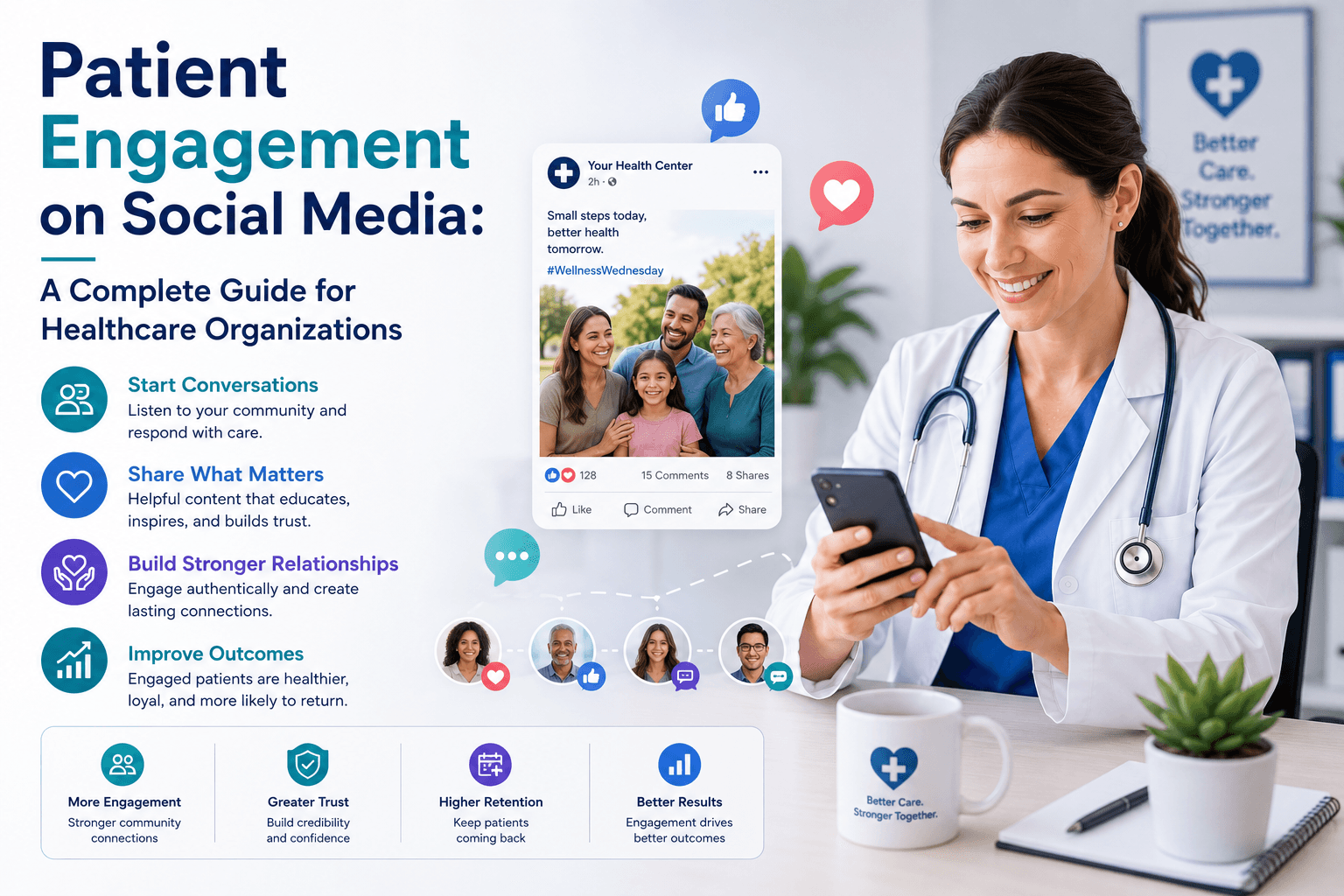
Most healthcare organizations measure social media success by counting followers. They celebrate when the number goes up. They worry when it stalls. Meanwhile, their posts get three likes and zero comments from actual patients.
That is not engagement. That is a number on a screen.
Real patient engagement on social media means people interact with your content in ways that build connection and trust. They ask questions. They share your posts with family members. They comment with their own experiences. They message your team looking for help. These interactions signal that your social media presence matters to the people you serve.
This guide covers how to create that kind of engagement. Practical strategies. Real examples. A framework you can start using immediately.
Key Takeaways
Patient engagement on social media measures meaningful interactions like comments, shares, and direct messages rather than passive metrics like follower counts.
Educational content that answers real patient questions consistently generates more engagement than promotional content about services and achievements.
Timely responses to comments and messages signal that your organization genuinely cares about patient communication rather than just broadcasting information.
HIPAA compliance and authentic engagement are compatible when organizations establish clear response protocols and train staff thoroughly.
Short-form video content featuring clinicians answering common health questions currently drives the strongest engagement across all major platforms.
Social listening tools help healthcare organizations identify community health concerns and join conversations patients are already having.
The organizations building the strongest patient relationships through social media are those that prioritize two-way communication over one-way broadcasting.
What Patient Engagement on Social Media Actually Means
Patient engagement on social media refers to the interactions between healthcare organizations and patients or community members on social platforms. These interactions include likes, comments, shares, direct messages, post clicks, video views, poll responses, and any other action where a user actively participates rather than passively scrolling.
This definition matters because it establishes what engagement is not. It is not follower count. It is not impression volume. Those metrics measure reach. Engagement measures connection. An organization with 1,000 followers and active comment sections has stronger patient engagement than one with 10,000 followers and radio silence on every post.
Understanding this distinction changes how you create content, how you measure success, and how you allocate social media resources. It shifts focus from growing audience size to deepening audience relationships.
Why Patient Engagement Matters for Healthcare Organizations
Patient engagement through social media produces tangible benefits that extend well beyond the marketing department.
Engaged patients are more likely to choose your organization when they need care. Someone who has interacted with your content, asked questions, and received helpful responses develops familiarity and trust. When they need a provider, your organization feels like a known quantity rather than an unknown risk.
Engaged patients share your content with their networks. A post about heart health awareness shared by 50 community members reaches hundreds of people who would never have seen it otherwise. This peer distribution carries more weight than any advertisement because it comes with implicit endorsement from someone the recipient knows and trusts.
Engaged patients provide feedback that improves your services. Comments reveal what patients find confusing about healthcare processes. Questions highlight information gaps your content should address. Complaints surface problems you can fix before they drive patients away.
There is also a practical business reality. Healthcare organizations operate in increasingly competitive markets. The organizations patients feel connected to are the ones they choose. Social media engagement builds that connection at scale.
Building a Patient-Centered Social Media Strategy
Engagement does not happen by accident. It results from deliberate strategy that prioritizes patient needs over organizational promotion.
Understand What Your Patients Actually Want
Most healthcare social media content fails because it answers questions nobody asked. Organizations post about new equipment purchases, staff awards, and facility renovations. These topics matter internally. They rarely matter to patients.
Patients want content that helps them understand their health, navigate healthcare decisions, and feel confident about the care they receive. They want to know if their symptoms warrant a doctor visit. They want to understand what a procedure involves before scheduling it. They want to feel like their providers see them as people rather than cases.
Discover what your specific patients want by reading comments on your existing posts. Note the questions your front desk staff answer repeatedly. Review messages received through your social accounts. Talk to clinicians about what patients seem most anxious or confused about during appointments.
This research provides a content roadmap far more valuable than any editorial calendar built on assumptions.
For organizations building their broader social media presence alongside engagement strategies, the healthcare social media strategy guide covers planning frameworks and content development approaches.
Choose Platforms Based on Patient Behavior
Different patient populations use different platforms. Matching platform to audience prevents the frustration of posting content where your patients will never see it.
Facebook remains the strongest platform for reaching patients over 45. It supports longer content, community discussion, and event promotion effectively. Instagram reaches younger demographics well and excels for visual content like provider introductions and facility tours. YouTube serves patients searching for detailed health information. TikTok increasingly influences health perceptions among younger audiences.
The common mistake is trying to maintain presence everywhere. Better to engage deeply on two platforms where your patients actually spend time than to post sporadically on six platforms where they do not.
Content That Drives Real Patient Engagement
Content type determines engagement more than any other factor. Here is what works and why.
Educational Content That Answers Questions
Educational posts consistently generate the strongest engagement across healthcare social media accounts. They serve a genuine patient need. They demonstrate expertise without feeling promotional. They invite follow-up questions and discussion.
Effective educational content starts with a specific patient question. "Why does my knee hurt more in cold weather." "What should I eat before a colonoscopy." "How do I know if my child's fever is serious." These topics match how patients actually think and search. They feel relevant and useful in a way that "Meet Our New MRI Machine" never will.
Short-form video works particularly well for educational content. A 60-second clip of a family medicine physician explaining when to worry about a headache will outperform a text post on the same topic. The format matches how people consume content on social platforms. It also builds provider familiarity in ways that text cannot.
Interactive Content That Invites Participation
Content that asks something of the audience generates more engagement than content that simply informs. Polls, questions, quizzes, and requests for patient experiences all signal that you want a conversation rather than a broadcast.
Simple interactive formats work well. A poll asking which health topic people want to learn about next. A question inviting parents to share their best tip for managing cold and flu season. A "this or that" post about healthy snack options.
These posts work because they lower the barrier to engagement. Commenting a quick opinion feels easier than composing a thoughtful response to educational content. Once someone engages once, they are more likely to engage again. Interactive content starts relationships that deeper content can develop.
Patient Stories That Build Emotional Connection
Patient success stories generate powerful engagement because they show real people experiencing real outcomes. They create emotional connection in ways that clinical descriptions cannot.
The mechanics matter. Always obtain written authorization. Let patients review and approve content before publication. Focus the narrative on the patient experience rather than on praising your organization. The story itself makes the case more effectively than any promotional language.
Video testimonials perform best, but written stories with photos work well too. The key is authenticity. Patients sharing genuine experiences connect with audiences. Overly scripted or polished stories feel like marketing and get scrolled past.
Behind-the-Scenes Content That Humanizes Your Team
Patients want care from people they trust, not just institutions with impressive credentials. Content that shows the human side of your organization builds that trust.
Provider introduction videos work well. A 90-second clip of a new physician sharing why they chose their specialty and what they enjoy about patient care builds familiarity before appointments happen. Staff spotlights show the team that supports patient care. Day-in-the-life content gives audiences a window into your organization's culture.
This content category performs well because it answers an unspoken patient question: "Will I feel comfortable here?" When patients can picture themselves interacting with your team, they are more likely to schedule that first appointment.
Responding to Comments and Managing Conversations
Engagement is a two-way activity. How your organization responds to comments and messages matters as much as what you post.
Timely, Thoughtful Responses
Every comment deserves a response. Positive comments. Negative comments. Simple thank-yous. Complex questions. Each response signals that you value the person who took time to engage with your content.
Response time matters. Patients asking questions through social media expect faster responses than those submitting contact forms on your website. Establish response time standards for your team. Same-day responses for questions. Within-hours responses for urgent-sounding inquiries.
Thoughtfulness matters equally. Generic responses like "Thanks for sharing" feel automated and dismissive. Responses that reference specific details from the comment show genuine attention. This does not require lengthy replies. A sentence that acknowledges the specific point someone made is more valuable than a paragraph of generic appreciation.
Handling Negative Feedback Professionally
Negative comments happen. They are not a crisis. They are an opportunity to demonstrate how your organization treats people who raise concerns.
Respond professionally and promptly. Acknowledge the concern. Express genuine desire to help. Provide a direct contact method for follow-up discussion. Never discuss specific patient situations in public comments. Never become defensive or argumentative.
Deleting negative comments should be rare, reserved for posts containing profanity, personal attacks, or protected health information. Audiences notice when organizations remove criticism. They respect organizations that address it openly.
Using Social Listening to Understand Your Community
Social listening means monitoring social platforms for conversations about your organization, your providers, your services, and relevant health topics, even when those conversations do not tag your account directly.
This practice reveals what your community actually thinks and feels about healthcare. It surfaces questions your content should address. It identifies emerging health concerns before they become widespread. It alerts you to reputation issues before they escalate.
Social listening tools can automate much of this monitoring. The insights they surface should inform content strategy, patient communication approaches, and service improvement efforts.
HIPAA Compliance and Patient Engagement
Compliance concerns prevent many healthcare organizations from engaging authentically on social media. The restrictions are real but more manageable than most teams assume.
The core HIPAA principle for social media is straightforward. Never share patient-identifiable information without explicit written authorization. This includes names, photos, specific dates, and detailed medical information that could identify an individual even without a name.
Within this constraint, extensive engagement is possible. Educational content, provider introductions, facility information, health awareness posts, community event coverage, and general responses to health questions all fall within compliant practice.
Establish clear guidelines. Train everyone with social media access on those guidelines. Create response protocols for common situations. When someone asks a question that would require sharing protected information to answer, move the conversation to a secure channel.
For organizations seeking detailed compliance workflow guidance, the healthcare social media management guide covers HIPAA considerations alongside publishing and approval processes.
Measuring Patient Engagement Effectively
Engagement measurement should guide strategy rather than simply justify effort. Here is what to track and why.
Engagement Metrics That Indicate Real Connection
Track metrics that reflect genuine interaction. Comments per post. Shares per post. Direct message volume. Video completion rates. Click-through rates on calls to action. Response time to messages and comments. Sentiment in comments and messages.
These metrics reveal whether your content connects with audiences. High reach with low engagement indicates content is visible but not valuable to viewers. High engagement with modest reach indicates content resonates strongly with the audience you have.
Turning Data Into Strategy Improvements
Numbers alone do not improve engagement. Analysis of what the numbers reveal does.
Review engagement data by content type. Which formats generate the most comments? Which topics drive the most shares? Which videos get watched to completion? Patterns emerge quickly when you look for them.
Apply what you learn. Increase production of formats and topics that perform. Reduce or rework approaches that consistently underperform. Test new ideas against established baselines. This continuous improvement cycle turns social media from a guessing game into a learning system.
Common Mistakes That Undermine Patient Engagement
Learning from patterns accelerates progress. Here are mistakes that damage engagement.
Broadcasting without listening. Social media used as a one-way publishing channel never builds meaningful engagement. Every post should invite response. Every response should receive acknowledgment.
Prioritizing promotional content over educational content. Patients engage with content that serves their needs. Content that serves organizational needs gets scrolled past.
Inconsistent posting. Engagement requires ongoing presence. Posting heavily one week and going silent the next month erodes audience relationships. Consistent, sustainable publishing beats sporadic volume.
Generic responses to comments. Patients notice when responses feel automated. Personalized acknowledgment, even brief, signals genuine attention.
Abandoning conversations. Responding to a comment and then disappearing when the person replies again signals that the initial response was performative. Close the loop on every conversation.
Treating engagement metrics as vanity numbers. High engagement that does not influence patient decisions or strengthen community trust is entertainment, not healthcare marketing. Connect engagement to organizational goals.
For teams building comprehensive engagement strategies, the patient engagement on social media guide provides additional frameworks and examples.
Frequently Asked Questions
What is patient engagement on social media?
Patient engagement on social media refers to meaningful interactions between healthcare organizations and their audiences on social platforms. This includes comments, shares, direct messages, poll responses, and video views. It measures connection rather than reach. Strong engagement indicates content resonates with patients and builds relationships that influence healthcare decisions.
Why is patient engagement important in healthcare?
Engaged patients are more likely to choose your organization for care, follow treatment recommendations, share your content with their networks, and provide feedback that improves services. Engagement builds trust that translates into patient relationships. It also creates community around your organization that supports both patient acquisition and retention.
How can healthcare organizations improve patient engagement on social media?
Create educational content answering real patient questions. Use video formats featuring clinicians. Post interactive content like polls and questions. Respond to comments promptly and personally. Share patient success stories with proper authorization. Show behind-the-scenes content that humanizes your team. Maintain consistent posting schedules so audiences know when to expect new content.
What types of social media posts get the most patient engagement?
Educational videos featuring clinicians answering common health questions consistently generate the strongest engagement. Patient success stories perform well. Interactive posts like polls and question prompts drive comment activity. Behind-the-scenes content showing the human side of healthcare organizations builds emotional connection. Promotional content about services consistently underperforms.
How do you measure patient engagement on social media?
Track comments per post, shares, direct message volume, video completion rates, click-through rates on calls to action, and response time to messages. Monitor sentiment in comments and messages. Compare engagement rates across content types to identify what resonates. Connect engagement metrics to patient acquisition data when possible.
How should healthcare organizations respond to negative comments?
Respond professionally and promptly. Acknowledge the concern genuinely. Offer a direct contact method for follow-up discussion. Never discuss specific patient situations publicly. Never become defensive. Delete only comments containing profanity, personal attacks, or protected health information. Visible, professional responses to criticism build more trust than perfect review profiles.
What is the role of HIPAA in social media patient engagement?
HIPAA requires protecting patient-identifiable information on social media. Never share patient names, photos, specific dates, or detailed medical information without written authorization. Educational content, provider introductions, and general health information are fully compliant. Establish clear guidelines, train staff, and move sensitive conversations to secure channels.
How often should healthcare organizations post on social media?
Three to five posts per week per platform works well for most organizations. Daily posting may work for larger teams. The critical factor is consistency. A sustainable schedule maintained over time builds more engagement than bursts of activity followed by silence. Quality matters more than frequency. One valuable post generates more engagement than three generic posts.
Building Relationships That Last Beyond the Scroll
Patient engagement on social media succeeds when organizations treat platforms as conversation spaces rather than broadcast channels. Every post is an invitation to interact. Every comment is an opportunity to connect. Every message is a chance to help someone feel seen and heard.
Start by understanding what your patients actually need from you. Create content that serves those needs. Respond to engagement with genuine attention. Measure what matters. Improve based on what you learn.
The organizations doing this well share a common characteristic. They use social media to make healthcare feel more human. Their patients respond with trust, loyalty, and the kind of word-of-mouth recommendations that no advertising budget can buy.
For healthcare marketing teams ready to build patient engagement systematically, Sociali.ai provides a purpose-built healthcare platform that combines content planning, multi-platform scheduling, engagement monitoring, and performance analytics. From individual practices to multi-location health systems, the platform helps organizations create the consistent, compliant social media presence that drives meaningful patient connection.
Free resource
Get the checklist


