AI Health Awareness Campaigns: Complete Guide
|
9
min read

AI Health Awareness Campaigns
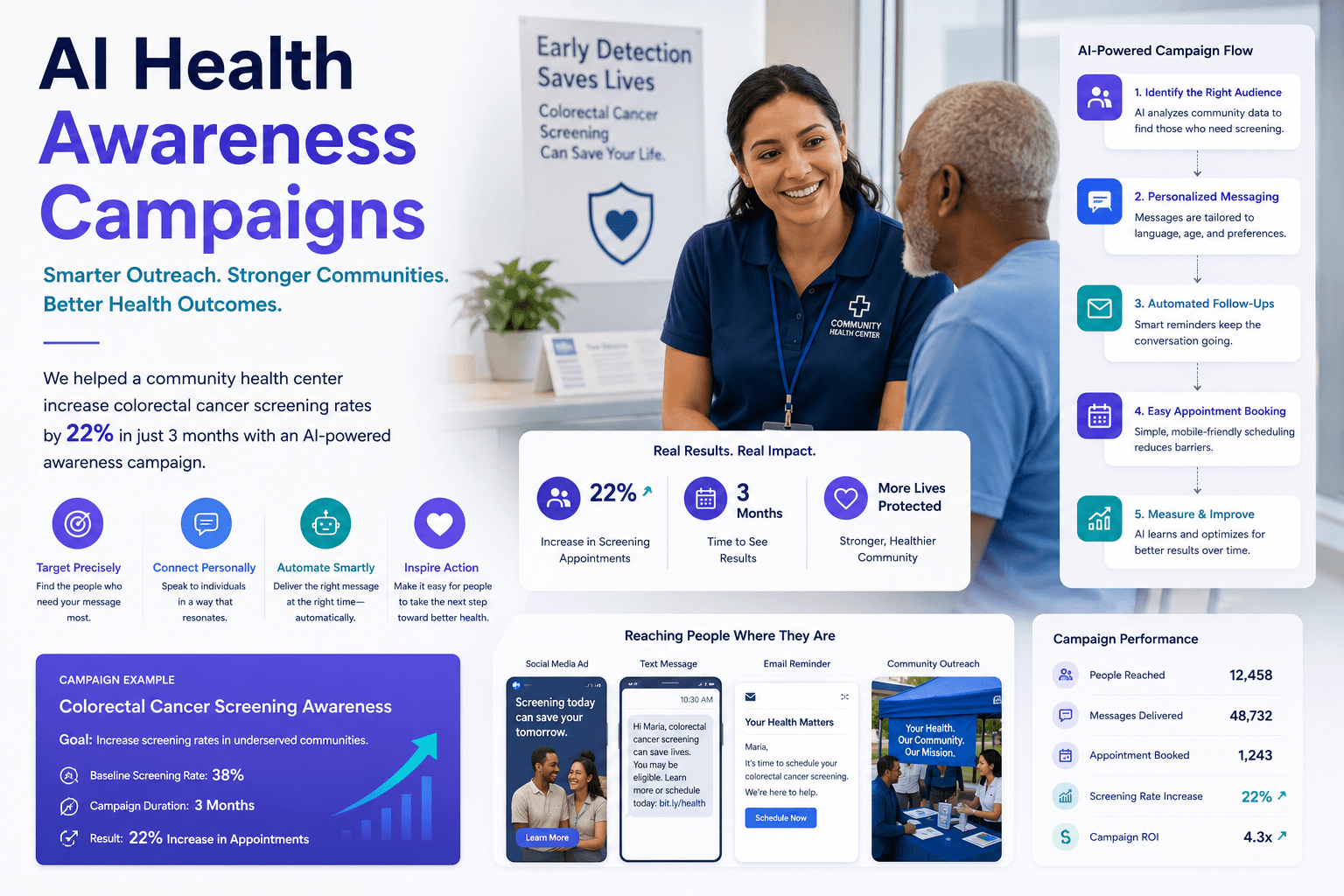
A community health center wanted to increase colorectal cancer screening rates in a county where only 38% of eligible adults were up to date. They had a small budget, two overwhelmed staff members, and a stack of generic brochures nobody read. Instead of running another ignored print campaign, they built a digital awareness effort that used audience data to find the right people, personalized messaging to connect, and automated follow-ups to keep the conversation going. Screening appointments rose 22% in three months. That is the reality of well-executed ai health awareness campaigns. Technology handles the precision and timing; the human team focuses on empathy, trust, and community relationships.
Key Takeaways
AI health awareness campaigns combine audience data, content personalization, and automation to deliver the right health message to the right person at the right time, without replacing human oversight.
Effective healthcare social media campaigns rely on educational content, not promotional posts, and meet people where they already spend time online.
Healthcare community building turns passive followers into active participants who advocate for their own health and support others, boosting campaign reach organically.
Predictive analytics can identify which patient populations are most likely to need a specific screening or preventive service, so resources focus where they make the biggest impact.
Compliance and trust remain paramount; AI automates the process but a qualified human must review every piece of content and patient communication for accuracy and sensitivity.
A structured campaign calendar that blends AI efficiency with human creativity lets small teams run major awareness efforts without burnout.
Measurement moves beyond vanity metrics to track appointment bookings, screening completions, and community sentiment shifts.
What AI Health Awareness Campaigns Actually Look Like
AI health awareness campaigns use artificial intelligence to plan, optimize, and automate the many moving parts of a public health or preventive care outreach effort. This includes audience identification, message creation, delivery scheduling, performance analysis, and ongoing refinement. The AI never writes the final script or makes clinical decisions. It surfaces insights, drafts variations, segments populations, and sends messages at times proven to generate responses.
Think of AI as the campaign analyst who never sleeps. It can sift through thousands of demographic and behavioral data points to identify who in your community is overdue for a mammogram or flu shot. It can test five different subject lines and tell you which one drives the most appointment bookings. It can automatically resend a modified message to someone who opened but did not click. The hospital marketing team still decides the tone, the clinical team still approves the medical content, and the community liaison still builds the personal relationships. AI removes the manual busywork that kills momentum.
The shift matters because healthcare awareness campaigns have historically been blunt instruments. A billboard, a radio spot, a newspaper ad. The same message hit everyone regardless of age, risk factors, or communication preferences. AI transforms that scattergun approach into something precise and personal. A 55-year-old man with a family history of heart disease receives a different message sequence than a 28-year-old woman due for a cervical screening. Both feel like the health system sees them as individuals.
Why Traditional Health Awareness Campaigns Fall Short
Conventional campaigns face two persistent problems. First, they waste resources. Blanketing a community with a single message means most recipients do not need or respond to it. Second, they struggle to sustain engagement. A one-time poster or Facebook post rarely drives action because behavior change requires multiple, well-timed touchpoints.
Healthcare organizations often lack the bandwidth to maintain the constant presence that effective awareness requires. A small nonprofit might post twice during Mental Health Awareness Month and hope for the best. A dental practice might send one email about oral cancer screening and move on. The public forgets fast.
AI breaks both barriers. It can orchestrate a steady, varied campaign across social media, email, SMS, and web content without a team working overtime. A behavioral health center can run a month-long anxiety awareness campaign with daily social posts, weekly educational emails, and timely blog content, all seeded by AI drafts that a clinician reviews in batches. The consistency builds trust and drives action.
Audience Segmentation and Personalized Outreach
The most powerful application of AI in health awareness is telling people exactly what they need to hear, when they need to hear it. Generic “get your screening” posts are background noise. Personalized messaging cuts through.
AI models can analyze de-identified patient population data, public health statistics, and community demographics to build segments like:
Adults 45-75 who have no record of a colonoscopy in the past ten years
Women 40+ without a mammogram order in the past two years
Parents of children aged 11-12 due for HPV vaccination
Diabetic patients overdue for an A1C test
Community members in specific ZIP codes with high flu hospitalization rates
Once segments exist, the AI can generate message variations that speak to each group's specific concerns. The colonoscopy-hesitant group gets content addressing fear, prep myths, and family stories. The flu shot group receives location-specific clinic hours and walk-in availability. Nothing gets sent until a human reviews every word. But the speed at which tailored content can be produced is orders of magnitude faster than manual drafting.
For a multi-location healthcare group, this capability scales beautifully. The central team builds the campaign framework and compliance-approved content modules. Each location adds its own providers, hours, and local flavor. The result is a massive awareness push that feels local and personal at every site.
Automating Healthcare Social Media Campaigns
Social media is where health awareness goes to either thrive or die quietly. A post that gets 12 views and zero engagement is not furthering public health. AI changes the equation by optimizing publishing time, format, and messaging based on real performance data.
A hospital promoting Stroke Awareness Month can use AI to schedule a mix of video testimonials, infographics, and symptom checklists across Facebook, Instagram, and LinkedIn. The system learns which content types generate the most shares and adjusts the calendar accordingly. If short videos outperform static images by 3x, the AI suggests increasing video frequency. The human team then feeds it more video scripts and patient stories.
The same tools power healthcare social media campaigns that feel responsive instead of static. During a local flu outbreak, the hospital can quickly swap scheduled content for urgent prevention messaging. The AI handles the rescheduling and notification, not a panicked coordinator at midnight. This agility is exactly what communities need during evolving health situations. For a deeper look at building a campaign framework that holds up under real-world pressure, this guide to creating a healthcare social media strategy that drives patient engagement lays out the foundation.
Building Real Healthcare Communities, Not Just Audiences
Likes and follows are vanity. Healthcare community building is about creating spaces where people support each other, share experiences, and become champions for their own health. AI assists here by identifying potential community ambassadors, spotting trending conversation topics, and flagging misinformation that needs a factual response.
A community health center running a diabetes prevention campaign can use AI to find local residents who actively engage with healthy eating content. Those individuals receive invitations to a private Facebook group moderated by a registered dietitian. The group becomes a source of peer support and accountability. The health center does not have to manually comb through thousands of profiles; AI narrows the list and drafts the invitation language.
Nonprofit healthcare organizations benefit enormously from this approach. They run on lean budgets with minimal staff. AI empowers them to foster vibrant communities without hiring a full-time social media manager. One focused staff member can oversee multiple condition-specific groups because AI handles post scheduling, moderation alerts, and engagement tracking. The staffer shows up for the human moments: answering a scared question, celebrating a milestone, de-escalating a tense exchange.
Patient engagement on social media deepens when people feel part of something. They comment, share their stories, and invite friends. The campaign stops being a broadcast and starts being a movement. This resource on patient engagement on social media breaks down the mechanics of turning passive viewers into active participants.
Content That Educates Without Overwhelming
Health awareness campaigns live and die by their content. A post that reads like a medical textbook excerpt gets scrolled past. One that explains a concept in plain, empathetic language gets saved and shared. AI can help strike that balance by drafting content at a specified reading level, with notes for the human editor about where to add warmth or local context.
A dental practice running an oral cancer awareness month can prompt AI for a series of posts explaining risk factors, self-exam steps, and treatment advances. The dentist reviews every clinical statement. The office manager adds a photo of the team holding a sign that says “We offer free screenings.” The result is medically sound, personally inviting, and more effective than either the dentist or a generic AI could produce alone.
For hospitals, patient education materials for conditions like heart failure or COPD can be adapted into awareness campaign content. AI repurposes the core information into social snippets, email series, and short video scripts. The clinical team verifies, and the campaign launches with a unified message across channels.
A steady stream of valuable content positions the organization as a trusted health resource. Over time, community members turn to that source first when a health concern arises. That trust translates into earlier screenings, better preventive care adherence, and ultimately healthier populations. Building a content engine that supports this requires strategy; the complete healthcare content marketing guide walks through the process of planning content that serves both health awareness goals and patient acquisition.
Campaign Planning, Scheduling, and Team Workflow
Awareness campaigns have many moving pieces. Medical observances, seasonal health risks, community events, and unexpected outbreaks all compete for attention. AI excels at calendar coordination.
An integrated platform can ingest a health observances calendar, map content themes to each month, and suggest a publishing cadence. The marketing team reviews, adjusts, and slots in local priorities. A behavioral health center might overlay Suicide Prevention Month content in September and seasonal affective disorder resources in November. The AI maintains the calendar, flags conflicts, and reminds the team when a piece needs review.
Multi-location groups gain further efficiency. A central marketing lead builds the master campaign, assigns content roles, and tracks completion across locations. AI dashboards show which clinics have published their localized versions and which are lagging. No more wondering if the satellite office remembered to post the breast cancer awareness event flyer. Coordinating this across many locations without an agency is far more feasible with the right tooling; managing social media for 10 or more locations shows how centralized planning and local execution can coexist.
Measuring What Matters in Health Awareness Campaigns
Impression counts and click-through rates are fine, but they do not tell the full story of a health awareness campaign. Meaningful metrics for healthcare organizations include:
Number of screening appointments booked during and immediately after the campaign
Reduction in no-show rates for preventive services
Increase in community members subscribing to health education emails
Change in patient-reported awareness of a specific condition (measured via pre/post surveys)
Number of peer-to-peer referrals generated through community group participation
Reduction in late-stage diagnoses of the targeted condition over time (a longer-term metric)
AI analytics tools can track many of these outcomes and attribute them to specific campaign elements. A hospital marketing director can see that the video series on mammogram myths drove more appointment requests than the infographic series, and shift resources accordingly for the next campaign.
This data-driven approach impresses leadership and unlocks budget. When you can demonstrate that a 5,000campaigngenerated150screeningappointments,withanestimateddownstreamvalueof5,000campaigngenerated150screeningappointments,withanestimateddownstreamvalueofX in early detection and treatment, the conversation shifts from cost to investment.
Compliance, Ethics, and the Human Mandate
Healthcare awareness campaigns operate in regulated territory. Patient communication must respect privacy, consent, and medical accuracy. AI introduces no new permission to bypass these rules.
Before any AI-touched content goes live, a human must verify: Is every medical claim supported by current guidelines? Has patient consent been obtained for any story or image used? Does the message honor opt-out preferences and communication channel restrictions? Is the tone appropriate for the health condition and community being addressed?
AI also raises ethical questions about targeting. It is one thing to send a diabetes prevention message to someone with a high risk score. It is another to make that person feel surveilled or judged. The best campaigns use data to help, not to manipulate. The language stays supportive: “Here are resources that might be useful for you” rather than “Based on your profile, you need this.” The distinction is everything.
A responsible AI healthcare marketing approach builds in ethical review checkpoints alongside clinical ones. The technology accelerates the work; the principles governing the work do not change.
Common Mistakes That Undermine Health Awareness Efforts
Even well-intentioned campaigns can stumble. Watch for these pitfalls.
Skipping community input. A campaign built entirely on data without speaking to real community members often misses cultural nuance. A hospital promoting prenatal care to a diverse population should co-create messages with community health workers, not rely solely on AI-generated audience profiles.
Over-automating the human moments. Automated birthday wishes are fine. An automated response to a comment about cancer recurrence fear is not. The latter requires a trained human. Map your campaign workflows so high-sensitivity interactions always flag a person.
Running one channel and calling it a campaign. An awareness effort limited to Facebook posts ignores community members on YouTube, local radio, church bulletins, and community health fairs. AI can coordinate omnichannel efforts; do not limit its scope.
Neglecting internal alignment. Front-desk staff and call center teams must know about the campaign. If a patient calls to book the advertised screening and the scheduler has no idea what they are talking about, trust erodes.
Measuring too early. Behavior change takes time. Do not judge a campaign after two weeks. Set realistic timelines for awareness, consideration, and action phases.
The Future of AI in Health Awareness
The next wave will bring tighter integration between electronic health records and campaign platforms, always with patient consent as the gateway. Imagine a system that identifies patients due for preventive services during a visit, then automatically enrolls them in a supportive follow-up awareness sequence after opt-in, without manual staff outreach. Geolocation data might trigger location-specific alerts during disease outbreaks, delivered through push notifications or digital signage. AI will get better at detecting early signals of health misinformation spreading in a community and suggest factual counter-content before myths take hold.
But the core truth will persist: the most effective health awareness campaigns combine intelligent technology with genuine human connection. An AI can tell someone they need a screening. A trusted community health worker, armed with the right message at the right time, can help them actually schedule it. The future belongs to organizations that master both sides.
AI health awareness campaigns let small teams think big. They enable hospitals, clinics, nonprofits, and community centers to run sophisticated outreach that was once reserved for organizations with massive budgets. The technology identifies, personalizes, schedules, and measures. The human team ensures empathy, accuracy, and trust. Together, they move communities toward better health.
If your organization is ready to build smarter awareness campaigns that educate, engage, and drive real health action, explore how Sociali.ai supports healthcare teams in planning, automating, and measuring every aspect of their outreach. Visit the Sociali.ai Healthcare Solution to see how you can bring community awareness efforts to life without burning out your team.
Frequently Asked Questions
How do AI health awareness campaigns improve patient engagement?
They deliver relevant, personalized health messages at optimal times rather than generic broadcasts. AI analyzes behavior and preferences to match content with individual needs, making patients feel understood and more likely to act on health recommendations.
Can small community health centers afford AI for awareness campaigns?
Many AI-powered marketing tools offer tiered pricing for smaller organizations. The time savings and improved campaign performance often offset the cost within a few months. Start with one campaign type, prove value, then expand.
What role does social media play in health awareness campaigns?
Social media serves as the primary distribution channel for educational content, community interaction, and event promotion. AI helps optimize post timing, format, and messaging to maximize reach and engagement across platforms.
How do healthcare organizations measure the success of an awareness campaign?
Track metrics like appointment bookings, screening completions, event attendance, and changes in community health knowledge. Combine these with engagement data to build a complete picture of campaign impact.
What are the biggest compliance risks in AI-driven health campaigns?
The main risks involve patient data privacy, lack of consent for personal stories, and publishing unverified medical claims. A thorough human review process for every piece of content eliminates most of these risks.
How does AI help with audience segmentation for public health messaging?
AI analyzes de-identified population data to group people by risk factors, demographics, health history, and communication preferences. Campaigns then target each segment with tailored messaging that addresses their specific concerns and barriers.
Can AI-generated content be trusted for sensitive health topics?
Only after clinical review. AI drafts serve as a starting point, but a qualified healthcare professional must verify every medical claim and adjust the tone for sensitivity. Trust depends on the human oversight, not the tool that produced the first draft.
What is the difference between a social media post and a health awareness campaign?
A social media post is a single piece of content. A campaign is a coordinated, multi-touch, multi-channel effort with specific health goals, defined audiences, and measured outcomes that unfolds over weeks or months.
Free resource
Get the checklist


